
Introduction
Starting a pilot career in India is a dream for many students who love aircraft, travel, technology, discipline, and the idea of working in the sky. A pilot career is exciting, respected, and full of responsibility. It is not only about flying an aircraft; it is about safety, decision-making, teamwork, technical knowledge, and continuous learning.
India has a growing aviation sector with opportunities in airlines, charter aviation, cargo operations, corporate aviation, flight training academies, helicopter services, and drone operations. Many students after 12th want to know how to become a pilot, how much pilot training costs, which license is required, and how to choose the right flying school.
The path to becoming a pilot in India requires proper planning. You need the right educational background, medical fitness, DGCA-approved training, flying hours, theory exams, documentation, and career preparation. This guide explains everything in simple language so that students, parents, and beginners can understand the full roadmap clearly.
What Does a Pilot Do?
A pilot is a trained aviation professional who operates an aircraft safely from one place to another. Pilots may fly passenger aircraft, cargo aircraft, private jets, helicopters, training aircraft, or specialized aviation vehicles depending on their license and career path.
A pilot’s role includes much more than takeoff and landing. Before a flight, pilots check the aircraft condition, weather reports, fuel planning, navigation route, safety documents, and flight plan. During the flight, they coordinate with air traffic control, monitor instruments, follow aviation rules, manage communication, and handle any unexpected situation calmly.
A good pilot must be disciplined, alert, technically sound, physically fit, and mentally strong. Since passengers, crew, cargo, and aircraft safety depend on the pilot’s decisions, this profession requires high responsibility and professional maturity.
Types of Pilot Careers in India
A pilot career in India can lead to different aviation roles. Students should understand these options before choosing their training path.
Commercial Airline Pilot
Commercial airline pilots fly passenger aircraft for domestic or international airlines. This is one of the most popular pilot career options in India. Airline pilots usually begin as first officers and later grow into senior first officers and captains after gaining experience.
Private Pilot
A private pilot flies aircraft for personal or non-commercial purposes. This path is suitable for aviation enthusiasts, business owners, or individuals who want to fly privately but do not plan to work as airline pilots.
Cargo Pilot
Cargo pilots fly aircraft that transport goods, parcels, equipment, and essential supplies. This career path is suitable for pilots who want professional flying opportunities outside passenger airlines.
Charter Pilot
Charter pilots fly private aircraft for individuals, companies, business travelers, tourists, and special travel requirements. This role may involve flexible schedules and different types of aircraft.
Flight Instructor
Flight instructors train student pilots at flying schools. This is a valuable career option for pilots who enjoy teaching and want to build flying experience while helping new students learn aviation skills.
Corporate Jet Pilot
Corporate jet pilots fly business aircraft for companies, business leaders, and private clients. This role requires professionalism, flexibility, and excellent communication skills.
Helicopter Pilot
Helicopter pilots work in areas such as tourism, emergency services, offshore operations, rescue support, private aviation, and government-related services. Helicopter flying requires separate training and skill development.
Defense Pilot
Defense pilots fly aircraft for the Indian Air Force, Navy, or Army aviation wings. This career path is different from civil aviation and involves defense selection procedures, military training, and service commitment.
Drone Pilot
Drone pilots operate unmanned aircraft for surveying, mapping, agriculture, media, infrastructure inspection, security, and logistics. This is an emerging aviation-related career path for students interested in modern aviation technology.
Basic Eligibility to Become a Pilot in India
To start a pilot career in India, students must understand the basic eligibility conditions. Requirements may vary depending on the license type and training path, but the general foundation is similar.
Educational Qualification
For a commercial pilot career, students generally need to complete 10+2 or equivalent education with Physics and Mathematics. These subjects are important because pilot training involves navigation, aircraft systems, aerodynamics, meteorology, and technical calculations.
Science Background
Physics and Mathematics are important for students who want to pursue a Commercial Pilot License. Students who did not study these subjects earlier may explore approved ways to complete them through recognized education boards before applying for pilot training.
Minimum Age
Different licenses have different age requirements. A student can begin aviation preparation early, but commercial pilot licensing requires the candidate to meet the required minimum age before license issue.
Medical Fitness
Medical fitness is one of the most important requirements for becoming a pilot. Students must clear DGCA medical examinations as required for pilot training and licensing. Good vision, hearing, physical fitness, and overall health are important.
English Communication Skills
English is widely used in aviation communication. Pilots must understand and communicate clearly with air traffic control, crew members, instructors, and aviation authorities. Good English communication helps during training, exams, interviews, and professional flying.
DGCA Requirements
The Directorate General of Civil Aviation regulates civil aviation training, licensing, and safety standards in India. Students must follow DGCA rules for exams, medicals, flying hours, documentation, and licensing.
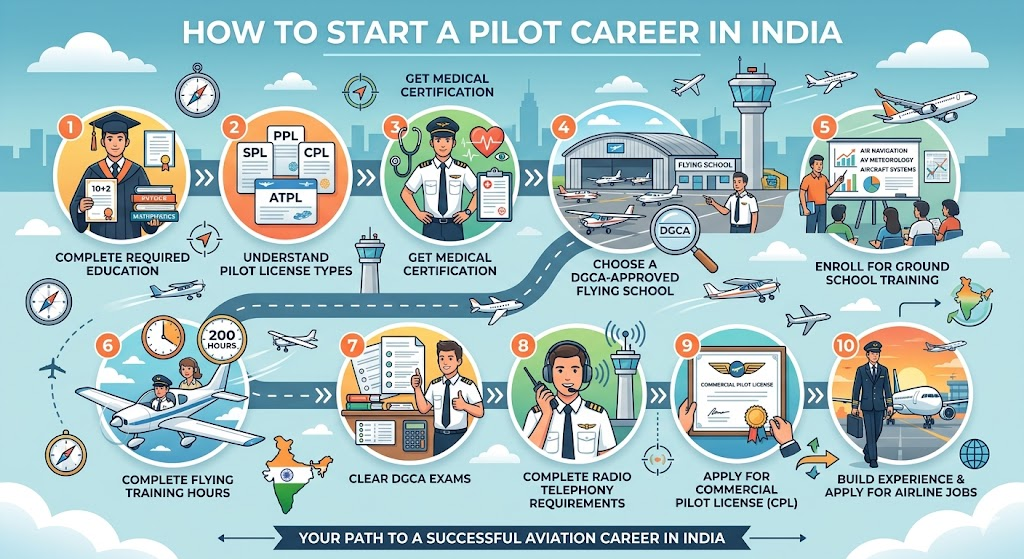
Step-by-Step Roadmap to Start a Pilot Career in India
Starting a pilot career becomes easier when you follow a clear roadmap. Below is a practical step-by-step guide for beginners.
Step 1: Complete the Required Education
The first step is to complete your 10+2 education with Physics and Mathematics. These subjects help you understand aviation concepts such as aircraft movement, speed, pressure, weather, navigation, and fuel calculations.
Students who are still in school should focus strongly on Mathematics, Physics, and English. If you have already completed 12th without Physics and Mathematics, do not panic. You can explore recognized options to complete these subjects separately before applying for commercial pilot training.
A strong academic base makes DGCA exam preparation easier and helps you understand aviation theory more confidently.
Step 2: Understand Pilot License Types
Before joining a flying school, you should understand different pilot licenses. The most common licenses are SPL, PPL, CPL, and ATPL.
SPL is usually the starting point for student pilots. PPL is for private flying. CPL is required to work as a professional commercial pilot. ATPL is the advanced license required for senior airline captain roles.
Understanding these licenses helps you plan your training budget, timeline, and career path properly.
Step 3: Get Class 2 and Class 1 Medical Certification
Medical fitness is a very important part of pilot training. Before spending money on training, students should complete the required medical checks to confirm that they are medically fit for aviation.
Class 2 medical is generally an early medical requirement for student pilots. Class 1 medical is required for commercial pilot licensing. Students should complete medical checks through approved medical examiners and keep all documents properly.
Medical fitness should not be ignored. It is better to check eligibility early instead of discovering a problem after joining a flying school.
Step 4: Choose a DGCA-Approved Flying School
Choosing the right flying school is one of the most important decisions in your pilot career. A good flying school should offer safe training, experienced instructors, proper aircraft availability, transparent fees, and strong student support.
Do not choose a flying school only because it offers low fees. Check the school’s DGCA approval, aircraft fleet, instructor quality, maintenance standards, student reviews, flying hour completion timeline, hostel facilities, and training environment.
A good flying school can make your training smoother, while a poor choice can delay your flying hours and increase your total cost.
Step 5: Enroll for Ground School Training
Ground school is classroom-based aviation theory training. Before and during flying training, students study important subjects that help them understand aircraft operations and DGCA exams.
Common ground school subjects include:
- Air Navigation
- Aviation Meteorology
- Air Regulations
- Technical General
- Technical Specific
- Radio Telephony
- Aircraft Systems
- Flight Planning
Ground school is very important because flying is not only practical skill. A pilot must understand weather, rules, instruments, aircraft performance, navigation, and safety procedures.
Step 6: Complete Flying Training Hours
Flying training is the practical part of pilot education. Students learn to handle aircraft under instructor supervision. Training begins with basic aircraft handling and gradually moves to advanced flying skills.
Students practice takeoff, landing, turns, climbs, descents, emergency procedures, navigation flying, night flying, solo flying, and cross-country flying depending on the license requirement.
For a commercial pilot license, students must complete the required flying hours as per applicable DGCA rules. The time needed to complete flying hours depends on weather, aircraft availability, instructor scheduling, student performance, and flying school management.
Step 7: Clear DGCA Exams
DGCA exams are an important part of becoming a commercial pilot in India. Students must prepare seriously for these exams because they test aviation knowledge and professional understanding.
Common DGCA exam subjects include:
- Air Regulations
- Air Navigation
- Aviation Meteorology
- Technical General
- Technical Specific
Students should create a study plan, attend quality ground classes, solve practice questions, revise regularly, and understand concepts instead of only memorizing answers.
Step 8: Complete Radio Telephony Requirements
Radio communication is a key part of aviation. Pilots must communicate clearly with air traffic control and follow standard aviation communication procedures.
Radio Telephony training helps students learn aviation phraseology, communication discipline, emergency communication, and proper radio usage. This is important for safe flight operations and professional pilot development.
Step 9: Apply for Commercial Pilot License
After completing the required flying hours, DGCA exams, medical requirements, and documentation, students can apply for a Commercial Pilot License.
The CPL application process requires careful document preparation. Students should keep records of flying hours, exam results, medical certificates, training documents, logbooks, identity documents, and flying school certificates.
Documentation mistakes can delay license processing, so students should stay organized from the beginning.
Step 10: Build Experience and Apply for Airline Jobs
After receiving a CPL, students can start preparing for aviation jobs. For airline careers, candidates may need type rating, simulator training, technical preparation, interview practice, psychometric preparation, and airline selection readiness.
A new CPL holder usually needs to keep improving aviation knowledge, communication skills, confidence, and interview performance. Some pilots also work as flight instructors or explore charter, cargo, and corporate aviation opportunities to gain experience.
Pilot License Types in India
| License Type | Full Form | Purpose | Suitable For | Basic Requirement |
|---|---|---|---|---|
| SPL | Student Pilot License | Allows a student to begin basic flying training | Beginners starting pilot training | Medical fitness, basic eligibility, flying school process |
| PPL | Private Pilot License | Allows private flying, not commercial airline work | Aviation enthusiasts and private flyers | Flying training and required exams |
| CPL | Commercial Pilot License | Allows a pilot to work professionally | Students who want airline or commercial aviation careers | Required flying hours, DGCA exams, Class 1 medical |
| ATPL | Airline Transport Pilot License | Advanced license for senior airline captain roles | Experienced commercial pilots | Higher experience and advanced requirements |
Pilot Training Cost in India
Pilot training cost in India varies widely depending on the flying school, aircraft type, training location, fuel prices, simulator requirements, exam fees, medical tests, accommodation, and type rating.
Students should avoid planning only for the flying school fee. The total cost may include several additional expenses. Parents and students should ask for a transparent cost breakdown before admission.
| Cost Category | Description | Cost Note |
|---|---|---|
| Medical Exams | Class 2 and Class 1 medical checks | Varies by medical center and process |
| Ground School | Theory classes for DGCA subjects | Varies by institute |
| Flying Training | Practical aircraft training hours | Usually the largest cost component |
| DGCA Exams | Examination-related fees and preparation | Varies / N/A |
| License Processing | Documentation and license application | Varies / N/A |
| Radio Telephony Training | Communication and RTR preparation | Varies by training provider |
| Accommodation | Hostel, food, and local living expenses | Depends on city and school |
| Type Rating | Aircraft-specific training for airline roles | Can be a major additional cost |
| Extra Flying Hours | Additional practice if needed | Depends on student performance |
Students should always ask the flying school about what is included and what is not included in the quoted fee.
How Long Does It Take to Become a Pilot in India?
The time required to become a pilot in India depends on training speed, weather, aircraft availability, DGCA exams, medical clearances, and student performance.
Some students complete training faster when aircraft availability is good and exams are cleared on time. Others may take longer due to weather delays, scheduling issues, exam backlogs, documentation delays, or financial breaks.
A realistic approach is better than expecting instant completion. Pilot training requires patience, consistency, and planning.
Skills Required to Become a Successful Pilot
A successful pilot needs more than technical training. The profession requires a strong mix of knowledge, discipline, and personality skills.
Discipline
Pilots must follow procedures, checklists, timings, and safety rules. Discipline is one of the most important qualities in aviation.
Communication
Clear communication is essential for speaking with air traffic control, crew members, instructors, engineers, and passengers.
Decision-Making
Pilots must make quick and safe decisions, especially during weather changes, technical issues, or emergency situations.
Technical Understanding
A pilot must understand aircraft systems, instruments, navigation, weather, and aviation regulations.
Situational Awareness
Situational awareness means knowing what is happening around the aircraft at all times. It helps pilots stay safe and avoid mistakes.
Leadership
Pilots lead the flight deck and coordinate with crew members. Leadership becomes more important as a pilot grows into captain roles.
Physical and Mental Fitness
A pilot must remain physically healthy and mentally calm. Stress management is important in aviation.
Problem-Solving
Every flight can bring different situations. Pilots must analyze problems and choose safe solutions.
Teamwork
Flying is not a solo activity. Pilots work with co-pilots, cabin crew, engineers, dispatchers, and air traffic controllers.
Time Management
Punctuality and planning are important in aviation. Pilots must manage reporting time, flight plans, briefings, and rest schedules.
Best Subjects and Courses for Pilot Aspirants
Students who want to become pilots should focus on subjects and skills that support aviation learning.
Important subjects include:
- Physics
- Mathematics
- English
- Geography basics
- Computer knowledge
- General science
- Communication skills
Students can also learn aviation basics, aircraft terminology, weather concepts, and map reading. Personality development and interview preparation are also useful for future airline selection.
After 12th, students can consider ground school classes, aviation counseling, medical checks, and flying school research before beginning full training.
How to Choose the Right Flying School in India
Choosing the right flying school can affect your cost, training time, confidence, and career progress. Students and parents should compare flying schools carefully.
Use this checklist before admission:
- Is the flying school DGCA-approved?
- Does it have a good safety record?
- How many aircraft are available for students?
- Are the aircraft maintained properly?
- How experienced are the instructors?
- What is the student-to-aircraft ratio?
- How long do students usually take to complete flying hours?
- Is the fee structure transparent?
- Are there hidden charges?
- Does the school provide hostel or accommodation support?
- Does it offer DGCA exam guidance?
- Does it help with documentation?
- Are past students satisfied with the training?
- Does it provide airline preparation support?
A good flying school should be transparent, safety-focused, and student-friendly.
Career Opportunities After Becoming a Pilot
After completing pilot training and earning the required license, students can explore several career opportunities.
Airlines
Many students aim to join domestic or international airlines as first officers. Airline jobs usually require strong technical knowledge, simulator preparation, communication skills, and selection readiness.
Charter Companies
Charter aviation offers flying opportunities for private clients, business travelers, tourism, and special travel needs.
Cargo Operators
Cargo aviation is important for logistics, e-commerce, supply chains, and urgent transport requirements.
Flight Training Academies
CPL holders may become flight instructors after completing the required instructor training and approvals. This path helps pilots build experience and teach new students.
Corporate Aviation
Corporate aviation involves flying private aircraft for companies, executives, and private owners.
International Opportunities
With proper licensing conversion, experience, and regulatory compliance, some pilots explore international opportunities.
Aviation Management
Some pilots and aviation graduates also move into aviation operations, safety, training, dispatch, airport management, or aviation consulting roles.
Salary and Growth Scope for Pilots in India
Pilot salary in India depends on many factors such as license type, airline, aircraft type, experience, role, company policy, type rating, and flying hours. A fresher CPL holder may not immediately earn a high airline salary. Career growth usually improves with experience, successful airline selection, aircraft type training, and seniority.
A pilot’s career growth may follow this path:
- Student Pilot
- Commercial Pilot License Holder
- Trainee First Officer
- Junior First Officer
- First Officer
- Senior First Officer
- Captain
- Senior Captain
- Training Captain
- Examiner or Management Role
Students should avoid believing unrealistic salary promises. A pilot career can be rewarding, but it requires investment, patience, training, and continuous performance.
Common Challenges in Starting a Pilot Career
Starting a pilot career is exciting, but students should also understand the challenges.
High Training Cost
Pilot training is expensive. Students should prepare a full financial plan before admission.
Medical Fitness
Medical issues can affect eligibility. Complete medical checks early.
DGCA Exam Preparation
DGCA exams require serious study and strong concepts. Poor preparation can delay progress.
Weather Delays
Flying training depends on weather. Bad weather can delay flying hours.
Aircraft Availability
If a flying school has limited aircraft, students may face scheduling delays.
Documentation Issues
Incorrect or incomplete documents can slow down exam registration and license processing.
Type Rating Cost
Students aiming for airline jobs may need type rating, which can add significant cost.
Competition
Airline selection is competitive. Students need technical knowledge, communication skills, and interview preparation.
Practical Tips to Overcome These Challenges
- Complete medical checks before investing heavily.
- Choose a flying school after detailed research.
- Maintain a realistic budget.
- Prepare for DGCA exams from the beginning.
- Improve English communication daily.
- Keep all documents organized.
- Build strong aviation basics.
- Stay patient during weather or scheduling delays.
- Avoid shortcuts and fake promises.
- Take guidance from trusted aviation professionals.
Mistakes to Avoid While Planning a Pilot Career
Many students make mistakes because they are excited and do not research properly. Avoid these common errors:
- Choosing a flying school only because it has low fees
- Ignoring medical fitness before admission
- Not understanding the total training cost
- Depending only on advertisements
- Not checking DGCA approval
- Poor preparation for DGCA exams
- Not improving English communication
- Ignoring documentation requirements
- Expecting instant airline placement
- Not planning for type rating cost
- Not speaking to current or past students
- Believing guaranteed job promises without proof
A pilot career should be planned carefully, not emotionally.
Beginner Roadmap After 10th
Students after 10th can begin early preparation for a pilot career.
What to Do After 10th
Choose Science stream with Physics and Mathematics if you want to become a commercial pilot. Focus on building strong basics in Mathematics, Physics, and English.
You can also start learning about aviation through books, documentaries, airport visits, aviation news, and basic flight concepts. This is also a good time to improve communication skills, confidence, discipline, and physical fitness.
Roadmap After 10th
| Stage | What to Focus On |
|---|---|
| Class 11 | Physics, Mathematics, English, discipline, aviation awareness |
| Class 12 | Board exams, aviation research, career counseling |
| Before Training | Medical awareness, flying school comparison, financial planning |
| After 12th | Medical checks, ground school, DGCA process, flying training |
Beginner Roadmap After 12th
After 12th, students can begin practical steps toward pilot training.
What to Do After 12th
First, confirm that you have Physics and Mathematics. Then complete the required medical checks. After that, research DGCA-approved flying schools and compare them carefully.
You should also start preparing for DGCA subjects and understand the cost, timeline, exams, and licensing process. Do not rush admission without checking the school’s reputation, aircraft availability, and training quality.
Roadmap After 12th
| Step | Action |
|---|---|
| Step 1 | Confirm educational eligibility |
| Step 2 | Complete medical checks |
| Step 3 | Research flying schools |
| Step 4 | Join ground school |
| Step 5 | Apply for required DGCA exam process |
| Step 6 | Begin flying training |
| Step 7 | Complete exams and flying hours |
| Step 8 | Apply for CPL |
| Step 9 | Prepare for airline or aviation jobs |
How Parents Can Support Pilot Aspirants
Parents play an important role in a student’s pilot career. Since pilot training requires financial planning, emotional support, and long-term commitment, parents should understand the process clearly.
Parents should help students verify flying schools, check total cost, understand medical requirements, and avoid unrealistic promises. It is also important to support students during exam preparation, flying delays, and career uncertainty.
A pilot career is not built overnight. With proper family support, students can stay motivated and focused.
Is a Pilot Career Right for You?
A pilot career may be right for you if you:
- Love aviation and aircraft
- Are disciplined and responsible
- Can handle pressure calmly
- Enjoy technical learning
- Have good communication skills
- Are ready for continuous training
- Can maintain physical and mental fitness
- Are comfortable with irregular schedules
- Can follow strict safety procedures
- Are willing to invest time and effort
It may not be ideal if you want a low-cost career path, fixed office hours, quick results, or a job without continuous exams and evaluations.
FAQs
1- How can I start a pilot career in India?
You can start a pilot career in India by completing 10+2 with Physics and Mathematics, clearing the required medical checks, choosing a DGCA-approved flying school, completing ground school, finishing flying training hours, passing DGCA exams, and applying for the required pilot license. The process requires planning, discipline, and financial preparation.
2- What qualification is required to become a pilot in India?
For a commercial pilot career, students generally need 10+2 or equivalent education with Physics and Mathematics. English communication is also important because aviation communication happens mainly in English. Students must also meet medical fitness and DGCA licensing requirements.
3- Can I become a pilot after 12th?
Yes, you can begin pilot training after 12th if you meet the required educational and medical eligibility. Students with Physics and Mathematics can move toward medical checks, DGCA exam preparation, flying school selection, and pilot training. Proper planning after 12th can save time and confusion.
4- Is Physics and Mathematics compulsory for pilot training?
Physics and Mathematics are important for commercial pilot training because aviation involves navigation, aircraft systems, weather, speed, distance, pressure, and technical calculations. Students who did not study these subjects should explore recognized ways to complete them before applying for commercial pilot training.
5- What is the cost of pilot training in India?
Pilot training cost in India varies depending on flying school, aircraft type, location, fuel cost, ground school, exams, medicals, accommodation, and type rating. Students should ask for a complete cost breakdown before admission. It is important to plan for both training fees and additional expenses.
6- How long does it take to become a commercial pilot?
The time required depends on flying school efficiency, aircraft availability, weather, exam clearance, medical approvals, documentation, and student performance. Some students complete training faster, while others take longer due to delays. A realistic timeline is better than expecting instant completion.
7- What is DGCA in pilot training?
DGCA stands for Directorate General of Civil Aviation. It is the civil aviation regulatory authority in India. DGCA plays an important role in pilot licensing, aviation safety, medical requirements, exams, flying school approvals, and civil aviation regulations.
8- What medical fitness is required to become a pilot?
Pilots need to meet aviation medical fitness standards. Medical checks generally include vision, hearing, physical health, and overall fitness. Students should complete the required Class 2 and Class 1 medical checks as applicable before investing heavily in training.
9- Can girls become pilots in India?
Yes, girls can absolutely become pilots in India. Aviation careers are open to eligible candidates regardless of gender. Many women pilots are successfully working in airlines, training academies, corporate aviation, and other aviation roles. The key requirements are education, medical fitness, training, and skill.
10- Is becoming a pilot difficult?
Becoming a pilot is challenging but achievable with the right preparation. Students must study aviation subjects, clear exams, complete flying training, stay medically fit, and develop strong communication and decision-making skills. The journey requires discipline, patience, and commitment.
11- What is the difference between CPL and PPL?
PPL stands for Private Pilot License and is mainly for private flying. CPL stands for Commercial Pilot License and is required to work as a professional pilot. Students who want airline, charter, cargo, or commercial aviation careers generally need a CPL.
12- How do I choose the best flying school in India?
Choose a flying school by checking DGCA approval, aircraft availability, instructor experience, safety record, fee transparency, student reviews, training timeline, maintenance quality, hostel facilities, and exam support. Do not select a school only because it offers the lowest fee.
Conclusion
Starting a pilot career in India is a rewarding journey, but it requires clear planning, strong discipline, medical fitness, financial preparation, and the right training path. Students should begin by understanding eligibility, license types, DGCA requirements, flying school options, training cost, and career opportunities. The most important step is to make informed decisions instead of rushing into admission based on advertisements or unrealistic promises. A successful pilot career is built through patience, consistent learning, safety awareness, and professional attitude. If you are serious about becoming a pilot, start early, stay focused, choose your flying school wisely, prepare well for exams, and keep improving your communication and technical knowledge. With the right roadmap and commitment, your dream of flying professionally can become a strong and meaningful aviation career in India.

