
Introduction
Becoming a pilot is one of the most exciting career goals for students who dream of flying aircraft, working in aviation, and building a respected professional future. However, pilot training in India is not something students should begin without proper planning. It involves education, medical fitness, DGCA-related requirements, ground school, flying hours, examinations, documentation, licensing, and career preparation.
Many students and parents feel confused because they hear different information from flying schools, coaching centers, social media, and friends. Some students do not know whether they should begin after 10th, after 12th, or after graduation. Others are unsure about medical tests, DGCA exams, pilot training cost, flying school selection, and airline job preparation.
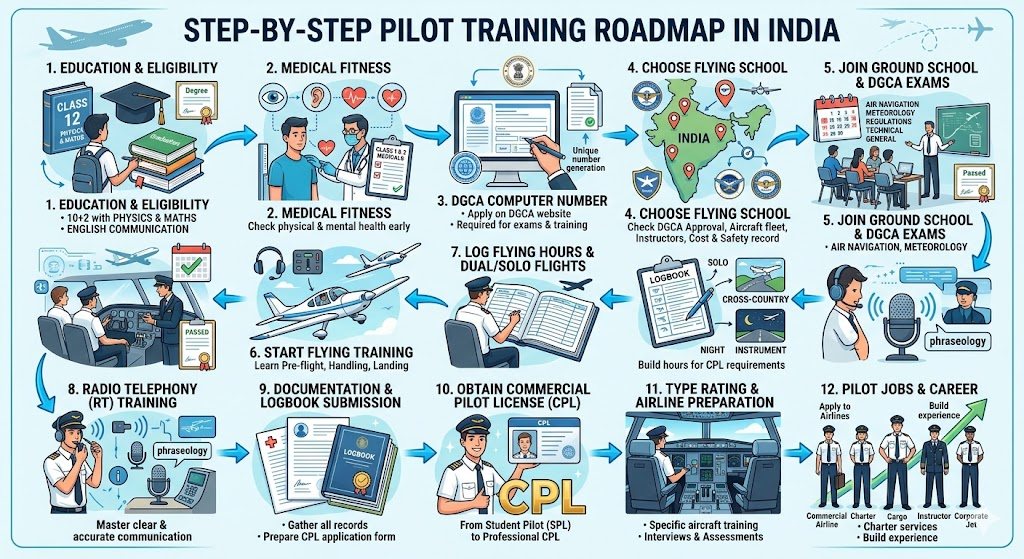
This step-by-step pilot training roadmap in India is designed to make the journey clear and practical. It explains what to do first, what comes next, and how to avoid common mistakes. Whether you are a student after 10th, a 12th-pass aviation aspirant, a graduate, or a parent researching pilot training, this guide will help you understand the full roadmap in simple language.
Why You Need a Pilot Training Roadmap
Pilot training is a serious career investment. It requires time, money, discipline, and long-term commitment. Without a clear roadmap, students may make costly mistakes such as choosing the wrong flying school, ignoring medical fitness, underestimating total expenses, delaying DGCA exam preparation, or missing important documents.
A proper pilot training roadmap helps students and parents understand:
- What qualifications are required
- When to complete medical checks
- Which license is needed for a pilot career
- How to select a flying school
- What ground school includes
- How DGCA exams fit into the journey
- How flying training works
- What documents must be maintained
- What happens after getting a CPL
- How to prepare for airline or aviation jobs
A roadmap also helps students avoid unrealistic expectations. Becoming a pilot is achievable, but it is not an instant process. It requires step-by-step progress, patience, and consistent preparation.
Who Can Follow This Pilot Training Roadmap?
This roadmap is useful for different types of aviation aspirants in India.
It is suitable for:
- Students after 10th who want to plan early
- Students after 12th who want to begin pilot training
- Graduates who want to enter aviation
- Career changers interested in flying
- Parents researching pilot training for their children
- Students planning Commercial Pilot License training
- Aviation aspirants preparing for DGCA exams
- Students comparing flying schools in India
- Beginners who do not understand aviation terms
The roadmap is mainly focused on students who want to become professional pilots through the Commercial Pilot License route. However, it also explains other pilot career options so that students can make informed decisions.
Step 1: Understand the Pilot Career Path in India
Before starting pilot training, students should understand the different pilot career paths available in India. Not every pilot works for a passenger airline. Aviation offers several flying and non-flying career options.
Commercial Airline Pilot
This is the most popular career goal for many students. Commercial airline pilots fly passenger aircraft for domestic or international airlines. They usually begin as trainee first officers or junior first officers and grow with experience.
Charter Pilot
Charter pilots fly private aircraft for business travelers, private clients, tourism, emergency travel, or special travel requirements. This career path can offer varied flying experience.
Cargo Pilot
Cargo pilots fly aircraft that transport goods, parcels, equipment, and essential supplies. This option is suitable for pilots interested in logistics and non-passenger aviation.
Corporate Jet Pilot
Corporate jet pilots fly private or business aircraft for companies, executives, and private owners. This role requires professionalism, flexibility, and strong communication skills.
Flight Instructor
Flight instructors train student pilots at flying schools. Many pilots choose this route to build flying experience and help new students learn aviation skills.
Helicopter Pilot
Helicopter pilots work in tourism, emergency services, offshore support, rescue work, private aviation, and other specialized operations. Helicopter training is different from fixed-wing aircraft training.
Defense Pilot
Defense pilots fly aircraft for the Indian Air Force, Navy, or Army aviation. This route is different from civil pilot training and involves military selection, defense training, and service requirements.
Drone Pilot
Drone pilots operate unmanned aircraft for mapping, surveying, agriculture, media, infrastructure inspection, logistics, and security. This is a growing aviation-related field for students interested in modern technology.
Most students who want to work as airline pilots usually follow the Commercial Pilot License pathway.
Step 2: Complete the Required Education
Education is the foundation of pilot training. For students planning a commercial pilot career in India, 10+2 with Physics and Mathematics is very important. These subjects help students understand aviation concepts such as aircraft performance, speed, distance, navigation, pressure, weather, and technical systems.
English communication is also important because aviation communication is mainly done in English. Pilots must communicate clearly with instructors, air traffic control, crew members, examiners, and airline interview panels.
Students who did not study Physics and Mathematics earlier should not panic. They can explore recognized ways to complete these subjects separately before applying for commercial pilot training. However, they should confirm eligibility requirements properly before investing in any training program.
| Stage | Recommended Focus | Why It Matters |
|---|---|---|
| Class 10 | Build interest in science, English, discipline, and aviation awareness | Helps students choose the right stream and prepare early |
| Class 11 | Study Physics, Mathematics, and English seriously | Builds the academic base needed for pilot training |
| Class 12 | Complete board exams with required subjects and start aviation research | Prepares students for eligibility and training decisions |
| After 12th | Check medical fitness, compare flying schools, and begin DGCA preparation | Helps students start the practical pilot training journey |
Students should not treat school education as separate from pilot training. Strong academic basics make ground school and DGCA exam preparation easier.
Step 3: Check Medical Fitness Early
Medical fitness is one of the most important parts of pilot training. Students should complete aviation medical checks before spending a large amount of money on flying school admission.
Pilot training requires good physical and mental fitness because pilots are responsible for aircraft safety, passenger safety, and decision-making during flight. Medical checks may include vision, hearing, general health, and other fitness standards as required by aviation authorities.
Class 2 Medical
Class 2 medical is generally an early medical requirement for student pilots. It helps confirm whether a student is medically fit to begin the aviation training path.
Class 1 Medical
Class 1 medical is required for students who want to hold a Commercial Pilot License. Since CPL is needed for professional flying, students should take Class 1 medical requirements seriously.
Vision and General Health
Vision standards, color perception, hearing ability, heart health, neurological fitness, and overall physical health can matter in aviation medical checks. Students should not hide medical history or ignore health-related concerns.
Physical and Mental Fitness
Pilots need physical stamina and mental calmness. Training can be stressful, and flight operations require alertness, confidence, and emotional control.
Medical checks should be completed early because discovering medical issues after paying large training fees can create serious financial and emotional stress.
Step 4: Learn About Pilot License Types
Before joining a flying school, students should understand the main pilot licenses in India. Each license has a different purpose.
| License | Full Form | Purpose | Suitable For | Career Use |
|---|---|---|---|---|
| SPL | Student Pilot License | Allows a student to begin basic flying training | Beginners entering pilot training | Training stage only |
| PPL | Private Pilot License | Allows private flying, not commercial employment | Aviation enthusiasts and private flyers | Not suitable for airline jobs |
| CPL | Commercial Pilot License | Allows a pilot to work professionally | Students aiming for commercial aviation careers | Required for airline, charter, cargo, and commercial pilot roles |
| ATPL | Airline Transport Pilot License | Advanced license for senior airline captain roles | Experienced commercial pilots | Used for higher airline command roles |
For students who want to become professional pilots, CPL is the key license. A CPL allows eligible pilots to apply for commercial flying roles, subject to airline requirements, type rating, experience, and hiring conditions.
Step 5: Research DGCA Requirements
The Directorate General of Civil Aviation, commonly known as DGCA, regulates civil aviation in India. Students planning pilot training must understand DGCA-related requirements because they affect licensing, medicals, exams, flying school approvals, training standards, and documentation.
DGCA is connected with:
- Pilot licensing
- Flying school approval
- Aviation safety standards
- Flight crew examinations
- Medical fitness requirements
- Flying hour requirements
- License application process
- Training records and documentation
Students should avoid relying only on informal advice. DGCA requirements can be detailed, and aviation rules must be followed carefully. Flying schools, ground schools, and aviation counselors can help, but students should also develop their own understanding of the process.
Step 6: Choose the Right Flying School
Choosing the right flying school is one of the most important decisions in the pilot training roadmap. A good flying school can support smooth training, while a poor decision can cause delays, extra cost, and frustration.
Students should never choose a flying school only because it offers the lowest fee. Low fees may look attractive, but training quality, aircraft availability, safety culture, instructor support, and transparency matter much more.
Flying School Selection Checklist
Before taking admission, check:
- DGCA approval status
- Aircraft availability
- Aircraft maintenance quality
- Instructor experience
- Safety record
- Student-to-aircraft ratio
- Student-to-instructor ratio
- Average flying hour completion timeline
- Transparent fee structure
- Hidden charges or extra costs
- Hostel and accommodation facilities
- Ground school support
- DGCA exam guidance
- Weather conditions at the training location
- Student reviews and past student feedback
- Logbook and documentation support
- Airline preparation or career guidance support
Students and parents should visit the campus if possible, speak to current students, check aircraft condition, understand the fee structure clearly, and ask direct questions before admission.
Step 7: Join Ground School Training
Ground school is the classroom learning part of pilot training. It helps students understand aviation theory before and during flying training. Many students think pilot training is only about flying aircraft, but theory knowledge is equally important.
Ground school prepares students for DGCA exams and helps them understand what happens during actual flight operations.
Common ground school subjects include:
- Air Navigation
- Aviation Meteorology
- Air Regulations
- Technical General
- Technical Specific
- Radio Telephony
- Aircraft Systems
- Flight Planning
- Human Performance
- Aviation Safety Basics
Why Ground School Is Important
Ground school helps students understand:
- How aircraft fly
- How weather affects flying
- How pilots navigate
- How aviation rules work
- How aircraft systems function
- How flight planning is done
- How to communicate professionally
- How to prepare for DGCA exams
Students should take ground school seriously from the beginning. Weak theory knowledge can delay exams, flying confidence, and future airline preparation.
Step 8: Prepare for DGCA Exams
DGCA exams are a major milestone in the pilot training journey. Students must clear the required aviation subjects to move toward licensing. These exams test technical knowledge, aviation rules, navigation understanding, meteorology, and aircraft systems.
DGCA Exam Preparation Tips
- Start preparation early
- Understand concepts instead of memorizing blindly
- Make a realistic study schedule
- Practice previous questions
- Take mock tests regularly
- Revise weak subjects often
- Study aviation terms daily
- Maintain subject-wise notes
- Ask instructors for doubt-clearing sessions
- Avoid last-minute preparation
- Stay updated with exam process and documentation
Exam delays can slow down the entire training journey. Students should treat DGCA exam preparation as a serious part of pilot training, not as a side activity.
Step 9: Start Flying Training
Flying training is the practical part of becoming a pilot. This is where students learn how to operate an aircraft under instructor guidance. Training usually begins with basic aircraft handling and gradually moves toward more advanced flying exercises.
During flying training, students learn:
- Pre-flight inspection
- Basic aircraft controls
- Taxiing
- Takeoff
- Climbing
- Turning
- Descending
- Landing
- Circuit flying
- Emergency procedures
- Navigation flying
- Solo flying
- Cross-country flying
- Night flying
- Instrument awareness
Flying training depends on many factors, including weather, aircraft availability, instructor schedule, maintenance, air traffic conditions, and student performance. Students should stay patient and disciplined during this stage.
Step 10: Complete Required Flying Hours
To apply for a Commercial Pilot License, students must complete the required flying hours as per applicable rules. Flying hours must be properly recorded in the student’s logbook. Accurate records are very important during license application.
| Training Component | What Students Learn | Why It Is Important |
|---|---|---|
| Basic Flying | Aircraft control, takeoff, landing, turns, climbs, descents | Builds basic aircraft handling confidence |
| Solo Flying | Flying without instructor after approval | Builds independence and decision-making |
| Circuit Flying | Repeated takeoff and landing practice | Improves landing skill and aircraft control |
| Cross-Country Flying | Navigation between different locations | Builds route planning and navigation ability |
| Night Flying | Flying in night conditions | Improves visibility awareness and instrument use |
| Instrument Awareness | Understanding aircraft instruments | Helps in safe flying and advanced training |
| Check Preparation | Final training checks and readiness | Prepares students for licensing stage |
Students should not rush flying hours without learning properly. The goal is not only to complete hours but to become a safe, confident, and skilled pilot.
Step 11: Complete Radio Telephony Training
Radio communication is a major part of aviation safety. Pilots must communicate clearly with air traffic control and follow standard aviation phraseology. Poor communication can create confusion, delays, or safety risks.
Radio Telephony training helps students develop:
- Clear aviation communication
- Correct phraseology
- Listening accuracy
- Confidence on radio
- Emergency communication skills
- Professional speaking discipline
- Better coordination with air traffic control
Students should practice communication regularly. Good radio skills also help during airline selection, simulator training, and real-world flying.
Step 12: Organize Documents and Training Records
Documentation is a critical part of the pilot training roadmap. Even if a student completes exams and flying hours, poor documentation can delay license processing.
Students should keep both physical and digital copies of important documents.
Important documents include:
- Class 10 certificate
- Class 12 certificate
- Physics and Mathematics proof
- Identity proof
- Address proof
- Passport if required
- Medical certificates
- Computer number details if applicable
- DGCA exam results
- Ground school records
- Flying logbook
- Flying school certificates
- RTR-related documents if applicable
- License application documents
- Payment receipts and training records
Students should maintain documents from the beginning instead of collecting everything at the last moment.
Step 13: Apply for Commercial Pilot License
After completing medical requirements, required exams, flying hours, and documentation, students can apply for a Commercial Pilot License. This is one of the most important stages in the pilot training journey.
Before submitting the CPL application, students should verify:
- Flying hours are complete and correctly logged
- DGCA exam requirements are completed
- Medical certificate is valid
- Educational documents are correct
- Flying school records are properly issued
- Logbook entries are accurate
- Required forms and documents are ready
Students should work closely with their flying school and verify every document carefully. Small errors can lead to delays.
Step 14: Plan for Type Rating and Airline Preparation
After getting a CPL, many students want to join airlines. However, CPL alone may not be the final step for airline entry. Airline aspirants may need type rating, simulator preparation, technical interview preparation, HR interview practice, psychometric preparation, and communication improvement.
What Is Type Rating?
Type rating is aircraft-specific training. It prepares a pilot to operate a particular aircraft type. For example, airline aircraft require specialized simulator and systems training before a pilot can operate them professionally.
Airline Preparation May Include
- Technical subject revision
- Aircraft systems knowledge
- Simulator assessment preparation
- Group discussion practice
- HR interview preparation
- Psychometric test preparation
- English communication improvement
- Grooming and professional behavior
- Crew resource management awareness
Students should avoid institutes or individuals who promise guaranteed airline jobs. Airline hiring depends on skill, performance, vacancies, training standards, market conditions, and selection process.
Step 15: Apply for Pilot Jobs and Build Experience
After CPL and required additional preparation, students can begin applying for aviation roles. Some students may directly prepare for airline selection, while others explore different aviation opportunities.
Career options after CPL may include:
- Airline trainee first officer
- Charter pilot
- Cargo pilot
- Flight instructor
- Corporate aviation pilot
- Aviation operations role
- Simulator support role
- International opportunities after meeting required conversion rules
Career growth depends on performance, skill, flying experience, interview readiness, type rating, medical fitness, and hiring conditions. Students should stay active, keep revising aviation knowledge, and continue improving communication skills.
Pilot Training Roadmap After 10th
Students after 10th should focus on early preparation. This is the best time to build the right academic foundation and aviation awareness.
| Stage | Action Plan | Student Goal |
|---|---|---|
| After Class 10 | Choose Science stream with Physics and Mathematics | Build eligibility for commercial pilot training |
| Class 11 | Focus on Physics, Mathematics, and English | Strengthen academic basics |
| Class 12 | Prepare for board exams and research aviation careers | Understand pilot training requirements |
| Before Training | Learn about medicals, DGCA, flying schools, and cost | Prepare mentally and financially |
| After 12th | Complete medical checks and start training planning | Move toward ground school and flying training |
Students after 10th do not need to rush into expensive aviation programs immediately. They should first build academic strength, communication skills, discipline, and physical fitness.
Pilot Training Roadmap After 12th
Students after 12th can begin the practical journey toward pilot training if they meet the required educational eligibility.
| Step | Action | Purpose |
|---|---|---|
| Step 1 | Confirm Physics and Mathematics eligibility | Ensures academic readiness |
| Step 2 | Complete aviation medical checks | Confirms medical fitness |
| Step 3 | Research DGCA requirements | Builds process clarity |
| Step 4 | Compare flying schools | Helps avoid wrong admission decisions |
| Step 5 | Join ground school | Prepares for DGCA exams |
| Step 6 | Begin DGCA exam preparation | Clears licensing theory requirements |
| Step 7 | Start flying training | Builds practical aircraft handling skills |
| Step 8 | Complete flying hours | Meets CPL training requirements |
| Step 9 | Organize documents | Prevents license delays |
| Step 10 | Apply for CPL | Moves toward professional pilot eligibility |
| Step 11 | Prepare for type rating and airline selection | Supports career growth |
After 12th, students should move carefully. The right order is important: first check eligibility and medical fitness, then plan cost and training, then join the right flying school.
Pilot Training Roadmap for Graduates
Graduates can also start pilot training if they meet educational and medical requirements. A graduation degree is not always the main requirement for pilot training, but it can be useful for overall career development and backup planning.
Graduates should first check whether they completed Physics and Mathematics at 10+2 level. If not, they may need to complete these subjects through a recognized route before starting commercial pilot training.
Graduates should also consider:
- Age and career timeline
- Financial planning
- Medical fitness
- Flying school selection
- DGCA exam preparation
- Full-time training commitment
- Backup career planning
- Airline hiring requirements
Graduates may have better maturity and communication skills, but they should be realistic about cost, training time, and job preparation.
Estimated Pilot Training Cost in India
Pilot training cost in India varies based on flying school, aircraft type, location, fuel cost, instructor charges, ground school, DGCA exam preparation, accommodation, medical checks, additional flying hours, and type rating.
Students should not rely on only one advertised fee. They should ask for a full cost breakdown before admission.
| Cost Area | What It Includes | Cost Note |
|---|---|---|
| Medical Checks | Class 2 and Class 1 medical process | Varies by medical center and process |
| Ground School | Theory classes and DGCA exam preparation | Varies by institute |
| DGCA Exams | Examination and preparation expenses | Varies / N/A |
| Flying Training | Aircraft flying hours with instructor and solo training | Usually the largest cost component |
| Study Material | Books, charts, software, and notes | Varies by training provider |
| Accommodation | Hostel, food, local travel, and living cost | Depends on city and training location |
| Documentation | License application and related paperwork | Varies / N/A |
| Radio Telephony Training | Communication and RTR preparation | Varies by training path |
| Extra Flying Hours | Additional practice if required | Depends on student performance |
| Type Rating | Aircraft-specific airline training | Can be a major additional cost |
Students and parents should prepare a realistic budget with extra margin. It is better to plan carefully than to stop training midway due to financial shortage.
How Long Does Pilot Training Take in India?
The time required to complete pilot training in India depends on many factors. Some students move faster, while others face delays due to weather, exams, aircraft availability, or documentation.
Timeline depends on:
- Weather conditions
- Aircraft availability
- Instructor schedule
- Flying school efficiency
- DGCA exam clearance
- Medical approvals
- Student learning speed
- Financial continuity
- Documentation accuracy
- Maintenance and operational delays
Students should ask flying schools about average completion timelines, but they should also understand that aviation training can face natural delays.
Common Mistakes Students Should Avoid
Pilot training can become stressful when students make avoidable mistakes. Here are the common mistakes to avoid:
- Starting training without medical checks
- Choosing a flying school only because of low fees
- Not checking DGCA approval
- Ignoring total training cost
- Not asking about hidden charges
- Poor DGCA exam preparation
- Weak English communication
- Not maintaining documents properly
- Believing guaranteed job promises
- Not planning for type rating cost
- Not speaking to past students
- Underestimating discipline and workload
- Not understanding the difference between PPL and CPL
- Joining without comparing multiple flying schools
- Depending only on social media information
A successful pilot training journey begins with careful research and realistic planning.
Skills Required During Pilot Training
Pilot training develops both technical and personal skills. Students should start improving these skills before joining a flying school.
Discipline
Aviation is based on rules, checklists, timing, and procedures. Discipline is essential for safe flying.
Communication
Pilots must communicate clearly with instructors, air traffic control, and crew members. English communication is especially important.
Decision-Making
Pilots must make safe and timely decisions during training and real flight situations.
Technical Understanding
Students must understand aircraft systems, navigation, meteorology, regulations, and flight planning.
Situational Awareness
Situational awareness means knowing what is happening around the aircraft at all times. It is essential for safe operations.
Time Management
Pilot training includes classes, flying slots, exams, revision, and documentation. Good time management helps students stay on track.
Leadership
Pilots must take responsibility and lead confidently, especially as they gain experience.
Problem-Solving
Weather changes, technical situations, and operational challenges require calm problem-solving.
Mental Fitness
Aviation training can be demanding. Students must handle pressure, feedback, delays, and exams with a stable mindset.
Teamwork
Pilots work with instructors, co-pilots, engineers, air traffic controllers, and ground staff. Teamwork is a daily part of aviation.
Practical Checklist Before Starting Pilot Training
Before starting pilot training, students should use this checklist:
- Completed 10+2 with Physics and Mathematics
- Checked medical fitness early
- Understood SPL, PPL, CPL, and ATPL
- Researched DGCA requirements
- Compared multiple flying schools
- Checked DGCA approval of flying school
- Understood total training cost
- Planned budget with family
- Prepared required documents
- Started English communication improvement
- Understood DGCA exam process
- Checked accommodation and living cost
- Spoke to current or past students
- Avoided guaranteed job promises
- Created a realistic training timeline
This checklist can help students avoid confusion before investing in pilot training.
Sample Step-by-Step Pilot Training Timeline
A beginner-friendly roadmap may look like this:
| Stage | Main Action | Outcome |
|---|---|---|
| Stage 1 | Complete 10+2 with Physics and Mathematics | Educational eligibility |
| Stage 2 | Complete medical checks | Medical fitness confirmation |
| Stage 3 | Understand DGCA and license requirements | Process clarity |
| Stage 4 | Select a DGCA-approved flying school | Training admission |
| Stage 5 | Join ground school | Theory preparation |
| Stage 6 | Clear DGCA exams | Exam eligibility progress |
| Stage 7 | Complete flying training | Practical flying experience |
| Stage 8 | Maintain logbook and documents | License-ready records |
| Stage 9 | Apply for CPL | Professional pilot license pathway |
| Stage 10 | Prepare for type rating and jobs | Career entry preparation |
This timeline may vary from student to student, but it gives a clear structure for planning.
Career Options After Completing Pilot Training
After completing pilot training and earning a Commercial Pilot License, students can explore different aviation opportunities.
Airline Pilot Pathway
Students can prepare for airline selection, simulator checks, interviews, and type rating. This is a common goal for CPL holders.
Charter Aviation
Charter companies may hire pilots for private aircraft operations, depending on requirements and experience.
Cargo Aviation
Cargo flying can offer opportunities in logistics and goods transportation.
Flight Instructor Pathway
Some pilots become instructors after completing required instructor training and approvals. This helps build experience and teaching skills.
Corporate Aviation
Corporate aviation involves flying private or business aircraft for companies and individual clients.
International Aviation
Some pilots explore international opportunities after meeting license conversion, experience, and regulatory requirements.
FAQs
1- What is the step-by-step pilot training roadmap in India?
The pilot training roadmap in India usually starts with completing 10+2 with Physics and Mathematics, checking medical fitness, understanding DGCA requirements, choosing a DGCA-approved flying school, joining ground school, clearing DGCA exams, completing flying hours, organizing documents, applying for CPL, and preparing for airline or aviation jobs.
2- Can I start pilot training after 12th?
Yes, students can start pilot training after 12th if they meet the required educational and medical eligibility. Students with Physics and Mathematics can begin by completing aviation medical checks, researching flying schools, joining ground school, and preparing for DGCA exams.
3- Is Physics and Mathematics compulsory for pilot training?
Physics and Mathematics are important for students planning commercial pilot training in India. These subjects help with navigation, aircraft performance, meteorology, technical systems, and DGCA exam preparation. Students who did not study these subjects should complete them through a recognized route before moving ahead.
4- What medical test is required for pilot training in India?
Pilot aspirants generally need aviation medical fitness checks such as Class 2 and Class 1 medicals depending on the training and licensing stage. These checks help confirm whether the student is physically and medically fit for pilot training and commercial flying.
5- What is DGCA’s role in pilot training?
DGCA regulates civil aviation in India. It is connected with pilot licensing, flying school approval, aviation exams, medical standards, training rules, safety requirements, and documentation. Students planning pilot training should understand DGCA-related processes clearly.
6- Which license is required to become a commercial pilot?
A Commercial Pilot License is required to work as a professional commercial pilot. Students who want airline, charter, cargo, corporate, or other commercial flying careers usually follow the CPL route after completing required training, exams, medicals, and documentation.
7- How do I choose the right flying school in India?
Choose a flying school by checking DGCA approval, aircraft availability, instructor experience, safety record, maintenance quality, transparent fees, student reviews, flying hour completion timeline, accommodation support, ground school quality, and documentation guidance. Do not choose only based on low fees.
8- What subjects are taught in ground school?
Ground school usually includes subjects such as Air Navigation, Aviation Meteorology, Air Regulations, Technical General, Technical Specific, Radio Telephony, Aircraft Systems, and Flight Planning. These subjects prepare students for DGCA exams and practical flying.
9- How many flying hours are needed for CPL?
Students need to complete the required flying hours as per applicable aviation rules for Commercial Pilot License eligibility. The exact structure may include instructor flying, solo flying, cross-country flying, night flying, and other required training components. Students should confirm current requirements with their flying school and applicable DGCA rules.
10- How much does pilot training cost in India?
Pilot training cost in India varies by flying school, aircraft type, fuel cost, city, ground school, DGCA exams, medicals, accommodation, additional flying hours, and type rating. Students should ask for a complete written cost breakdown before admission and plan extra budget for unexpected expenses.
11- How long does it take to become a pilot in India?
The timeline depends on weather, aircraft availability, flying school efficiency, DGCA exam clearance, medical approvals, documentation, student performance, and financial planning. Some students complete training faster, while others take longer due to delays.
12- What should I do after getting a CPL?
After getting a CPL, students can prepare for airline selection, type rating, simulator checks, technical interviews, HR interviews, and communication improvement. They can also explore charter aviation, cargo flying, flight instructor roles, corporate aviation, or other aviation opportunities depending on eligibility and hiring conditions.
Conclusion
A pilot training roadmap in India helps students move from confusion to clarity. The journey begins with the right education, especially Physics and Mathematics, followed by medical fitness checks, DGCA awareness, flying school selection, ground school, exams, flying training, documentation, and CPL application. Each step is important and should be completed carefully. Students should avoid shortcuts, unrealistic promises, and poor planning because pilot training is a serious investment. With discipline, patience, strong preparation, and the right guidance, aviation aspirants can build a meaningful pilot career in India. The best approach is to start with research, confirm eligibility, choose a trustworthy flying school, prepare well for DGCA exams, and stay consistent throughout the journey.

