
Introduction
Choosing a flying school is not only about fees, location, or advertisements. One of the most important things Indian flying students should check is the training aircraft.
Training aircraft affect learning quality, flying cost, scheduling, safety discipline, comfort, and confidence. A good aircraft fleet can help students learn smoothly, while poor aircraft availability can create delays and frustration.
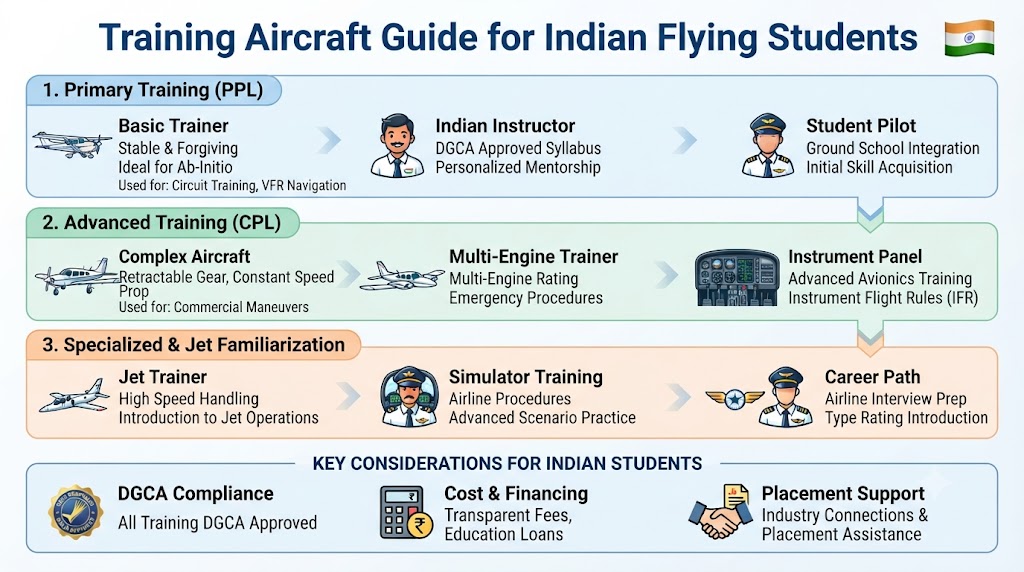
This Training Aircraft Guide for Indian Flying Students explains what training aircraft are, why they matter, what types are commonly used, and what students should check before joining a flight school.
What Is a Training Aircraft?
A training aircraft is an aircraft used to teach student pilots how to fly. These aircraft are selected because they are stable, reliable, easier to handle, and suitable for repeated training exercises.
Student pilots use training aircraft for:
- Basic aircraft handling
- Takeoff and landing practice
- Circuit flying
- Solo flying
- Navigation training
- Emergency procedure practice
- Instrument flying basics
- Skill development before advanced training
Training aircraft are not chosen only for speed or luxury. They are chosen for safety, simplicity, learning value, and operating cost.
Why Aircraft Choice Matters for Indian Flying Students
Aircraft choice matters because every aircraft gives a different learning experience. Some aircraft are simple and affordable for beginners. Some have modern glass cockpit systems. Some are used for multi-engine or advanced training.
For Indian students, aircraft availability is very important. Even if a flying school has good instructors, training can slow down if aircraft are often unavailable due to maintenance, scheduling pressure, or a high student-to-aircraft ratio.
Students should never choose a flying school only by the lowest fee. They should also check fleet condition, maintenance discipline, aircraft availability, and instructor experience.
Common Types of Training Aircraft Used in India
Single-Engine Piston Aircraft
Most students begin training on single-engine piston aircraft. These aircraft are commonly used for basic flying, circuits, solo flights, and navigation training.
They are usually more affordable than multi-engine aircraft and are suitable for beginner-level learning.
Glass Cockpit Training Aircraft
Glass cockpit aircraft use digital screens instead of only traditional round instruments. They help students understand modern cockpit displays, navigation systems, and electronic flight information.
These aircraft can be useful for students who want early exposure to modern cockpit systems.
Traditional Cockpit Aircraft
Traditional cockpit aircraft use round dial instruments such as airspeed indicator, attitude indicator, altimeter, heading indicator, and vertical speed indicator.
These aircraft are excellent for building basic instrument understanding and manual flying discipline.
Multi-Engine Training Aircraft
Multi-engine aircraft are used for advanced training. They help pilots learn engine management, asymmetric thrust control, emergency handling, and higher cockpit workload.
These aircraft are usually more expensive to operate than single-engine trainers.
Simulator-Supported Training
Some flight schools also use simulators or procedure trainers. These help students practice cockpit flow, radio calls, instrument scanning, navigation, and emergency procedures before or alongside real aircraft flying.
Popular Training Aircraft Examples
Different flying schools may use different aircraft depending on approval, cost, maintenance, and availability.
Common trainer aircraft globally include:
- Cessna 152
- Cessna 172
- Piper training aircraft
- Diamond DA40
- Diamond DA42
- Tecnam aircraft
- Similar single-engine and twin-engine trainers
This does not mean every Indian flying school uses all these aircraft. Students should check the actual fleet of the FTO before taking admission.
Single-Engine Training Aircraft
Single-engine aircraft are usually the first aircraft for student pilots. They are used for learning basic control, takeoff, landing, climbs, descents, turns, circuits, navigation, and solo flying.
These aircraft are helpful because they are easier to understand and usually cost less per hour than advanced aircraft.
For CPL aspirants, single-engine aircraft help build the foundation. Strong single-engine skills make later training easier.
Multi-Engine Training Aircraft
Multi-engine aircraft are used when students move to advanced training. These aircraft have two engines and require more planning, more checklist discipline, and better workload management.
In multi-engine training, students learn:
- Engine start and shutdown
- Power management
- Engine failure handling
- Asymmetric thrust control
- Single-engine approach
- Emergency procedures
- Advanced cockpit discipline
Multi-engine flying is useful for pilots who want to prepare for professional aviation stages, but students should start it only after building strong basic flying skills.
Glass Cockpit vs Traditional Cockpit
Both cockpit types are useful. One is not always better than the other.
| Feature | Glass Cockpit | Traditional Cockpit |
|---|---|---|
| Display Type | Digital screens | Round dial instruments |
| Learning Style | Modern system awareness | Strong basic instrument discipline |
| Navigation | Often easier to display | Requires more manual understanding |
| Cost | May be higher | May be lower |
| Useful For | Modern cockpit exposure | Foundation flying skills |
| Challenge | Can create screen dependency | Requires stronger manual scan |
A good student should learn the basics first and then adapt to modern systems. Technology helps, but basic flying skill is still the foundation.
What Students Should Check in a Flight School Fleet
Before joining a flying school, students should ask practical questions about the aircraft fleet.
They should check:
- How many aircraft are available?
- How many are currently serviceable?
- What aircraft types are used for training?
- What is the student-to-aircraft ratio?
- How often do aircraft go into maintenance?
- Are there long waiting times for flying slots?
- Are instructors experienced on those aircraft?
- Are aircraft documents and approvals updated?
- Is the fleet suitable for CPL training needs?
- Does the school have backup aircraft if one is grounded?
These questions help students understand whether the school can support smooth training progress.
How Fleet Quality Affects Training Progress
Fleet quality has a direct impact on training progress. If aircraft are well maintained and available regularly, students can fly more consistently.
If aircraft are frequently unavailable, students may face delays. Long gaps between flights can reduce confidence and force students to repeat lessons.
A good fleet does not always mean brand-new aircraft. It means aircraft are properly maintained, available, documented, and operated with safety discipline.
Safety and Maintenance Awareness
Student pilots do not need to become aircraft engineers, but they should respect maintenance and safety procedures.
Before every flight, students should follow instructor guidance and complete proper pre-flight checks. They should report anything unusual, such as fuel smell, fluid leakage, damaged parts, unusual instrument readings, or abnormal sounds.
Students should never pressure instructors or staff to fly an aircraft if there is a genuine safety concern. In aviation, safety is more important than completing hours quickly.
Training Aircraft and Cost Impact
Aircraft type affects training cost. A basic single-engine trainer usually costs less per hour than a multi-engine aircraft. A newer aircraft or glass cockpit aircraft may also cost more than a simpler trainer.
However, students should not look only at hourly cost. A cheaper aircraft is not helpful if it is rarely available or causes repeated delays.
Students should compare:
- Hourly aircraft cost
- Aircraft availability
- Maintenance reliability
- Instructor quality
- Training structure
- Total expected completion time
The cheapest option is not always the best option.
Common Mistakes Students Make
Many students make the mistake of choosing a flying school only by fee. This can create problems later if aircraft availability is poor.
Another mistake is not checking the real fleet condition. A school may list several aircraft, but students should ask how many are actively flying.
Some students ignore maintenance downtime and later face long delays.
Another common mistake is assuming all aircraft provide the same learning experience. In reality, aircraft type, cockpit layout, speed, handling, and systems can affect training.
Students should also avoid ignoring instructor experience. A good aircraft with poor instruction will not give the best learning outcome.
Practical Checklist for Indian Students
Before joining a flight school, use this checklist:
- Check aircraft types used for training
- Ask how many aircraft are serviceable
- Check aircraft-to-student ratio
- Ask about average monthly flying hours
- Confirm maintenance and safety discipline
- Ask about backup aircraft
- Understand hourly aircraft charges
- Check whether aircraft support CPL training needs
- Ask about simulator support if available
- Speak with current or past students if possible
- Review documentation and approval process
- Confirm logbook and training record system
This checklist can help students make a smarter decision before paying admission or training fees.
FAQs on Training Aircraft for Indian Flying Students
1. What is a training aircraft?
A training aircraft is an aircraft used to teach student pilots basic and advanced flying skills such as takeoff, landing, navigation, circuits, and emergency procedures.
2. Which aircraft do Indian flying students usually train on?
Many students begin on single-engine piston aircraft. The exact aircraft type depends on the flying school fleet and approval.
3. Is a glass cockpit aircraft better for training?
Glass cockpit aircraft are useful for modern cockpit exposure, but traditional cockpit aircraft are also excellent for building strong basic flying skills.
4. Why is aircraft availability important?
If aircraft are not regularly available, students may face training delays. Regular flying helps students maintain confidence and progress.
5. Should students choose a flying school with the cheapest aircraft cost?
Not always. Students should compare cost with aircraft condition, availability, maintenance quality, instructor support, and training structure.
6. Are multi-engine aircraft used from the beginning?
Usually, students begin with single-engine aircraft. Multi-engine aircraft are generally used later for advanced training.
7. What should students ask about aircraft maintenance?
Students can ask about aircraft serviceability, maintenance downtime, safety procedures, and whether aircraft documents are updated.
8. Can aircraft type affect training speed?
Yes, indirectly. Reliable aircraft availability can help students fly regularly, while poor availability can cause delays.
9. Do all Indian flight schools use the same aircraft?
No. Aircraft fleet varies by flying school, approval, budget, location, and training syllabus.
10. What is the best aircraft for beginner pilots?
The best aircraft is one that is safe, reliable, beginner-friendly, properly maintained, and supported by experienced instructors.
Final Thoughts
Training aircraft play a very important role in pilot training. For Indian flying students, the aircraft fleet can affect safety, confidence, cost, scheduling, and overall learning quality.
A good training aircraft should be suitable for beginners, properly maintained, regularly available, and supported by qualified instructors.
Students should not choose a flying school only by low fees or marketing claims. They should check aircraft condition, fleet availability, maintenance discipline, instructor support, and training structure.

