
Introduction
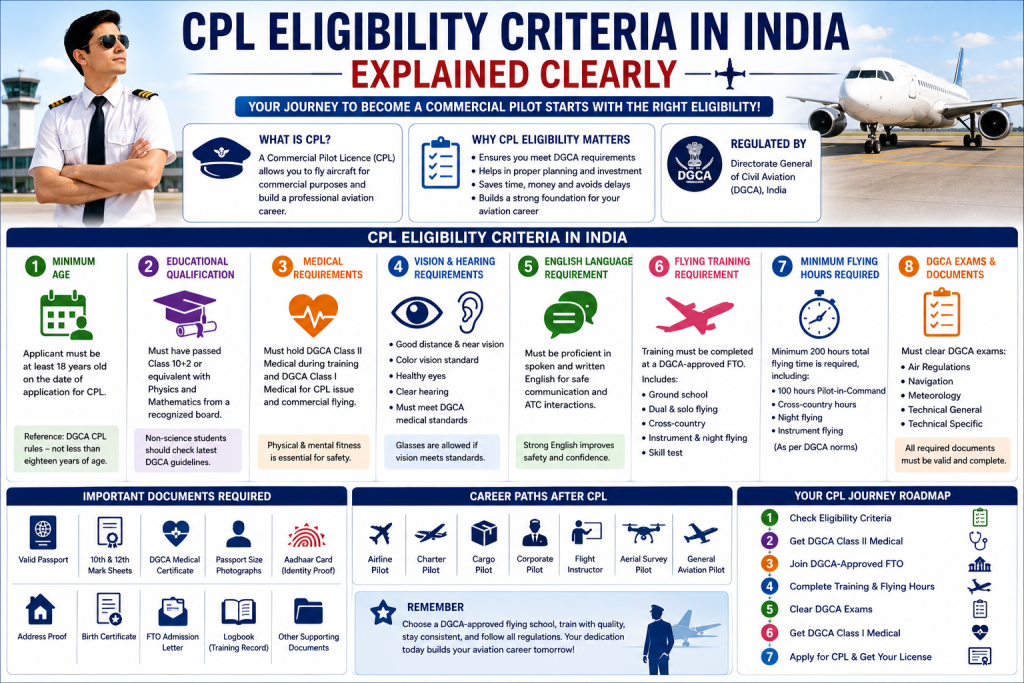
Becoming a commercial pilot is one of the most exciting career goals for aviation students in India. A Commercial Pilot Licence, commonly called CPL, allows a trained pilot to fly professionally and build a career in airlines, charter aviation, cargo operations, flight instruction, corporate flying, and other commercial aviation roles.
However, before joining a flight school, every student must clearly understand the CPL eligibility criteria in India. Many students start planning without checking age, education, medical fitness, DGCA exams, flying hours, and documentation requirements. This can lead to confusion, delays, or unnecessary expenses.
This guide explains CPL eligibility in simple language so students and parents can plan the commercial pilot journey with confidence.
What Is a Commercial Pilot Licence?
A Commercial Pilot Licence is a professional pilot licence that allows a person to fly aircraft for commercial purposes, subject to aircraft rating, medical fitness, and regulatory requirements.
In simple words, CPL is required if you want to work as a paid pilot.
A CPL can help you move toward roles such as:
- Airline First Officer
- Charter Pilot
- Cargo Pilot
- Corporate Pilot
- Flight Instructor
- Aerial Survey Pilot
- Government Aviation Pilot
- General Aviation Pilot
In India, pilot licensing is regulated by the Directorate General of Civil Aviation, commonly known as DGCA.
Why CPL Eligibility Matters
Understanding CPL eligibility is important because pilot training requires time, money, discipline, and careful planning.
Before joining a flying school, students should know:
- Whether they meet the age requirement
- Whether their education is accepted
- Whether they are medically fit
- Which DGCA exams they must clear
- How many flying hours are required
- What documents are needed
- Which training organisation is approved
- What career path is realistic after CPL
Clear eligibility planning helps avoid wrong decisions.
Minimum Age Requirement for CPL in India
For a Commercial Pilot Licence in India, the applicant must be at least 18 years old on the date of application. DGCA’s Commercial Pilot’s Licence rules state that the applicant shall be “not less than eighteen years of age” on the date of application.
Students can begin aviation preparation earlier through ground classes, basic aviation study, simulator practice, and medical planning. However, CPL issue requires meeting the official age requirement.
Educational Qualification for CPL in India
For CPL in India, the candidate must have passed Class 10+2 or equivalent with Physics and Mathematics from a recognized board or university. DGCA’s CPL rule lists the educational qualification as Class 10+2 or equivalent with Physics and Mathematics.
This means students from science backgrounds usually meet the basic education requirement if they studied Physics and Mathematics in Class 12.
Students who did not study Physics and Mathematics should not assume they are automatically eligible. They should verify the current DGCA position and consider completing these subjects through a recognized board if required.
There have been discussions and reports about possible relaxation for non-science students, but students should rely on the latest official DGCA rules before making training decisions. Reports have described proposed changes for arts and commerce students, but such proposals should be treated carefully unless officially implemented.
Medical Requirements for CPL
Medical fitness is one of the most important CPL eligibility criteria.
A commercial pilot must be physically and mentally fit to operate an aircraft safely. Pilot medical checks usually include:
- Vision test
- Hearing test
- Blood pressure check
- General health review
- Heart health assessment
- Neurological fitness
- Medical history review
- Medication review
- Mental fitness evaluation
Students usually begin with a DGCA Class II Medical and later require DGCA Class I Medical for CPL issue and professional flying.
It is wise to complete medical checks early before investing heavily in training.
Vision and Hearing Requirements
Pilots must have good functional vision and hearing because cockpit work depends on reading instruments, seeing traffic, identifying runway lights, and communicating with air traffic control.
Wearing glasses does not automatically disqualify a candidate. Many pilots fly with corrective lenses if their vision meets the required medical standard.
Candidates should check:
- Distance vision
- Near vision
- Color vision
- Eye health
- Hearing clarity
- Speech and communication ability
Any existing medical condition should be discussed honestly with a DGCA-approved medical examiner.
English Language Requirement
English is the international language of aviation. Pilots must communicate clearly with air traffic control, instructors, crew members, and airline operations teams.
A CPL candidate should be comfortable with:
- Spoken English
- Aviation phraseology
- Radio communication
- Reading manuals
- Understanding checklists
- Writing reports
- Listening to ATC instructions
Strong English communication improves safety and confidence during training.
Flying Training Requirement
CPL training must be completed through proper flight training as per DGCA requirements. Students should choose a DGCA-approved Flying Training Organisation, also called FTO.
Training generally includes:
- Ground school
- Dual flying with instructor
- Solo flying
- Cross-country flying
- Instrument flying
- Night flying
- Navigation training
- Emergency procedures
- Simulator training where applicable
- Skill tests
The quality of the flying school matters. Students should check aircraft availability, instructor strength, maintenance standards, weather conditions, training records, and transparency before joining.
Flying Hours Required for CPL
A CPL candidate in India generally needs to complete 200 hours of flight training for the Commercial Pilot Licence pathway. DGCA and flight training references commonly describe 200 flying hours as the core CPL flight training requirement.
These hours may include different categories such as:
- Dual flying
- Solo flying
- Pilot-in-command flying
- Cross-country flying
- Instrument flying
- Night flying
The exact distribution of hours should always be checked with current DGCA rules and the selected FTO.
DGCA Examinations for CPL
CPL candidates must clear DGCA theoretical examinations.
Common CPL subjects include:
- Air Navigation
- Aviation Meteorology
- Air Regulation
- Technical General
- Technical Specific
Candidates may also need radio telephony-related certification depending on the flying and licensing path.
DGCA exams require serious preparation. Students should not treat them lightly because delays in clearing exams can increase training time and cost.
RTR Requirement
Many CPL candidates also prepare for the RTR licence or Radio Telephony Restricted Aeronautical exam, conducted by the Wireless Planning and Coordination Wing.
RTR is important because pilots must use aircraft radio communication safely and correctly.
It tests knowledge of:
- Radio communication procedures
- ATC phraseology
- Emergency communication
- Aviation radio rules
- Practical communication ability
Documents Required for CPL
Students should keep documents organized from the beginning.
Common documents may include:
- Class 10 certificate
- Class 12 certificate
- Physics and Mathematics proof
- Identity proof
- Address proof
- Passport
- Medical certificates
- DGCA exam results
- Flying logbook
- Passport-size photographs
- Computer number details
- Police verification if required
- FTO training records
Incorrect or incomplete documentation can delay licence processing.
Step-by-Step Process to Obtain CPL in India
- Complete Class 12 with required subjects
- Check DGCA eligibility rules
- Apply for DGCA computer number
- Complete Class II Medical
- Choose a DGCA-approved FTO
- Start ground school preparation
- Clear DGCA theory exams
- Begin flight training
- Complete required flying hours
- Complete Class I Medical
- Clear required skill tests
- Apply for CPL issue
- Build further ratings or airline preparation
This process requires patience and planning.
Difference Between SPL, PPL, and CPL
| Licence | Purpose | Typical Use |
|---|---|---|
| SPL | Student Pilot Licence | Basic training and solo flying stage |
| PPL | Private Pilot Licence | Non-commercial personal flying |
| CPL | Commercial Pilot Licence | Professional paid flying career |
A student aiming for an airline career usually progresses toward CPL and then additional ratings or airline selection steps.
CPL Eligibility Checklist
| Requirement | Basic Expectation |
|---|---|
| Age | Minimum 18 years for CPL issue |
| Education | Class 10+2 or equivalent with Physics and Mathematics |
| Medical | DGCA medical fitness, including Class I for professional licensing |
| English | Good aviation communication ability |
| Flying Hours | Generally 200 hours for CPL pathway |
| Exams | DGCA theory exams and required radio communication certification |
| Training | DGCA-approved FTO training |
| Documents | Education, medical, exam, logbook, and identity documents |
Common Reasons Students Face Delays
Many CPL aspirants face delays because of avoidable issues.
Common reasons include:
- Not checking medical fitness early
- Missing Physics or Mathematics eligibility
- Poor DGCA exam preparation
- Choosing the wrong flying school
- Weather delays during training
- Aircraft availability problems
- Incomplete logbook entries
- Expired medical certificates
- Documentation errors
- Poor financial planning
A well-prepared student can avoid many of these problems.
Common Myths About CPL Eligibility
| Myth | Fact |
|---|---|
| You need perfect eyesight to become a pilot | Corrected vision may be acceptable if medical standards are met |
| CPL guarantees an airline job | CPL is a licence, but airline hiring has separate selection requirements |
| Only rich students can become pilots | Training is expensive, but planning, loans, and scholarships may help |
| Women have different CPL eligibility rules | Eligibility standards are generally the same |
| You can skip DGCA exams | DGCA exams are a required part of the licensing pathway |
| Any flying school is acceptable | Students should choose DGCA-approved and reliable FTOs |
| Age is the only important requirement | Education, medical, exams, flying hours, and documents also matter |
Tips to Improve Your CPL Preparation
To improve your chances, focus on:
- Complete DGCA medical early
- Strengthen Physics and Mathematics basics
- Improve English communication
- Research FTOs carefully
- Prepare seriously for DGCA exams
- Keep all documents organized
- Maintain physical fitness
- Plan finances realistically
- Track flying hours properly
- Stay disciplined throughout training
Pilot training rewards consistency and professionalism.
How to Choose a Flying School in India
Before joining any FTO, check:
- DGCA approval status
- Aircraft fleet size
- Aircraft maintenance quality
- Instructor availability
- Safety record
- Training completion timeline
- Weather conditions
- Hostel and student facilities
- Ground school support
- Fee transparency
- Student reviews
- Logbook and documentation support
DGCA has also directed flying schools to display useful information such as training duration for 200 hours, aircraft availability, instructors, examiners, ground school, and simulator availability to help students make informed choices.
Career Opportunities After CPL
After CPL, students can explore several aviation roles.
Airline First Officer
Many CPL holders aim to join airlines as junior first officers after completing required airline selection, type rating, and company training.
Charter Pilot
Charter pilots fly private aircraft for individuals, companies, and special travel needs.
Cargo Pilot
Cargo pilots transport goods, packages, and logistics shipments.
Flight Instructor
Some pilots become instructors to train new students and build experience.
Corporate Pilot
Corporate pilots fly business aircraft for companies and executives.
Aerial Survey Pilot
Aerial survey pilots support mapping, inspection, photography, and monitoring missions.
Government or Special Operations Pilot
Some pilots work in government aviation, rescue support, surveillance, or other specialized operations.
Frequently Asked Questions
1. What is the minimum age for CPL in India?
The minimum age for Commercial Pilot Licence issue in India is 18 years on the date of application. Students may start preparation earlier, but the licence requires meeting DGCA age criteria.
2. Is Physics compulsory for CPL in India?
Yes, DGCA rules currently list Physics as part of the Class 10+2 or equivalent educational requirement for CPL. Students without Physics should verify official DGCA rules before joining training.
3. Is Mathematics compulsory for CPL in India?
Yes, Mathematics is also part of the Class 10+2 or equivalent requirement listed under DGCA CPL eligibility. It is important for navigation, flight planning, and aviation calculations.
4. Can commerce students become commercial pilots in India?
Commerce students should verify the latest DGCA rules. Reports have discussed possible changes, but students should not rely only on news or unofficial claims before investing in training.
5. Is Class I Medical mandatory for CPL?
Yes, Class I Medical fitness is required for professional commercial pilot licensing and flying. Students often start with Class II Medical before progressing toward Class I.
6. How many flying hours are required for CPL in India?
The CPL pathway generally requires 200 hours of flight training. The exact hour distribution should be checked with current DGCA rules and the selected flying school.
7. Can I start CPL training after graduation?
Yes, graduates can start CPL training if they meet age, education, medical, and DGCA requirements. Many students begin after Class 12, while others start after college.
8. How long does CPL training take?
CPL training time varies depending on weather, aircraft availability, exam clearance, student performance, and FTO efficiency. Many schools estimate around one to two years, but timelines can vary.
9. Is English compulsory for becoming a pilot?
Yes, English communication is essential in aviation. Pilots must understand ATC instructions, manuals, checklists, radio calls, and cockpit communication.
10. Does CPL guarantee an airline job?
No. CPL makes you eligible for professional flying roles, but airline jobs depend on hiring demand, interviews, simulator assessment, type rating, medical fitness, and overall performance.
Conclusion
CPL eligibility in India is not difficult to understand when broken into clear parts: age, education, medical fitness, DGCA exams, flying hours, training, and documentation. A student must be at least 18 years old for CPL issue, complete the required educational qualification with Physics and Mathematics, meet medical standards, clear exams, and complete required flying training.
If you are serious about becoming a commercial pilot, start with proper planning. Check official DGCA requirements, complete your medical early, choose a reliable flying school, prepare for exams, and stay disciplined throughout training. With the right preparation and guidance, a CPL can become the foundation for a rewarding aviation career.

