
Introduction
Weather is one of the most important factors in aviation decision-making. A flight may be legally possible, but that does not always mean it is safe, practical, or suitable for the pilot’s experience level.
Indian pilots operate in highly varied weather conditions. Depending on the location and season, they may encounter dense winter fog, summer heat, monsoon rain, thunderstorms, haze, dust storms, strong crosswinds, mountain turbulence, sea-breeze changes, or rapidly reducing visibility.
Safe weather decision-making is not limited to reading a METAR or TAF. Pilots must understand what the reported and forecast conditions mean for the aircraft, route, runway, terrain, fuel, alternatives, and their own abilities.
A professional pilot remains willing to delay, divert, return, land, or cancel whenever the available safety margin becomes too small.
Why Weather Decision-Making Matters
Weather affects almost every part of a flight, including:
- Aircraft performance
- Take-off distance
- Climb capability
- Visibility
- Cloud clearance
- Navigation
- Fuel consumption
- Runway selection
- Crosswind control
- Approach stability
- Landing distance
- Alternate availability
- Pilot workload
Many weather-related problems do not develop from one major mistake. They often result from several smaller decisions, such as accepting marginal visibility, delaying a diversion, carrying limited fuel, or continuing because the destination appears close.
Good decision-making helps pilots identify these risks before they combine into a dangerous situation.
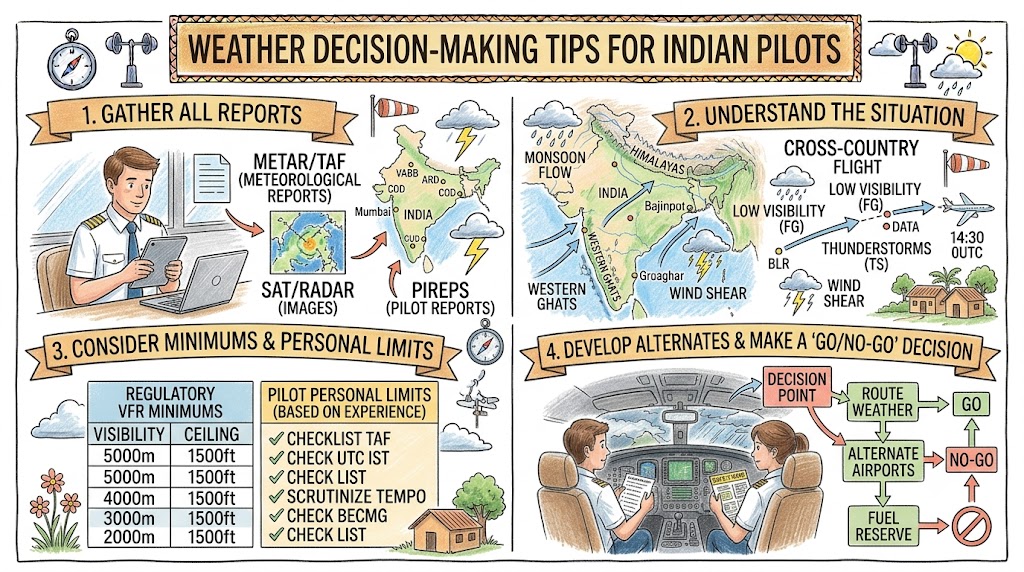
Understand the Complete Weather Picture
A pilot should never make a flight decision using only one report.
A complete weather assessment may include:
- Current METAR
- Any newer SPECI
- Valid TAF
- Short-term weather trend
- SIGMET information
- Aerodrome warnings
- Wind-shear warnings
- Significant weather charts
- Radar and satellite information
- Winds at planned altitude
- Departure weather
- Route weather
- Destination weather
- Alternate aerodrome weather
- Reports from instructors or recently returned pilots
Each source provides a different part of the weather picture.
A METAR shows observed conditions at an aerodrome, while a TAF indicates expected changes. Radar may show developing rain or thunderstorms, while SIGMET information warns of significant hazards across a larger area.
Begin With the Planned Flight
Weather cannot be judged without understanding the type of flight being planned.
Conditions suitable for a short dual circuit session may not be suitable for:
- First solo flight
- Student cross-country exercise
- Mountain route
- Night flight
- Long navigation exercise
- Flight over unfamiliar terrain
- Operation from a short runway
- Flight without suitable alternates
Before reviewing the weather, clearly define:
- Departure aerodrome
- Destination
- Planned route
- Altitude
- Expected flight time
- Training exercise
- Alternate aerodromes
- Latest safe return time
- Aircraft limitations
- Student or pilot experience
The same weather can create different risks for different flights.
Use a Structured Decision-Making Process
A structured process prevents pilots from focusing on only one factor.
The PAVE checklist is a useful method.
Pilot
Consider:
- Recent flying experience
- Weather experience
- Fatigue
- Stress
- Illness
- Hydration
- Confidence level
- Instrument qualification
- Personal weather minimums
Aircraft
Consider:
- Aircraft performance
- Fuel capacity
- Navigation equipment
- Weather-related equipment
- Aircraft serviceability
- Crosswind capability
- De-icing or anti-icing capability
- Performance in high density altitude
- Runway requirements
Environment
Consider:
- Wind
- Visibility
- Cloud base
- Thunderstorms
- Turbulence
- Terrain
- Temperature
- Runway conditions
- Daylight
- Destination and alternate weather
External Pressure
Consider:
- Training schedule
- Passenger expectations
- Instructor availability
- Desire to return home
- Commercial pressure
- Hotel or transport bookings
- Fear of losing a flight slot
- Pressure to complete a course quickly
External pressure is dangerous because it can encourage a pilot to accept conditions that would otherwise be rejected.
Set Personal Weather Minimums
Legal weather limits represent minimum regulatory requirements. Personal limits should normally be more conservative, especially for student pilots and pilots with limited recent experience.
Personal minimums may cover:
- Minimum visibility
- Minimum cloud base
- Maximum surface wind
- Maximum crosswind
- Maximum gust spread
- Minimum runway length
- Minimum fuel reserve
- Maximum thunderstorm proximity
- Minimum daylight remaining
- Maximum acceptable turbulence
- Required number of suitable alternates
Personal limits should be written down before the flight.
They should not be changed simply because:
- The aircraft has already been booked.
- The instructor is waiting.
- The passengers have arrived.
- The destination is important.
- Other pilots are flying.
- The weather is only slightly outside the limit.
A personal limit has little value if it is ignored whenever it becomes inconvenient.
Separate Legal, Aircraft and Personal Limits
Pilots should compare three different types of limits.
| Limit type | Meaning |
|---|---|
| Regulatory limit | Minimum condition permitted by applicable rules |
| Aircraft limit | Restriction or performance limit for the aircraft |
| Personal limit | Pilot’s own conservative operating boundary |
Flying may be legal but still unsuitable because:
- The pilot lacks experience.
- The aircraft has limited performance.
- The runway is short or wet.
- The crosswind is near the pilot’s maximum.
- The route lacks good alternates.
- Weather is deteriorating.
- The pilot is tired or under pressure.
The safest decision should be based on the most restrictive relevant limit.
Evaluate Weather Trends
The direction in which the weather is changing can be more important than the current conditions.
Ask:
- Is visibility improving or reducing?
- Is the cloud base rising or lowering?
- Is wind increasing?
- Are gusts becoming stronger?
- Are thunderstorms developing?
- Is fog expected after sunset?
- Is rain moving toward the destination?
- Is the temperature and dew point spread narrowing?
- Is a weather system arriving earlier than forecast?
Weather that is currently acceptable but deteriorating may present greater risk than slightly marginal weather that is steadily improving.
Pilots should compare several recent observations rather than relying on one report.
Check the Weather for the Return Flight
A common mistake is checking only the departure conditions.
The weather may be acceptable at take-off but unsuitable by the expected return time.
Before departure, determine:
- Expected time at the destination
- Expected return time
- Forecast conditions at both times
- Sunset or daylight limitations
- Fog development risk
- Thunderstorm development period
- Wind changes
- Alternate availability
A local training flight should also have a clear latest return time.
Account for Indian Seasonal Weather
India experiences major seasonal weather variations. Pilots should understand the typical risks associated with each period.
Summer Weather
Summer flying may involve:
- High temperatures
- High density altitude
- Reduced climb performance
- Longer take-off distance
- Thermal turbulence
- Haze
- Dust
- Strong surface heating
- Pre-monsoon thunderstorms
High temperature can reduce aircraft performance even when the runway appears long enough.
Pilots should calculate:
- Take-off distance
- Climb performance
- Landing distance
- Aircraft weight
- Density altitude
- Obstacle-clearance margin
Early-morning flights may offer cooler and smoother conditions, but morning haze or low visibility must still be considered.
Monsoon Weather
Monsoon conditions may include:
- Heavy rain
- Thunderstorms
- Cumulonimbus clouds
- Wind shear
- Microbursts
- Reduced visibility
- Low clouds
- Water-covered runways
- Rapidly changing wind
- Local flooding
A pilot should never continue toward a thunderstorm simply because the visible rain area appears small.
Convective hazards may extend beyond the obvious cloud or rainfall.
During monsoon planning, consider:
- Additional fuel for diversion
- Suitable alternates
- Movement of rain cells
- Runway surface condition
- Crosswind changes
- Possibility of holding
- Reduced braking effectiveness
- Rapid visibility reduction
Winter Weather
Winter operations, particularly in northern India, may involve:
- Dense fog
- Mist
- Haze
- Low cloud
- Temperature inversions
- Reduced runway visibility
- Delayed improvement
- Low sun and glare
Forecast improvement times should not be treated as guaranteed.
If fog is expected to clear at a particular time, pilots should wait for actual observations confirming that conditions are suitable.
Dust and Haze
Dust and haze can reduce horizontal visibility even when the sky above appears clear.
These conditions may affect:
- Ground-reference navigation
- Traffic detection
- Runway identification
- Horizon definition
- Terrain awareness
- Return-to-base decisions
Pilots should not judge visibility only from the aerodrome apron. Conditions along the route may be significantly worse.
Mountain Weather
Flights near mountains or elevated terrain require additional caution.
Hazards may include:
- Mountain waves
- Rotor turbulence
- Strong downdrafts
- Rapid cloud formation
- Reduced visibility
- Valley winds
- Terrain obscuration
- Limited escape routes
Pilots without appropriate mountain-flying experience should avoid attempting such operations in doubtful weather.
Coastal Weather
Coastal flying may involve:
- Sea-breeze changes
- High humidity
- Coastal haze
- Low cloud
- Rapid wind-direction changes
- Thunderstorm development
- Reduced visibility near the shoreline
A sea breeze may cause a runway change or increasing crosswind during a training flight.
Assess Wind Properly
The reported wind speed alone does not provide enough information.
Pilots should evaluate:
- Wind direction
- Average speed
- Gust speed
- Crosswind component
- Tailwind component
- Variability
- Wind at altitude
- Terrain effects
- Forecast wind changes
A moderate wind directly along the runway may be manageable, while a lower wind across the runway may exceed the student’s crosswind limit.
Gust spread is also important.
For example, a wind of 10 knots gusting to 24 knots creates a 14-knot gust spread. This may significantly affect airspeed, control, and approach stability.
Check Crosswind Before Departure
Before accepting a runway, calculate or estimate the crosswind component.
Compare it with:
- Aircraft information
- Flying-school limit
- Instructor limit
- Student solo limit
- Personal limit
- Runway condition
Crosswind risk increases when combined with:
- Short runway
- Wet surface
- Strong gusts
- Poor visibility
- High workload
- Limited recent experience
Identify Thunderstorm Warning Signs
Thunderstorm-related hazards include:
- Severe turbulence
- Lightning
- Hail
- Heavy rain
- Wind shear
- Microbursts
- Downdrafts
- Gust fronts
- Rapid wind-direction changes
Warning signs may include:
- Rapidly growing cumulus clouds
- Dark cloud bases
- Towering vertical development
- Lightning
- Distant thunder
- Sudden wind shift
- Blowing dust
- Rain curtains
- Rapid temperature change
Avoid trying to pass under, through, or too close to a developing thunderstorm.
Do Not Depend on the Forecast Alone
Forecasts are valuable but not perfect.
Actual conditions may:
- Develop earlier
- Develop later
- Be stronger than expected
- Be weaker than expected
- Affect a different area
- Remain longer than forecast
Compare forecasts with current observations.
A forecast showing good weather does not overrule an actual report showing poor weather.
Plan More Than One Alternate
An alternate should be genuinely usable, not just listed to complete the flight plan.
Evaluate:
- Weather at the alternate
- Runway suitability
- Fuel required
- Operating hours
- Navigation route
- Terrain
- Distance from destination
- Expected weather at arrival time
Where weather is unstable, consider a second option.
A good alternate is one that remains practical if the original destination becomes unavailable.
Carry a Fuel Margin for Weather
Weather may increase fuel consumption through:
- Headwinds
- Diversions
- Holding
- Re-routing
- Repeated approaches
- Delayed landing
- Longer taxi time
- Use of an alternate
Pilots should avoid planning fuel so tightly that one unexpected weather change creates an emergency.
Fuel should be planned according to applicable requirements, aircraft procedures, route conditions, and realistic operational margins.
Establish Decision Points Before Departure
Pilots should decide in advance when they will:
- Delay the flight
- Cancel the flight
- Turn back
- Divert
- Land at an alternate
- Discontinue an approach
- Execute a go-around
Examples of decision points include:
- Visibility below personal minimum
- Cloud base below route requirement
- Crosswind above student limit
- Thunderstorm developing near the route
- Fuel reaching a predetermined level
- Loss of reliable ground reference
- Destination weather falling below the required condition
Pre-planned decision points reduce the temptation to continue.
Use the Three-P Process
The Three-P process is useful before and during flight.
Perceive
Identify the hazard.
Examples:
- Visibility is reducing.
- Thunderstorms are developing.
- Wind is increasing.
- Fuel use is higher than expected.
- The destination cloud base is lowering.
Process
Evaluate what the hazard means.
Consider:
- Aircraft capability
- Pilot experience
- Terrain
- Fuel
- Distance from alternate
- Available escape options
Perform
Take action.
Possible actions include:
- Delay
- Cancel
- Turn back
- Divert
- Climb or descend when safe and permitted
- Request assistance
- Land at the nearest suitable aerodrome
The action should be taken while several options remain available.
Reassess Weather During Flight
A pre-flight weather briefing is not the end of weather decision-making.
During flight, monitor:
- Forward visibility
- Cloud base
- Ground references
- Wind drift
- Turbulence
- Rain development
- Destination reports
- Alternate reports
- Fuel remaining
- Time to sunset
- Pilot workload
A pilot should regularly ask:
- Are conditions as forecast?
- Is the route still clear?
- Is the destination still suitable?
- Is the alternate still available?
- Do I still have enough fuel?
- Am I becoming uncomfortable?
- Is it time to turn back?
Turn Back Early
Turning back is easiest when the pilot still has:
- Good visibility
- Adequate fuel
- Familiar terrain
- Several alternate options
- Manageable workload
Waiting until conditions become severe can remove these options.
A timely return is a sign of good judgement, not failure.
Avoid “Press-On” Thinking
Press-on thinking occurs when a pilot continues despite increasing risk because the flight has already begun.
Common thoughts include:
- The destination is very close.
- The weather may improve.
- Another aircraft just landed.
- I have already flown most of the route.
- I do not want to disappoint passengers.
- I do not want to lose the training slot.
- I can probably get through before the rain arrives.
These thoughts can weaken objective decision-making.
The safest choice should be based on conditions, not the amount of time or effort already invested.
Understand Plan Continuation Bias
Plan continuation bias is the tendency to continue with the original plan even when changing conditions suggest that a different action is safer.
It may cause a pilot to:
- Continue toward worsening weather
- Delay diversion
- Attempt an unstable approach
- Ignore an alternate
- Use more fuel than planned
- Accept stronger wind than intended
Pilots can reduce this risk by defining clear decision points before departure.
Do Not Copy Other Pilots’ Decisions
Another pilot may have:
- More experience
- A different aircraft
- Different equipment
- Instrument qualifications
- Greater crosswind capability
- Better route knowledge
- A different destination
- Different personal limits
The fact that another aircraft departed or landed does not prove that the conditions are suitable for you.
Every pilot must make an independent decision.
Use the Instructor as a Resource
Student pilots should discuss weather with their instructor before every flight.
Useful questions include:
- What is the main weather threat today?
- What is the expected trend?
- What are the student wind limits?
- What is the latest safe return time?
- Which alternate is suitable?
- What should trigger a turn-back?
- Is thunderstorm development expected?
- Is the visibility suitable for visual navigation?
- Is the aircraft performance adequate for the temperature?
- What is the plan if the destination weather deteriorates?
Students should gradually learn to present their own weather assessment rather than waiting for the instructor to provide the answer.
Build a Go/No-Go Table
A simple table can improve discipline.
| Factor | Acceptable | Caution | No-go |
|---|---|---|---|
| Visibility | Above personal minimum with margin | Near personal minimum | Below required limit |
| Cloud base | Comfortable for route and terrain | Limited margin | Below safe requirement |
| Crosswind | Well within student limit | Near personal limit | Above allowed limit |
| Thunderstorms | None affecting route | Developing nearby | On or approaching route |
| Fuel | Strong reserve and alternate margin | Reduced flexibility | Inadequate for safe plan |
| Weather trend | Stable or improving | Uncertain | Deteriorating |
| Pilot condition | Rested and confident | Mild fatigue or concern | Unfit, stressed or pressured |
The exact values should be established with the instructor or operator.
Weather Decision-Making Checklist
Pilot Readiness
- Properly rested
- Medically fit
- Adequately hydrated
- Comfortable with expected conditions
- Recent experience considered
- Personal weather limits reviewed
- External pressure identified
Weather Information
- Latest METAR checked
- Latest SPECI checked
- TAF reviewed
- Weather trend understood
- SIGMET checked
- Aerodrome warnings reviewed
- Wind-shear warnings reviewed
- Radar and satellite information reviewed where available
Route Assessment
- Departure suitable
- Route weather suitable
- Destination suitable
- Alternate suitable
- Terrain clearance considered
- Thunderstorm activity assessed
- Visibility and cloud base checked
- Wind at altitude reviewed
Aircraft Assessment
- Take-off performance calculated
- Landing performance checked
- Density altitude considered
- Crosswind component calculated
- Fuel requirement confirmed
- Weather-related equipment checked
- Aircraft limitations reviewed
Decision Planning
- Personal limits satisfied
- Turn-back point established
- Diversion options identified
- Minimum fuel decision point set
- Latest safe return time established
- Go-around criteria reviewed
- Instructor or operational approval received where required
Common Weather Decision-Making Mistakes
Looking Only at Current Weather
The weather may deteriorate before the flight ends.
Ignoring Temporary Forecast Conditions
A TEMPO thunderstorm, fog, or low-cloud period may overlap with arrival or return time.
Accepting Conditions at the Limit
Flying exactly at the minimum leaves little margin for weather variation or pilot error.
Delaying Diversion
A late diversion may result in lower fuel, worsening weather, and increased workload.
Underestimating Crosswind
Total wind and crosswind component are not the same.
Relying on Visual Appearance
Weather may look acceptable from the aerodrome while being poor along the route.
Ignoring External Pressure
Schedule pressure can influence judgement without the pilot realizing it.
Continuing Because Others Are Flying
Another pilot’s decision may not be appropriate for your experience or aircraft.
Failing to Check the Alternate
An alternate may become unsuitable at the same time as the destination.
Treating Cancellation as Failure
Cancelling due to unsafe conditions is a professional aviation decision.
Key Takeaways
- Weather decisions should consider the complete flight, not only departure conditions.
- Personal minimums should be more conservative than minimum legal limits.
- METAR, SPECI, TAF, warnings, route weather, and alternates should be reviewed together.
- Indian pilots must prepare for monsoon storms, winter fog, summer heat, haze, dust, coastal changes, and mountain weather.
- Weather trends are often more important than one isolated report.
- Crosswind, gusts, visibility, cloud base, fuel, and terrain must be evaluated together.
- Decision points should be established before departure.
- Weather must be reassessed throughout the flight.
- Turning back or diverting early preserves options.
- External pressure should never control a safety decision.
Frequently Asked Questions
What is a go/no-go weather decision?
It is the pilot’s decision to begin, delay, modify, or cancel a flight after assessing weather, aircraft capability, pilot readiness, and operational risks.
Should a pilot fly when the weather is exactly at the legal minimum?
Not automatically. Personal experience, aircraft capability, terrain, runway conditions, weather trend, and available alternatives must also be considered.
What weather information should Indian pilots check?
Pilots should review current observations, forecasts, significant-weather warnings, wind information, route conditions, destination weather, and suitable alternates using approved operational sources.
Why are personal weather minimums important?
They provide a safety margin based on the pilot’s experience, recent practice, aircraft, route, and training level.
How should pilots handle a deteriorating forecast?
They should consider delaying, modifying, shortening, diverting, or cancelling the flight before safety margins become too small.
Is temporary weather in a TAF important?
Yes. Temporary fog, thunderstorms, heavy rain, low visibility, or low clouds may affect the flight during departure, arrival, or return.
When should a pilot turn back?
A pilot should turn back when conditions approach personal or operational limits, the route becomes uncertain, visibility reduces, fuel margins decline, or the pilot becomes uncomfortable.
Can pilots fly near thunderstorms when the route appears clear?
Thunderstorms can produce turbulence, wind shear, lightning, hail, and downdrafts beyond the visible rain area. Conservative avoidance is essential.
Why is weather trend important?
A deteriorating trend can make currently acceptable weather unsafe before the flight is completed.
Should student pilots use the same limits as experienced pilots?
No. Student limits should normally be more conservative and should follow flying-school and instructor requirements.
What should a pilot do if destination weather becomes unsuitable?
The pilot should use the pre-planned safe option, such as returning, diverting, holding only when appropriate, or landing at a suitable alternate before fuel or weather becomes critical.
Is cancelling a flight because of weather a bad decision?
No. Cancelling or delaying a flight when conditions are unsuitable demonstrates sound judgement and professional airmanship.
Conclusion
Safe weather decision-making requires preparation, discipline, and the willingness to change the plan. Indian pilots should evaluate current conditions, forecasts, seasonal hazards, aircraft performance, personal limits, fuel, terrain, and alternates before departure. During flight, weather should be reassessed continuously, and action should be taken while safe options remain available.

