
Introduction
Becoming a professional pilot in India requires more than learning how to fly an aircraft. Aspiring pilots also need to develop strong theoretical knowledge and successfully complete the examinations applicable to their pilot training and licensing pathway. For many students, DGCA pilot exams are an important part of this journey.
Preparing for these examinations can feel challenging, especially when you are studying subjects such as Air Navigation, Aviation Meteorology, Air Regulations, and technical topics at the same time. The key is to avoid last-minute preparation and follow a structured study plan from the beginning.
A good preparation strategy involves understanding the current syllabus, selecting reliable study materials, strengthening basic concepts, solving practice questions, revising regularly, and keeping track of official DGCA updates. Since examination procedures and requirements can change, candidates should always verify the latest information through the official DGCA and Pariksha portals.
This guide explains how aspiring pilots can organize their preparation and approach DGCA pilot exams with greater confidence.
Understanding DGCA Pilot Exams
The Directorate General of Civil Aviation (DGCA) is India’s civil aviation regulatory authority. Its Central Examination Organisation conducts Flight Crew examinations under the applicable aviation rules and procedures.
The official DGCA Pariksha portal provides services and information related to Flight Crew examinations, including registration, examination schedules, syllabus information, notices, admit-card details, and results.
The examinations applicable to a candidate depend on the licence or rating being pursued. Therefore, before beginning preparation, students should understand their particular training pathway and identify the examinations that apply to them.
Rather than depending on information shared through old notes or online groups, candidates should check the latest official DGCA information before registering for an examination.
Know the DGCA Exam Subjects
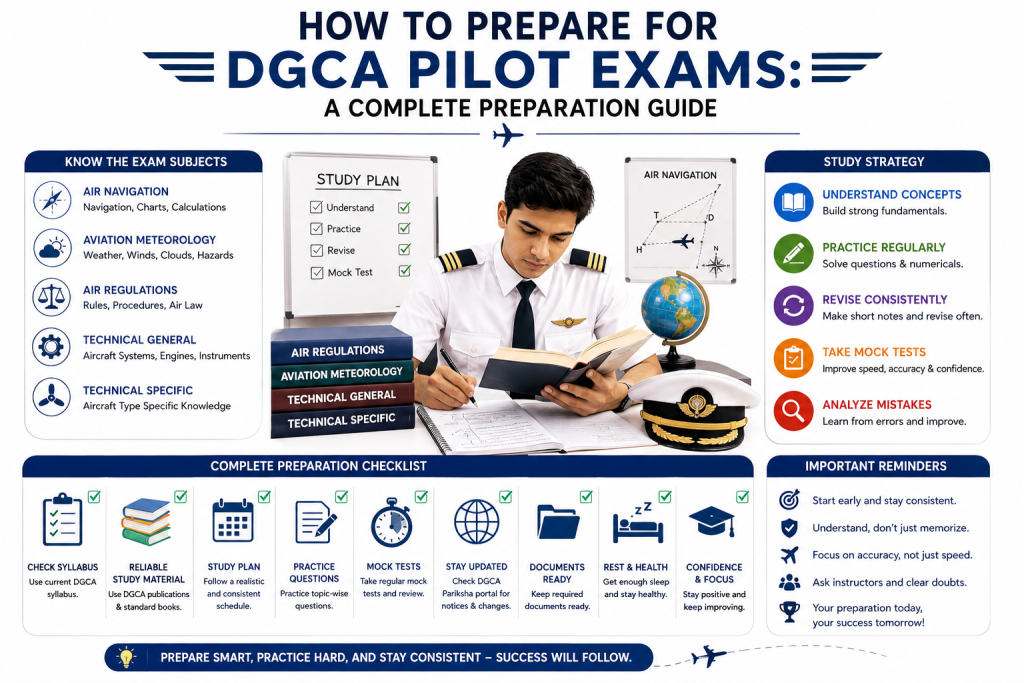
Students preparing for CPL-related examinations may need to study subjects such as:
- Air Navigation
- Aviation Meteorology
- Air Regulations
- Technical General
- Technical Specific
The exact subjects and applicable requirements can depend on the licence or examination category. Candidates should therefore verify the current syllabus through official DGCA resources before creating their final study plan.
Understanding the subjects at the beginning makes it easier to divide your preparation into manageable sections.
Understand the Exam Requirements
Before studying, take some time to understand the administrative side of the examination.
Candidates should check:
- Current eligibility requirements
- Applicable examination subjects
- Latest syllabus
- Registration process
- Examination calendar
- Applicable fees
- Required documents
- Admit-card instructions
- Examination centre information
- Latest DGCA notices
The official Pariksha portal should be treated as the primary source for current examination information.
This step is important because preparing for an examination without understanding the current requirements can create unnecessary problems later.
Create a DGCA Exam Study Plan
A structured study plan can make preparation much easier. Instead of trying to study every subject at once, divide your preparation into smaller stages.
Stage 1: Understand
Begin by reading the syllabus and identifying the topics covered under each subject. Focus on understanding the basic concepts before moving to difficult areas.
Stage 2: Practice
Once you understand a topic, solve relevant questions and numerical problems. Regular practice helps you identify areas where your understanding is still weak.
Stage 3: Revise
After completing the syllabus, spend sufficient time revising important concepts, formulas, regulations, and previously difficult topics.
A simple weekly schedule can include:
- New topic study
- Numerical practice
- Question practice
- Revision of previous topics
- Mock-test practice
- Mistake analysis
Choose a study schedule that you can follow consistently rather than creating an unrealistic timetable.
Study the Current Official Syllabus First
One of the first things you should do is check the current syllabus.
The DGCA Pariksha portal provides examination-related resources, including syllabus information. Use the syllabus as your preparation checklist and track your progress topic by topic.
You can divide topics into three categories:
- Topics not yet started
- Topics currently being studied
- Topics completed and ready for revision
This method helps you see your progress and prevents important topics from being forgotten.
Choose Reliable Study Materials
The quality of your study material can directly affect your preparation.
Useful resources may include:
- Official DGCA publications
- Current regulatory material
- Standard aviation textbooks
- Reliable training-school materials
- Aviation charts
- Technical references
- Legitimately available practice questions
- Mock-test resources
Avoid depending entirely on old notes or question banks. Aviation regulations and examination procedures may change, and older material may not always reflect current requirements.
Before using a study resource, compare it with the current syllabus and official information.
Build Strong Fundamentals
One of the biggest mistakes students make is trying to memorize everything without understanding the concepts.
Strong fundamentals make it easier to deal with questions that are presented differently from the examples you have already studied.
For example, while preparing for navigation, understand why a calculation works instead of memorizing only the final answer. Similarly, when studying meteorology, learn how atmospheric conditions develop and how they affect flight operations.
Conceptual understanding also helps connect theoretical knowledge with practical flight training.
How to Prepare for Air Navigation
Air Navigation can require both theoretical understanding and regular numerical practice.
Start with basic concepts before moving to more complicated calculations. Depending on the current syllabus, preparation may include navigation principles, charts, time calculations, position-related concepts, and other navigation topics.
A useful preparation method is:
- Understand the concept.
- Learn the relevant calculation method.
- Study a solved example.
- Solve a similar problem independently.
- Check your answer.
- Record mistakes.
- Practice the same concept again later.
Maintain a separate collection of important formulas and calculations. However, make sure you understand how and when each formula is used rather than memorizing formulas without context.
How to Prepare for Aviation Meteorology
Meteorology becomes easier when you connect theoretical concepts with real aviation situations.
Important areas may include:
- Atmosphere
- Temperature
- Pressure
- Wind
- Clouds
- Visibility
- Atmospheric stability
- Weather systems
- Thunderstorms
- Icing
- Turbulence
- Aviation weather reports and forecasts
Try to understand the relationship between different weather conditions instead of memorizing definitions separately.
For example, understanding how temperature, pressure, moisture, and atmospheric movement interact can make many meteorology concepts easier to remember.
How to Prepare for Air Regulations
Air Regulations requires careful study because aviation rules and procedures are subject to regulatory changes.
Use current official regulatory information and applicable Civil Aviation Requirements while preparing.
You can organize your notes into sections such as:
- Important rules
- Pilot responsibilities
- Operational requirements
- Definitions
- Procedures
- Airspace-related information
- Frequently revised information
Avoid depending entirely on old notes. Always verify important regulatory information against current official sources.
How to Prepare for Technical Subjects
Technical subjects require an understanding of aircraft systems, components, and operating principles.
Instead of memorizing individual components, try to understand how a complete system works.
For every system, ask yourself:
- What is its purpose?
- What are its main components?
- How does it operate?
- What happens if a component fails?
- What indications might the pilot observe?
For Technical Specific preparation, candidates should confirm the aircraft type and applicable requirements according to their current training and examination pathway.
Practice Questions Regularly
Question practice should be part of your preparation from the beginning.
After completing a topic, solve questions related to it. This allows you to identify knowledge gaps before moving too far ahead.
When you make a mistake, try to identify its cause.
For example:
- Did you misunderstand the concept?
- Did you forget a formula?
- Did you make a calculation error?
- Did you misunderstand the question?
- Was it simply a careless mistake?
Keeping a record of these mistakes can make revision much more effective.
Use Mock Tests and Timed Practice
Mock tests are useful once you have covered a reasonable portion of the syllabus.
They can help you improve:
- Time management
- Accuracy
- Concentration
- Question-solving speed
- Confidence
- Identification of weak areas
After completing a mock test, do not focus only on the score. Spend time reviewing incorrect and uncertain answers.
A lower score can still be useful if it helps you identify the areas that require more preparation.
Maintain a Regular Revision Strategy
Revision should not be postponed until the last few days.
A better approach is to revise continuously.
You can follow a simple routine:
- Review new material on the same day.
- Revisit important topics during the week.
- Review completed chapters periodically.
- Practice difficult calculations regularly.
- Revise mistakes from previous tests.
- Conduct full mock tests closer to the examination.
Short revision notes can be useful during the final preparation period.
However, avoid spending too much time making notes and too little time practicing questions.
Keep Track of DGCA Updates
Candidates should regularly check official DGCA information during their preparation.
The DGCA Pariksha portal provides examination-related information such as schedules, notices, syllabus resources, registration services, admit-card information, and results.
Examination dates, procedures, and other requirements may change. Therefore, information found in an old preparation guide or social media post should not be treated as the final authority.
Make checking official updates part of your preparation routine.
Common Mistakes to Avoid
1. Starting Without Checking the Syllabus
Studying without understanding the syllabus can result in an unbalanced preparation plan.
2. Depending Only on Memorization
Memorization may help with revision, but conceptual understanding is important for unfamiliar questions.
3. Using Outdated Study Material
Old regulatory information or examination instructions may no longer be applicable.
4. Ignoring Difficult Subjects
Avoiding difficult subjects can create major gaps in preparation. Give additional time to areas that require more practice.
5. Starting Question Practice Too Late
Regular practice is important for improving accuracy and speed. Do not wait until the final week.
6. Ignoring Mistakes
Simply checking your score is not enough. Review your mistakes and understand why they happened.
7. Ignoring Official DGCA Notices
Always verify examination-related information through official DGCA sources.
How to Stay Consistent During Preparation
DGCA exam preparation can become demanding, particularly when students are also attending ground classes or flight training.
Consistency is therefore important.
Some useful habits include:
- Follow a realistic daily study schedule.
- Break large chapters into smaller targets.
- Take regular short breaks.
- Keep distractions away while studying.
- Review difficult subjects regularly.
- Track your weekly progress.
- Get sufficient rest.
- Reserve time for revision.
- Avoid leaving the entire syllabus for the final weeks.
You do not necessarily need to study for extremely long hours every day. A consistent and focused routine is more sustainable.
Final Checklist Before the DGCA Exam
Before appearing for your examination, go through this checklist:
- Current syllabus checked
- Applicable subjects confirmed
- Important concepts revised
- Numerical topics practiced
- Difficult areas reviewed
- Mock tests completed
- Mistakes analyzed
- Examination schedule verified
- Examination centre details checked
- Admit card checked
- Required documents prepared
- Latest DGCA notices reviewed
- Adequate rest taken
This final check can help prevent avoidable last-minute problems.
Frequently Asked Questions
1. What are DGCA pilot exams?
DGCA conducts Flight Crew examinations as part of the regulatory framework for pilot licensing in India. The Central Examination Organisation is responsible for conducting these examinations under the applicable rules and procedures.
2. Where can I find current DGCA examination information?
Candidates can use the official DGCA Pariksha portal for current information relating to Flight Crew registration, examination schedules, syllabus, notices, admit cards, results, and other examination-related services.
3. Which subjects should CPL candidates prepare?
CPL-related examination subjects can include Air Navigation, Aviation Meteorology, Air Regulations, Technical General, and Technical Specific. Candidates should confirm the current syllabus and applicable subjects for their examination category before beginning preparation.
4. Can I prepare for DGCA exams by memorizing question banks?
Question banks can be useful for practice, but they should not replace conceptual learning. Understanding the subject helps you approach questions that may be worded differently from the examples you have practiced.
5. How should I prepare for Air Navigation?
Begin with the basic concepts and gradually move to numerical problems and more advanced topics. Practice regularly, maintain a record of mistakes, and revise calculations frequently.
6. How can I prepare for Aviation Meteorology?
Focus on understanding atmospheric conditions, weather systems, clouds, winds, visibility, weather hazards, and aviation weather information. Connecting concepts with practical flight situations can make the subject easier to understand.
7. How should I study Air Regulations?
Use current official regulatory material and applicable Civil Aviation Requirements. Organize your notes into logical sections and regularly check for updates to aviation regulations.
8. Are mock tests useful for DGCA exam preparation?
Yes. Mock tests can help improve time management, accuracy, concentration, and familiarity with examination-style questions. Reviewing your mistakes after each test is particularly important.
9. How can I avoid studying outdated DGCA information?
Use current official DGCA resources for the syllabus, examination calendar, notices, registration requirements, and other regulatory information. Do not rely exclusively on old notes or information shared through unofficial sources.
10. How early should I start preparing for DGCA pilot exams?
There is no single preparation timeline that works for every student. Your preparation time depends on your existing knowledge, the subjects involved, and your training schedule. Starting early gives you more time to understand difficult concepts, practice questions, and revise before the examination.
Conclusion
Preparing for DGCA pilot exams becomes easier when you follow a structured and consistent approach. Instead of relying on last-minute memorization, begin by understanding the current syllabus and examination requirements. Then divide your preparation into manageable subjects and build your knowledge step by step.
Give regular attention to Air Navigation, Aviation Meteorology, Air Regulations, and technical subjects applicable to your examination. Practice questions frequently, use mock tests to measure your progress, and keep a record of the areas where you make mistakes.
Most importantly, stay connected with official DGCA updates. Examination procedures, schedules, regulations, and requirements can change, so candidates should verify the latest information before applying or appearing for an examination.
With proper planning, regular revision, reliable study material, and consistent practice, aspiring pilots can approach their DGCA examinations in a more organized and confident way.

