
Introduction
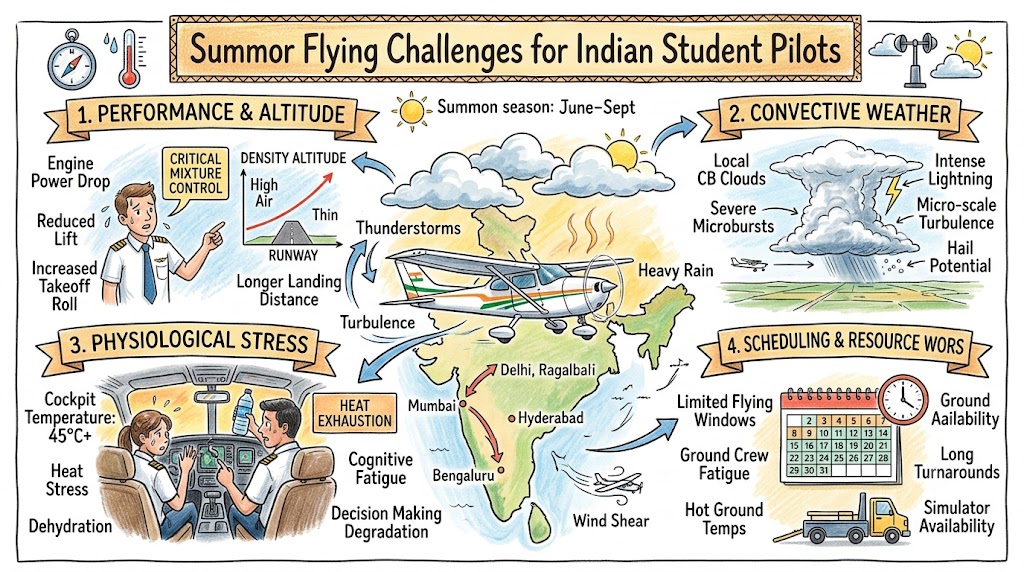
Summer flight training in India can be both productive and demanding. Longer daylight hours may create more opportunities for flying, but high temperatures, strong surface heating, turbulent air, reduced aircraft performance, dehydration, haze, dust, and rapidly developing thunderstorms can make training more challenging.
For student pilots, these conditions require more than good aircraft-handling skills. They demand careful preparation, accurate weather interpretation, disciplined decision-making, and close coordination with the flight instructor.
Summer flying is not automatically unsafe. However, the risks increase when a pilot ignores aircraft performance limitations, underestimates weather changes, or continues a flight despite physical discomfort or deteriorating conditions.
This guide explains the most important summer flying challenges faced by Indian student pilots and provides practical ways to manage them safely.
Understanding Indian Summer Flying Conditions
Summer weather conditions differ widely across India. A student flying in Rajasthan may face extreme heat, dust, and strong surface winds, while a trainee in coastal India may experience high humidity, haze, sea-breeze changes, and developing thunderstorms.
Pre-monsoon weather can also produce intense convective activity. The India Meteorological Department notes that high-frequency pre-monsoon thunderstorms commonly affect eastern and northeastern India, with significant activity also occurring over parts of peninsular India.
Student pilots must therefore avoid treating “summer weather” as one fixed condition. Every training area has its own local patterns involving terrain, wind, humidity, visibility, thunderstorms, and temperature.
The safest approach is to study the local weather behaviour around the flying school and review each day’s actual conditions before departure.
Major Summer Flying Challenges
| Summer challenge | Possible effect on training | Recommended student action |
|---|---|---|
| High temperature | Reduced aircraft performance | Complete performance calculations |
| High density altitude | Longer take-off and weaker climb | Check runway, weight and climb margins |
| Thermal turbulence | Difficulty maintaining altitude and attitude | Use smooth control inputs |
| Gusty surface winds | Challenging take-offs and landings | Follow instructor and aircraft limits |
| Thunderstorms | Wind shear, turbulence, lightning and hail | Delay, divert or cancel the flight |
| Hot cockpit | Fatigue and reduced concentration | Hydrate and limit heat exposure |
| Haze and dust | Reduced visibility and visual references | Review METAR, visibility and local reports |
| Engine overheating | Higher operating temperatures | Monitor engine indications closely |
High Temperature and Aircraft Performance
Hot air is less dense than cooler air. As air density decreases, the wings, propeller, and normally aspirated engine may become less effective.
This can lead to:
- Longer take-off distance
- Slower acceleration
- Reduced climb performance
- Lower engine power
- Reduced propeller efficiency
- Greater runway requirement
- Smaller obstacle-clearance margins
The FAA’s aircraft-performance guidance explains that air density is affected by altitude, temperature, and humidity, and that high density altitude represents thinner air that can reduce aircraft performance.
Student pilots should never assume that an aircraft will perform the same way on a hot afternoon as it did during a cool morning flight.
Density Altitude
Density altitude is one of the most important concepts in summer flying. It represents the altitude at which the aircraft feels it is operating based on the surrounding air density.
An aerodrome may be located at a moderate elevation, but high temperature can make the aircraft perform as though it were operating at a much higher altitude.
Why Density Altitude Matters
At high density altitude:
- The take-off roll may increase.
- The aircraft may climb slowly.
- Engine power may decrease.
- The propeller may produce less thrust.
- The wings may generate less lift at a given true airspeed.
- Obstacles may become more difficult to clear.
- A heavily loaded aircraft may have limited performance margins.
Before departure, students should calculate aircraft performance using the approved Pilot Operating Handbook or Aircraft Flight Manual.
Performance planning should include:
- Aerodrome elevation
- Outside air temperature
- Pressure setting
- Aircraft weight
- Runway length
- Runway surface
- Wind direction and speed
- Obstacles near the departure path
Calculations should not be treated as paperwork alone. They should influence the final go/no-go decision.
Longer Take-Off Distance
High temperatures can noticeably increase the runway distance required for take-off.
A student pilot may observe slower acceleration and may feel tempted to pull the aircraft into the air before it is ready. This can place the aircraft in a low-energy condition with limited climb capability.
Students should:
- Use the correct take-off technique.
- Maintain the recommended rotation speed.
- Avoid forcing the aircraft off the runway.
- Confirm that the aircraft is accelerating normally.
- Follow the school’s rejected-take-off policy.
- Identify a decision point before beginning the take-off roll.
- Allow an adequate safety margin beyond calculated performance.
Any unusual acceleration, engine indication, or directional-control issue should be treated seriously.
Reduced Climb Performance
The aircraft may become airborne but climb less effectively in hot conditions.
Reduced climb performance becomes especially important when operating near:
- Trees
- Buildings
- Power lines
- Hills
- Rising terrain
- Restricted airspace boundaries
- Short runways
Students should not focus only on whether the aircraft can take off. They must also determine whether it can climb safely after take-off.
A practical summer departure briefing should include:
- Expected climb rate
- Initial climb speed
- Obstacle location
- Emergency landing options
- Engine-failure plan
- Turn-back limitations
- Actions if the expected climb is not achieved
Thermal Turbulence
Strong sunlight heats the ground unevenly. Different surfaces then heat the air above them at different rates.
Dry fields, roads, rocky areas, buildings, and open land may generate rising columns of warm air. These updrafts can be surrounded by descending air, producing bumps and sudden vertical movement.
Thermal turbulence is often stronger during the hotter part of the day. FAA flight-training guidance notes that thermal turbulence and wind gusts can significantly affect aircraft control and flight performance.
How Thermal Turbulence Affects Students
Thermal activity may make it difficult to:
- Maintain altitude
- Hold a constant attitude
- Maintain heading
- Fly accurate circuits
- Control airspeed
- Perform steep turns
- Maintain a stable approach
A common beginner mistake is to chase every small movement with large control inputs. This usually increases workload and makes the aircraft less stable.
Students should use smooth corrections, maintain the correct attitude, and accept small temporary deviations when conditions are turbulent.
Gusty Winds and Crosswind Conditions
Summer heating can contribute to gusty and variable surface winds. Local terrain, sea breezes, dust storms, thunderstorms, and strong convective activity may cause rapid changes in wind speed or direction.
These conditions can challenge student pilots during:
- Taxiing
- Take-off
- Circuit flying
- Final approach
- Flare
- Landing rollout
A student must know the demonstrated crosswind information for the aircraft and comply with the stricter operating limits established by the flying school or instructor.
Practical Crosswind Preparation
Before entering the aircraft:
- Check the latest wind report.
- Compare the wind with runway direction.
- Estimate the crosswind component.
- Review the correct control positions while taxiing.
- Discuss the go-around decision.
- Confirm the school’s solo wind limit.
- Identify expected gust corrections with the instructor.
A go-around is a normal safety decision, not a failed landing.
Pre-Monsoon Thunderstorms
Thunderstorms are among the most serious summer weather hazards.
They may produce:
- Severe turbulence
- Lightning
- Heavy rain
- Hail
- Strong downdrafts
- Microbursts
- Gust fronts
- Wind shear
- Rapid visibility reduction
- Sudden wind-direction changes
IMD aviation procedures identify cumulonimbus clouds, thunderstorms, turbulence, wind shear, hail, line squalls, dust storms, and rapidly changing winds as operationally significant weather conditions. IMD also issues aerodrome, light-aircraft, and wind-shear warnings for relevant hazards.
Student pilots should never attempt to fly beneath a thunderstorm or pass close to a developing cumulonimbus cloud. Dangerous turbulence and wind shear can extend beyond the visible rain area.
Signs of Developing Convective Weather
Students should watch for:
- Rapidly growing cumulus clouds
- Darkening cloud bases
- Towering vertical development
- Lightning
- Distant thunder
- Sudden wind shifts
- Blowing dust
- Falling temperature
- Increasing gusts
- Heavy rain curtains
When convective activity is building, delaying or cancelling the flight is often the best decision.
Wind Shear and Microbursts
Wind shear is a rapid change in wind speed, direction, or both. It is especially hazardous during take-off and landing because the aircraft is close to the ground and has limited time to recover.
IMD identifies thunderstorms, microbursts, gust fronts, strong surface winds, sea-breeze fronts, mountain waves, and low-level temperature inversions as conditions commonly associated with wind shear.
Students must treat wind-shear alerts seriously. They should never continue an approach simply because another aircraft has landed successfully.
The correct response depends on the aircraft, phase of flight, school procedure, instructor direction, and published operating guidance.
Haze, Dust and Reduced Visibility
Summer conditions can create haze, dust, smoke, or suspended particles that reduce visibility.
Reduced visibility can make it harder to:
- Identify the runway
- Maintain visual navigation
- See nearby traffic
- Recognize landmarks
- Judge distance from terrain
- Maintain orientation in unfamiliar areas
A student pilot should not rely only on how the weather looks from the ground. Visibility may be acceptable near the aerodrome but poor along the planned route.
Before departure, review:
- METAR and SPECI
- TAF
- Local or area forecast
- Relevant weather warnings
- SIGMET information
- Radar and satellite imagery when available
- Reports from instructors and recently returned crews
IMD’s aviation meteorological services provide information intended for pre-flight planning, including aerodrome reports, forecasts, significant-weather information, warnings, and route-related briefings.
Dehydration and Heat Stress
A hot cockpit can affect pilot performance before the aircraft even begins taxiing.
Dehydration may cause:
- Headache
- Fatigue
- Dizziness
- Sleepiness
- Muscle cramps
- Irritability
- Reduced concentration
- Slower decision-making
FAA aeromedical guidance identifies hot cockpits, flight lines, humidity, activity, and altitude as factors that can contribute to dehydration.
Hydration Tips for Student Pilots
- Drink water before reaching the aerodrome.
- Carry suitable drinking water where permitted.
- Avoid starting the flight already thirsty.
- Limit excessive caffeine before flying.
- Eat a light and balanced meal.
- Wear comfortable clothing suitable for cockpit conditions.
- Report dizziness, nausea, weakness, or headache immediately.
- Do not hide physical discomfort to avoid losing a flight slot.
Being medically fit at the beginning of a flight does not guarantee that the pilot will remain comfortable and alert throughout a long training session.
Hot Cockpit and Ground Delays
Small training aircraft may become extremely uncomfortable when parked in direct sunlight.
Heat exposure may increase during:
- External inspection
- Fuel checks
- Waiting for clearance
- Extended taxiing
- Holding on the ground
- Repeated circuit operations
Complete the pre-flight inspection carefully, but avoid unnecessary time inside a closed cockpit before engine start.
Where school procedures permit, students can prepare charts, checklists, navigation logs, and briefing notes in a cooler area before entering the aircraft.
However, efforts to reduce heat exposure must never lead to a rushed inspection.
Engine Temperature Management
High outside air temperature can make engine cooling more difficult, particularly during prolonged ground operations and repeated low-speed training exercises.
Students should monitor:
- Oil temperature
- Oil pressure
- Cylinder-head temperature, when available
- Fuel pressure
- Engine sound
- Engine response
- Other aircraft-specific indications
Avoid unnecessary high-power operation while stationary. Follow the approved checklist and instructor guidance for leaning, cooling, taxi power, climb configuration, and abnormal indications.
Never continue simply because the reading is “only slightly higher than normal.” Investigate unexpected changes before they become serious.
Weight and Balance in Hot Weather
A heavily loaded aircraft may perform poorly in high temperatures even when it remains within the legal maximum take-off weight.
Student pilots should understand that legal weight does not always guarantee adequate operational performance.
During summer planning, consider:
- Fuel load
- Instructor and student weight
- Baggage
- Survival or training equipment
- Runway length
- Aerodrome elevation
- Temperature
- Required climb performance
Reducing unnecessary weight may improve performance, but fuel must never be reduced below safe operational requirements.
Choosing the Best Time for Training
Early-morning flights often provide cooler temperatures, smoother air, and improved aircraft performance compared with hot afternoon periods.
Morning training may be especially useful for:
- First solo preparation
- Circuit consolidation
- Navigation exercises
- Steep turns
- Stall exercises
- Precision approaches
- Performance-limited operations
However, mornings can present other hazards, including mist, low visibility, low cloud, calm-wind runway changes, and wet surfaces.
The best training time is determined by the complete weather picture, not temperature alone.
Summer Pre-Flight Checklist
Before every summer flight, confirm the following:
Weather
- Latest METAR, SPECI and TAF checked
- Thunderstorm and wind-shear warnings reviewed
- Visibility and haze assessed
- Surface wind and gusts checked
- Route weather examined
- Alternate plan discussed
Aircraft Performance
- Density altitude considered
- Take-off distance calculated
- Landing distance calculated
- Climb performance checked
- Weight and balance completed
- Obstacle clearance reviewed
Pilot Readiness
- Adequately hydrated
- Properly rested
- Suitable meal taken
- No heat-related symptoms
- Required documents available
- Personal limits reviewed
Operational Planning
- Instructor briefing completed
- Go/no-go criteria clear
- Go-around plan discussed
- Emergency actions reviewed
- Fuel requirement confirmed
- Training objectives adjusted to conditions
Common Mistakes Made by Student Pilots
Ignoring Density Altitude
Students may complete the usual checklist without evaluating how temperature affects take-off and climb performance.
Rushing the Pre-Flight Inspection
Heat discomfort can encourage a student to skip or shorten inspection items. This creates a much greater risk than the heat itself.
Overcontrolling in Turbulence
Large and rapid control movements increase workload and may destabilize the aircraft.
Continuing Toward Developing Storms
A student may assume that the storm is still far away or that the flight can be completed before it arrives. Convective conditions can change quickly.
Flying While Dehydrated
Some trainees avoid drinking water because they do not want to interrupt the training schedule. This can reduce alertness and judgement.
Focusing Only on Legal Limits
Weather may be technically within published limits but still unsuitable for the student’s current ability.
Avoiding a Go-Around
Trying to save an unstable landing is far more dangerous than beginning another circuit.
Role of the Flight Instructor
Flight instructors play an essential role in teaching students how to manage summer conditions.
An effective summer briefing should cover:
- Expected temperature
- Density altitude
- Aircraft performance
- Wind and crosswind component
- Turbulence
- Thunderstorm development
- Visibility
- Personal limitations
- Go-around criteria
- Flight cancellation criteria
Students should actively participate in the briefing rather than waiting for the instructor to make every decision.
The objective of training is not only to learn how to control the aircraft. It is also to develop the judgement required to decide when not to fly.
Key Takeaways
- High temperatures can reduce aircraft take-off and climb performance.
- Density altitude must be included in summer flight planning.
- Thermal turbulence requires smooth and controlled inputs.
- Thunderstorms, wind shear, gust fronts, and microbursts demand conservative decisions.
- Haze and dust may reduce visual references and traffic awareness.
- Dehydration can reduce concentration and judgement.
- Early-morning flying may provide better conditions, but complete weather checks remain necessary.
- Students must follow the aircraft manual, flying-school procedures, instructor guidance, and current official weather information.
Frequently Asked Questions
Is summer a suitable season for student pilot training in India?
Yes. Training can continue safely when weather, aircraft performance, pilot fitness, and operational limitations are properly evaluated.
Why does an aircraft climb slowly in hot weather?
Hot air is less dense. This reduces engine, propeller, and aerodynamic performance, which may lower the aircraft’s climb capability.
What is density altitude?
Density altitude is pressure altitude corrected for non-standard temperature. It helps pilots understand how the aircraft is likely to perform in the existing atmospheric conditions.
Are early-morning flights always safer in summer?
They often offer cooler and smoother conditions, but fog, mist, low visibility, low cloud, or wet runways may still create hazards.
Can student pilots fly near thunderstorms?
Student pilots should avoid thunderstorms and follow instructor, school, and official weather guidance. Flying under or close to thunderstorms can expose the aircraft to severe turbulence and wind shear.
How can pilots reduce dehydration during training?
Students should hydrate before flying, carry water where permitted, avoid excessive caffeine, and report symptoms such as headache, dizziness, or unusual fatigue.
Why is thermal turbulence stronger in the afternoon?
Strong daytime heating causes rising columns of warm air. Uneven heating creates updrafts and downdrafts that can produce turbulent conditions.
Should a student continue if the wind is within the aircraft limit?
Not automatically. Flying-school limits, instructor guidance, runway conditions, gusts, student experience, and personal limitations must also be considered.
What should a student do during an unstable approach?
Follow the established go-around procedure. A go-around is the correct response when a safe, stable landing is no longer assured.
Where should Indian student pilots obtain weather information?
Students should use approved flight-planning and meteorological information supplied through their flying school, instructor, aviation meteorological office, and official IMD aviation services.
Conclusion
Summer flying helps Indian student pilots develop valuable weather awareness, performance-planning skills, and aeronautical decision-making. High temperature, density altitude, turbulence, thunderstorms, reduced visibility, and dehydration must never be underestimated. Careful preparation, conservative decisions, proper hydration, and close coordination with the instructor can make summer training both safe and productive.

