
Introduction
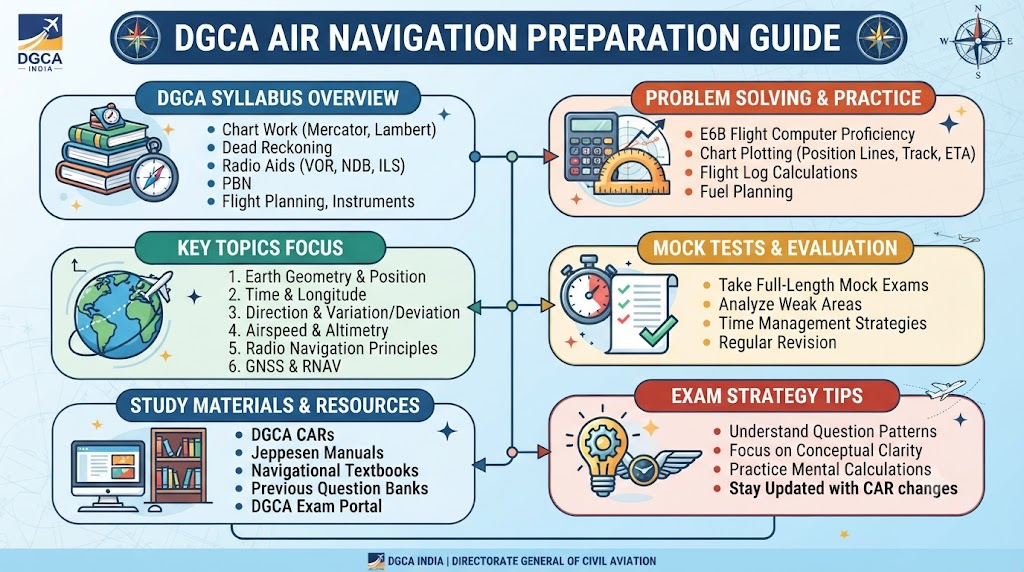
Preparing for the DGCA Air Navigation examination requires a strong understanding of navigation concepts, calculations, charts, and practical flight-planning techniques.
For aspiring commercial pilots in India, Air Navigation is an important part of building professional aviation knowledge.
A structured study plan can help students improve both their accuracy and confidence while solving navigation problems.
This guide explains the major topics, preparation methods, common mistakes, and practical strategies for effective DGCA Air Navigation preparation.
What Is DGCA Air Navigation?
Air Navigation is the study of determining an aircraft’s position, direction, distance, and intended route during flight. It combines theoretical knowledge with calculations and practical interpretation of navigation information.
For pilot students, navigation knowledge is important because pilots need to understand how an aircraft moves from one location to another while considering factors such as:
- Direction and bearings
- Distance
- Speed
- Time
- Wind
- Track and heading
- Drift
- Magnetic variation
- Navigation charts
- Navigation instruments
DGCA Air Navigation preparation should therefore focus on understanding concepts and applying them, rather than simply memorizing formulas.
Major Topics to Cover for DGCA Air Navigation
Students should divide the syllabus into manageable sections and study each topic systematically.
| Air Navigation Topic | Key Areas to Focus On |
|---|---|
| Basic Navigation | Latitude, longitude, coordinates, directions and positions |
| Time | UTC, local time, time conversion and calculations |
| Distance and Speed | Nautical miles, knots, speed-time-distance relationships |
| Bearings | True, magnetic and relative bearings |
| Wind | Wind velocity, wind triangle, drift and wind correction |
| Dead Reckoning | Position estimation using heading, speed, time and wind |
| Magnetic Compass | Variation, deviation, compass errors and headings |
| Charts | Chart symbols, scale, plotting and route measurement |
| Radio Navigation | Basic principles and interpretation of navigation aids |
| Flight Planning | Route, distance, time, fuel-related calculations and navigation data |
Understand Navigation Fundamentals First
Before moving to complicated numerical problems, students should understand the basic terminology used in Air Navigation.
Latitude and Longitude
Latitude identifies a position north or south of the Equator, while longitude identifies a position east or west of the Prime Meridian.
Understanding coordinates is essential because navigation calculations frequently require students to determine or interpret an aircraft’s position.
True, Magnetic, and Compass Directions
Students should understand the relationship between true direction, magnetic direction, and compass direction.
A mistake in distinguishing these references can affect an entire navigation calculation. Therefore, students should practice converting between different directional references until the process becomes familiar.
Distance, Speed, and Time
The relationship between distance, speed, and time is fundamental to navigation.
Students should be comfortable rearranging formulas and working with aviation units such as:
- Nautical miles
- Knots
- Hours
- Minutes
- Seconds
Accuracy in unit conversion is particularly important in calculation-based questions.
Master Time and UTC Calculations
Time calculations are an important part of navigation preparation.
Students should understand:
- UTC
- Local time
- Time differences
- Conversion between hours and minutes
- Flight time calculations
- Estimated time of arrival
- Time zones
A small error in time conversion can affect subsequent calculations. Practice different time-conversion examples regularly instead of relying only on memorized procedures.
Learn Bearings and Direction Calculations
Bearings indicate direction from one point to another. Students should become comfortable working with different types of bearings and understand how they relate to aircraft heading and navigation references.
While studying bearings, pay attention to:
- True bearing
- Magnetic bearing
- Relative bearing
- Reciprocal direction
- Heading versus track
- Angular differences
Drawing a simple diagram before solving a complicated question can make the relationship between these values much easier to understand.
Understand Wind Triangle and Wind Correction
Wind is one of the most important practical concepts in Air Navigation.
An aircraft’s movement over the ground can differ from its movement through the air because of wind. Students therefore need to understand how wind affects:
- Ground track
- Groundspeed
- Heading
- Drift
- Wind correction angle
Wind Triangle
The wind triangle helps determine the relationship between aircraft heading, aircraft airspeed, wind direction and speed, and the resulting ground track.
Students should practice both conceptual and numerical problems. Do not attempt to memorize a single procedure for every question because different problem formats may require different approaches.
Drift and Wind Correction
Drift occurs when crosswind causes an aircraft’s actual track to differ from its intended track.
Students should understand the difference between:
- Heading
- Track
- Drift angle
- Wind correction angle
This distinction becomes much easier once students solve several diagrams and numerical examples.
Study Dead Reckoning Carefully
Dead reckoning involves estimating an aircraft’s position using known information such as:
- Starting position
- Heading
- Airspeed
- Time
- Wind
- Estimated movement
Students should practice identifying what information is provided and what information needs to be calculated.
A good approach is to write the known values first, identify the required value, select the appropriate method, and then check whether the answer is reasonable.
Learn Magnetic Compass Concepts
Magnetic compass questions can involve several related concepts. Students should understand the differences among:
- True north
- Magnetic north
- Compass north
- Variation
- Deviation
- Compass errors
Rather than memorizing isolated rules, understand the relationship between these references. This makes it easier to solve unfamiliar questions.
Practice Charts and Plotting
Navigation charts are an important practical component of aviation navigation.
Students should learn how to interpret:
- Chart scale
- Coordinates
- Direction
- Distances
- Symbols
- Routes
- Reference points
Regular plotting practice can improve speed and reduce errors during calculations.
Understand Basic Radio Navigation
Students should also develop a basic understanding of radio navigation principles and the information provided by navigation aids.
Depending on the applicable DGCA syllabus and current examination requirements, students may encounter concepts involving navigation systems, bearings, positions, and related instruments.
The exact regulatory syllabus and examination requirements should always be checked against the latest applicable DGCA information before beginning preparation.
How to Prepare for DGCA Air Navigation Step by Step
1. Understand the Syllabus
Start by identifying the topics that are relevant to your current DGCA examination requirements. Divide the syllabus into theory, calculations, charts, and practical navigation concepts.
2. Build Your Fundamentals
Do not immediately begin with difficult numerical problems. First understand basic concepts such as direction, coordinates, time, speed, distance, heading, and track.
3. Create a Formula Sheet
Maintain a personal revision sheet containing important formulas and conversions.
However, use the formula sheet for revision rather than depending on it without understanding what each formula represents.
4. Practice Numerical Questions
Navigation requires calculation skills. Solve numerical questions regularly and write each step clearly.
After solving a question, check:
- Units
- Formula selection
- Arithmetic
- Direction
- Sign or angular interpretation
- Final answer
5. Practice Charts
Set aside regular time for chart interpretation and plotting. This can help improve both understanding and speed.
6. Solve Previous-Style Questions
Practice questions that resemble the type and difficulty of the examination. This helps students identify weak areas and become familiar with calculation patterns.
7. Take Timed Mock Tests
Once the fundamentals are strong, start solving complete practice sets under time limits.
Record the questions you get wrong and identify why the mistake occurred.
8. Revise Weak Areas
Do not spend all your revision time studying topics you already understand. Use practice-test results to identify weaker areas and focus additional effort there.
Practical Study Strategy
A consistent study routine is usually more useful than attempting to complete everything at the last minute.
| Preparation Stage | Suggested Focus | Main Objective |
|---|---|---|
| Stage 1 | Navigation fundamentals and terminology | Build conceptual understanding |
| Stage 2 | Time, distance, speed, bearings and coordinates | Improve basic calculations |
| Stage 3 | Wind triangle, drift and dead reckoning | Develop applied navigation skills |
| Stage 4 | Compass, charts and radio navigation | Strengthen technical knowledge |
| Stage 5 | Practice questions and numerical problems | Improve accuracy |
| Stage 6 | Mock examinations | Improve speed and time management |
| Stage 7 | Final revision | Correct weak areas and reinforce formulas |
How to Improve Calculation Speed and Accuracy
Speed should come after understanding.
To improve your performance:
- Practice calculations regularly.
- Keep your working organized.
- Write down units at each important stage.
- Avoid rushing through the question.
- Learn to identify unnecessary information.
- Recheck calculations when the result appears unrealistic.
- Practice converting minutes and hours accurately.
- Use diagrams when they clarify direction or wind relationships.
- Maintain a record of recurring mistakes.
With regular practice, many calculations that initially appear complicated become easier to recognize.
Common Mistakes in DGCA Air Navigation Preparation
Memorizing Without Understanding
Memorizing formulas without knowing when or why they are used can create problems when a question is presented differently.
Ignoring Units
Mixing hours with minutes or nautical miles with another distance unit can produce incorrect results.
Confusing Heading and Track
Heading describes the direction the aircraft is pointing, while track describes the aircraft’s actual path over the ground. Confusing these concepts can lead to errors in wind-related questions.
Neglecting Chart Practice
Reading theory alone may not provide enough practical confidence for chart-related problems.
Spending Too Much Time on One Question
During an examination, getting stuck on one difficult calculation can reduce the time available for other questions.
Not Reviewing Incorrect Answers
Simply completing practice tests is not enough. Students should understand why an answer was wrong and how to prevent the same mistake.
Important Considerations Before the Examination
Before appearing for the examination, students should make sure they are comfortable with:
- Basic navigation terminology
- Important formulas
- Unit conversions
- UTC and time calculations
- Bearings and directions
- Wind calculations
- Dead reckoning
- Compass concepts
- Chart interpretation
- Numerical problem solving
- Time management
Students should also verify the latest DGCA examination syllabus, applicable rules, permitted materials, and examination instructions rather than relying on outdated study material.
Benefits and Limitations of Structured Preparation
A structured preparation method can provide several benefits:
- Better understanding of navigation concepts
- Improved calculation accuracy
- Greater confidence
- More effective revision
- Better time management
- Easier identification of weak topics
However, structured preparation has limitations if it becomes purely mechanical. Students should not rely exclusively on memorized formulas, answer patterns, or old questions. Aviation navigation requires conceptual understanding, and students should be prepared to apply their knowledge to unfamiliar problems.
Frequently Asked Questions
1. Is DGCA Air Navigation difficult?
The difficulty depends on the student’s understanding of navigation concepts and ability to perform calculations. Regular practice can make the subject considerably more manageable.
2. What should I study first for Air Navigation?
Start with basic navigation concepts, coordinates, direction, distance, speed, and time. Once these fundamentals are clear, move toward wind, dead reckoning, charts, and more advanced calculations.
3. Are numerical questions important for Air Navigation preparation?
Yes. Students should regularly practice numerical problems because navigation involves applying theoretical concepts to calculations.
4. How can I improve my Air Navigation calculation speed?
Practice regularly under time limits, maintain organized working, learn common calculation methods, and review mistakes after each practice session.
5. Should I memorize navigation formulas?
You should know important formulas, but understanding what they represent and when to use them is more valuable than memorization alone.
6. Why is wind calculation important in Air Navigation?
Wind can affect an aircraft’s track, groundspeed, and required heading. Understanding wind correction is therefore an important part of navigation knowledge.
7. Should I practice navigation charts?
Yes. Chart practice can help develop familiarity with coordinates, scale, distances, directions, and route-related information.
8. How can I prepare for time-related navigation questions?
Practice UTC, local-time, time-zone, duration, and estimated-arrival calculations while carefully checking units and conversions.
9. What is the biggest mistake students make in Air Navigation?
One common mistake is focusing on memorizing procedures without understanding the underlying concepts. Confusing heading, track, bearing, and wind correction can also cause calculation errors.
10. How should I revise before the DGCA Air Navigation examination?
Review important concepts and formulas, solve timed practice questions, revisit incorrect answers, and focus on weaker topics instead of repeatedly studying only familiar areas.
Conclusion
Effective DGCA Air Navigation preparation requires a combination of conceptual understanding, calculation practice, chart work, and regular revision. Students should gradually progress from basic navigation principles to wind calculations, dead reckoning, compass concepts, charts, and examination-style questions.
Rather than depending entirely on memorization, focus on understanding how navigation principles work and how they are applied to practical problems. A consistent preparation routine, careful calculation habits, and regular mock-test practice can help aspiring pilots approach the examination with greater confidence and accuracy.

