
Introduction
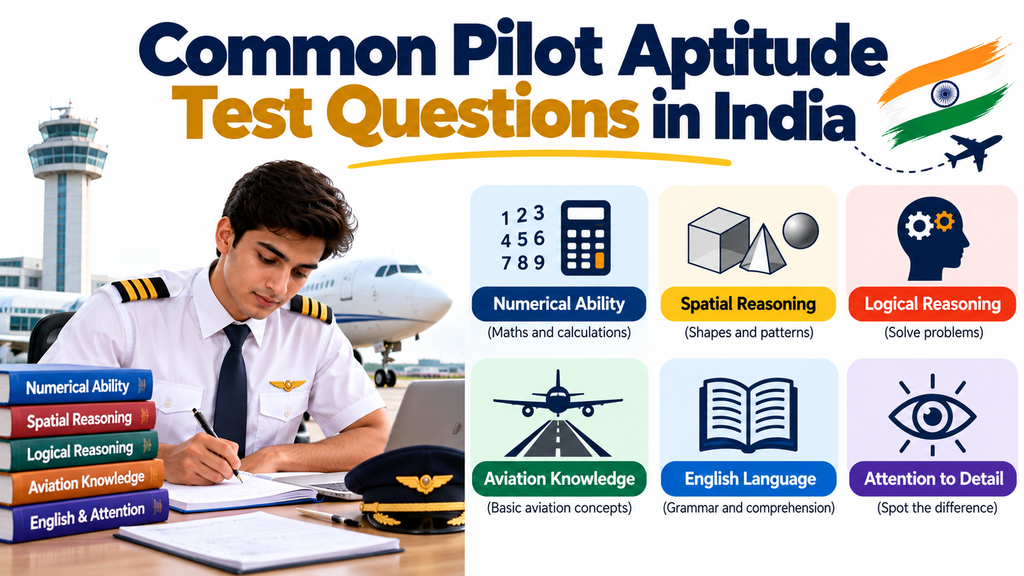
Becoming a pilot requires more than good marks and a passion for flying. Aspiring pilots also need clear thinking, good concentration, and sound decision-making skills. These abilities help pilots understand information and respond to changing situations. Pilot aptitude tests may assess these skills during flight school admission or airline selection. They can include numerical reasoning, logical patterns, spatial awareness, memory, and attention. Some assessments may also check coordination and the ability to manage several tasks. However, every airline and flying school may follow a different selection process. The questions, time limits, and assessment methods can vary between programmes. Therefore, candidates should understand their test format before beginning preparation. This guide explains common pilot aptitude test questions in India, with sample answers and simple explanations. It also covers preparation methods, common mistakes, and important points for aspiring pilots.
What Is a Pilot Aptitude Test?
A pilot aptitude test assesses abilities that may help a person learn and perform flying tasks. It often focuses on how candidates think, process information, and solve problems.
Unlike a school examination, an aptitude test may measure reasoning and practical thinking. Some assessments use timed questions. Others use computer-based exercises to assess coordination, memory, or attention.
In India, aptitude tests may form part of flying school admission, cadet pilot selection, or airline recruitment. For example, the Indira Gandhi Rashtriya Uran Akademi (IGRUA) has included a pilot aptitude test in its published selection process. Other organisations may follow different procedures.
It is important to understand that there is no single aptitude test for every aspiring pilot in India. The test depends on the organisation and the type of selection process.
Aptitude tests are also different from the Directorate General of Civil Aviation (DGCA) flight crew licensing examinations. These examinations assess the knowledge required for the relevant licensing pathway. Passing an aptitude test does not automatically provide a pilot licence or guarantee admission.
Common Skills Tested in Pilot Aptitude Assessments
Pilot aptitude assessments can cover several skills. The exact subjects depend on the test provider and the programme.
| Aptitude area | What it checks | Practice example |
|---|---|---|
| Numerical reasoning | Basic calculations and number relationships | Calculate distance using speed and time |
| Logical reasoning | Patterns and relationships | Find the next number in a sequence |
| Spatial awareness | Position, direction, and rotation | Track a direction after a turn |
| Memory | Ability to recall information | Remember a sequence of numbers |
| Concentration | Attention to small details | Find differences between two codes |
| Coordination | Visual and motor responses | Follow a moving target on a screen |
| Mechanical reasoning | Basic physical principles | Understand how connected gears rotate |
| Situational judgement | Practical thinking and choices | Choose a sensible response to a situation |
These are common examples of skills that an assessment may measure. They are not a fixed list of sections used by every organisation.
Numerical Reasoning
Numerical reasoning tests how well you work with numbers. Questions may involve percentages, ratios, simple calculations, or number sequences.
Some questions may use speed, distance, and time. You should understand the basic formulas and use the correct units.
Logical Reasoning
Logical reasoning measures your ability to recognise patterns and relationships. You may need to find a missing number, identify a different shape, or complete a sequence.
Look for a clear rule before selecting an answer. Do not guess based only on the appearance of the options.
Spatial Awareness
Spatial awareness means understanding the position and movement of objects. Questions may involve directions, shapes, rotations, or visual patterns.
For example, a question may ask which direction an arrow points after a turn. These exercises help you practise visualising movement and orientation.
Memory and Concentration
Memory tasks may ask you to recall numbers, letters, symbols, or instructions. Concentration tasks may require you to identify small differences between similar items.
Read carefully and avoid rushing. A small error can change an otherwise correct answer.
Coordination and Multitasking
Some assessments use computer-based exercises to evaluate coordination, reaction, or the ability to manage several tasks. The methods vary by assessment provider.
Basic home exercises can help you become familiar with following instructions. However, they cannot fully reproduce a professional aviation assessment.
Common Pilot Aptitude Test Questions with Answers
The following 15 questions are original practice examples. They help explain common reasoning methods and are not official or leaked questions from DGCA, IGRUA, or any airline.
Numerical Reasoning Questions
Question 1: Find the next number.
3, 6, 9, 12, __?
- A. 13
- B. 14
- C. 15
- D. 18
Correct answer: C. 15
Explanation: Each number increases by three. Add three to 12 to get 15.
Question 2: Calculate the distance.
An aircraft travels at a constant speed of 180 kilometres per hour for two hours. How far does it travel?
- A. 180 km
- B. 270 km
- C. 360 km
- D. 400 km
Correct answer: C. 360 km
Explanation:
Distance = Speed × Time
Distance = 180 × 2 = 360 km.
Question 3: Calculate the percentage.
A candidate answers 36 questions correctly out of 45. What percentage is correct?
- A. 70%
- B. 75%
- C. 80%
- D. 85%
Correct answer: C. 80%
Explanation:
Percentage = (Correct answers ÷ Total questions) × 100
Percentage = (36 ÷ 45) × 100 = 80%.
Question 4: Complete the number sequence.
2, 6, 18, 54, __?
- A. 108
- B. 126
- C. 162
- D. 216
Correct answer: C. 162
Explanation: Each number is multiplied by three. Therefore, 54 × 3 = 162.
Logical Reasoning Questions
Question 5: Find the next letter.
A, C, E, G, __?
- A. H
- B. I
- C. J
- D. K
Correct answer: B. I
Explanation: The sequence skips one letter each time. After G comes I.
Question 6: Identify the item that does not belong.
- A. Triangle
- B. Square
- C. Circle
- D. Rectangle
Correct answer: C. Circle
Explanation: The other shapes have straight sides and corners. A circle has no straight sides or corners.
Question 7: Complete the number pattern.
5, 10, 20, 40, __?
- A. 45
- B. 60
- C. 70
- D. 80
Correct answer: D. 80
Explanation: Each number doubles. Multiply 40 by two to get 80.
Spatial Awareness Questions
Question 8: Follow the directions.
A person faces north. They turn right twice. Which direction are they facing now?
- A. North
- B. South
- C. East
- D. West
Correct answer: B. South
Explanation: The first right turn points east. The second right turn points south.
Question 9: Understand a rotation.
An arrow points east. It rotates 90 degrees anticlockwise. Which direction does it point now?
- A. North
- B. South
- C. East
- D. West
Correct answer: A. North
Explanation: A 90-degree anticlockwise turn from east points north.
Memory and Attention Questions
Question 10: Remember the sequence.
Read this sequence once: 4 – 8 – 2 – 7 – 5.
Which number appears fourth?
- A. 2
- B. 5
- C. 7
- D. 8
Correct answer: C. 7
Explanation: The fourth number is 7. For practice, hide the sequence before answering.
Question 11: Find the matching code.
Reference code: AB4729.
Which option matches it exactly?
- A. AB4729
- B. AB4279
- C. BA4729
- D. AB4728
Correct answer: A. AB4729
Explanation: Only option A matches every letter and number in the correct order.
Mechanical Reasoning Question
Question 12: Understand connected gears.
Two external gears touch each other. If the first gear rotates clockwise, which way does the second gear rotate?
- A. Clockwise
- B. Anticlockwise
- C. It does not move
- D. It changes direction randomly
Correct answer: B. Anticlockwise
Explanation: Two directly connected external gears rotate in opposite directions.
Situational Judgement Questions
Question 13: Respond to an unclear instruction.
During a training exercise, you do not understand an instruction. What is the most sensible response?
- A. Guess what it means
- B. Ignore the instruction
- C. Ask for clarification when appropriate
- D. Copy another person’s actions without checking
Best practice answer: C. Ask for clarification when appropriate.
Explanation: Clear communication helps prevent misunderstandings. In real aviation, the correct response depends on the situation and applicable procedures.
Question 14: Manage an error.
You notice an error during a timed practice task. What should you do?
- A. Panic and restart everything
- B. Follow the instructions and correct the error if permitted
- C. Ignore the remaining instructions
- D. Stop paying attention
Best practice answer: B. Follow the instructions and correct the error if permitted.
Explanation: Staying calm helps you think clearly. Always follow the assessment rules.
Question 15: Respond to changing information.
You are following a route on a practice screen. A new instruction changes the required direction. What should you do?
- A. Continue following the old direction
- B. Read and follow the new instruction
- C. Choose a direction randomly
- D. Stop reading the instructions
Best practice answer: B. Read and follow the new instruction.
Explanation: The exercise tests your ability to notice and respond to changing information. In an actual assessment, follow the stated rules.
Numerical Reasoning Questions for Aspiring Pilots
Numerical reasoning becomes easier when you understand the formulas. Start with simple examples and increase the difficulty gradually.
Speed, Distance, and Time
The main relationship is:
Distance = Speed × Time
You can also use these formulas:
- Speed = Distance ÷ Time
- Time = Distance ÷ Speed
For example, a vehicle covers 240 kilometres in three hours.
Speed = 240 ÷ 3 = 80 km/h.
Always check the units. If speed is given in kilometres per hour, time must be in hours.
Ratios and Percentages
Ratios compare two quantities. Percentages express a value out of 100.
For example, if 18 out of 30 answers are correct:
(18 ÷ 30) × 100 = 60%.
Practise these calculations until you can solve simple questions accurately. Mental maths may save time, but written steps can help prevent mistakes.
Number Sequences
Look for a repeated rule between the numbers. The rule may involve addition, subtraction, multiplication, division, or alternating patterns.
For example, 4, 7, 10, 13 follows a rule of adding three. The next number is 16.
Do not assume every sequence follows the same rule. Check the relationships before selecting an answer.
Logical Reasoning and Spatial Awareness Practice
Logical and spatial questions test how you understand patterns, shapes, and movement. You can practise these skills through simple exercises.
- Solve number and letter sequences. Identify the rule before choosing an answer.
- Rotate shapes on paper. Predict how they will look after a quarter-turn or half-turn.
- Follow directions on a grid. Track your position after each move.
- Compare similar diagrams. Look for changes in position, direction, shape, or order.
- Practise mental rotation. Imagine an object turning without moving the paper.
- Review incorrect answers. Identify the rule or direction you missed.
Start with easy exercises and focus on accuracy. Increase the difficulty when you can solve basic questions consistently.
Memory, Concentration, and Multitasking Practice
Regular practice can help you become more familiar with memory and attention tasks. Try these activities during your study sessions.
- Number recall: Read a short number sequence, hide it, and repeat it from memory.
- Symbol matching: Compare two rows of letters or symbols and identify differences.
- Instruction recall: Read three short instructions and repeat them in order.
- Timed observation: Study a diagram briefly, then answer questions about its details.
- Attention practice: Complete a short task without switching to unrelated activities.
- Task switching: Alternate between two simple tasks while following their rules.
Do not focus on speed alone. A fast answer is not useful if it is incorrect. Keep sessions manageable and take breaks when needed.
How to Prepare for a Pilot Aptitude Test in India
A clear preparation plan helps you use your time well. You do not need to practise every possible question type if your chosen assessment covers only a few areas.
Understand Your Test Format
Read the latest instructions from your flying school, airline, or cadet pilot programme. Identify the skills assessed, time limits, and any practice resources.
Check whether the test is computer-based and whether special equipment is required. If any instruction is unclear, contact the organisation.
Avoid relying only on old forum posts or unofficial sample papers. Selection procedures may change between admission cycles.
Build a Daily Practice Routine
Set aside time for numerical reasoning, logical reasoning, spatial awareness, and memory exercises. Spend more time on areas where you make repeated mistakes.
Regular practice is often more useful than one long session immediately before the test.
Improve Accuracy Before Speed
First, solve questions without a strict time limit. Check your answers and understand each mistake.
Then repeat similar questions under timed conditions. This approach helps you develop a reliable method before adding time pressure.
Use Mock Tests Carefully
Mock tests help you practise time management and identify weaker areas. Choose exercises that match the skills described by your assessment provider.
A mock test from another organisation may still help with general reasoning. However, it may not reflect the actual selection test.
Review Every Mistake
Keep a record of incorrect answers. Note whether each mistake came from a calculation error, a missed pattern, poor attention, or a misunderstanding.
Review this record regularly. Practising similar questions can help you apply the correct method next time.
Prepare Before Test Day
Get enough rest and arrive with the documents or equipment required by the organiser. Read the instructions carefully before starting.
If the assessment is computer-based, understand the permitted controls and practice procedure. Avoid last-minute shortcuts that may cause confusion.
Follow a Simple Preparation Plan
| Preparation stage | Main activity | Goal |
|---|---|---|
| First stage | Learn the test format | Understand the requirements |
| Early practice | Solve untimed questions | Build accuracy |
| Regular practice | Work on weaker skills | Improve consistency |
| Timed practice | Complete suitable mock tests | Manage time |
| Final review | Check errors and instructions | Prepare calmly |
This plan is a general guide. Adjust it to your available time and the requirements of your chosen assessment.
Common Mistakes Candidates Should Avoid
Many candidates make avoidable mistakes during preparation. Watch out for the following problems.
- Ignoring the test format: Different organisations may use different assessments. Check the latest instructions first.
- Focusing only on speed: Fast answers can still be wrong. Build accuracy before increasing your pace.
- Guessing patterns too early: Check the relationship between several items before deciding on a rule.
- Misreading directions: Read terms such as clockwise, anticlockwise, increase, and decrease carefully.
- Ignoring units: Convert minutes into hours when required for a speed calculation.
- Memorising answers: Learn the method behind each answer instead of relying on repeated questions.
- Practising only one skill: Prepare for each relevant section of your assessment.
- Trusting unofficial claims: Do not assume online examples are actual examination questions.
- Skipping instructions: Follow the organiser’s rules about timing, equipment, and permitted assistance.
- Neglecting rest: Tiredness may affect concentration. Maintain a sensible routine before test day.
A simple practice record can help you identify repeated errors. Use it to plan your next session.
Important Considerations for Indian Candidates
Aptitude testing is only one possible part of pilot training admission or recruitment. Candidates must also understand the requirements of their chosen pathway.
Check DGCA Requirements
The Directorate General of Civil Aviation regulates important aspects of civil pilot licensing in India. Its official DGCA website provides regulatory information. The DGCA Pariksha portal provides flight crew examination information and candidate services.
Check the latest official guidance before making decisions about licensing or examinations. Requirements may depend on the licence and applicable rules.
Understand Selection and Licensing
A flying school may use an aptitude test during admission. An airline may use its own assessments during recruitment. These processes are different from the examinations and other requirements for pilot licensing.
Passing one selection test does not mean that every other condition has been met. Candidates may still need to meet applicable academic, medical, training, examination, and licensing requirements.
Verify Programme Requirements
Before applying, review the current admission or recruitment notice. Check eligibility, assessment stages, deadlines, and required documents.
Avoid relying on claims of guaranteed selection or access to confidential questions. Focus on building the skills that the relevant assessment measures.
For general aviation career information, pilotsindia.com can be a useful starting point. For official licensing and examination requirements, consult the relevant DGCA guidance and the organisation conducting your assessment.
Frequently Asked Questions
1. What is a pilot aptitude test?
A pilot aptitude test assesses selected skills that may be useful in aviation. These can include numerical reasoning, memory, spatial awareness, concentration, coordination, and decision-making.
2. What types of questions appear in pilot aptitude tests in India?
Depending on the assessment, questions may cover number patterns, calculations, directions, visual reasoning, memory, or coordination. Some selection processes may also include psychometric assessments.
3. Is mathematics required for pilot aptitude tests?
Basic numerical reasoning may be included in some aptitude tests. Questions can involve percentages, number sequences, ratios, or speed and time. The level varies by assessment.
4. How can beginners practise pilot aptitude questions at home?
Start with basic reasoning questions, timed calculations, direction exercises, and memory tasks. Review your mistakes after each session and follow the instructions for your chosen assessment.
5. Are pilot aptitude tests difficult for beginners?
Difficulty depends on the assessment and your preparation. Timed exercises may feel challenging at first. Regular practice can help you become familiar with common question types.
6. Do all airlines use the same aptitude test?
No. Airlines, flying schools, and cadet pilot programmes may use different assessment methods. Check the requirements of the specific organisation.
7. Are aptitude tests included in cadet pilot selection?
Some cadet pilot programmes include aptitude or psychometric assessments. The selection stages vary, so candidates should read the current programme notice carefully.
8. How can I improve speed and accuracy?
Learn the method first and practise without time pressure. Once you can answer correctly, introduce timed exercises. Review errors and avoid rushing through instructions.
9. Does passing an aptitude test guarantee pilot training admission?
No. An aptitude test is only one possible selection stage. Admission may depend on eligibility, medical fitness, other assessments, available seats, and programme rules.
10. Where can candidates check official aviation requirements?
Candidates should consult the DGCA website and the DGCA Pariksha portal. They should also review the latest admission or recruitment notice from the relevant organisation.
Conclusion
Preparing for a pilot aptitude test begins with understanding what the assessment measures. Numerical reasoning, logical thinking, spatial awareness, memory, and concentration are useful areas to practise when they match your test requirements. Sample questions help you learn methods, but they should not be treated as guaranteed examination questions. Focus on accuracy before speed, review mistakes, and use timed practice when you are ready. Check the latest instructions from your chosen flying school, airline, or cadet pilot programme before making a study plan. Keep aptitude assessments separate from official licensing examinations and other eligibility requirements. Reliable information is important when planning a long-term aviation career. Use official DGCA resources for regulatory details and pilotsindia.com for general aviation career information. With consistent practice and a clear understanding of the process, you can prepare in a more organised and informed way.

