
Introduction
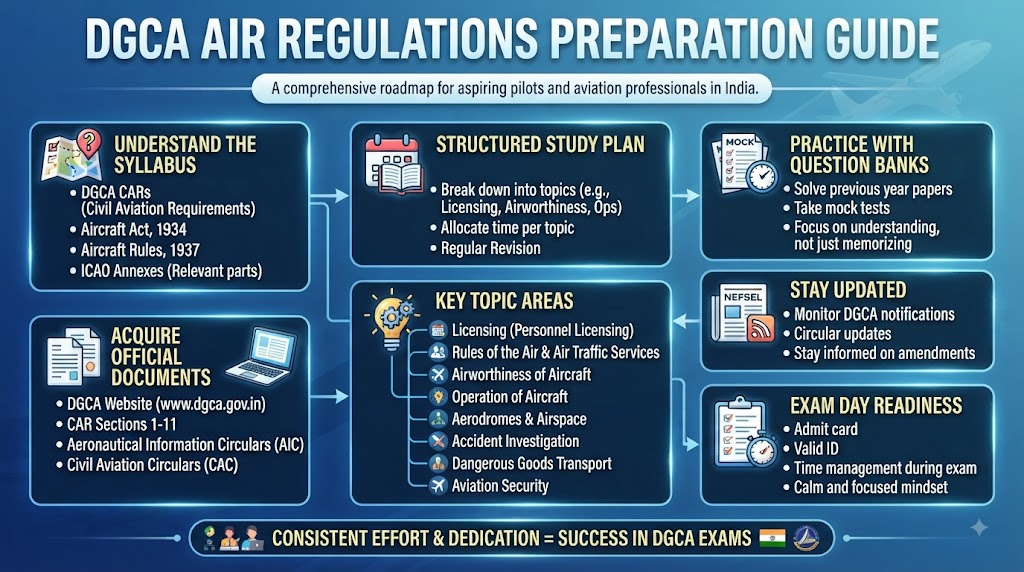
Preparing for DGCA Air Regulations is an important step for aspiring pilots in India. The subject introduces students to the rules, procedures, responsibilities, and regulatory principles that govern aviation operations.
For many students, Air Regulations can initially seem difficult because it contains technical terminology, detailed rules, procedures, and concepts that require careful interpretation. Simply memorizing answers may help with some questions, but a stronger preparation strategy involves understanding what the rules mean and how they relate to real aviation situations.
A good preparation plan combines reliable study material, regular revision, question practice, mistake analysis, and awareness of current regulatory information. Students should also remember that aviation regulations and examination requirements can change, so current official information should always take priority over older notes or informal sources.
This guide explains how student pilots can prepare for DGCA Air Regulations in a structured and practical way.
Understanding DGCA Air Regulations
Air Regulations is concerned with the rules and procedures that help govern safe and organized aviation operations.
For a student pilot, studying this subject means becoming familiar with concepts related to:
- Rules governing aircraft operations
- Pilot responsibilities
- Flight procedures
- Air traffic services
- Communication procedures
- Aviation terminology
- Operational requirements
- Safety-related responsibilities
- Applicable regulatory authorities
The exact syllabus and examination requirements should always be checked against the latest information applicable to the student’s examination.
The objective should not be to memorize isolated statements. Students should understand the purpose of the rules and the situations in which they apply.
Why Air Regulations Is Important for Student Pilots
Air Regulations is not only an examination subject. Regulatory knowledge becomes part of everyday professional aviation.
A pilot needs to understand the responsibilities associated with operating an aircraft and interacting with other parts of the aviation system.
A strong understanding of regulations can help students develop awareness of:
- Legal responsibilities
- Operational limitations
- Flight procedures
- Communication requirements
- Air traffic services
- Safety procedures
- Pilot responsibilities
- Proper operational decision-making
Learning these concepts during training gives students a foundation that can remain useful as they progress from student flying toward professional operations.
Know the Current DGCA Syllabus and Exam Requirements
Before beginning serious preparation, students should first identify the current requirements applicable to their examination.
This is important because regulatory information and examination procedures may change over time.
Students should verify the latest information relating to:
- Current syllabus
- Eligibility requirements
- Examination procedures
- Application requirements
- Examination format
- Official publications
- Relevant notices or updates
Using an old preparation guide without checking whether it remains current can create unnecessary confusion.
A good starting point is therefore to establish exactly what needs to be studied before creating a detailed study plan.
Build a Study Plan
Once the syllabus and requirements are understood, students can divide the material into manageable sections.
Instead of trying to complete everything in a few days, create a study schedule that allows time for learning, revision, and practice.
A basic study plan can include:
Topic Study
Choose a specific topic and study it carefully rather than moving randomly between chapters.
Revision
Review previously studied topics regularly so that information remains familiar.
Question Practice
Solve questions related to the topics you have studied.
Mistake Analysis
Record questions that you answered incorrectly and understand why the mistake occurred.
Weekly Review
At the end of each week, review the topics covered and identify areas that still need attention.
The exact number of study hours will vary from one student to another. Consistency is generally more useful than following an unrealistic schedule.
Start With the Fundamentals
Students often find regulations easier to understand when they first become comfortable with basic aviation terminology.
Before moving into complicated regulatory concepts, make sure you understand common terms used in aviation.
These may include concepts related to:
- Aircraft operations
- Pilot responsibilities
- Aerodromes
- Air traffic services
- Flight rules
- Aviation communication
- Operational procedures
- Regulatory authorities
Understanding terminology reduces confusion when reading more detailed material.
If a student repeatedly comes across an unfamiliar term, it is better to clarify its meaning rather than simply memorizing the sentence in which it appears.
Study Regulations by Topic
Organizing the subject into groups can make preparation more manageable.
Rules of the Air
Students should develop a clear understanding of the basic rules that govern aircraft operations and the relationship between aircraft operating in the same airspace.
Rather than memorizing individual statements without context, try to understand why these rules exist and how they support safe separation and predictable operations.
Pilot Responsibilities
Understand the responsibilities assigned to pilots in different operational situations.
Pay attention to what a pilot is expected to know, do, communicate, or consider during flight operations.
Air Traffic Services
Develop a basic understanding of how air traffic services support aircraft operations.
Students should understand the relationship between pilots and air traffic services and why proper communication and compliance with applicable procedures are important.
Communication Procedures
Communication is an essential part of aviation operations.
Students should become familiar with relevant terminology and procedures while paying close attention to the exact meaning of regulatory requirements.
Flight Rules and Procedures
Study applicable flight rules and procedures carefully.
Try to understand when different rules apply rather than learning them as unrelated facts.
Aircraft and Operational Requirements
Students should also understand the regulatory concepts connected with aircraft operations, documentation, equipment, and other operational responsibilities included in their applicable syllabus.
Always refer to the current syllabus and applicable regulatory material for the exact topics required.
Focus on Understanding, Not Just Memorization
One of the common difficulties in Air Regulations preparation is relying too heavily on memorization.
Memorization has a role, especially when learning definitions and specific regulatory information, but understanding provides a stronger foundation.
When studying a rule, ask yourself:
- What does this rule mean?
- Why does it exist?
- When does it apply?
- Who is responsible?
- What situation does it address?
- How would this rule affect a pilot during an actual operation?
For example, instead of memorizing a statement about a particular operational procedure, try to understand the purpose behind the procedure and the circumstances in which it would be relevant.
This approach can make unfamiliar question wording easier to handle.
Use Official and Reliable Study Material
The quality and currency of study material matter significantly when preparing for a regulatory examination.
Students should prioritize current and reliable sources, including:
- Applicable official DGCA material
- Current aviation regulations
- Official notices and publications
- Current examination guidance
- Reputable aviation training material
- Instructor-provided study resources
Question banks and preparation notes can be useful, but they should not replace the underlying regulatory material.
Students should also be careful with old PDFs and unverified online explanations. A resource that was accurate several years ago may not necessarily reflect the current regulatory position.
Make Short Revision Notes
Creating your own revision notes can make the final stages of preparation much easier.
Instead of copying entire chapters, record the information that requires repeated review.
Useful notes may include:
- Important definitions
- Key responsibilities
- Difficult rules
- Important procedures
- Frequently confused concepts
- Exceptions
- Mistakes from practice questions
Keep the notes concise.
The purpose of revision notes is to provide a quick way to refresh your understanding rather than create another textbook.
Use Comparisons for Confusing Topics
Some aviation concepts can be difficult because similar terms or procedures appear close to each other.
Comparison tables can help students identify the differences.
For example, students can create their own comparison notes for:
- Similar aviation terms
- Different flight rules
- Different air traffic services
- Related procedures
- Different pilot responsibilities
The comparison should always be based on current and reliable regulatory information.
A simple table can make differences easier to remember than several pages of continuous text.
Practice Questions Regularly
Question practice is an important part of examination preparation.
After studying a topic, solve relevant questions rather than waiting until the entire syllabus has been completed.
Regular practice can help you:
- Test your understanding
- Improve recall
- Identify weak areas
- Recognize confusing topics
- Become comfortable with question wording
- Improve time management
However, students should avoid treating a question bank as the complete syllabus.
The goal should be to understand why an answer is correct rather than simply remembering which option was correct the last time you saw the question.
Learn From Your Mistakes
Incorrect answers can be useful learning opportunities.
When you make a mistake, do not simply mark the answer and move on.
Ask:
- What did I misunderstand?
- Which topic was involved?
- Why was my answer incorrect?
- What is the correct principle?
- Why did the incorrect option appear convincing?
- Is this a mistake I have made before?
Maintain a mistake log containing the questions or concepts that repeatedly cause problems.
Reviewing this log during revision can help you focus on areas that genuinely need improvement.
Revise Difficult Topics More Frequently
Not every topic requires the same amount of revision time.
After completing practice questions, divide your subjects into three general groups:
- Strong areas
- Moderate areas
- Weak areas
Strong topics may only need occasional review.
Weak topics deserve more attention because repeatedly making mistakes in the same area can reduce overall preparation quality.
This approach is more efficient than spending equal amounts of time on every topic regardless of your level of understanding.
Use Active Recall
Active recall means attempting to remember information without continuously looking at the notes.
For example, after studying a topic, close your book and ask yourself:
- What are the main rules?
- What are the important definitions?
- What responsibilities are involved?
- What situations does this rule apply to?
- Which concepts are easy to confuse?
Then compare your answers with the study material.
This method can help identify gaps in your knowledge that passive reading may not reveal.
Use Spaced Revision
Instead of studying a topic once and leaving it until the examination, review it several times over a period.
A simple approach could be:
First study: Understand the topic.
First revision: Review it after a short interval.
Second revision: Test yourself with questions.
Later revision: Review mistakes and difficult points.
Final revision: Use concise notes to refresh the topic.
Regular exposure can make important concepts easier to recall when needed.
Practice Time Management
Knowing the material is important, but students should also become comfortable answering questions efficiently.
During practice sessions:
- Read the complete question.
- Identify important words.
- Avoid rushing.
- Do not spend too much time on one difficult question.
- Return to difficult questions when appropriate.
- Review answers if time permits.
Words such as except, not, required, prohibited, and unless can significantly change the meaning of a question.
Careful reading can prevent mistakes that have nothing to do with a lack of knowledge.
Understand Question Wording
Regulatory questions may sometimes test whether a student understands the exact meaning of a rule.
A small change in wording can change the context.
Pay attention to words such as:
- Must
- May
- Shall
- Required
- Prohibited
- Except
- Unless
- Applicable
- Responsible
Rather than immediately selecting an answer that looks familiar, read the entire question and identify what it is actually asking.
This is particularly important when several answer options appear similar.
Common DGCA Air Regulations Preparation Mistakes
Relying Only on Question Banks
Question banks can provide valuable practice, but depending entirely on them can leave gaps in understanding.
Students should learn the regulation behind the question.
Using Outdated Material
Old notes may contain information that has changed.
Always check important regulatory information against current and reliable sources.
Memorizing Without Understanding
Memorization alone can become difficult when a question is presented in unfamiliar wording.
Understanding the underlying concept makes it easier to apply the information.
Ignoring Weak Topics
Students sometimes spend most of their time studying topics they already understand.
This can create a false sense of preparation while difficult topics remain unresolved.
Not Practicing Questions
Reading regulations without testing yourself does not always reveal whether you can actually recall and apply the information.
Studying Everything at the Last Minute
Last-minute preparation can increase stress and leave insufficient time for proper revision.
Regular preparation is generally easier to manage.
Ignoring Official Updates
Students should not assume that information from an old preparation cycle remains unchanged.
Checking current official information is an important part of regulatory preparation.
Confusing Similar Terms
If two concepts are repeatedly confused, create a comparison note and review the difference until it becomes clear.
A Practical DGCA Air Regulations Study Routine
A simple study routine can make preparation more organized.
Study Session
Choose one topic and focus on understanding it.
Revision Session
Review material studied previously.
Practice Session
Answer questions related to the topics covered.
Mistake Review
Record incorrect answers and understand the reason for each mistake.
Weekly Review
At the end of the week, revisit difficult areas and evaluate your progress.
The routine can be adjusted according to your available time, existing knowledge, and examination schedule.
How to Prepare During the Final Weeks
The final weeks should focus on strengthening knowledge rather than creating unnecessary confusion.
Students can use this period to:
- Complete unfinished topics.
- Revise important concepts.
- Review difficult areas.
- Practice questions.
- Analyze mistakes.
- Review concise notes.
- Check current examination information.
Avoid constantly changing study resources during the final stage.
If you have already developed a reliable study system, focus on strengthening it rather than introducing multiple new materials.
How to Prepare One Day Before the Exam
The day before the examination should generally be focused on calm revision rather than trying to learn the entire syllabus.
Students can:
- Review short notes.
- Revisit difficult concepts.
- Check important mistakes.
- Confirm examination details.
- Prepare required documents.
- Get adequate sleep.
- Avoid unnecessary late-night studying.
A tired student may find it harder to concentrate and recall information effectively.
Exam-Day Preparation
On examination day, students should follow the latest official instructions provided for their examination.
General preparation can include:
- Arriving with sufficient time.
- Carrying required documents.
- Following examination instructions.
- Reading each question carefully.
- Managing time sensibly.
- Avoiding careless mistakes.
- Reviewing answers where permitted.
Students should not rely on old advice regarding examination procedures if current official instructions say otherwise.
How to Stay Updated With Aviation Regulations
Aviation regulations can change as the industry, procedures, and regulatory requirements develop.
For this reason, students should make it a habit to check current information from appropriate official sources.
Pay attention to:
- Regulatory changes
- Official notices
- Updated publications
- Examination announcements
- Changes to applicable procedures
This is particularly important when using older study materials.
A preparation guide can be useful for understanding a topic, but current official information should take priority when there is a difference.
Role of Coaching and Instructor Guidance
An experienced instructor can help students understand difficult regulatory concepts more efficiently.
Instructor guidance can be useful for:
- Explaining complicated rules
- Clarifying terminology
- Providing practical examples
- Identifying weak areas
- Reviewing difficult questions
- Explaining common mistakes
However, coaching should complement personal study rather than replace it.
Students still need to understand the applicable regulations and maintain their own preparation routine.
How Air Regulations Knowledge Helps After the Exam
Passing an examination is not the end of regulatory learning.
Pilots continue to use regulatory knowledge during their training and professional careers.
It can become relevant during:
- Pre-flight preparation
- Flight operations
- Communication
- Operational decision-making
- Solo flying
- Professional aviation activities
A pilot’s responsibility does not end when an examination is passed.
Maintaining familiarity with current applicable regulations is part of responsible aviation practice.
Frequently Asked Questions
1. What is DGCA Air Regulations?
DGCA Air Regulations refers to the regulatory knowledge student pilots need to understand the rules, procedures, responsibilities, and operational requirements relevant to aviation in India and their applicable pilot training pathway.
2. Why is Air Regulations important for student pilots?
It helps student pilots understand their responsibilities, operational procedures, communication requirements, and the regulatory framework within which aviation activities are conducted.
3. How should I start preparing for the DGCA Air Regulations exam?
Start by checking the current syllabus and examination requirements applicable to you. Then organize the material into topics, study each topic carefully, create revision notes, and begin regular question practice.
4. Should I study regulations or only practice questions?
Students should study the underlying regulations and use practice questions to test their understanding. Depending only on question banks can leave gaps in knowledge.
5. How can I remember difficult Air Regulations topics?
Use short notes, active recall, spaced revision, topic comparisons, and regular practice questions. Understanding why a rule exists can also make it easier to remember.
6. Are old DGCA notes and question banks reliable?
They can be useful for practice, but they should not automatically be treated as current. Aviation regulations and examination requirements can change, so important information should be checked against current reliable sources.
7. How often should I revise Air Regulations?
Revision should be regular rather than limited to the final few days. The exact schedule depends on your preparation timeline, but revisiting topics at intervals can improve recall.
8. What should I do if I keep making the same mistakes?
Record the questions you repeatedly get wrong, identify the underlying concept, review the relevant material, and test yourself again. A mistake log can help you identify recurring weaknesses.
9. How can I prepare during the final weeks before the exam?
Focus on completing the syllabus, revising difficult topics, practicing questions, reviewing mistakes, and using concise notes. Avoid relying entirely on last-minute memorization.
10. Where should I check for the latest DGCA examination and regulatory information?
Students should refer to the latest information issued by the relevant official aviation authority and applicable examination documentation rather than relying solely on old notes, informal websites, or previously shared material.
Conclusion
Preparing for DGCA Air Regulations successfully requires more than memorizing a collection of answers. Students need to understand the rules, procedures, responsibilities, and terminology that form the foundation of safe aviation operations.
A structured approach can make preparation much easier. Start by understanding the current syllabus, divide the material into manageable topics, use reliable study resources, create concise notes, practice questions regularly, and maintain a record of mistakes.
Students should also remember that aviation regulations are subject to change. Current official information should therefore always take priority over outdated study material.

