
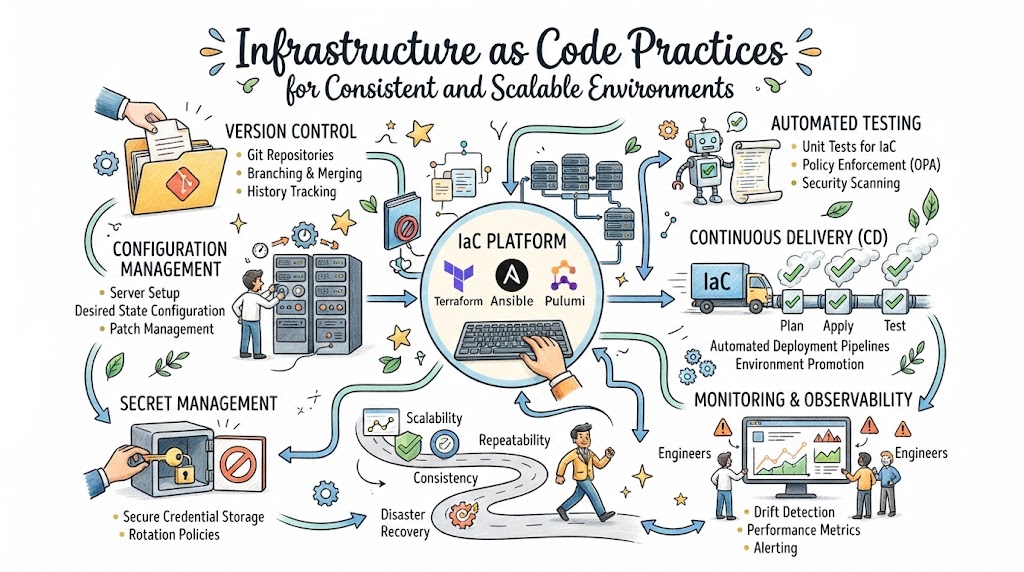
Introduction
Modern applications depend on servers, networks, databases, containers, security rules, monitoring systems, and cloud services. Managing these resources manually becomes difficult as applications and engineering teams grow.
Manual configuration often creates inconsistent environments. A development environment may behave differently from testing, staging, or production. Engineers may also make undocumented changes that are difficult to identify or reverse.
Infrastructure as Code practices solve this problem by defining infrastructure through version-controlled configuration files. Teams can review, test, deploy, and update infrastructure using repeatable automation instead of relying on manual actions.
This article explains the main Infrastructure as Code concepts, tools, workflows, challenges, projects, career skills, DORA metrics, and practical implementation methods. It also explains how engineering intelligence can connect infrastructure changes with deployments, incidents, and service reliability.
Why Infrastructure as Code Practices Matter
Infrastructure as Code, commonly called IaC, is important for anyone responsible for delivering or operating software.
For beginners
IaC helps beginners understand how cloud resources, networks, permissions, and application environments fit together. It also provides practical experience with automation and source control.
For DevOps professionals
DevOps engineers use IaC to create repeatable environments, automate provisioning, reduce configuration errors, and support reliable CI/CD pipelines.
For SRE teams
SRE teams need predictable systems. Version-controlled infrastructure makes failures easier to investigate because teams can identify what changed and when it changed.
For platform engineers
Platform teams use reusable IaC modules to offer approved infrastructure components through internal developer platforms.
For engineering managers
Managers gain clearer infrastructure ownership, improved change visibility, stronger review processes, and better information about delivery risks.
For software organizations
Organizations can scale infrastructure more safely without depending on undocumented manual knowledge held by individual employees.
The Role of IaC in Modern DevOps
Cloud platforms allow teams to create infrastructure quickly. However, speed without standardization can create security, cost, reliability, and governance problems.
Infrastructure as Code turns cloud infrastructure into a controlled engineering process. Infrastructure definitions can be stored in Git, reviewed through pull requests, tested in pipelines, and deployed using automation.
IaC also supports:
- Consistent development, testing, and production environments
- Automated cloud resource provisioning
- Disaster recovery and environment rebuilding
- GitOps workflows
- Policy-based security checks
- Cost controls and resource tagging
- Platform engineering and self-service infrastructure
- Auditable infrastructure changes
IaC is not only about creating servers. It covers networks, databases, identity rules, Kubernetes clusters, monitoring services, storage, load balancers, secrets integration, and many other components.
Important Infrastructure as Code Concepts
Declarative Configuration
A declarative configuration describes the desired final state.
For example, a configuration may state that an application needs three servers, one load balancer, and a managed database. The IaC tool determines which actions are required to reach that state.
This approach is commonly used by Terraform, Kubernetes, Pulumi, AWS CloudFormation, and Azure Bicep.
Imperative Automation
Imperative automation describes the exact steps that must be performed.
For example:
- Create a virtual network.
- Create a subnet.
- Start a server.
- Install a web server.
- Configure the application.
Imperative methods provide control but may require more detailed error handling.
Idempotency
Idempotency means that running the same configuration repeatedly should produce the same result without creating unnecessary duplicate resources.
An idempotent configuration helps teams safely rerun automation after partial failures.
Infrastructure State
Some IaC tools maintain a state file that records the relationship between configuration code and real infrastructure.
State must be stored securely because it may contain resource details. Teams should normally use remote state storage, encryption, access controls, and locking.
Immutable Infrastructure
Immutable infrastructure replaces an existing resource rather than changing it manually.
For example, instead of updating a production server directly, a team creates a new server image, deploys it, verifies it, and removes the old server.
This reduces configuration drift and makes rollback easier.
Configuration Drift
Configuration drift occurs when the real environment no longer matches the approved configuration.
It can happen when someone changes a firewall rule, server setting, or cloud resource manually.
Regular drift detection helps teams identify and correct these differences.
Reusable Modules
A module is a reusable collection of infrastructure definitions.
A platform team might create approved modules for:
- Virtual networks
- Kubernetes clusters
- Databases
- Application environments
- Monitoring services
- Identity and access rules
Modules reduce duplicated code and help teams follow common standards.
Policy as Code
Policy as Code converts security, compliance, cost, and governance rules into automated checks.
A policy may prevent teams from:
- Creating publicly accessible databases
- Using unapproved cloud regions
- Deploying resources without required tags
- Opening unrestricted network ports
- Selecting resources above an approved cost limit
Step-by-Step Infrastructure as Code Process
Step 1: Understand the Infrastructure Requirements
Document the application architecture before writing configuration files.
Identify:
- Compute requirements
- Network design
- Storage needs
- Database services
- Security controls
- Monitoring requirements
- Availability expectations
- Backup and recovery needs
The main mistake is automating an unclear or poorly designed architecture. Automation cannot correct weak planning.
Expected result: A clear infrastructure design and ownership model.
Step 2: Select an Appropriate IaC Tool
Choose a tool based on cloud platforms, team knowledge, integrations, security requirements, and infrastructure complexity.
Terraform may suit multi-cloud environments. CloudFormation may fit AWS-focused teams. Bicep may suit Microsoft Azure environments. Pulumi may help teams that prefer programming languages.
Avoid selecting a tool only because it is popular.
Expected result: A tool aligned with the organization’s technical environment.
Step 3: Store Infrastructure Code in Git
Create a dedicated repository or a clearly organized infrastructure directory.
Use branches, pull requests, reviews, release tags, and protected main branches. Every important infrastructure change should have a visible history.
Avoid storing passwords, private keys, or access tokens in Git.
Expected result: Traceable and reviewable infrastructure changes.
Step 4: Build Small Reusable Modules
Start with reusable components such as networks, compute instances, databases, or monitoring configurations.
Keep modules focused. A single module should not attempt to control an entire organization’s infrastructure.
Add input validation, useful outputs, documentation, and safe default values.
Expected result: Infrastructure components that can be reused across teams and environments.
Step 5: Separate Environment Configuration
Development, testing, staging, and production may share modules while using different input values.
Keep environment-specific details separate from reusable logic. Production should also have stronger access controls and approval requirements.
Avoid copying complete infrastructure directories for every environment because the copies will eventually become inconsistent.
Expected result: Standardized environments with controlled differences.
Step 6: Validate and Test the Code
Run formatting, syntax validation, linting, security scanning, policy checks, and deployment-plan reviews.
Testing may include:
- Static code analysis
- Module tests
- Integration tests
- Security checks
- Cost estimation
- Policy validation
- Temporary environment deployment
Do not wait until production deployment to discover configuration problems.
Expected result: Fewer infrastructure defects and safer changes.
Step 7: Integrate IaC with CI/CD
Create a pipeline that automatically validates every proposed infrastructure change.
A typical pipeline may:
- Format and validate the code.
- Run security and policy checks.
- Generate an infrastructure plan.
- Require human review for sensitive changes.
- Apply approved changes.
- Record the deployment result.
- Run post-deployment verification.
Avoid allowing every branch to modify production directly.
Expected result: Controlled and repeatable infrastructure delivery.
Step 8: Monitor Changes and Detect Drift
Connect infrastructure deployments with logs, metrics, alerts, incidents, and engineering timelines.
Run scheduled drift checks and investigate unexpected differences.
Avoid automatically correcting every drift event without understanding why it happened. Some differences may indicate an emergency change or an incomplete configuration.
Expected result: Better visibility into the relationship between infrastructure changes and service behaviour.
Relevant Infrastructure as Code Tools
The right combination depends on the cloud provider, application architecture, budget, regulatory requirements, team experience, and existing delivery systems.
| Tool | Main Purpose | Key Features | Best Suited For | Learning Difficulty |
|---|---|---|---|---|
| Terraform | Multi-provider infrastructure provisioning | Declarative code, modules, plans, provider ecosystem | Multi-cloud and cloud-neutral teams | Medium |
| OpenTofu | Open-source infrastructure provisioning | Terraform-compatible workflow, state management, modules | Teams preferring community-led IaC | Medium |
| AWS CloudFormation | AWS resource automation | Native AWS integration, change sets, stack management | AWS-focused organizations | Medium |
| Azure Bicep | Microsoft Azure provisioning | Concise syntax, Azure integration, reusable modules | Azure-focused teams | Medium |
| Pulumi | Infrastructure through programming languages | TypeScript, Python, Go, C# and reusable packages | Software-focused platform teams | Medium to high |
| Ansible | Configuration and application automation | Agentless operation, playbooks, broad integrations | Configuration management and orchestration | Beginner to medium |
| Crossplane | Kubernetes-based cloud control | Custom resources, compositions, platform APIs | Kubernetes and platform engineering teams | High |
| Packer | Machine-image automation | Repeatable server images, multi-platform builders | Immutable infrastructure workflows | Medium |
| Checkov | IaC security scanning | Misconfiguration detection, policy checks | DevSecOps pipelines | Beginner to medium |
| Terratest | Automated infrastructure testing | Tests real infrastructure using Go | Teams requiring deeper IaC testing | High |
No tool is suitable for every organization. A small team may need a simple workflow, while an enterprise may need policy enforcement, centralized state, private module registries, cost controls, and detailed audit records.
Benefits of Infrastructure as Code
Faster environment provisioning
Teams can create environments through automation instead of submitting repeated manual requests.
Greater consistency
Reusable modules and common configuration reduce differences between development, testing, and production.
Reduced manual work
Engineers spend less time repeating cloud-console actions and more time improving reusable automation.
Better collaboration
Developers, operations teams, security specialists, and platform engineers can review the same infrastructure changes.
Improved reliability
Tested and version-controlled infrastructure reduces undocumented configuration changes.
Stronger security
Security checks can identify open ports, weak encryption, public storage, or excessive permissions before deployment.
Faster recovery
Teams can rebuild affected environments from approved code during failures or disaster-recovery exercises.
Better decision-making
Infrastructure events can be connected with deployment, incident, cost, reliability, and engineering performance data.
Common Challenges and Practical Solutions
| Challenge | Practical Solution |
|---|---|
| Too many IaC tools | Define clear responsibilities for provisioning, configuration, testing, security, and orchestration. |
| Poor module design | Build small modules with clear inputs, outputs, ownership, and documentation. |
| Configuration drift | Run scheduled drift detection and restrict unnecessary manual changes. |
| Unsafe state storage | Use encrypted remote state, locking, backups, and role-based access controls. |
| Secrets in configuration | Store secrets in an approved secrets manager and retrieve them securely during deployment. |
| Weak testing | Add validation, linting, security scanning, policy checks, and temporary environment tests. |
| Unclear ownership | Assign owners for modules, environments, state, policies, and deployment pipelines. |
| Slow approvals | Use risk-based approval rules instead of applying the same process to every change. |
| Limited practical skills | Build small DevOps projects before managing production infrastructure. |
| Missing performance data | Connect infrastructure deployments with delivery, reliability, and incident information. |
Infrastructure as Code Best Practices
Use version control for every important change
Infrastructure should follow the same review discipline as application code. Pull requests create a visible place for technical discussion and approval.
Keep modules focused and reusable
Small modules are easier to understand, test, update, and replace. They also reduce the effect of unexpected changes.
Pin provider and module versions
Uncontrolled upgrades can introduce breaking changes. Test new versions before using them in production.
Protect the state file
Use remote storage, encryption, locking, backup policies, and limited permissions. Never treat the state file as ordinary project data.
Review the deployment plan
The plan shows which resources will be created, modified, or deleted. Destructive changes should receive additional review.
Add automated security checks
Scan IaC during pull requests. Detect security issues before resources are created.
Avoid permanent manual changes
Emergency changes may sometimes be necessary, but they should be added back to the code after the incident.
Maintain clear documentation
Document module purpose, required inputs, outputs, examples, dependencies, ownership, and upgrade instructions.
Measure outcomes, not code volume
The number of modules or infrastructure commits does not prove success. Measure deployment reliability, recovery, consistency, lead time, and service health.
Practical Example: Creating a Standard Application Environment
Consider a company that deploys web applications on a cloud platform.
Previously, engineers created networks, virtual machines, security groups, and monitoring rules manually. Each environment had small differences, and production problems were difficult to reproduce.
The platform team creates reusable IaC modules for:
- Virtual networks
- Application servers
- Managed databases
- Load balancers
- Monitoring alerts
- Identity roles
- Backup policies
Development teams provide basic inputs such as application name, environment, region, expected capacity, and service owner.
A CI/CD pipeline validates the request, scans the configuration, creates a deployment plan, and applies the approved change.
The result is not simply faster provisioning. The company also gains consistent security controls, standard naming, cost tags, monitoring coverage, and a complete change history.
Real-World Use Cases
Startups
Startups can reproduce development, testing, and production environments without hiring a large infrastructure team.
Medium-sized technology companies
Growing companies can introduce reusable modules, controlled CI/CD pipelines, standard monitoring, and cost tagging.
Large enterprises
Enterprises can use private module registries, policy as code, centralized state management, approval workflows, and detailed audit records.
Cloud-native teams
Cloud-native teams can combine Terraform or OpenTofu with Kubernetes, Helm, GitOps, and observability platforms.
SRE teams
SRE teams can connect infrastructure changes with incidents, SLO compliance, error-budget consumption, and recovery performance.
Platform engineering teams
Platform teams can turn approved modules into self-service infrastructure products for developers.
Regulated organizations
Regulated teams can enforce encryption, data-location rules, identity controls, logging, approvals, and audit requirements through code.
Infrastructure as Code DevOps Roadmap
| Stage | Important Concepts | Practical Exercise | Expected Outcome |
|---|---|---|---|
| DevOps fundamentals | Automation, collaboration, delivery flow | Map a software delivery lifecycle | Understand DevOps responsibilities |
| Linux and networking | Files, processes, DNS, ports, routing | Configure a Linux web server | Understand infrastructure foundations |
| Git | Commits, branches, reviews, tags | Store configuration in Git | Track infrastructure changes |
| Scripting | Bash or Python fundamentals | Automate resource checks | Reduce repetitive work |
| CI/CD | Pipelines, approvals, artifacts | Build an IaC validation pipeline | Automate testing and delivery |
| Containers | Images, registries, networking | Containerize a sample application | Understand portable workloads |
| Kubernetes | Pods, services, deployments, Helm | Deploy an application cluster | Manage containerized platforms |
| Cloud platforms | Compute, networking, identity, storage | Create a small cloud environment | Understand managed cloud resources |
| Infrastructure as Code | State, modules, plans, drift | Build reusable Terraform modules | Provision repeatable environments |
| Observability | Metrics, logs, traces, alerts | Monitor infrastructure health | Detect operational problems |
| DevSecOps | Secrets, scanning, policies | Add Checkov or policy checks | Identify risks before deployment |
| SRE and platforms | SLOs, error budgets, self-service | Create a standard service template | Improve reliability and developer experience |
| Engineering intelligence | DORA metrics, incidents, timelines | Relate changes to delivery outcomes | Make evidence-based improvements |
DevOps Skills Required for IaC
Technical knowledge should include:
- Linux administration
- Networking fundamentals
- Git and source control
- Bash, Python, or another scripting language
- CI/CD pipeline design
- Docker and container concepts
- Kubernetes fundamentals
- Cloud computing
- Infrastructure as Code
- Configuration management
- Monitoring and observability
- Identity and access management
- Secrets management
- Security scanning
- Troubleshooting
Non-technical DevOps Engineer skills are equally important:
- Clear communication
- Documentation
- Collaboration
- Risk awareness
- Problem-solving
- Change management
- Incident communication
- Ability to learn from failures
Infrastructure as Code DevOps Projects
Project 1: Automated Web Server
Objective: Provision a basic web server automatically.
Tools: Terraform or OpenTofu, Git, Linux and a cloud account.
Main tasks: Create a network, security rule, server instance, and startup script.
Skills developed: Provider configuration, resources, variables, outputs, and basic cloud networking.
Expected result: A repeatable web-server environment.
Project 2: Reusable Three-Tier Environment
Objective: Build infrastructure for a web, application, and database architecture.
Tools: Terraform, cloud services, Git and CI/CD.
Main tasks: Create modules, environment variables, remote state, and deployment plans.
Skills developed: Module design, dependencies, state management, and environment separation.
Expected result: Reusable development and staging environments.
Project 3: Secure IaC Pipeline
Objective: Add automated validation and security checks.
Tools: GitHub Actions, GitLab CI or Jenkins, Checkov, TFLint and a secrets manager.
Main tasks: Validate code, scan configurations, review plans, and require production approval.
Skills developed: CI/CD, security scanning, policy enforcement, and change control.
Expected result: A safer infrastructure delivery workflow.
Project 4: Self-Service Platform Template
Objective: Build an approved infrastructure template for application teams.
Tools: Terraform or Crossplane, Kubernetes, GitOps, monitoring and policy tools.
Main tasks: Create reusable components, enforce policies, publish documentation, and track deployment results.
Skills developed: Platform engineering, governance, observability, reliability, and product thinking.
Expected result: A controlled self-service infrastructure workflow.
Courses and Certifications
A Best DevOps Course should provide more than recorded explanations. Effective training should include Git workflows, cloud labs, module development, state management, CI/CD integration, security scanning, troubleshooting, and realistic projects.
Beginners may benefit from structured training because it provides an ordered learning path. Working professionals may use courses to fill gaps in cloud architecture, security, Kubernetes, or platform engineering.
The Best DevOps Certifications for an individual depend on the selected cloud provider, IaC tool, current role, and career direction.
Before choosing a program, compare:
- Practical lab access
- Instructor experience
- Updated technical content
- Project quality
- Troubleshooting exercises
- Cloud coverage
- Security coverage
- Community or mentoring support
- Assessment method
A certificate can demonstrate structured study, but it cannot replace practical implementation experience.
Career Opportunities
| Role | Main Responsibilities | Important Skills |
|---|---|---|
| DevOps Engineer | Automate infrastructure and delivery pipelines | Git, CI/CD, cloud, IaC, scripting |
| Site Reliability Engineer | Improve reliability and recovery | Monitoring, SLOs, incidents, automation |
| Platform Engineer | Build reusable internal platforms | Kubernetes, IaC, APIs, developer experience |
| Cloud Engineer | Design and operate cloud resources | Networking, identity, cloud services, IaC |
| DevSecOps Engineer | Integrate security into delivery | Policy as Code, scanning, secrets, compliance |
| Automation Engineer | Automate operational processes | Scripting, APIs, configuration management |
| Infrastructure Engineer | Manage compute, network and storage | Linux, networking, cloud and IaC |
| Build and Release Engineer | Control builds and releases | CI/CD, Git, artifacts and environments |
| Observability Engineer | Improve system visibility | Metrics, logs, traces and service health |
| Engineering Productivity Engineer | Improve developer workflows | Automation, platforms, metrics and tooling |
DevOps Engineer Salary Factors
DevOps Engineer Salary levels vary significantly. Reliable comparisons must consider:
- Country and city
- Experience level
- Cloud platform knowledge
- Infrastructure as Code experience
- Kubernetes skills
- Security knowledge
- Certifications
- Industry
- Company size
- Production responsibility
- Communication ability
- Incident-management experience
Salary numbers should not be considered universal because job titles and responsibilities differ between employers. Professionals should compare roles based on actual responsibilities rather than title alone.
Infrastructure as Code Interview Questions and Answers
1. What is Infrastructure as Code?
Infrastructure as Code is the practice of defining and managing infrastructure through machine-readable files instead of manual configuration.
2. What is the difference between declarative and imperative IaC?
Declarative IaC defines the desired state. Imperative automation defines the exact sequence of actions.
3. Why is idempotency important?
It allows automation to run repeatedly without creating unnecessary duplicate resources or inconsistent results.
4. What information does an IaC state file contain?
It records mappings and metadata that help the tool understand which configured resources already exist.
5. How should remote state be protected?
Use encryption, access controls, locking, backups, audit logging, and separate permissions for sensitive environments.
6. What is configuration drift?
Configuration drift is the difference between the approved code and the real infrastructure.
7. How can drift be reduced?
Restrict manual changes, run scheduled checks, use immutable infrastructure, and update code after emergency modifications.
8. Why should IaC changes use pull requests?
Pull requests support review, discussion, automated testing, approval, and a visible change history.
9. How should secrets be managed in IaC?
Secrets should remain in an approved secrets manager and be retrieved securely during deployment.
10. What should an IaC CI/CD pipeline validate?
It should check formatting, syntax, security, policies, cost risks, deployment plans, approvals, and post-deployment health.
11. What makes a good infrastructure module?
A good module has a focused purpose, clear inputs, useful outputs, safe defaults, tests, documentation, and an owner.
12. How would you investigate an unexpected resource deletion?
Review the deployment plan, Git history, pipeline logs, state history, audit records, dependencies, and recent manual actions.
13. Can Kubernetes manifests be considered Infrastructure as Code?
Yes. They describe the desired state of Kubernetes resources and can be versioned, reviewed, and automatically applied.
14. What is Policy as Code?
Policy as Code expresses security, compliance, cost, or governance requirements as automated rules.
15. Why is provider version pinning important?
It prevents untested provider updates from unexpectedly changing infrastructure behaviour.
16. How can IaC improve disaster recovery?
Teams can recreate approved infrastructure from version-controlled definitions instead of rebuilding it manually.
17. How can IaC influence change-failure rate?
Testing, review, standard modules, and controlled deployment can reduce configuration errors that cause service failures.
18. Why should infrastructure metrics not be used to punish individuals?
Infrastructure delivery is a shared system involving tools, processes, architecture, reviews, and organizational decisions.
DORA Metrics and Engineering Intelligence
Deployment Frequency
Deployment frequency measures how often a team successfully releases changes.
For IaC, it can include approved infrastructure deployments. Frequent deployment is useful only when changes remain safe and controlled.
Lead Time for Changes
Lead time measures how long it takes for a committed change to reach production.
Long infrastructure lead times may indicate slow reviews, manual approvals, testing delays, or unclear ownership.
Change-Failure Rate
Change-failure rate measures the percentage of changes that cause degraded service, rollback, hotfix, or incident response.
Infrastructure failures may result from unsafe network rules, capacity mistakes, permission changes, or untested dependencies.
Time to Restore Service
This metric measures how quickly service is restored after a failure.
Version history, automated rollback, reusable environments, monitoring, and tested recovery procedures can reduce recovery time.
Additional Reliability Indicators
Teams should also examine:
- Mean time to recovery
- Mean time to resolution
- Incident trends
- SLO compliance
- Error-budget consumption
- Rollback frequency
- Failed infrastructure deployments
- Configuration drift
- Service health trends
- Engineering productivity
Metrics should support learning and process improvement. They should not be used as isolated employee-performance targets.
DORA Metrics Tools Comparison
| Tool Type | Data Collected | Main Insight | Suitable Team |
|---|---|---|---|
| Source-control analytics | Commits, reviews, merge times | Development flow and change history | Software engineering teams |
| CI/CD analytics | Builds, deployments, failures | Deployment frequency and pipeline health | DevOps and release teams |
| Incident-management platforms | Alerts, incidents, acknowledgements | Recovery time and incident patterns | SRE and operations teams |
| Observability platforms | Metrics, logs, traces, SLOs | Service health and failure impact | Cloud-native teams |
| IaC platforms | Plans, applies, policies, drift | Infrastructure delivery and governance | Platform and infrastructure teams |
| Engineering intelligence platforms | Data across development and operations tools | Delivery, reliability and recovery relationships | Engineering leaders and multi-team organizations |
BestDevOps Learning Support
BestDevOps can support learners through practical tutorials, DevOps Roadmap content, tool comparisons, certification guidance, DevOps Interview Questions, hands-on DevOps Projects, course information, career resources, and industry practices.
A beginner can use a DevOps Tutorial for Beginners to understand Git, Linux, cloud computing, scripting, CI/CD, containers, Kubernetes, and Infrastructure as Code in a logical order.
Working professionals can use comparisons and project ideas to evaluate tools, strengthen missing skills, and prepare for broader responsibilities.
DevOpsIQ Use Cases for Infrastructure Teams
DevOpsIQ can connect information from systems such as GitHub, GitLab, Jenkins, Jira, Prometheus, and Datadog.
This unified information can help teams:
- Relate infrastructure commits to deployments
- Track infrastructure deployment frequency
- Identify failed changes and rollbacks
- Connect incidents with recent deployments
- Measure recovery performance
- Monitor SLO compliance
- Track error-budget consumption
- Compare service reliability trends
- Identify services with repeated operational risk
- Make better engineering decisions
The Pulse Score provides a simplified view of service health based on available engineering and reliability information. It can help leaders identify where further investigation may be needed.
However, one score cannot explain every engineering problem. Teams should combine the Pulse Score with technical evidence, architecture knowledge, incident reviews, business context, and team feedback.
Engineering timelines can show deployments, failures, incidents, rollbacks, and recovery events in sequence. This helps teams understand what changed, what happened afterward, and how quickly the service recovered.
Future Trends in Infrastructure as Code
AI-assisted operations
AI may help engineers review configurations, detect unusual changes, explain deployment failures, and recommend investigation paths. Human review will remain important for critical decisions.
Platform engineering
More organizations are building internal platforms that offer approved infrastructure through templates, APIs, portals, and automated workflows.
Internal developer platforms
Developers will increasingly request environments through simple interfaces while platform teams maintain the underlying modules and policies.
Automated incident response
Infrastructure events may trigger automated diagnostics, rollback recommendations, capacity changes, or recovery workflows.
DevSecOps and Policy as Code
Security, cost, compliance, and operational rules will continue moving earlier into infrastructure pipelines.
GitOps
Git repositories will increasingly act as the approved source of truth for infrastructure and application configurations.
FinOps
Infrastructure code will be checked for cost impact, resource ownership, budget rules, and inefficient configuration.
Advanced observability
Teams will connect infrastructure changes with metrics, logs, traces, user impact, SLOs, and incident timelines.
Engineering intelligence
Engineering intelligence platforms will help organizations understand relationships between code changes, infrastructure deployments, delivery speed, failures, and recovery.
Frequently Asked Questions
1. Can Infrastructure as Code be used without a public cloud?
Yes. IaC can manage private clouds, virtual machines, networks, Kubernetes clusters, data centres, and hybrid environments.
2. Should development and production use separate IaC repositories?
They may use separate repositories or directories depending on security and ownership requirements. The important point is to reuse approved modules while protecting production access.
3. How often should infrastructure drift be checked?
The frequency depends on risk and change volume. Critical production environments may need continuous or daily checks, while lower-risk environments may be checked less frequently.
4. Is Terraform required for learning Infrastructure as Code?
No. Terraform is widely used, but learners can also use OpenTofu, CloudFormation, Bicep, Pulumi, Crossplane, Ansible, or other tools.
5. Should every infrastructure change be fully automated?
Most repeatable changes should be automated. Emergency actions may sometimes be manual, but they should be documented and reflected in code afterward.
6. Can small teams benefit from Infrastructure as Code?
Yes. Small teams gain repeatability, documentation, recovery support, and reduced dependence on individual knowledge.
7. How should teams manage multiple cloud accounts?
Use consistent modules, separate state, clear naming, role-based permissions, account boundaries, and environment-specific pipelines.
8. What should be documented inside an IaC module?
Document its purpose, inputs, outputs, dependencies, assumptions, examples, supported versions, security considerations, and ownership.
9. Is low-code cloud provisioning the same as IaC?
Not always. A graphical tool may automate provisioning, but IaC normally emphasizes versioned, reviewable, testable, and repeatable definitions.
10. How can teams safely remove cloud resources through IaC?
Review the plan carefully, protect critical resources, require approval, verify backups, understand dependencies, and test removal procedures in lower environments.
11. Does Infrastructure as Code remove the need for cloud knowledge?
No. Engineers still need to understand networking, identity, security, availability, storage, cost, and service limitations.
12. How do teams know whether their IaC program is improving?
They can track provisioning time, failed changes, drift, recovery time, policy violations, deployment lead time, service reliability, and developer feedback.
Key Takeaways
- Infrastructure as Code converts infrastructure management into a controlled software engineering process.
- Version control creates traceability, review, and collaboration.
- Reusable modules improve consistency across environments.
- Remote state must be encrypted, locked, backed up, and access-controlled.
- CI/CD pipelines should validate, scan, review, and verify infrastructure changes.
- Policy as Code helps enforce security, compliance, cost, and governance rules.
- Drift detection identifies differences between approved code and real infrastructure.
- Practical projects are essential for developing usable IaC skills.
- DORA metrics should support team improvement rather than individual punishment.
- Engineering intelligence helps connect infrastructure changes with delivery and reliability outcomes.
Conclusion
Infrastructure as Code practices help engineering teams create infrastructure that is consistent, repeatable, scalable, and easier to manage. Instead of depending on manual cloud-console actions, teams define infrastructure through code that can be reviewed, tested, versioned, and deployed through controlled pipelines.
Successful IaC implementation requires more than learning tool syntax. Engineers must understand networking, cloud services, access control, state management, module design, security scanning, testing, monitoring, and incident response. They must also know when human review is necessary and how to design automation that supports rather than complicates engineering work.
Organizations should begin with clear infrastructure requirements, select tools that fit their environment, create small reusable modules, protect state, separate environment configuration, and add automated checks. As the process matures, teams can introduce Policy as Code, self-service platforms, drift detection, cost controls, and engineering intelligence.
Measurement is another important part of continuous improvement. Deployment frequency, lead time, change-failure rate, recovery time, SLO compliance, incident trends, and rollback frequency can reveal weaknesses in the infrastructure delivery process. These metrics must be interpreted with technical context and team feedback.
BestDevOps can help individuals build knowledge through tutorials, roadmaps, tools, projects, course information, certification guidance, and interview preparation. DevOpsIQ can help organizations connect infrastructure changes with deployments, incidents, recovery events, and service reliability. Together, learning, automation, measurement, and continuous improvement create a stronger foundation for modern software delivery.

