
Introduction
Becoming a commercial pilot requires a combination of practical flying skills, aviation knowledge, discipline, and proper training. While flight hours and aircraft handling skills are important, theoretical knowledge forms the foundation of safe and professional flying.
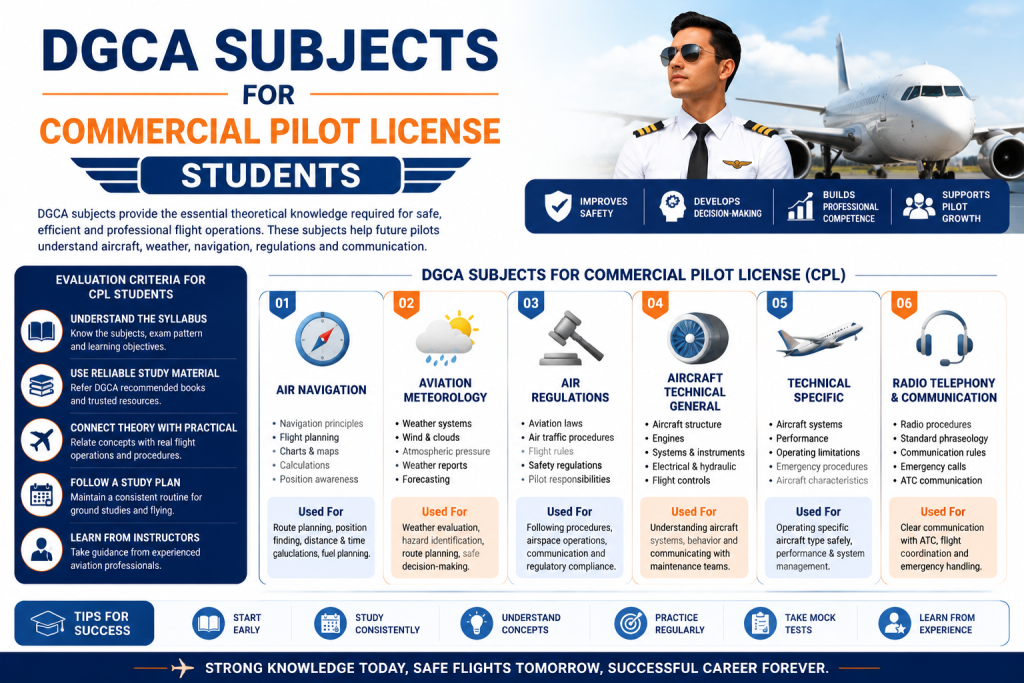
For aspiring pilots in India, DGCA subjects for Commercial Pilot License students are an essential part of pilot training. These subjects help students understand aircraft operations, weather conditions, navigation techniques, aviation rules, and technical aspects of flying.
The Directorate General of Civil Aviation (DGCA) conducts theoretical examinations that CPL students need to complete as part of their professional pilot journey. Understanding these subjects helps future pilots develop better decision-making skills and apply classroom knowledge during real flight operations.
A strong understanding of DGCA subjects allows student pilots to become more confident during flight training and prepares them for the responsibilities of commercial aviation.
Real-World Examples of How DGCA Subjects Help Pilots
DGCA subjects are not only required for examinations; they directly support pilots during everyday aviation operations.
Weather Decision-Making Before Flight
Aviation Meteorology knowledge helps pilots understand weather reports, cloud formations, wind conditions, and possible hazards before departure.
For example, a pilot planning a flight must analyze weather conditions to decide whether the route is suitable or whether alternative planning is required.
Safe Route Planning
Air Navigation knowledge helps pilots calculate routes, understand aircraft position, and manage flights efficiently during different phases of flight.
Understanding Aircraft Performance
Aircraft Technical subjects help pilots understand how aircraft systems work and how different conditions affect performance.
Following Aviation Procedures
Air Regulations knowledge helps pilots follow communication procedures, airspace rules, and operational standards.
Effective Communication
Radio Telephony knowledge allows pilots to communicate clearly with air traffic controllers and other aviation personnel.
Evaluation Criteria for CPL Students Before Preparing for DGCA Subjects
Before beginning DGCA exam preparation, CPL students should consider several important factors.
Understanding the DGCA Syllabus
Students should understand the required subjects, examination structure, and learning objectives before creating a study plan.
Selecting Reliable Study Materials
Aviation textbooks, training resources, and instructor guidance help students build accurate knowledge.
Connecting Theory With Practical Flying
Students should focus on understanding how subjects apply during actual flight operations rather than only memorizing information.
Creating a Consistent Study Routine
CPL training involves both flying and ground studies. A balanced schedule helps students manage both effectively.
Learning From Experienced Instructors
Guidance from aviation instructors can help students understand complex topics and improve exam preparation.
What Are DGCA Subjects for Commercial Pilot License Students?
DGCA subjects are aviation-related theoretical subjects that CPL students study to develop the knowledge required for professional flying.
These subjects cover different areas of aviation, including:
- Flight navigation
- Weather science
- Aircraft systems
- Aviation laws
- Communication procedures
- Aircraft-specific technical knowledge
The purpose of these subjects is to ensure pilots understand the operational, technical, and safety aspects of aviation before becoming professional flight crew members.
Why DGCA Subjects Are Important for Commercial Pilots
Develop Aviation Decision-Making Skills
Commercial pilots regularly make decisions based on weather, aircraft performance, navigation information, and operational conditions.
Strong theoretical knowledge helps pilots evaluate situations effectively.
Improve Flight Safety
Aviation safety depends on pilots understanding procedures, aircraft limitations, and environmental factors.
DGCA subjects provide the knowledge required to operate aircraft safely.
Support Professional Pilot Development
Airline pilots need more than flying ability. They must understand the technical and operational aspects of aviation.
Build Confidence During Flight Training
Students who understand aviation concepts often perform better during practical training because they can connect theory with real flying situations.
DGCA Subjects Required for Commercial Pilot License Students
1. Air Navigation
Air Navigation is one of the most important subjects for CPL students.
It focuses on how pilots determine aircraft position, plan routes, and safely navigate from one location to another.
Key Topics Include:
- Navigation principles
- Flight planning
- Charts and maps
- Navigation calculations
- Distance and time calculations
- Position awareness
- Route selection
Practical Application:
Pilots use navigation knowledge during:
- Cross-country flights
- Route planning
- Position monitoring
- Fuel planning
A strong understanding of navigation helps pilots maintain situational awareness throughout a flight.
2. Aviation Meteorology
Weather plays a major role in aviation safety. Aviation Meteorology helps pilots understand atmospheric conditions and weather-related risks.
Key Topics Include:
- Weather systems
- Wind patterns
- Cloud types
- Atmospheric pressure
- Temperature effects
- Weather reports
- Weather forecasting
Practical Application:
Pilots use meteorology knowledge to:
- Evaluate flight conditions
- Identify possible weather hazards
- Plan safer routes
- Make operational decisions
Understanding weather helps pilots avoid unnecessary risks during flight operations.
3. Air Regulations
Air Regulations cover the rules and procedures that govern aviation operations.
Key Topics Include:
- Aviation laws
- Air traffic procedures
- Pilot responsibilities
- Flight rules
- Safety regulations
- Operational requirements
Practical Application:
Pilots use air regulation knowledge to:
- Follow aviation procedures
- Operate within controlled airspace
- Communicate correctly with authorities
- Maintain compliance with aviation standards
This subject helps pilots understand their responsibilities as professional aviators.
4. Aircraft Technical General
Aircraft Technical General introduces students to basic aircraft systems and components.
Key Topics Include:
- Aircraft structure
- Engines
- Flight controls
- Electrical systems
- Hydraulic systems
- Aircraft instruments
Practical Application:
Pilots use technical knowledge to:
- Understand aircraft behavior
- Identify possible issues
- Communicate effectively with maintenance teams
- Follow operational procedures
A pilot does not need to be an aircraft engineer, but understanding aircraft systems is essential for safe operation.
5. Technical Specific
Technical Specific focuses on the particular aircraft type that a pilot operates.
Key Topics Include:
- Aircraft systems
- Aircraft performance
- Operating limitations
- Emergency procedures
- Aircraft characteristics
Practical Application:
Pilots use technical specific knowledge to understand:
- Aircraft controls
- Performance calculations
- System operations
- Emergency responses
This knowledge becomes especially important when transitioning to different aircraft types.
6. Radio Telephony and Communication
Communication is a critical part of aviation operations.
Radio Telephony training helps pilots communicate effectively with air traffic controllers and aviation personnel.
Key Topics Include:
- Aviation communication procedures
- Radio terminology
- Standard phraseology
- Emergency communication
- Air traffic communication
Practical Application:
Pilots use communication skills during:
- Takeoff and landing procedures
- Flight coordination
- Weather updates
- Emergency situations
Clear communication improves flight safety and operational efficiency.
How to Prepare for DGCA CPL Examinations
Create a Subject-Wise Study Plan
Students should divide preparation time according to subject difficulty and personal learning needs.
A structured plan helps manage multiple subjects effectively.
Understand Concepts Instead of Memorizing
Aviation requires practical understanding. Students should focus on why concepts work and how they apply in real situations.
Practice Regularly
Regular practice helps improve:
- Calculation skills
- Exam confidence
- Time management
- Problem-solving ability
Review Mistakes
Analyzing incorrect answers helps students understand weak areas and improve performance.
Combine Ground Training With Flying
Practical flying experience makes theoretical concepts easier to understand.
Common Challenges Faced by CPL Students
Managing Multiple Subjects
CPL students often study several technical subjects together, which requires proper planning.
Understanding Navigation Calculations
Navigation involves mathematical concepts that require regular practice.
Learning Technical Topics
Aircraft systems can seem complex initially, but practical examples make learning easier.
Balancing Flight Training and Exams
Students need to manage flying schedules along with theoretical preparation.
Keeping Updated With Aviation Information
Aviation regulations and procedures may change, so students should stay informed.
Tips to Successfully Clear DGCA Exams
- Start preparation early.
- Create regular study habits.
- Focus on understanding concepts.
- Practice navigation problems frequently.
- Revise aviation regulations regularly.
- Use quality study resources.
- Take guidance from experienced instructors.
- Practice mock examinations.
- Maintain proper notes.
- Connect theory with flying experience.
Common Mistakes CPL Students Should Avoid
Ignoring Ground Studies
Some students focus heavily on flying and underestimate the importance of theoretical knowledge.
Studying Only Before Exams
Aviation subjects require continuous learning and revision.
Memorizing Without Understanding
Professional pilots need practical knowledge, not only exam preparation.
Avoiding Difficult Subjects
Students should spend extra time improving challenging areas.
Not Applying Theory During Flights
Connecting classroom concepts with practical flying improves understanding.
How DGCA Subjects Help During Real Flying
Before Flight
Pilots use DGCA knowledge for:
- Weather evaluation
- Route planning
- Aircraft performance checks
- Regulatory compliance
During Flight
Pilots apply knowledge for:
- Navigation monitoring
- Communication
- Weather assessment
- Aircraft management
After Flight
Pilots review:
- Flight performance
- Operational decisions
- Safety considerations
Theoretical knowledge continues to support pilots throughout their careers.
Frequently Asked Questions
1. What are DGCA subjects for CPL students?
DGCA subjects are aviation theory subjects that commercial pilot students study to gain the knowledge required for professional flying.
2. How many DGCA exams are required for CPL training?
The number of examinations depends on applicable DGCA requirements and the student’s licensing pathway.
3. Which DGCA subject is difficult for CPL students?
Difficulty varies between students, but subjects involving calculations and technical concepts often require additional practice.
4. Is DGCA exam preparation difficult?
Preparation requires dedication, consistent study, and a proper understanding of aviation concepts.
5. Can students prepare for DGCA exams without coaching?
Some students prepare independently, while others prefer instructor guidance and structured training programs.
6. How long does DGCA CPL exam preparation take?
Preparation time depends on the student’s background, study schedule, and understanding of aviation concepts.
7. Why is Air Navigation important for pilots?
Air Navigation helps pilots plan routes, determine aircraft position, and safely manage flights.
8. Is Aviation Meteorology necessary for commercial pilots?
Yes, weather knowledge helps pilots make safer decisions before and during flights.
9. How do DGCA subjects help during actual flying?
They provide the theoretical foundation needed for navigation, aircraft operation, communication, and safety decisions.
10. What is the best way to prepare for DGCA CPL exams?
A combination of structured study, practical understanding, regular revision, and instructor guidance can support effective preparation.
Conclusion
DGCA subjects form the foundation of commercial pilot training in India. They provide aspiring pilots with essential knowledge about navigation, weather, aircraft systems, communication, and aviation regulations.
While flying skills are necessary for becoming a commercial pilot, strong theoretical knowledge helps pilots make better decisions and operate aircraft safely.
CPL students who approach DGCA preparation with consistency, discipline, and practical understanding can build a stronger foundation for their aviation careers. Learning these subjects is not only about passing examinations; it is about developing the knowledge required to become a responsible professional pilot.

