
Introduction
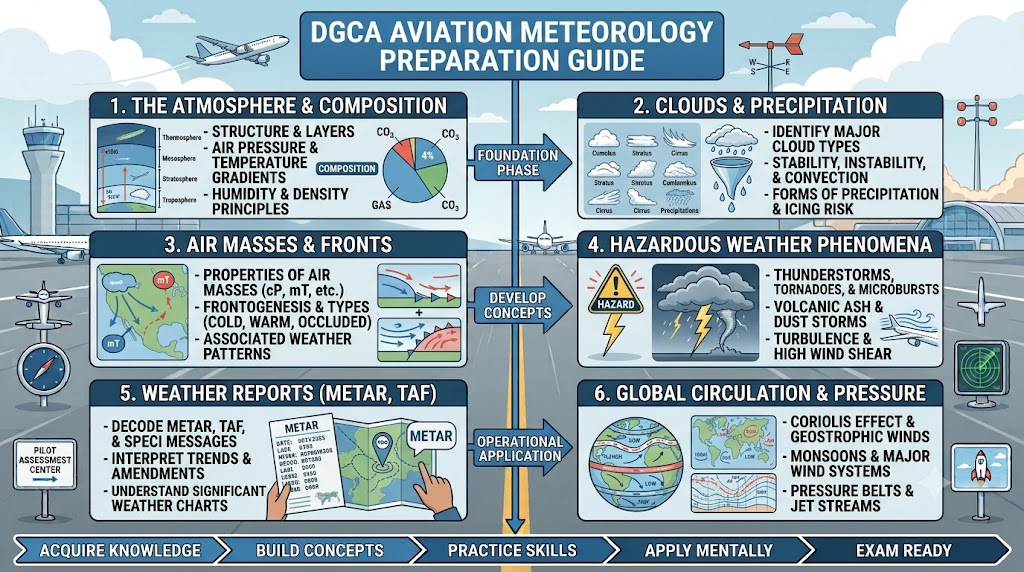
Aviation meteorology is an important part of pilot training because weather can directly influence flight planning, aircraft performance, visibility, and operational decisions. For students preparing for DGCA-related aviation examinations, understanding meteorology requires more than memorizing definitions and weather terms. A strong foundation in atmospheric conditions, weather systems, aviation hazards, and weather reports can make the subject much easier to understand. This guide explains the major areas students should study and practical ways to prepare effectively.
Main Content
Understanding Aviation Meteorology
Aviation meteorology is the study of weather and atmospheric conditions as they relate to aviation. It helps pilots understand how the atmosphere behaves and how different weather conditions may affect flight operations.
Weather is constantly changing. Temperature, pressure, wind, humidity, clouds, visibility, and precipitation can all influence an aircraft’s operating environment.
For a pilot, meteorology is not simply about knowing whether it will rain. It involves understanding the reasons behind weather changes and recognizing conditions that may create challenges during a flight.
Some important areas of aviation meteorology include:
- The atmosphere and its structure.
- Temperature and atmospheric pressure.
- Humidity and dew point.
- Wind and air movement.
- Cloud formation.
- Visibility.
- Weather systems.
- Thunderstorms.
- Turbulence.
- Icing.
- Fog and precipitation.
- Aviation weather reports and forecasts.
Why Meteorology Matters for Pilot Training
Weather knowledge is closely connected with safe and effective flight planning.
A pilot needs to understand whether expected weather conditions could affect a planned flight and how changing conditions may influence the operation.
Meteorological knowledge can help pilots understand situations involving:
- Strong winds.
- Reduced visibility.
- Thunderstorms.
- Turbulence.
- Icing conditions.
- Fog.
- Heavy precipitation.
- Changes in atmospheric pressure.
- Significant weather systems.
For students, this makes meteorology both a theoretical and practical subject. Learning the definitions is important, but understanding how the concepts relate to real weather situations is equally valuable.
Important Aviation Meteorology Topics
Atmosphere and Atmospheric Conditions
The atmosphere is the layer of gases surrounding Earth. Its characteristics change with altitude, location, temperature, and other environmental factors.
Students should develop a basic understanding of atmospheric structure and the way atmospheric conditions influence aviation.
Rather than trying to memorize isolated facts, it is useful to understand relationships between different elements of the atmosphere.
Temperature, Pressure, and Density
Temperature, pressure, and air density are fundamental concepts in aviation meteorology.
Temperature describes how warm or cold the air is, while atmospheric pressure refers to the force exerted by the atmosphere.
Air density is related to both temperature and pressure and is important in aviation because changes in air density can influence aircraft performance.
For beginners, the important point is to understand that the atmosphere is not uniform. Conditions can change with altitude and location, and those changes can affect the aircraft environment.
Humidity and Dew Point
Humidity refers to the amount of water vapor present in the atmosphere.
Dew point is the temperature to which air must be cooled, under the relevant conditions, for saturation to occur.
The relationship between temperature and dew point is particularly useful when studying the possibility of condensation, cloud formation, and fog.
Students should understand the difference between humidity and dew point rather than treating them as interchangeable terms.
Understanding Wind
Wind is the movement of air, and it is one of the most important weather elements for aviation.
Students should understand concepts such as:
- Wind direction.
- Wind speed.
- Headwind.
- Tailwind.
- Crosswind.
- Gusts.
- Changes in wind direction or speed.
Wind conditions are particularly important around takeoff and landing because aircraft movement relative to the surrounding air and runway can be affected by the wind.
Understanding wind also helps students interpret aviation weather reports.
Clouds and Their Aviation Significance
Clouds form when moist air cools sufficiently for water vapor to condense.
Aviation students should become familiar with the major cloud types and understand what different cloud structures can indicate about atmospheric conditions.
Some commonly discussed cloud types include:
Cirrus: High-level clouds that often appear thin and wispy.
Cumulus: Clouds that commonly have a rounded or puffy appearance.
Stratus: Generally layered clouds that can cover large areas.
Cumulonimbus: Large vertically developed clouds associated with thunderstorms and potentially hazardous conditions.
Not every cloud presents a significant aviation hazard. However, recognizing cloud development can help pilots understand the broader weather situation.
Visibility, Fog, and Mist
Visibility is particularly important to aviation because pilots need to know how clearly they can see the surrounding environment and relevant visual references.
Fog forms when near-surface air becomes sufficiently saturated for tiny water droplets to remain suspended close to the ground.
Mist is also associated with reduced visibility but generally represents less severe obscuration than fog under commonly used meteorological definitions.
Students should understand how temperature, humidity, dew point, and atmospheric conditions can contribute to reduced visibility.
Atmospheric Stability and Instability
Atmospheric stability describes how the atmosphere responds when air is displaced vertically.
In a stable atmosphere, vertical movement tends to be limited. In an unstable atmosphere, vertical air movement can be more pronounced.
This concept helps explain why some atmospheric conditions are more favorable for vertical cloud development and turbulence than others.
Understanding stability can make topics such as cloud development, convection, and turbulence easier to study.
Fronts and Air Masses
An air mass is a large body of air with relatively similar temperature and moisture characteristics.
A front is a boundary or transition zone between different air masses.
Students commonly study:
- Warm fronts.
- Cold fronts.
- Stationary fronts.
- Occluded fronts.
Weather associated with fronts can vary depending on the surrounding atmospheric conditions.
Understanding fronts helps students interpret larger weather patterns rather than viewing individual weather events in isolation.
Thunderstorms
Thunderstorms are among the most important weather phenomena for aviation students to understand.
They can involve several potentially hazardous conditions, including:
- Strong updrafts and downdrafts.
- Turbulence.
- Lightning.
- Heavy precipitation.
- Hail.
- Icing.
- Wind shear.
- Rapid changes in visibility.
Thunderstorms are associated with significant atmospheric instability and strong vertical air movement.
Students should understand the stages and general development of thunderstorms and why they are treated seriously in aviation weather planning.
Turbulence
Turbulence refers to irregular or disturbed movement of air.
It can occur for several reasons, including convection, terrain, weather systems, and atmospheric conditions at higher altitudes.
Common categories discussed in aviation meteorology include:
- Convective turbulence.
- Mechanical turbulence.
- Clear-air turbulence.
- Mountain-related turbulence.
The intensity and location of turbulence can vary considerably.
Students should understand the causes and characteristics of different types rather than simply memorizing their names.
Aircraft Icing
Aircraft icing occurs when supercooled water droplets or other suitable atmospheric conditions result in ice accumulation on an aircraft.
Ice accumulation can alter the aerodynamic characteristics of aircraft surfaces and may affect performance.
Icing is therefore an important aviation weather hazard.
Students should understand the atmospheric conditions associated with icing and the general risks involved. Actual operational procedures should always be learned through approved training material and aircraft-specific guidance.
Weather Information Used by Pilots
Pilots use different forms of weather information to understand current and forecast conditions.
Some commonly encountered aviation weather products include:
- METAR.
- TAF.
- SIGMET.
- AIRMET, where applicable.
- Weather charts.
- Radar information.
- Satellite information.
- Wind and significant-weather information.
Each product serves a different purpose.
Students should understand what type of information each product provides and whether it represents an observation, forecast, warning, or broader weather analysis.
Understanding METAR
METAR is a coded aviation weather report that provides observations from an aerodrome.
Depending on the report, students may encounter information concerning:
- Wind.
- Visibility.
- Present weather.
- Clouds.
- Temperature.
- Dew point.
- Atmospheric pressure.
- Other relevant observations.
Learning to interpret METARs is easier when students first understand the individual components rather than attempting to memorize the entire code as one block.
Regular practice can gradually make the format much more familiar.
Understanding TAF
TAF stands for Terminal Aerodrome Forecast.
While a METAR generally describes observed weather conditions, a TAF provides forecast information for an aerodrome.
Understanding this difference is essential.
Students should be able to distinguish between information describing what is being observed and information describing expected future conditions.
Reading Weather Charts
Weather charts provide a broader picture of atmospheric conditions.
Depending on the chart, students may encounter information about:
- Pressure systems.
- Fronts.
- Wind.
- Significant weather.
- Areas of particular meteorological interest.
Charts can initially look complicated, but students can become more comfortable with them by learning each symbol and feature separately.
Practical DGCA Meteorology Preparation Strategy
Step 1: Build the Basics
Begin with fundamental concepts such as the atmosphere, temperature, pressure, density, humidity, dew point, and wind.
These topics provide the foundation for understanding more advanced weather concepts.
Step 2: Understand Weather Formation
Once the basics are clear, study clouds, precipitation, atmospheric stability, air masses, and fronts.
Try to understand why particular weather conditions develop rather than memorizing definitions alone.
Step 3: Focus on Aviation Hazards
Give special attention to weather hazards that have important aviation significance.
These include:
- Thunderstorms.
- Turbulence.
- Icing.
- Fog.
- Wind shear.
- Strong winds.
- Reduced visibility.
Understanding the relationship between weather conditions and aviation hazards makes revision more meaningful.
Step 4: Learn Weather Reports
Practice reading METAR and TAF information regularly.
Start by learning individual abbreviations and components. Then gradually work toward interpreting complete reports.
Step 5: Practice Questions
Use appropriate practice questions after studying each topic.
Practice helps identify areas where understanding is weak.
Instead of simply checking whether an answer is correct, review why the answer is correct.
Step 6: Review Weak Areas
Keep track of topics that repeatedly cause confusion.
For example, a student may understand clouds well but struggle with pressure systems or weather-report decoding.
Focused revision can make study time more effective.
Step 7: Stay Updated With Applicable Requirements
Examination formats, syllabi, procedures, and regulatory requirements can change.
Students should verify current requirements through appropriate official information and approved training material rather than relying exclusively on older notes.
Important Meteorology Topics at a Glance
| Topic | What to Understand | Why It Matters |
|---|---|---|
| Atmospheric pressure | Pressure changes and basic pressure systems | Helps understand weather patterns |
| Temperature | Temperature variation and its atmospheric effects | Important for understanding atmospheric behavior |
| Humidity and dew point | Moisture, saturation, and condensation | Helps explain clouds and fog |
| Wind | Direction, speed, headwind, tailwind, and crosswind | Important for flight planning and operations |
| Clouds | Basic cloud types and development | Helps identify atmospheric conditions |
| Visibility | Factors that reduce visual range | Important for aviation operations |
| Thunderstorms | Development and associated hazards | Important because of significant weather risks |
| Turbulence | Causes and different types | Helps understand atmospheric movement |
| Icing | Conditions that support ice formation | Important aviation weather hazard |
| Weather reports | METAR, TAF, and other information | Supports weather interpretation |
Common Mistakes Students Should Avoid
Memorizing Without Understanding
Meteorology contains many definitions and terms, which can tempt students to rely entirely on memorization.
This approach can become difficult when examination questions require students to understand relationships between different concepts.
For example, understanding how temperature and dew point relate to saturation is more useful than memorizing the terms independently.
Ignoring METAR and TAF Practice
Students sometimes spend most of their preparation time reading theory and leave weather-report interpretation until the end.
Regular METAR and TAF practice can help build familiarity with aviation weather terminology and reporting formats.
Confusing Weather Terms
Some terms can appear similar but have different meanings.
Students should clearly distinguish concepts such as:
- Humidity and dew point.
- Visibility and cloud base.
- Headwind and tailwind.
- Weather observation and weather forecast.
- Stability and instability.
Creating simple notes that compare confusing concepts can be useful during revision.
Ignoring Aviation Hazards
A student may focus heavily on basic atmospheric theory and spend too little time understanding aviation hazards.
Thunderstorms, turbulence, icing, fog, and wind shear deserve careful attention because they connect meteorological theory with practical aviation.
Relying on Outdated Material
Aviation information can change.
Students should make sure their study material is appropriate for their current training and examination requirements.
Older notes may still contain useful fundamental concepts, but current regulatory and examination information should be verified.
Studying Only Before the Examination
Trying to learn the entire subject shortly before an examination can make it difficult to build a strong understanding.
Regular revision is generally more useful because students have time to identify and correct weak areas.
Overlooking Practical Interpretation
Meteorology becomes easier to understand when theoretical concepts are connected with actual weather situations.
For example, after studying dew point, students can think about how temperature and moisture relate to fog and cloud formation.
Practical Revision Approach
| Preparation Stage | Main Focus | Suggested Approach |
|---|---|---|
| Foundation | Atmosphere, pressure, temperature, humidity | Build strong conceptual understanding |
| Weather systems | Clouds, air masses, fronts, stability | Understand how weather develops |
| Aviation hazards | Thunderstorms, icing, turbulence, fog | Study causes and aviation significance |
| Weather reports | METAR and TAF | Practice interpretation regularly |
| Practice questions | Application of concepts | Review both correct and incorrect answers |
| Final revision | Weak areas and important concepts | Use concise notes and repeated practice |
Important Considerations
Aviation meteorology should not be treated as a subject that only needs to be memorized for an examination.
The knowledge has practical importance because weather can change rapidly and influence many aspects of flight operations.
Students should therefore try to connect theoretical concepts with real aviation situations.
For example, learning about atmospheric pressure becomes more meaningful when students understand how pressure systems relate to weather. Similarly, learning about humidity and dew point becomes easier when connected with cloud and fog formation.
Another important consideration is the use of reliable study material.
Students should use appropriate aviation textbooks, approved training resources, instructor guidance, and current information relevant to their examination. Current DGCA requirements should be verified through official sources because regulations and examination arrangements can change.
Students should also avoid assuming that one old question paper or study guide represents the complete current examination.
When practicing METAR and TAF interpretation, accuracy matters. Students should learn the meaning of individual codes and understand the overall weather picture rather than simply memorizing example reports.
It is also important to understand the difference between theoretical knowledge and operational decision-making. General meteorology knowledge can explain weather conditions, but actual flight decisions must follow applicable procedures, operational requirements, and appropriate professional guidance.
Frequently Asked Questions
1. What is aviation meteorology?
Aviation meteorology is the study of atmospheric and weather conditions as they relate to aviation. It covers subjects such as wind, pressure, temperature, clouds, visibility, turbulence, icing, and weather systems.
2. Why is meteorology important for pilot training?
Meteorology helps pilots understand weather conditions that may influence flight planning, aircraft operations, visibility, and other aspects of flying.
3. What topics should I study for aviation meteorology?
Important areas include atmospheric pressure, temperature, humidity, dew point, wind, clouds, visibility, fronts, air masses, thunderstorms, turbulence, icing, and aviation weather reports.
4. What is the difference between METAR and TAF?
A METAR generally provides observed weather conditions at an aerodrome, while a TAF provides forecast information for an aerodrome.
5. Why are thunderstorms important in aviation?
Thunderstorms can involve several significant weather hazards, including turbulence, lightning, heavy precipitation, hail, icing, strong vertical air movement, and wind shear.
6. How can I practice METAR decoding?
Begin by learning the individual components of a METAR and then practice interpreting complete reports using appropriate aviation study material. Regular practice can make the coded format easier to recognize.
7. Is aviation meteorology difficult for beginners?
It can seem difficult initially because it includes many new terms and concepts. However, learning the fundamentals first and gradually connecting them to practical weather situations can make the subject easier to understand.
8. Should I memorize meteorology concepts or understand them?
Understanding should come first. Some terminology and codes require memorization, but a strong conceptual understanding makes it easier to apply the information and answer questions involving related concepts.
9. How can I prepare for aviation meteorology effectively?
Build your fundamentals, study weather systems and hazards, practice METAR and TAF interpretation, solve appropriate practice questions, review weak areas, and use current study material relevant to your training.
10. Can DGCA examination requirements change?
Yes. Examination arrangements, regulatory requirements, and other details can change. Students should verify current information through appropriate official sources and their approved training resources.
Conclusion
Aviation meteorology is an important part of pilot education because weather influences the environment in which aircraft operate. A good preparation strategy begins with basic concepts such as temperature, pressure, humidity, dew point, and wind before moving into clouds, weather systems, aviation hazards, and weather reports.
METAR and TAF interpretation should receive regular attention because they connect meteorological theory with practical aviation information. Students should also understand thunderstorms, turbulence, icing, fog, and wind shear rather than treating them as simple terms to memorize.
The most effective preparation combines conceptual understanding, regular practice, revision, and appropriate study material. Students should also verify current DGCA requirements because examination and regulatory information can change.
Approaching aviation meteorology as a practical aviation subject, rather than simply an examination topic, can help students build stronger and more useful knowledge for their future flying careers.

