
Introduction
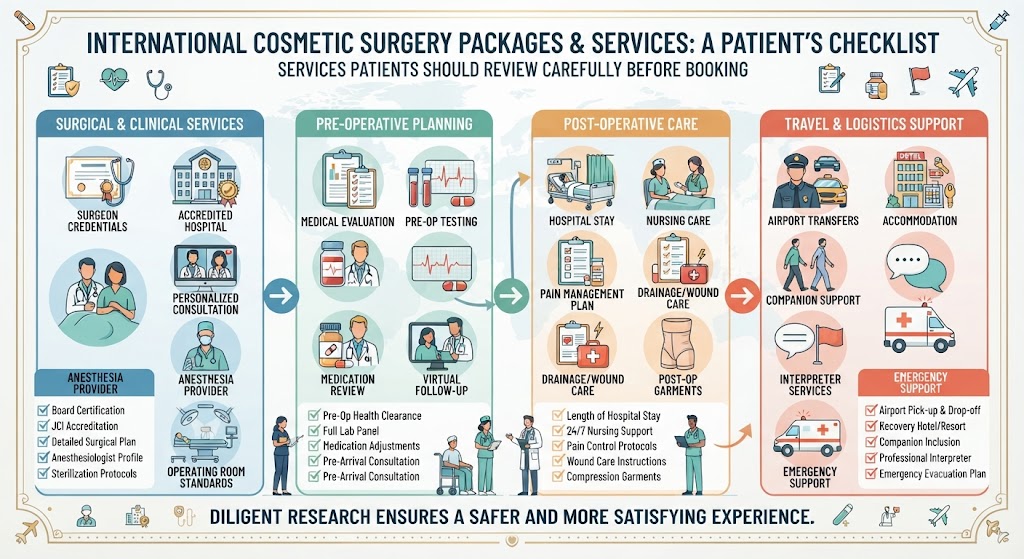
International cosmetic surgery packages can appear convenient because they may combine medical treatment, accommodation, local transportation and patient coordination under one advertised price.
However, the words complete, premium or all-inclusive do not have one universal medical or legal meaning. One package may include the surgeon, hospital, anesthesia and follow-up care, while another may cover only the procedure, hotel and airport transfers.
The Centers for Disease Control and Prevention advises medical travellers to investigate professional qualifications, facility credentials, follow-up arrangements, insurance coverage and the possible cost of emergency care before travelling. It also warns that travel during recovery can create additional health risks, including blood clots after surgery.
Patients should therefore separate attractive travel services from essential medical care. A luxury hotel or private driver may improve comfort, but neither confirms that the surgeon is qualified or that the operating facility has appropriate safety systems.
BestCosmeticHospitals.com can help patients begin comparing hospitals, surgeons, destinations, procedures and estimated costs. Every package detail should still be confirmed directly with the hospital and independently verified before payment.
What Is an International Cosmetic Surgery Package?
An international cosmetic surgery package is a collection of medical and non-medical services offered to patients travelling outside their home country for treatment.
A package may include:
- Online consultation
- Surgeon’s fee
- Hospital or clinic charges
- Anesthesia
- Medical tests
- Medication
- Implants or medical supplies
- Hotel accommodation
- Airport transfers
- Hospital transportation
- Translation support
- Patient coordination
- Compression garments
- Follow-up appointments
- Remote aftercare
Some packages are arranged directly by a hospital. Others are sold by a clinic, medical tourism agency, independent coordinator or travel company.
Patients should identify which organization is legally responsible for each service. The company collecting payment may not own the hospital or employ the surgeon.
Why Cosmetic Surgery Packages Appeal to International Patients
Patients may consider a package because it appears to simplify:
- Hospital selection
- Appointment scheduling
- Travel planning
- Communication
- Accommodation
- Local transport
- Treatment payments
- Recovery arrangements
Package pricing may also make it easier to compare plastic surgery costs by country.
However, convenience should not replace medical research. ISAPS advises patients considering surgery abroad to create a proper plan, choose the procedure and surgeon carefully, verify the surgical facility and understand recovery arrangements.
A professionally organized itinerary does not necessarily mean that the medical treatment has been independently assessed for safety or suitability.
Separate Medical Services from Travel Services
The first step is to divide the package into two categories.
Medical Services
These may include:
- Surgeon consultation
- Medical assessment
- Procedure
- Anesthesia
- Operating-room use
- Nursing care
- Hospital stay
- Medication
- Implants
- Laboratory testing
- Postoperative examinations
- Complication management
Non-Medical Services
These may include:
- Flights
- Visa assistance
- Hotel
- Meals
- Airport collection
- Local transportation
- Translator
- Tourism activities
- Personal assistant
- Mobile telephone service
Both categories may be useful, but medical quality should be evaluated independently from travel convenience.
A five-star hotel should not influence how patients judge surgeon training, anesthesia care, infection control or emergency support.
Services Patients Should Review Carefully
1. Online Consultation
Many international packages begin with an online assessment through photographs, forms or a video consultation.
Ask:
- Will I speak directly with the operating surgeon?
- Who reviews my photographs and health information?
- Is the coordinator medically qualified?
- Will the surgeon examine me in person before confirming surgery?
- Can the treatment plan change after examination?
- What happens when I am found medically unsuitable?
- Is the deposit refundable in that situation?
Online consultations can help with initial planning, but they may not replace a physical examination, complete medical history, testing and anesthesia review.
ISAPS recommends that patients understand whether they are suitable for the planned procedure and receive medical screening for factors that may increase complication risk.
Be cautious when a procedure is approved within minutes by a sales representative who has not arranged a meaningful surgeon consultation.
2. Named Operating Surgeon
The package should identify the surgeon by full name before the patient pays.
Verify:
- Medical registration
- Specialist status
- Board certification or national equivalent
- Training in plastic surgery
- Experience with the exact procedure
- Professional standing
- Hospital affiliation
- Who will perform each part of the operation
ISAPS advises patients to verify the surgeon’s certification, training and the credentials of the clinic or hospital.
Do not accept vague wording such as “one of our top surgeons” unless the agreement clearly explains how the surgeon will be selected and whether the patient can refuse a substitution.
3. Hospital or Clinic Charges
The package should identify the exact facility where surgery will take place.
Ask whether the fee includes:
- Operating theatre
- Recovery room
- Nursing care
- Medical equipment
- Overnight stay
- Private room
- Additional hospital nights
- Emergency care
- Intensive-care services
- Hospital discharge documents
Patients should verify that the facility is legally authorized for surgery and check the name, scope and validity of any accreditation.
ISAPS identifies a safe surgical setting as one authorized by the country’s regulatory system, with trained personnel and emergency procedures. It advises patients to verify hospital or clinic accreditation or certification.
JCI explains that accreditation involves an external assessment of healthcare quality and patient-safety standards. Accreditation may be a useful indicator, but it does not guarantee an individual outcome.
4. Anesthesia Services
Anesthesia should not appear as a simple unexplained line in the package.
Confirm:
- Name and qualification of the anesthesia professional
- Type of anesthesia planned
- Preoperative anesthesia assessment
- Monitoring during surgery
- Recovery-room monitoring
- Management of previous anesthesia reactions
- Emergency equipment
- Whether the anesthesia fee is fully included
Ask whether the anesthetist will remain present throughout the procedure.
A package should not reduce anesthesia costs by assigning responsibilities to people who are not appropriately qualified under local law.
5. Medical Tests
Some packages describe preoperative testing as included but do not identify the tests.
Ask for a written list covering:
- Blood tests
- Pregnancy test where relevant
- Heart assessment
- Imaging
- Infection screening
- Anesthesia investigations
- Other procedure-specific testing
Also ask:
- Are tests performed before travel or after arrival?
- Who reviews the results?
- What happens when a test is abnormal?
- Will surgery be delayed or cancelled?
- Who pays for additional investigations?
- Is the deposit refundable if surgery cannot proceed?
Medical tests should be selected according to the patient’s procedure, age, health and clinical assessment rather than offered as one identical list for everyone.
6. Implant and Medical-Device Costs
Packages for breast augmentation, facial implants or other device-based procedures should identify the product clearly.
Request:
- Manufacturer
- Product name
- Size and type
- Model or serial information
- Regulatory status
- Warranty details
- Implant identification card
- Replacement or removal terms
- Cost difference between product options
Do not accept “premium implant included” without documented product information.
Patients should retain implant records because they may be needed for future monitoring, treatment or revision surgery.
7. Medication and Medical Supplies
Ask whether the package includes:
- Medication used in hospital
- Discharge medication
- Pain relief
- Antibiotics when prescribed
- Compression garments
- Dressings
- Wound-care materials
- Drain supplies
- Special support garments
Confirm how many days of medication are provided and what happens if additional treatment is required.
Patients should receive clear instructions about dosage, possible side effects and where to obtain replacement medicine.
8. Hospital Stay
A package may advertise one hospital night even when the appropriate stay depends on the procedure and recovery.
Ask:
- Is the procedure normally day surgery?
- Why is the stated stay appropriate?
- Who decides when discharge is safe?
- What clinical monitoring is provided?
- What happens when discharge must be delayed?
- How much does an extra night cost?
- Can the patient be transferred to another hospital if needed?
Discharge should be based on clinical condition, not on the package schedule or hotel booking.
9. Accommodation
Package accommodation may be provided through a hotel, apartment or recovery house.
Confirm:
- Name and location
- Number of nights
- Room type
- Accessibility
- Lift availability
- Distance from the hospital
- Food arrangements
- Cleaning schedule
- Flexible extension terms
- Whether a companion can stay
- Cancellation rules
A recovery house should not automatically be assumed to be a medical facility.
Ask:
- Are nurses present?
- What are their qualifications?
- Is care available overnight?
- Who manages medication and dressings?
- What happens during an emergency?
- Is the property licensed to provide healthcare?
ISAPS advises patients to plan where they will stay while recovering and confirm that the accommodation can meet their postoperative needs.
10. Airport and Local Transfers
Transportation can be useful, especially when patients have limited mobility.
Ask whether transfers include:
- Airport to hotel
- Hotel to hospital
- Hospital to accommodation
- Follow-up appointments
- Pharmacy visits
- Return to airport
- Transport for a companion
- Additional journeys during complications
Check whether the vehicle is suitable after surgery and whether assistance is available for entering, leaving and carrying luggage.
Transport staff should not provide medical advice unless they are qualified to do so.
11. Interpreter and Language Support
Clear communication is necessary for consent, medication instructions and emergency care.
Ask:
- Is a professional medical interpreter available?
- Is the service available during consultations and surgery admission?
- Is it available after normal working hours?
- Are written instructions provided in a language I understand?
- Who interprets during an emergency?
- Is interpretation included in the price?
Do not rely only on automated translation for consent forms, risks or urgent medical communication.
The patient should be able to speak directly with the surgeon and clinical team rather than receiving every medical explanation through a salesperson.
12. Patient Coordinator
A coordinator may help arrange appointments, travel and communication.
Clarify whether the coordinator is:
- A hospital employee
- Clinic employee
- Medical tourism agent
- Independent contractor
- Sales representative
- Qualified nurse or other healthcare professional
Ask what decisions the coordinator is permitted to make.
A coordinator should not:
- Diagnose the patient
- Confirm medical suitability
- Select the operation without a surgeon
- Change medication
- Promise a result
- Minimize complications
- Replace emergency medical care
Patients should understand whether the coordinator receives a commission for bringing them to a particular provider.
13. Postoperative Appointments
The package should state how many follow-up appointments are included and who conducts them.
Ask:
- Will the operating surgeon examine me?
- Are nurses or assistants providing the review?
- On which days will appointments occur?
- Are dressings, drains and stitches included?
- Is imaging included when necessary?
- What happens if additional reviews are needed?
- Is follow-up available during evenings or weekends?
ISAPS advises patients to plan aftercare and understand where they will be during the first postoperative period, when anesthesia-related or bleeding concerns may arise.
One short appointment before the return flight may not be enough for every procedure.
14. Remote Follow-Up
International packages often include follow-up through telephone calls, photographs or video appointments.
Confirm:
- Length of remote support
- Named person responsible
- Surgeon availability
- Response times
- Secure method for sharing photographs
- Process for urgent concerns
- Coordination with doctors at home
- Whether additional consultations cost extra
Remote communication can support aftercare, but it cannot replace physical examination, laboratory testing, wound treatment or emergency care when these are needed.
The CDC advises arranging follow-up care before travelling and understanding that treatment of complications after returning home may be expensive and may not be covered by insurance.
15. Complication Management
This is one of the most important sections of the package.
Ask what happens if the patient develops:
- Infection
- Bleeding
- Wound separation
- Blood clot
- Breathing difficulty
- Delayed healing
- Implant problem
- Severe asymmetry
- Anesthesia complication
- Need for another operation
The written policy should explain:
- Which hospital provides emergency care
- Who pays for treatment
- Whether extra nights are included
- Whether the surgeon’s professional fee is charged again
- Whether anesthesia is charged again
- Whether medication and testing are covered
- How care continues after returning home
CDC investigations have documented serious adverse outcomes, including infections, among patients receiving travel-related cosmetic procedures. A 2026 CDC review identified reports involving both international and domestic facilities, showing why complication planning should be taken seriously.
A provider claiming that complications “never happen” should be treated as a warning sign.
16. Revision Surgery Policy
Revision treatment is different from urgent complication care.
A revision policy should define:
- What the provider considers a revision
- When a result can be assessed
- Clinical reasons for revision
- Excluded situations
- Surgeon’s fee
- Hospital fee
- Anesthesia fee
- Implant or material charges
- Flights and accommodation
- Time limit for requesting review
- Required photographs or examinations
- Whether treatment must occur in the same country
The phrase “free revision” often does not mean that every cost is covered.
A patient may still be responsible for travel, hotel, hospital charges, anesthesia, medication and lost income.
17. Travel Insurance and Complication Insurance
Ordinary holiday insurance may exclude planned medical procedures.
Before travelling, obtain written answers about coverage for:
- Planned cosmetic surgery
- Complications
- Emergency hospitalization
- Additional accommodation
- Flight changes
- Medical evacuation
- Repatriation
- Treatment after returning home
- A travelling companion
- Pre-existing conditions
ISAPS advises patients to evaluate insurance and the total financial cost, including additional treatment if a complication occurs.
Do not accept a coordinator’s verbal statement that “insurance is included.” Ask for the policy document, insurer name, coverage limits, exclusions and claims process.
What “All-Inclusive” May Not Include
A package described as all-inclusive may still exclude:
- Flights
- Visa fees
- Medical tests
- Specialist medical clearance
- Anesthesia
- Implants
- Additional medication
- Compression garments
- Blood transfusion
- Intensive-care treatment
- Extra hospital nights
- Additional hotel nights
- Companion expenses
- Local follow-up at home
- Emergency treatment
- Revision surgery
- Changed return flights
- Lost income
- Currency-conversion charges
- Bank-transfer fees
Patients should request an itemized quotation with an included and excluded column.
The ISAPS fee guidance advises patients to consider surgeon, facility, anesthesia, implants, garments, laboratory work, medication, aftercare, travel, time away from work and possible complication costs when calculating the total expense.
Package Comparison Table
| Package Area | Evidence to Request | Positive Sign | Warning Sign |
|---|---|---|---|
| Surgeon | Full name, registration and qualifications | Independently verifiable specialist | Surgeon named only after payment |
| Facility | Licence, location and accreditation | Valid information for exact branch | Certificate belongs to another facility |
| Procedure | Written treatment plan | Exact technique and limitations explained | Vague “full transformation” description |
| Anesthesia | Provider’s name and qualification | Proper assessment and continuous monitoring | No named anesthesia professional |
| Medical tests | Itemized test list | Tests based on personal assessment | Same minimal testing for every patient |
| Accommodation | Hotel or recovery-house details | Accessible and close to medical care | Luxury marketing without care information |
| Follow-up | Appointment schedule | Surgeon-led reviews and emergency contact | One quick appointment only |
| Complications | Written treatment and payment policy | Clear emergency pathway | Provider refuses to discuss complications |
| Revision | Defined coverage and exclusions | Transparent clinical and financial terms | “Free revision” without details |
| Insurance | Full policy document | Coverage and exclusions clearly stated | Verbal promise from coordinator |
| Refunds | Written cancellation terms | Clear timelines and conditions | Non-refundable payment before assessment |
| Total price | Itemized quotation | Medical and travel charges separated | One package figure without breakdown |
Combining Multiple Procedures in One Package
Some international packages promote several operations during one trip.
Examples may include:
- Tummy tuck with liposuction
- Breast augmentation with breast lift
- Facelift with eyelid surgery
- Body contouring across several areas
- Hair transplant with facial procedures
Combining procedures may reduce separate travel arrangements, but it can also increase operating time, recovery demands and the complexity of aftercare.
Ask:
- Why are these procedures being combined?
- Are all procedures medically appropriate?
- How long will surgery take?
- What are the anesthesia risks?
- Is overnight monitoring required?
- Would staged treatment be safer?
- How will mobility be affected?
- Is blood-clot prevention planned?
- Can the accommodation support the recovery?
The package should be designed around clinical suitability rather than maximizing the amount of treatment sold during one journey.
Travel Timing and Return Flights
The return date should not be decided only by the lowest airfare or package duration.
Surgery and long periods of immobility during travel can both increase blood-clot risk. The CDC specifically notes that air travel after surgery may add risk because patients can remain seated for long periods during a period of increased clotting tendency.
Before purchasing flights, ask the surgeon:
- How long should I stay near the hospital?
- Which follow-up appointments are required?
- When can I travel safely?
- Will I receive written fitness-to-fly guidance?
- What happens if recovery delays travel?
- Who pays for a changed ticket?
Avoid packages that schedule sightseeing or long-distance travel immediately after surgery.
Payment, Deposit and Refund Terms
Patients should understand the financial agreement before sending money.
Check:
- Deposit amount
- Remaining-payment schedule
- Currency
- Bank fees
- Card charges
- Refundable amount
- Cancellation deadline
- Rescheduling rules
- Medical-cancellation terms
- Visa-refusal terms
- Provider-cancellation terms
- Surgeon-substitution policy
- Refund processing time
Ask what happens if:
- Medical tests show surgery is unsuitable
- The surgeon changes
- The hospital changes
- The procedure changes
- Travel is cancelled
- The patient decides not to proceed after consultation
Do not send payment to a personal bank account unless the provider has supplied a clear and verifiable legal explanation.
Keep copies of quotations, invoices, messages, agreements and payment receipts.
Cosmetic Surgery Package Price by Procedure
Package prices may be marketed around individual procedures such as:
- Rhinoplasty cost by country
- Liposuction cost by country
- Breast augmentation cost by country
- Tummy tuck cost by country
- Hair transplant cost by country
Patients should compare identical services.
For example, one breast augmentation quotation may include implants, anesthesia, overnight care and garments. Another may list only the surgeon’s fee.
Similarly, hair transplant packages may differ according to:
- Number of grafts
- Technique
- Doctor involvement
- Medication
- Follow-up
- Accommodation
- Number of treatment sessions
General country price comparisons are useful only as a starting point. A personal quotation should be issued after appropriate clinical assessment.
Warning Signs in International Cosmetic Surgery Packages
Be cautious when a provider:
- Guarantees perfect results
- Describes surgery as risk-free
- Offers a discount that expires immediately
- Refuses to name the surgeon
- Changes the surgeon after payment
- Approves treatment without medical assessment
- Focuses more on the hotel than the hospital
- Claims every cost is included without providing a breakdown
- Will not explain anesthesia arrangements
- Recommends several operations without assessing health
- Provides no emergency plan
- Provides no written revision terms
- Says ordinary travel insurance covers everything
- Pressures the patient to pay through a personal account
- Schedules tourism during early recovery
- Promises a fixed return date regardless of healing
- Communicates only through a salesperson
- Refuses to provide medical records
A patient should be prepared to leave the arrangement when important information remains unclear.
Questions to Ask Before Booking a Package
- Who is the operating surgeon?
- How can I verify the surgeon’s registration?
- Where will surgery take place?
- Is the facility licensed and accredited?
- Who will provide anesthesia?
- Which medical tests are included?
- What implant or medical products will be used?
- How many hospital nights are included?
- What happens if I need an extra hospital night?
- Who provides postoperative care?
- How many surgeon follow-up appointments are included?
- What services does the coordinator provide?
- Is the recovery accommodation medically staffed?
- What happens during an emergency?
- Who pays for complication treatment?
- What exactly is included in the revision policy?
- Are flights and travel insurance included?
- Which costs are excluded?
- When is the deposit refundable?
- Who provides follow-up after I return home?
How BestCosmeticHospitals.com Supports Package Research
BestCosmeticHospitals.com helps patients begin structured comparisons of:
- Best cosmetic hospitals in the world
- Best cosmetic surgeons in the world
- Cosmetic surgery abroad
- Best countries for plastic surgery
- Plastic surgery cost by country
- Hospital facilities
- Procedure availability
- International patient services
- Recovery expectations
- Treatment inclusions
- Safety considerations
The platform can help patients prepare questions and identify areas requiring verification.
It should not replace direct consultation, official credential checks, independent financial advice or a personal medical assessment.
Final Package Review Checklist
Before paying for an international cosmetic surgery package, confirm that you have:
- Verified the named surgeon
- Confirmed procedure-specific experience
- Verified the hospital licence
- Checked accreditation details
- Identified the anesthesia professional
- Received an individual medical assessment
- Received a written treatment plan
- Reviewed possible risks
- Identified all medical tests
- Confirmed implant or product details
- Reviewed the hospital-stay allowance
- Checked accommodation suitability
- Confirmed transport arrangements
- Identified interpreter availability
- Understood the coordinator’s role
- Received a follow-up schedule
- Reviewed the complication policy
- Reviewed the revision policy
- Checked insurance exclusions
- Confirmed the recommended length of stay
- Received an itemized cost breakdown
- Identified every excluded expense
- Reviewed deposit and refund terms
- Kept an emergency fund
- Arranged follow-up at home
- Prepared to cancel when safety information cannot be verified
Frequently Asked Questions
1. What does an all-inclusive cosmetic surgery package normally cover?
Coverage varies between providers. It may include the procedure, surgeon, hospital, hotel and transfers, but patients must request a written list of inclusions and exclusions.
2. Are flights usually included in international surgery packages?
Many packages exclude international flights even when local transfers are included. Patients should confirm flights, baggage, ticket changes and cancellation expenses separately.
3. Does a package price include treatment of complications?
Not always. Emergency tests, extra hospital nights, medication and another operation may be excluded. The complication policy should be obtained in writing.
4. How can patients verify the hospital included in a package?
Check the hospital’s licence and accreditation through the issuing regulator or accrediting body. Confirm that the certificate applies to the exact treatment location.
5. Is hotel accommodation the same as a medical recovery facility?
No. A hotel generally provides accommodation rather than clinical care. A recovery house should identify its licences, staff qualifications and emergency procedures.
6. Can a coordinator decide whether a patient is suitable for surgery?
Medical suitability should be determined by qualified clinical professionals. A coordinator may organize services but should not replace the surgeon or anesthesia team.
7. What does free revision surgery usually mean?
The meaning varies. It may exclude hospital charges, anesthesia, implants, flights, accommodation and medication, so every included expense should be documented.
8. Should patients book flights before the surgeon confirms recovery time?
Return travel should be planned around the procedure and medical guidance. Flexible booking may reduce financial pressure if healing takes longer than expected.
9. Are cosmetic surgery packages always cheaper than booking services separately?
Not necessarily. Patients should compare the complete package with individually priced medical care, travel, insurance, accommodation and aftercare.
10. What is the most important package detail to review?
No single detail is enough. Surgeon qualifications, facility safety, anesthesia, complication care, aftercare and complete costs should all be reviewed together.
Conclusion
International cosmetic surgery packages can make overseas treatment easier to organize, but convenience and attractive pricing should not be confused with medical quality.
Patients should examine every part of the package separately. The surgeon, hospital, anesthesia, testing, implants, hospital stay, aftercare, complication policy and revision terms require more attention than hotel quality or airport transfers.
The WHO Surgical Safety Checklist was designed to reduce surgical errors and improve communication among surgeons, anesthesia professionals and nurses. Patients can ask whether the facility uses this checklist or an equivalent structured system.
BestCosmeticHospitals.com can support initial comparisons between hospitals, specialists, destinations, procedures and estimated costs. The final decision should be made only after independent verification and direct consultation with qualified medical professionals.

