
Introduction
Wind and turbulence are natural parts of flying. Every student pilot must learn how wind affects aircraft movement, take-off performance, navigation, climb, approach, and landing.
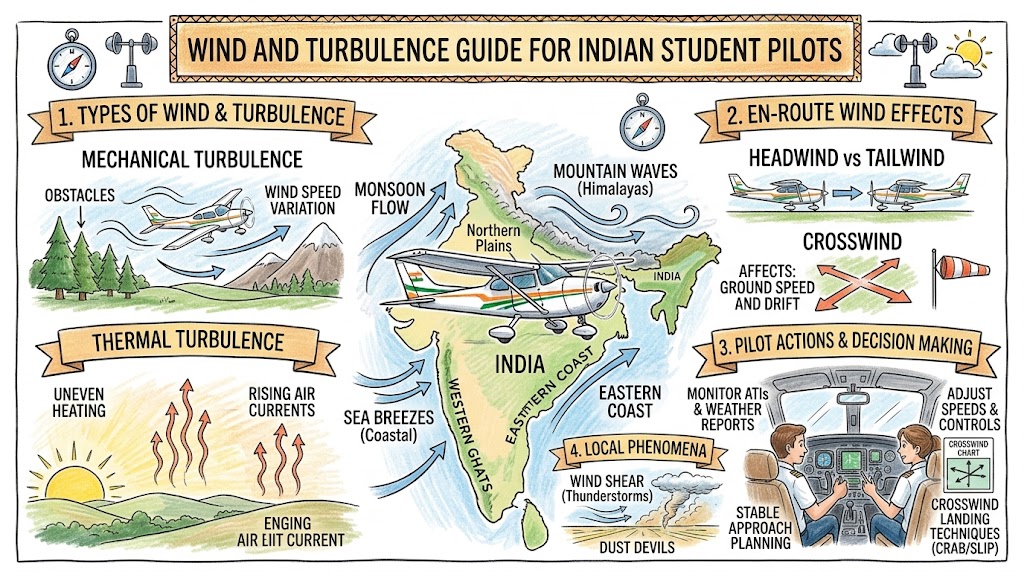
For Indian student pilots, wind conditions can change significantly depending on location and season. Coastal areas may experience sea breezes, northern regions may face strong seasonal winds, desert regions may produce dust-laden gusts, and pre-monsoon weather can create strong turbulence and wind shear.
Understanding wind is not only about reading a wind speed and direction. It also involves recognizing gusts, crosswinds, headwinds, tailwinds, mechanical turbulence, thermal activity, and dangerous weather changes.
This guide explains the major wind and turbulence concepts that Indian student pilots should understand before and during flight training.
Why Wind Knowledge Matters for Student Pilots
Wind affects almost every phase of flight.
It can change:
- Take-off distance
- Climb performance
- Ground track
- Fuel consumption
- Flight time
- Circuit pattern
- Approach stability
- Landing distance
- Aircraft control
- Passenger comfort
A student pilot who understands wind can make better decisions and maintain better control of the aircraft.
Poor wind awareness may lead to navigation errors, unstable approaches, runway excursions, excessive drift, or difficulty maintaining altitude and heading.
Understanding Wind Direction and Speed
Wind direction describes where the wind is coming from.
For example, a wind reported from 270 degrees is blowing from the west toward the east.
Wind speed is normally expressed in knots.
Students should understand the difference between:
- Surface wind
- Wind at altitude
- Average wind
- Gusting wind
- Variable wind
- Crosswind
- Headwind
- Tailwind
The wind experienced at the surface may be different from the wind at circuit altitude or during cross-country flight.
Major Wind Conditions in Flight Training
| Wind condition | Effect on aircraft | Student pilot response |
|---|---|---|
| Headwind | Reduces groundspeed | Allow extra flight time and fuel |
| Tailwind | Increases groundspeed | Watch landing distance and circuit spacing |
| Crosswind | Pushes aircraft sideways | Apply drift correction and correct landing technique |
| Gusting wind | Causes rapid airspeed changes | Use smooth inputs and follow approved gust procedures |
| Variable wind | Direction changes frequently | Monitor wind reports and windsock |
| Wind shear | Sudden change in wind speed or direction | Avoid hazardous conditions and follow procedures |
| Mechanical turbulence | Bumpy airflow near terrain or buildings | Maintain safe altitude and reduce workload |
| Thermal turbulence | Rising and sinking air due to heating | Use smooth control corrections |
| Mountain wave | Strong vertical airflow near terrain | Avoid unless trained and conditions are suitable |
Headwinds
A headwind blows against the direction of flight.
During take-off, a headwind can improve performance by helping the aircraft reach the required airspeed with a lower groundspeed.
During cruise, however, a headwind reduces groundspeed and increases flight time.
Effects of a Headwind
- Shorter take-off ground roll
- Lower groundspeed
- Longer flight time
- Higher fuel requirement
- Increased drift correction during route changes
- Possible difficulty reaching the destination within planned fuel margins
Student pilots should calculate flight time and fuel using forecast winds rather than still-air figures.
Tailwinds
A tailwind blows in the same direction as the aircraft’s flight path.
During cruise, it increases groundspeed and may reduce flight time.
During take-off and landing, a tailwind can be dangerous because it increases the groundspeed required to achieve the correct airspeed.
Effects of a Tailwind
- Longer take-off roll
- Longer landing distance
- Higher groundspeed on approach
- Greater risk of runway overrun
- Faster movement around the circuit
- Reduced time to make corrections
Student pilots should not accept a tailwind take-off or landing unless it is permitted by aircraft limitations, runway requirements, weather conditions, and flying-school procedures.
Crosswinds
A crosswind blows across the runway or flight path.
Crosswind training is an essential part of pilot development because many runways are not perfectly aligned with the wind.
Crosswinds affect:
- Taxi control
- Take-off direction
- Climb-out track
- Circuit positioning
- Final approach
- Flare
- Landing rollout
Crosswind Component
The crosswind component is the part of the wind acting across the runway.
A strong wind slightly off the runway direction may produce a significant crosswind component.
Students should compare the crosswind component with:
- Aircraft information
- Flying-school limits
- Instructor limits
- Student solo limits
- Personal experience
- Runway condition
A demonstrated crosswind value is not always the same as a strict aircraft operating limit. Flying schools may apply more conservative limits for students.
Crosswind Taxi Technique
Wind affects an aircraft even while it is on the ground.
Students should position the flight controls correctly during taxiing.
The correct control position depends on:
- Wind direction
- Aircraft type
- High-wing or low-wing design
- Nosewheel or tailwheel configuration
- Taxi direction
Incorrect control positioning may allow a strong gust to lift a wing or reduce directional control.
Always follow the aircraft checklist and instructor guidance.
Crosswind Take-Off Technique
During a crosswind take-off, the student must maintain directional control and prevent the upwind wing from lifting.
Typical considerations include:
- Applying appropriate aileron into the wind
- Maintaining runway centreline
- Using correct rudder input
- Rotating at the recommended speed
- Allowing the aircraft to establish the correct climb attitude
- Correcting for drift after becoming airborne
Control inputs may be stronger during the early part of the take-off roll and gradually adjusted as airspeed increases.
Avoid forcing the aircraft into the air before it is ready.
Crosswind Landing Techniques
Two commonly taught crosswind landing methods are the crab method and the wing-low method.
Crab Method
The aircraft is pointed slightly into the wind during the approach to maintain the runway centreline.
Before or during touchdown, the aircraft must be properly aligned with the runway to avoid side loading on the landing gear.
Wing-Low Method
The pilot lowers the wing into the wind while using opposite rudder to keep the aircraft aligned with the runway.
The upwind main wheel may touch down first.
The exact method depends on:
- Aircraft type
- Instructor technique
- Wind strength
- Runway condition
- School procedure
Student pilots should practise these techniques only under proper instructor supervision.
Gusting Winds
A gust is a short-term increase in wind speed.
Gusting conditions can cause sudden changes in:
- Airspeed
- Lift
- Aircraft attitude
- Climb rate
- Descent rate
- Drift
- Approach stability
A strong gust may temporarily increase lift, while a sudden decrease in wind may reduce airspeed and lift.
Flying in Gusty Conditions
Students should:
- Maintain the recommended approach speed
- Apply any approved gust correction
- Avoid large control movements
- Expect changing control pressure
- Maintain runway alignment
- Be ready to go around
- Avoid excessive speed increases
Adding too much speed can create a long float and increase landing distance.
Use only the gust correction recommended by the aircraft manual, instructor, or flying school.
Variable Winds
Variable wind means the wind direction is changing.
This may happen during:
- Light wind conditions
- Thunderstorm activity
- Sea-breeze development
- Local terrain effects
- Weather-front movement
A runway that was suitable at the beginning of a flight may become less suitable later.
Students should monitor:
- Windsock
- Air traffic control reports
- Radio calls from other pilots
- Aircraft drift
- Changes in turbulence
- Runway selection
Never assume that the wind remains unchanged throughout the sortie.
Sea-Breeze Effects
Coastal flying schools in India may experience sea-breeze circulation.
During the day, land heats faster than the sea. Cooler air from the sea moves inland and can change the wind direction and speed.
Sea-breeze development may cause:
- Runway changes
- Increasing crosswinds
- Turbulence near the coastline
- Wind shifts during circuits
- Changes in visibility
- Local cloud development
Student pilots training near coastal cities should learn the usual timing and direction of local sea-breeze patterns.
Land Breeze
At night or early morning, land may cool faster than the sea.
This can produce a land breeze, where air moves from land toward the sea.
The land breeze is usually weaker than the daytime sea breeze but may still affect early-morning training operations.
Thermal Turbulence
Thermal turbulence develops when the sun heats the ground unevenly.
Different surfaces heat at different rates.
Strong heating may occur over:
- Dry fields
- Roads
- Industrial areas
- Buildings
- Rocky terrain
- Open ground
The rising warm air creates updrafts, while surrounding cooler air may descend.
Effects of Thermal Turbulence
- Difficulty maintaining altitude
- Sudden climb or descent
- Airspeed variation
- Unstable turns
- Bumpy circuit conditions
- Increased workload
- Passenger discomfort
Thermal turbulence is often stronger during the afternoon.
Students should use smooth control inputs and avoid chasing every small altitude change.
Mechanical Turbulence
Mechanical turbulence occurs when wind flows around or over obstacles.
Common sources include:
- Hills
- Mountains
- Trees
- Buildings
- Hangars
- Uneven terrain
- Airport structures
The air on the downwind side of an obstacle may become disturbed and turbulent.
Mechanical turbulence becomes stronger when wind speed increases.
Student pilots should be cautious when flying low near terrain or large structures.
Mountain Turbulence
Airflow over hills and mountains can produce strong vertical currents and turbulence.
Possible hazards include:
- Downdrafts
- Updrafts
- Rotor turbulence
- Mountain waves
- Sudden airspeed changes
- Reduced climb performance
Mountain flying requires special knowledge, training, and conservative planning.
Students should not attempt mountain operations without proper instructor guidance and suitable weather conditions.
Wake Turbulence
Wake turbulence is created by aircraft as their wings generate lift.
It forms rotating air patterns behind the aircraft, known as wingtip vortices.
Wake turbulence is strongest behind aircraft that are:
- Heavy
- Slow
- Cleanly configured
- Producing high lift
Student pilots flying light training aircraft must be careful when operating behind larger aircraft.
Wake Turbulence Precautions
- Maintain safe spacing
- Note the larger aircraft’s rotation point
- Avoid flying below and behind its path
- Be cautious during calm wind conditions
- Follow air traffic control instructions
- Delay take-off when necessary
Wake turbulence may remain near the runway when surface winds are light.
Wind Shear
Wind shear is a sudden change in wind speed, direction, or both over a short distance.
It may occur during:
- Take-off
- Climb
- Approach
- Landing
- Thunderstorm activity
- Frontal passage
- Sea-breeze movement
- Strong temperature inversion
Wind shear can cause rapid changes in airspeed and aircraft performance.
Possible Wind Shear Signs
- Sudden airspeed increase or decrease
- Unexpected pitch changes
- Rapid vertical speed changes
- Unusual power requirement
- Sudden wind-direction change
- Blowing dust
- Strong gust front
- Thunderstorm nearby
Wind shear near the ground is especially dangerous because there is little altitude available for recovery.
Student pilots should avoid known or suspected severe wind-shear conditions.
Microbursts
A microburst is a strong, concentrated downdraft that reaches the ground and spreads outward.
It can create extreme wind shear.
An aircraft may first experience an increasing headwind, followed by a downdraft, and then a strong tailwind.
This sequence can create a rapid loss of airspeed and climb performance.
Microbursts are commonly associated with thunderstorms and heavy rain.
Student pilots should never attempt to fly through or near suspected microburst activity.
Turbulence Intensity
Turbulence may be described as light, moderate, severe, or extreme.
Light Turbulence
Small changes in altitude or attitude occur. The aircraft remains easy to control.
Moderate Turbulence
Larger changes occur. Airspeed and altitude may vary, and maintaining precise control becomes more difficult.
Severe Turbulence
The aircraft may experience large and abrupt changes. Temporary loss of control may occur.
Extreme Turbulence
The aircraft may be violently disturbed and may suffer structural damage.
Student pilots should avoid conditions forecast or reported as severe or extreme turbulence.
Maintaining Control in Turbulence
When turbulence is encountered, students should:
- Maintain a safe attitude
- Use smooth control movements
- Avoid overcontrolling
- Maintain the recommended turbulence penetration speed
- Keep wings approximately level
- Avoid chasing altitude
- Monitor airspeed
- Secure loose items
- Follow instructor or air traffic instructions
- Consider returning, diverting, or landing
The priority is aircraft control, not perfect altitude holding.
Turbulence Penetration Speed
Aircraft manuals may provide a recommended turbulence penetration or manoeuvring speed.
This speed helps reduce structural loads during turbulence.
The correct speed may vary with aircraft weight.
Student pilots should know:
- Where to find the speed
- How weight affects it
- When to use it
- Why excessive speed is dangerous in turbulence
Never use a memorized number without confirming the correct aircraft-specific information.
Wind Effects During Circuit Flying
Wind changes the shape of the circuit pattern.
Upwind Leg
A headwind may reduce groundspeed and increase time spent climbing.
Crosswind Leg
The aircraft may drift away from or toward the runway.
Downwind Leg
A tailwind may increase groundspeed and shorten the time available for checks.
Base Leg
A strong tailwind can push the aircraft toward final approach more quickly than expected.
Final Approach
Crosswind, gusts, and turbulence may affect alignment and descent rate.
Students must adjust the circuit visually and avoid relying only on fixed timing.
Wind Effects on Navigation
Wind causes drift during cross-country flight.
Without correction, the aircraft may move away from the planned track.
Students should calculate:
- Wind correction angle
- Heading
- Groundspeed
- Estimated time en route
- Fuel required
During flight, compare:
- Planned track
- Actual track
- Time between checkpoints
- Wind direction
- Groundspeed
If actual conditions differ from the forecast, update the navigation plan.
Strong Wind and Fuel Planning
Headwinds can increase flight time and fuel consumption.
Students should include adequate fuel for:
- Stronger-than-forecast headwinds
- Diversion
- Holding
- Additional circuits
- Return to base
- Alternate aerodrome
- Required reserve
Never continue simply because the destination appears close.
Stable Approach in Windy Conditions
A stable approach becomes especially important during gusty or crosswind conditions.
A stable approach should include:
- Correct airspeed
- Correct descent path
- Proper alignment
- Appropriate configuration
- Controlled rate of descent
- Suitable power setting
- Clear runway
- Ability to go around
If the aircraft is not stable, aligned, or under control, execute a go-around.
When to Go Around
A go-around should be considered when:
- The approach is unstable
- The aircraft is not aligned
- Airspeed is outside safe limits
- Drift cannot be controlled
- The runway is occupied
- A sudden gust affects the approach
- Wind shear is suspected
- Touchdown occurs too far along the runway
- The aircraft bounces significantly
- The pilot feels uncomfortable
A go-around is a normal safety procedure.
Personal Wind Limits
Student pilots should have conservative personal limits.
These may include:
- Maximum crosswind
- Maximum total wind
- Maximum gust spread
- Minimum visibility
- Minimum cloud base
- Maximum turbulence level
- Minimum runway length
Solo limits should normally be stricter than dual-training limits.
Students should never increase personal limits simply because a flight slot is available.
Wind and Turbulence Pre-Flight Checklist
Weather Review
- Surface wind checked
- Gusts reviewed
- Crosswind component calculated
- Wind at altitude checked
- Turbulence forecast reviewed
- Wind shear warnings checked
- Thunderstorm risk reviewed
- Sea-breeze or terrain effects considered
Aircraft Planning
- Take-off distance checked
- Landing distance checked
- Aircraft weight considered
- Turbulence penetration speed reviewed
- Crosswind capability discussed
- Fuel calculation updated
Pilot Readiness
- Personal wind limits reviewed
- Instructor briefing completed
- Go-around decision discussed
- Alternate runway considered
- Workload assessed
- No pressure to complete the flight
In-Flight Monitoring
- Wind changes monitored
- Drift corrected
- Airspeed checked
- Turbulence level assessed
- Fuel remaining reviewed
- Return or diversion plan available
Common Mistakes Made by Student Pilots
Ignoring Gusts
A student may focus only on average wind speed and fail to consider the higher gust value.
Incorrect Crosswind Calculation
The total wind speed is not always the same as the crosswind component.
Overcontrolling
Large control movements can make turbulence more uncomfortable and reduce stability.
Flying a Fixed Circuit
Wind changes the circuit shape. Timing alone may lead to poor spacing and unstable approaches.
Delaying a Go-Around
Students may try to save an approach even when runway alignment or airspeed is no longer safe.
Underestimating Headwinds
Unexpected headwinds can increase flight time and reduce fuel reserves.
Following Larger Aircraft Too Closely
Wake turbulence can be dangerous for light training aircraft.
Flying Near Thunderstorms
Dangerous turbulence and wind shear can extend beyond visible rain.
Role of the Flight Instructor
Flight instructors help students convert weather information into practical decisions.
Wind and turbulence training should include:
- Wind interpretation
- Crosswind calculation
- Taxi control positioning
- Crosswind take-offs
- Crosswind landings
- Drift correction
- Circuit adjustment
- Gust management
- Turbulence control
- Wind shear awareness
- Wake turbulence avoidance
- Go-around decisions
Students should gradually learn to assess conditions independently while remaining within school and instructor limits.
Key Takeaways
- Wind affects every phase of flight.
- Headwinds reduce groundspeed, while tailwinds increase landing and take-off distance.
- Crosswind components must be calculated before flight.
- Gusting winds require smooth control inputs and stable-approach discipline.
- Thermal and mechanical turbulence are common during Indian flight training.
- Wind shear and microbursts can be dangerous near the ground.
- Wake turbulence is a serious risk for light training aircraft.
- Wind changes the circuit shape and cross-country navigation.
- Personal limits should remain conservative.
- A go-around is the correct decision when control or stability is uncertain.
Frequently Asked Questions
What is the difference between wind and turbulence?
Wind is the movement of air, while turbulence is irregular or disturbed airflow that causes sudden aircraft movement.
Is turbulence dangerous for student pilots?
Light turbulence is common and manageable, but moderate or stronger turbulence may exceed student ability or training limits.
How does a headwind affect a flight?
A headwind lowers groundspeed, increases flight time, and may increase fuel consumption.
Why is a tailwind dangerous during landing?
A tailwind increases groundspeed and landing distance, which can increase the risk of runway overrun.
What is a crosswind component?
It is the portion of the wind blowing across the runway rather than directly along it.
How should a pilot respond to turbulence?
Maintain control, use smooth inputs, monitor airspeed, follow the recommended speed, and avoid chasing altitude.
What causes thermal turbulence?
Thermal turbulence is caused by uneven ground heating, which creates rising and sinking air currents.
Can turbulence occur in clear weather?
Yes. Mechanical turbulence, mountain waves, wake turbulence, and clear-air turbulence can occur without visible storms.
When should a student pilot go around?
A go-around should be made whenever the approach becomes unstable, misaligned, unsafe, or uncomfortable.
Why is wind shear dangerous?
Wind shear can cause sudden airspeed and lift changes, particularly during take-off and landing when the aircraft is close to the ground.
Conclusion
Wind and turbulence are essential parts of pilot training. Indian student pilots must learn how headwinds, tailwinds, crosswinds, gusts, thermal activity, mechanical turbulence, wind shear, and wake turbulence affect aircraft performance and control. Careful weather analysis, conservative limits, smooth handling, and timely go-around decisions help make windy-weather training safer and more productive.

