
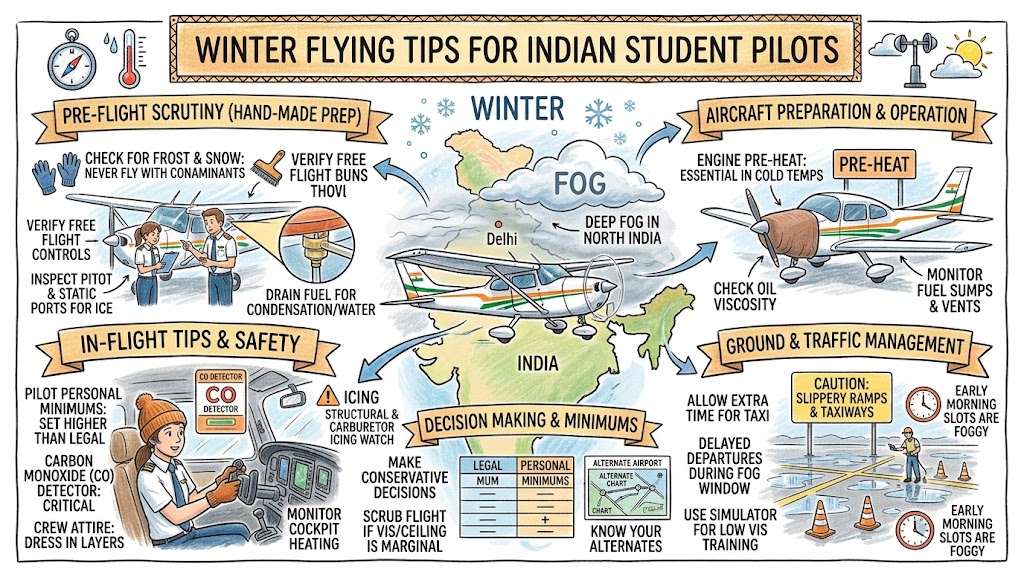
Introduction
Winter can offer some of the smoothest and most comfortable flying conditions in India. Cooler air often improves aircraft performance, reduces thermal turbulence, and makes cockpit conditions more manageable.
However, winter also brings its own challenges. Fog, mist, haze, low cloud, poor visibility, cold engine starts, moisture, wet runways, and rapidly changing morning weather can affect flight training.
For student pilots, winter flying is an excellent opportunity to improve weather interpretation, pre-flight preparation, navigation planning, and aeronautical decision-making.
The goal is not only to enjoy better aircraft performance. It is to understand how winter conditions can change visibility, runway safety, aircraft systems, and flight schedules.
Understanding Winter Flying Conditions in India
Winter conditions vary significantly across India.
Northern India may experience:
- Dense morning fog
- Very low visibility
- Cold surface temperatures
- Haze and air pollution
- Delayed flight operations
- Low cloud in some areas
Western and central regions may experience:
- Cool mornings
- Dry air
- Haze
- Temperature inversions
- Large differences between morning and afternoon temperatures
Coastal areas may remain relatively mild but can still experience:
- Mist
- Humidity
- Reduced early-morning visibility
- Sea-breeze changes
- Moisture on aircraft surfaces
Mountainous regions may face:
- Very low temperatures
- Frost
- Strong terrain-related winds
- Mountain waves
- Rapid weather changes
- Snow or ice at higher elevations
Student pilots must understand the specific winter pattern around their flying school rather than assuming that all Indian regions experience the same conditions.
Major Winter Flying Challenges
| Winter challenge | Possible effect on training | Recommended action |
|---|---|---|
| Fog and mist | Low visibility and delayed departures | Wait for safe conditions and updated reports |
| Haze | Reduced visual range and poor landmarks | Review route visibility carefully |
| Low temperature | Difficult engine start and cold equipment | Follow approved cold-start procedures |
| Frost or moisture | Reduced lift and increased drag | Inspect and clean aircraft surfaces |
| Wet runway | Longer landing roll and reduced braking | Calculate performance with safety margins |
| Temperature inversion | Trapped haze and poor visibility | Study local morning weather patterns |
| Low cloud | Reduced visual operating area | Check cloud base before departure |
| Cold cockpit | Reduced comfort and concentration | Wear suitable clothing without restricting movement |
Check Weather Conditions Carefully
Winter weather may appear calm and pleasant while still being unsuitable for visual flight training.
Before every flight, students should review:
- Current aerodrome weather report
- Terminal forecast
- Visibility
- Cloud base
- Temperature and dew point
- Wind direction and speed
- Runway condition
- Local weather warnings
- Destination and alternate conditions
- Expected improvement or deterioration
A clear sky above the aerodrome does not always mean good horizontal visibility. Haze, smoke, dust, and pollution can make distant objects difficult to identify.
Students should compare reported visibility with their school’s operational limits and their own experience level.
Understand Fog Formation
Fog is one of the most common winter challenges for flight training in northern India.
Fog forms when air near the ground becomes saturated and water vapour condenses into tiny droplets. It often develops when nights are cool, winds are light, and the air contains enough moisture.
Common Signs of Fog Risk
- Small difference between temperature and dew point
- Clear or partly clear night
- Light surface wind
- High humidity
- Moist ground
- Previous evening haze or mist
- Fog reported at nearby aerodromes
Fog can reduce visibility quickly and may remain longer than expected.
Student pilots should never assume that visibility will improve exactly at the forecast time. Actual conditions must always be checked before departure.
Avoid Pressure to Depart Early
Training schedules may become disrupted during winter because fog delays morning operations.
Students may feel pressure to complete a planned sortie once visibility begins to improve. However, marginal conditions can deteriorate again or remain unsuitable along the route.
A safe decision may include:
- Delaying departure
- Shortening the exercise
- Remaining within the local training area
- Changing to ground instruction
- Cancelling the flight
- Waiting for a more reliable weather improvement
Missing one training slot is far better than entering conditions beyond the pilot’s qualification or experience.
Pay Attention to Visibility, Not Only Cloud
Student pilots often focus heavily on cloud base while giving less attention to horizontal visibility.
Poor visibility can affect:
- Runway identification
- Circuit spacing
- Traffic detection
- Landmark recognition
- Visual navigation
- Distance judgement
- Terrain awareness
- Return-to-base decisions
Winter haze may make the horizon unclear. This can make attitude control more difficult, particularly for inexperienced pilots.
Students should avoid continuing visual flight when reliable ground references or a clear horizon are no longer available.
Inspect the Aircraft for Frost and Moisture
In colder regions, frost may form on aircraft surfaces during early mornings.
Even a thin layer of frost can disturb smooth airflow over the wings and reduce aerodynamic performance.
Inspect carefully:
- Wing upper surfaces
- Horizontal stabilizer
- Vertical stabilizer
- Control surfaces
- Windshield
- Pitot tube
- Static ports
- Air inlets
- Propeller
- Antennas
Do not attempt take-off with frost, snow, or ice on critical aircraft surfaces.
Moisture may also collect on the windshield or inside the cockpit. Ensure that visibility through the windshield is clear before taxiing.
Follow Correct Cold-Start Procedures
Cold temperatures can make engine starting more difficult.
Possible concerns include:
- Thick engine oil
- Reduced battery performance
- Slow starter operation
- Longer warm-up time
- Uneven engine response
- Increased wear during incorrect starting
Students must follow the approved aircraft checklist and instructor guidance.
Avoid repeated or excessive engine-start attempts, as this may drain the battery or create other risks.
After starting, monitor:
- Oil pressure
- Engine temperature
- Engine sound
- Electrical indications
- Fuel pressure
- Idle stability
Allow the engine to warm within approved limits before applying high power.
Use Carburettor Heat Correctly
Carburettor icing can occur even when outside temperatures are above freezing. It is influenced by temperature, humidity, throttle setting, and pressure changes within the carburettor.
Possible indications may include:
- Gradual reduction in engine revolutions
- Rough engine operation
- Loss of power
- Unexpected performance reduction
Students flying carburetted aircraft should understand:
- When carburettor ice is likely
- How to recognize its symptoms
- When to apply carburettor heat
- What indications to expect after application
- Aircraft-specific procedures
Always follow the Pilot Operating Handbook, checklist, and instructor guidance.
Allow Extra Time for Engine Warm-Up
An engine should not be rushed into high-power operation immediately after a cold start.
During warm-up:
- Monitor oil pressure
- Keep power within recommended limits
- Avoid unnecessary high revolutions
- Check engine response
- Confirm stable instrument indications
- Complete engine checks carefully
However, prolonged idling should also be avoided because it wastes fuel and may create engine or temperature-management issues.
The correct warm-up procedure depends on the aircraft and engine type.
Understand Improved Aircraft Performance
Cold air is denser than warm air. This often improves:
- Engine power
- Propeller efficiency
- Wing performance
- Climb rate
- Take-off performance
Students may notice stronger acceleration and better climb performance during winter mornings.
However, improved performance does not remove the need for calculation. Wind, runway condition, aircraft weight, elevation, and surface contamination still affect take-off and landing distance.
A student should never assume that cold weather automatically guarantees a short and safe take-off.
Be Prepared for Shorter Take-Off Performance
Improved acceleration may cause the aircraft to reach rotation speed sooner than expected.
Students should:
- Maintain directional control
- Use the correct rotation speed
- Avoid rotating early
- Follow the centreline
- Confirm engine indications
- Use smooth control inputs
Better performance should not lead to reduced discipline.
Manage Low Sun and Glare
Winter sun may remain low on the horizon during morning and evening flights.
Glare can make it difficult to see:
- Runway markings
- Aircraft traffic
- Ground obstacles
- Navigation landmarks
- Instrument indications
- Haze layers
Students can prepare by:
- Cleaning the windshield
- Carrying suitable aviation-safe sunglasses
- Using the sun visor where available
- Reviewing the runway direction
- Anticipating glare on final approach
- Avoiding sudden turns directly toward strong sunlight
Sunglasses should not interfere with instrument readability or colour recognition.
Prepare for Wet or Damp Runways
Fog, dew, frost, or overnight moisture can leave runway surfaces wet.
Wet surfaces may reduce braking effectiveness and increase landing distance.
Students should consider:
- Runway length
- Surface condition
- Crosswind
- Tailwind
- Aircraft weight
- Touchdown point
- Braking action
- Standing water
- Go-around options
A stable approach and accurate touchdown become especially important when the available runway is limited.
Avoid aggressive braking unless required by the situation and permitted by the aircraft procedure.
Maintain a Stable Approach
Winter haze, mist, and low sun can affect depth perception.
This may cause a student to:
- Fly too high
- Fly too low
- Misjudge runway distance
- Flare too early
- Flare too late
- Drift from the centreline
A stable approach should include:
- Correct airspeed
- Correct descent rate
- Proper alignment
- Appropriate power setting
- Clear landing area
- Timely configuration
- Readiness to go around
When the approach is unstable, execute a go-around.
Dress Appropriately for Flight
Students should wear clothing that protects against cold while allowing full movement.
Avoid:
- Bulky jackets that restrict controls
- Loose scarves near moving parts
- Gloves that reduce grip
- Footwear that reduces pedal sensitivity
- Clothing that interferes with seat belts
Layers are often more practical than one heavy garment.
Remember that cockpit temperature may increase after engine start or during daytime flying. Clothing should remain comfortable throughout the sortie.
Stay Hydrated in Winter
People often drink less water in cold weather because they feel less thirsty.
However, dehydration can still affect:
- Concentration
- Alertness
- Decision-making
- Reaction time
- Physical comfort
Students should drink water before flying and carry water when permitted.
Avoid relying only on tea or coffee. Excessive caffeine may cause restlessness, dehydration symptoms, or discomfort during flight.
Complete a Careful Pre-Flight Inspection
Cold mornings can encourage students to rush the external inspection.
Never shorten the inspection because of discomfort.
Check:
- Fuel quantity and quality
- Oil level
- Tyres and brakes
- Control movement
- Pitot and static openings
- Engine compartment
- Propeller
- Frost or moisture
- Lights
- Windshield condition
- Drain points
- Covers and locks
Use a flashlight during low-light morning inspections when necessary.
Plan for Delays
Winter operations often involve unpredictable delays due to fog, visibility, air traffic restrictions, or runway conditions.
Students should plan for:
- Late departures
- Reduced training time
- Additional fuel requirements
- Changes in exercise
- Instructor availability
- Sunset limitations
- Return-to-base weather
- Alternate landing options
Do not allow schedule pressure to influence safety decisions.
Review Fuel Planning
Cold weather does not remove the need for conservative fuel planning.
Consider:
- Taxi delays
- Holding time
- Weather diversion
- Fog at destination
- Return to departure aerodrome
- Alternate airport
- Additional circuit time
- Unexpected air traffic delays
Carry fuel in accordance with applicable rules, aircraft limitations, and school procedures.
Never reduce a required reserve merely to remain within a desired weight.
Monitor Changing Weather During Flight
Winter conditions may improve after sunrise but can also remain poor in haze-prone areas.
During flight, monitor:
- Forward visibility
- Ground references
- Cloud base
- Destination weather
- Sun position
- Fuel remaining
- Time available
- Alternate landing options
Turn back early when visibility begins to reduce.
Waiting until visual references are nearly lost creates unnecessary risk.
Use Conservative Personal Limits
A newly solo student should operate within stricter limits than an experienced commercial pilot.
Personal limits may include:
- Minimum visibility
- Minimum cloud base
- Maximum crosswind
- Maximum gust spread
- Minimum runway length
- Daylight restrictions
- Distance from the aerodrome
- Route familiarity
The flying school or instructor may impose additional limitations.
Personal limits should be decided before the flight, not after entering marginal weather.
Communicate Clearly With the Instructor
Students should discuss any concern before engine start.
Important questions include:
- Is visibility expected to improve?
- Is fog present along the training route?
- What is the latest safe return time?
- What is the plan if visibility reduces?
- Which alternate aerodrome is suitable?
- Are there known wet-runway concerns?
- Is frost possible?
- Are special engine-start procedures required?
Good communication is part of professional airmanship.
Winter Pre-Flight Checklist
Weather Check
- Current visibility reviewed
- Fog and mist risk assessed
- Temperature and dew point compared
- Cloud base checked
- Wind and gusts reviewed
- Destination and alternate weather checked
- Expected weather trend understood
Aircraft Check
- Frost and moisture removed
- Pitot and static openings clear
- Windshield clean
- Engine oil checked
- Battery condition considered
- Fuel drains checked
- Tyres and brakes inspected
- Engine warm-up procedure reviewed
Pilot Check
- Properly rested
- Adequately hydrated
- Warm but unrestricted clothing worn
- Sunglasses carried if necessary
- Personal weather limits reviewed
- No pressure to complete the flight
Operational Check
- Fuel reserve confirmed
- Alternate plan available
- Latest safe return time identified
- Go-around criteria reviewed
- Visibility escape plan discussed
- Instructor briefing completed
Common Winter Flying Mistakes
Departing as Soon as Fog Begins to Lift
Partial improvement does not always mean conditions are stable or suitable along the complete route.
Ignoring Frost
A thin layer of frost may appear harmless but can significantly affect airflow.
Rushing the Engine Start
Incorrect or repeated starting attempts may damage equipment or drain the battery.
Focusing Only on Reported Visibility
Actual visibility may differ across the route, especially in haze, smoke, or local fog.
Wearing Restrictive Clothing
Bulky clothing can interfere with controls and emergency movement.
Underestimating Dehydration
Cold weather can reduce thirst without removing the body’s need for water.
Continuing Into Deteriorating Visibility
Turning back early is safer than continuing until navigation becomes difficult.
Forcing a Landing on a Wet Runway
An unstable approach should always lead to a go-around.
Role of the Flight Instructor
The instructor should help the student connect classroom weather knowledge with real aerodrome conditions.
Useful winter training topics include:
- Fog formation
- Temperature and dew point
- Visibility interpretation
- Low-cloud decision-making
- Carburettor icing
- Cold engine start
- Wet-runway performance
- Frost inspection
- Alternate planning
- Return-to-base decisions
Students should gradually learn to make the weather assessment themselves rather than waiting for the instructor to provide every answer.
Key Takeaways
- Winter often improves aircraft performance but may reduce visibility.
- Fog, haze, mist, and low cloud are major concerns for Indian student pilots.
- Frost and moisture must be removed before flight.
- Cold-start and engine warm-up procedures must follow the approved checklist.
- Carburettor icing can occur even when the weather does not appear extremely cold.
- Wet runways require stable approaches and larger safety margins.
- Low sun can affect visibility and depth perception.
- Students should use conservative personal limits and turn back early when conditions worsen.
- Flight schedules should never take priority over safety.
Frequently Asked Questions
Is winter a good season for pilot training in India?
Yes. Cooler weather can provide smoother air and improved aircraft performance, but fog, haze, low visibility, and cold-start issues must be managed carefully.
Why is fog common during Indian winters?
Fog often develops when moist air near the ground cools to its dew point during calm and cold nights.
Can a student pilot fly in light fog?
A student pilot should fly only when visibility meets applicable regulations, school limits, instructor requirements, and personal minimums.
Does cold weather improve aircraft performance?
Generally, colder and denser air improves engine, propeller, and wing performance. Other factors such as wind, weight, and runway condition must still be considered.
Is frost dangerous on a training aircraft?
Yes. Frost can disturb airflow, reduce lift, and increase drag. It must be completely removed before flight.
Can carburettor icing occur in winter only?
No. Carburettor icing can occur in different seasons when temperature and humidity conditions are suitable.
Why should pilots clean the windshield before a winter flight?
A clean windshield improves visibility in haze, mist, glare, and low-sun conditions.
Are wet runways common during winter mornings?
They can occur because of dew, mist, fog, frost, or overnight moisture. Runway condition should be checked before departure.
Should student pilots carry sunglasses during winter?
Yes, because low winter sun and glare can reduce visibility. Sunglasses must be suitable for aviation use.
What should a student do if visibility worsens during flight?
The student should follow the planned escape option, inform air traffic services when appropriate, turn back or divert early, and avoid continuing into unsafe conditions.
Conclusion
Winter flying can provide valuable training opportunities for Indian pilot students, but it requires careful preparation. Fog, haze, low visibility, frost, wet runways, cold engines, and glare must be managed with disciplined weather checks and conservative decisions. A thorough pre-flight inspection, clear instructor communication, and willingness to delay or cancel a flight will help make winter training safer and more productive.

