
Introduction
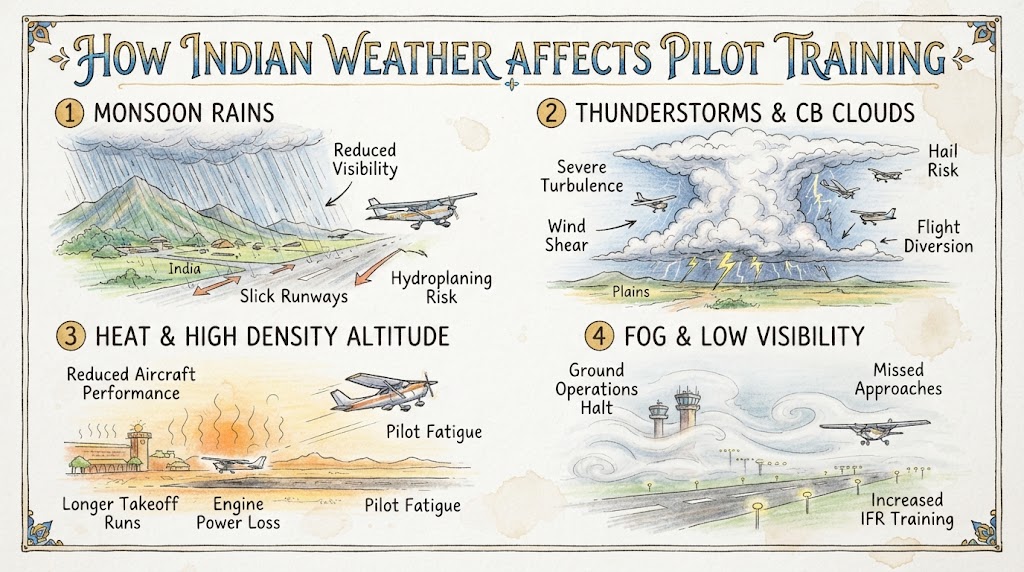
Weather plays a major role in every stage of pilot training in India. Student pilots may encounter heavy monsoon rain, summer heat, winter fog, haze, thunderstorms, gusty winds, coastal humidity, mountain turbulence, and rapidly changing visibility. These conditions influence flying schedules, aircraft performance, lesson planning, solo authorisation, navigation exercises, and safety decisions. Understanding how Indian weather affects pilot training helps students prepare for interruptions, use training time effectively, and develop the weather judgement required of a professional pilot. This guide from Pilotsindia.com explains the main weather conditions faced by aviation students and how flying schools manage them safely.
Why Weather Is Important During Pilot Training
Pilot training depends on suitable conditions both on the ground and in the air. A student may be prepared, the aircraft may be serviceable, and the instructor may be available, but the flight still cannot take place when the weather is unsafe or outside approved operating limits.
Weather affects training through:
- Visibility and cloud clearance
- Take-off and landing performance
- Aircraft control
- Training area availability
- Navigation and route selection
- Runway conditions
- Fuel planning
- Instructor workload
- Student experience level
- Flight-school operating procedures
- Solo-flight authorisation
- Availability of alternate aerodromes
Weather knowledge is also part of pilot licensing in India. DGCA requirements for student and commercial pilot licensing include aviation meteorology among the required knowledge subjects.
Aviation meteorology should therefore be treated as both an examination subject and a practical flying skill.
Understanding India’s Diverse Aviation Weather
India has mountains, deserts, plains, plateaus, long coastlines, tropical regions, islands, and areas with very different seasonal weather patterns.
A flying school in northern India may lose training hours because of winter fog. A coastal academy may experience monsoon rain, sea-breeze changes, and cyclonic weather. A school in a hot inland region may face high density altitude and strong afternoon turbulence.
This means there is no single weather pattern that describes pilot training throughout India. Students should evaluate a flying school’s local climate before selecting a training location.
Important local questions include:
- How many flying days are normally available?
- Which months have frequent rain or fog?
- Does the aerodrome experience strong crosswinds?
- Are thunderstorms common in the afternoon?
- Does the school operate near mountains or coastlines?
- Are alternate aerodromes available?
- How does the school reschedule weather-cancelled flights?
- Does the training area remain usable during the monsoon?
Historical weather patterns can help with general planning, but daily flight decisions must be based on current official aviation weather information.
Main Indian Weather Conditions Affecting Training
| Weather condition | Common training impact | Main concern for students |
|---|---|---|
| Monsoon rain | Delays, cancellations, wet runways, reduced training hours | Visibility, low cloud, thunderstorms, and runway condition |
| Winter fog | Delayed morning departures and cancelled VFR flights | Poor visibility and hidden terrain |
| Summer heat | Reduced aircraft performance and uncomfortable conditions | Density altitude and longer take-off distance |
| Thunderstorms | Route changes and training suspensions | Turbulence, lightning, hail, wind shear, and heavy rain |
| Strong winds | Circuit and solo restrictions | Crosswind, gusts, and aircraft control |
| Haze and dust | Reduced visual navigation capability | Poor visibility and loss of ground references |
| Low cloud | Limits training altitude and route availability | Visual flight requirements and terrain clearance |
| Mountain weather | Rapid changes and turbulence | Downdrafts, terrain obscuration, and limited diversion options |
| Coastal weather | Changing winds and high humidity | Sea breezes, thunderstorms, and sudden showers |
| Cyclonic systems | Major disruption to flying operations | Strong winds, heavy rain, and airport restrictions |
Monsoon Effects on Pilot Training
The southwest monsoon is normally associated with the June-to-September season, while the northeast monsoon is especially relevant to parts of southern and southeastern India during the later part of the year. IMD classifies March to May as pre-monsoon, June to September as southwest monsoon, and October onward as the post-monsoon period in its seasonal reporting.
Reduced Number of Flying Days
Continuous or repeated rainfall can reduce the number of days available for visual flight training.
A student may experience:
- Delayed first flights
- Shorter training periods
- Cancelled circuit sessions
- Rescheduled solo flights
- Delayed navigation exercises
- Limited access to the training area
- Difficulty completing planned monthly hours
The exact effect depends on the location, aerodrome infrastructure, aircraft type, and school procedures.
Low Cloud Bases
Monsoon conditions can produce low cloud layers that restrict the height available for training.
Low clouds may affect:
- General handling exercises
- Stall practice
- Steep turns
- Forced-landing practice
- Navigation exercises
- Circuit operations
- Visual separation from terrain
Even when surface visibility appears acceptable, a low cloud base may make a training flight unsuitable.
Heavy Rain and Visibility
Heavy rain can reduce forward visibility and hide terrain, traffic, and the runway.
It may also:
- Increase pilot workload
- Make visual navigation difficult
- Create water on the runway
- Reduce braking effectiveness
- Disturb circuit operations
- Require an early return or diversion
Students must avoid assuming that a short rain shower is harmless. Convective rain may be connected with dangerous turbulence and wind changes.
Wet Runways
Rain can leave water on the runway, affecting aircraft acceleration, braking, directional control, and take-off or landing distance.
Students should learn to consider:
- Runway surface condition
- Standing water
- Crosswind
- Aircraft performance information
- School operating limitations
- Instructor judgement
Aircraft performance must always be calculated using approved aircraft documents and current runway information.
Thunderstorms and Convective Weather
Thunderstorms are among the most serious weather hazards faced during pilot training.
They may contain:
- Severe turbulence
- Lightning
- Hail
- Heavy precipitation
- Strong updrafts
- Powerful downdrafts
- Wind shear
- Microbursts
- Rapid visibility reduction
- Icing
- Sudden wind changes
ICAO identifies wind-shear and thunderstorm encounters as recognised aviation occurrence categories, while current aviation training material treats thunderstorms, turbulence, poor visibility, and gusty winds as major operational hazards.
Effect on Daily Training
Thunderstorms may lead to:
- Suspension of solo flying
- Closure of the training area
- Delayed departures
- Diversions
- Shortened lessons
- Increased separation from affected areas
- Grounding of training aircraft
- Changes to circuit direction or runway use
Afternoon Convection
Strong daytime heating can create rising air and convective cloud development. A clear morning may therefore be followed by towering cumulus or thunderstorms later in the day.
Students should review the forecast period covering the entire planned flight rather than checking only the current conditions before departure.
Cumulonimbus Avoidance
Cumulonimbus clouds should not be used as navigation references or approached for training experience. Their effects can extend outside the visible rain area.
A student must follow:
- Official weather warnings
- Flight-school procedures
- Instructor instructions
- Aircraft limitations
- Air traffic control information
- Conservative avoidance decisions
Winter Fog and Pilot Training
Winter fog is a major training challenge in parts of northern India. It can reduce visibility during the early morning and occasionally remain for several hours.
Delayed Morning Flying
Many flying schools prefer early-morning training because winds and thermal activity may be lighter. Fog can remove this useful training period.
A normal schedule may change from:
- Early departure
- Multiple morning sorties
- Navigation training
- First-solo preparation
to:
- Delayed reporting
- Ground classes
- Simulator practice
- Weather observation
- Aircraft technical study
Effect on Student Progress
Repeated fog delays can affect:
- Training continuity
- Solo consolidation
- Monthly flying hours
- Instructor availability
- Aircraft scheduling
- Licence completion time
However, these delays can also become valuable learning opportunities when students compare forecast fog with actual visibility improvement.
Fog Dissipation Does Not Guarantee Safe Conditions
When fog begins to clear, students may feel pressure to begin flying immediately. The weather may still include:
- Local fog patches
- Poor slant visibility
- Haze
- Low cloud
- Reduced visibility near rivers or low ground
- Different conditions away from the aerodrome
The instructor must evaluate the complete training area rather than only the runway view.
Haze, Smoke, and Dust
Haze is common in several Indian regions and may significantly reduce visual clarity.
A student pilot may be able to see the ground directly below but struggle to identify:
- Distant landmarks
- Terrain features
- Other aircraft
- Navigation checkpoints
- The horizon
- The aerodrome from a distance
Slant Visibility
Reported horizontal visibility at an aerodrome may not fully describe the visibility experienced while looking diagonally through haze from the aircraft.
This can affect:
- Visual navigation
- Joining procedures
- Circuit spacing
- Forced-landing field selection
- Terrain awareness
- Traffic detection
Dust and Dust Storms
Hot and dry regions may experience widespread dust or sudden dust storms.
Dust can cause:
- Rapid visibility reduction
- Strong and gusty winds
- Difficult visual navigation
- Aircraft contamination
- Delayed operations
- Increased maintenance requirements
A student should never continue a visual flight merely because the destination was visible earlier in the flight.
High Temperature and Aircraft Performance
High summer temperatures can reduce aircraft performance.
The FAA’s official pilot weather material explains that temperature, altitude, pressure, and air density affect aircraft performance.
Density Altitude
Density altitude represents the performance effect of air density. It becomes higher when temperature increases or atmospheric pressure decreases.
A high-density-altitude condition may cause:
- Longer take-off roll
- Reduced climb rate
- Lower engine performance in many training aircraft
- Reduced propeller efficiency
- Slower acceleration
- Reduced obstacle-clearance margin
Effect on Training Aircraft
Light training aircraft can be especially sensitive to:
- High temperatures
- Heavy loading
- Short runways
- High-elevation aerodromes
- Limited headwind
- Poor climb performance
Students must use the aircraft flight manual or pilot operating handbook for actual performance calculations.
Training Schedule Changes
During very hot periods, a flying school may schedule more training:
- Early in the morning
- Later in the afternoon
- At reduced aircraft weight
- With modified lesson plans
- Under stricter performance limits
Such scheduling should be understood as a safety and performance decision rather than an administrative inconvenience.
Wind and Crosswind Training
Wind is an essential part of pilot training because every pilot must learn to control an aircraft during take-off, landing, and navigation.
Headwind
A headwind generally reduces groundspeed and changes flight time and fuel planning. During take-off and landing, it may improve performance relative to still-air conditions when correctly considered through approved performance data.
Tailwind
A tailwind generally increases groundspeed and may increase take-off or landing distance.
Training operations with a tailwind must remain within:
- Aircraft limitations
- Runway requirements
- School procedures
- Instructor-approved limits
Crosswind
Crosswind training teaches students to control drift and maintain runway alignment.
However, the acceptable crosswind depends on:
- Aircraft type
- Student experience
- Runway condition
- Gusts
- Instructor judgement
- Demonstrated aircraft capability
- Flying-school limits
There is no single universal crosswind limit for every student.
Gusty Winds
Gusts can create rapid changes in:
- Airspeed
- Flight path
- Rate of descent
- Aircraft attitude
- Control pressure
A student who performs comfortably in a steady wind may not yet be ready for the same average wind with strong gusts.
Wind Shear and Microbursts
Wind shear is a rapid change in wind speed, direction, or both over a short distance.
It is particularly dangerous near the ground during:
- Take-off
- Initial climb
- Approach
- Landing
- Go-around
A microburst is a concentrated downdraft that spreads outward near the surface and can create severe performance changes.
IMD provides aviation warnings and meteorological services that include wind-shear information for affected aerodrome operations. India’s aviation weather system also provides METAR, SPECI, TAF, trend forecasts, aerodrome warnings, and SIGMET products through its meteorological network.
Student pilots should treat every wind-shear warning seriously and follow instructor, ATC, and aircraft procedures.
Low Cloud and Ceiling Restrictions
Low cloud may limit or prevent VFR training even when rain is not present.
It can affect:
- Circuit training
- Navigation
- General handling
- Solo exercises
- Emergency practice
- Terrain clearance
- Entry into the training area
A student must consider cloud along the complete route, including departure, training area, destination, alternates, and return.
Cloud Development During Training
A cloud layer may gradually lower or develop vertically during a flight.
Warning signs may include:
- Lowering cloud bases
- Increasing cloud coverage
- Reduced visibility
- Darkening showers
- Towering cumulus
- Disappearing terrain features
- Difficulty maintaining visual references
An early return is usually safer than waiting until conditions become critical.
Mountain Weather and Training
Flying near mountains requires additional knowledge and experience.
Possible hazards include:
- Mountain waves
- Rotor turbulence
- Strong downdrafts
- Valley winds
- Rapid cloud formation
- Hidden terrain
- Limited escape routes
- Reduced radio or navigation coverage
- Sudden visibility changes
Terrain Obscuration
Cloud or precipitation may hide ridges, passes, or valleys.
A route that appeared open earlier may become unsuitable during the flight.
Downdrafts
A downdraft near terrain may exceed the climb capability of a light training aircraft.
Students must never assume that increasing power will always allow the aircraft to outclimb descending air.
Specialist Instruction
Mountain operations should be conducted only with appropriate training, suitable weather, an authorised instructor, and a clear escape plan.
Coastal Weather and Sea Breezes
Coastal flying schools may experience daily wind changes caused by the different heating rates of land and water.
Sea Breeze
During daytime heating, cooler air may move from the sea toward the land.
This can change:
- Runway wind
- Crosswind component
- Circuit conditions
- Turbulence
- Cloud development
Land Breeze
At night or during the early morning, the wind pattern may reverse in some coastal locations.
Coastal Humidity
High humidity can support:
- Haze
- Mist
- Low cloud
- Showers
- Thunderstorm development
- Reduced visibility
Students should check whether the expected wind change will occur during the planned flight rather than evaluating only the departure wind.
Tropical Cyclones and Training Disruption
Cyclonic systems over the Bay of Bengal or Arabian Sea may cause widespread aviation disruption.
Possible effects include:
- Strong surface winds
- Heavy rain
- Widespread cloud
- Low atmospheric pressure
- Airport restrictions
- Runway flooding
- Route closures
- Aircraft relocation
- Cancellation of several training days
IMD’s civil aviation services include tropical cyclone monitoring and the distribution of aviation meteorological information through its national network.
Pilot training should not be planned close to cyclonic weather merely because the centre of the storm is located far from the aerodrome. Outer rain bands and wind changes may affect a much wider area.
Weather Effects on Different Training Exercises
Circuit Training
Circuits require suitable:
- Visibility
- Cloud base
- Surface wind
- Crosswind
- Runway condition
- Traffic conditions
Strong gusts or changing winds can increase student workload significantly.
First Solo Flight
First-solo weather is normally more conservative than conditions accepted for dual training.
The instructor may consider:
- Student consistency
- Wind and gusts
- Crosswind
- Visibility
- Cloud base
- Traffic
- Forecast changes
- Time available before sunset
- Availability of another runway
A student should never compare personal solo limits with those of another student.
Navigation Exercises
Navigation flights require suitable conditions across the complete route.
Weather may affect:
- Visual checkpoints
- Groundspeed
- Heading calculations
- Fuel requirement
- Route selection
- Alternate planning
- Return conditions
General Handling
Exercises such as stalls, steep turns, and emergency practice usually require sufficient altitude, visibility, and cloud clearance.
Low cloud can make a general-handling lesson impossible even when circuit flying remains available.
Instrument Training
Instrument training may be conducted under simulated or actual instrument conditions depending on aircraft equipment, approvals, instructor qualifications, and school procedures.
Actual poor weather is not automatically suitable for instrument training. Thunderstorms, icing, severe turbulence, and strong winds may still make the flight unsafe.
Night Flying
Night training requires careful attention to:
- Visibility
- Cloud
- Haze
- Terrain
- Wind
- Thunderstorms
- Weather at alternate aerodromes
Haze that seems manageable during daylight can make ground lights and the natural horizon difficult to identify at night.
Official Aviation Weather Sources for Students
India’s Central Aviation Meteorological Division explains that METAR and SPECI provide coded aerodrome observations, while TAF provides a concise forecast of expected aerodrome conditions. METARs are generally issued at half-hourly intervals in India, with special reports issued when specified criteria are met.
Student pilots should become familiar with:
- METAR
- SPECI
- TAF
- TREND forecasts
- SIGMET
- Aerodrome warnings
- Wind-shear warnings
- Weather radar
- Satellite imagery
- Significant-weather charts
- Upper-wind information
- ATIS
- Official pre-flight briefings
IMD’s Online Briefing System allows authorised pilots and flight dispatchers to access meteorological briefing documents for flight planning.
Consumer weather applications can support general awareness, but they should not replace official aviation weather products or a flying school’s approved briefing procedure.
Sample Weather Impact on a Training Day
Consider a fictional student scheduled for three exercises:
- Early-morning circuits
- A late-morning navigation flight
- Afternoon general handling
The morning begins with mist and reduced visibility. Circuit training is delayed until visibility improves.
By late morning, visibility becomes acceptable, but the temperature rises rapidly. The instructor recalculates aircraft performance and reduces the planned load.
During the navigation briefing, the TAF indicates temporary thunderstorms during the expected return period. Satellite and radar information also show developing convective cloud near the planned route.
The instructor changes the navigation exercise to a shorter local flight. The afternoon general-handling lesson is later cancelled because towering cumulus develops near the training area.
The student completes fewer flying hours than planned but gains practical experience in:
- Weather interpretation
- Performance planning
- Risk management
- Schedule flexibility
- Go or no-go decisions
This is a normal part of professional pilot development.
Weather-Related Training Delays
Weather delays can be frustrating, especially when students have limited time or accommodation costs.
However, completing flying hours should never take priority over safety.
A good flying school should have a clear system for:
- Weather cancellations
- Rescheduling
- Aircraft allocation
- Instructor availability
- Ground-school use
- Simulator practice
- Progress monitoring
- Student communication
Before joining a school, students should ask how frequently local weather affects training and how cancelled flights are managed.
Using Non-Flying Days Productively
A weather cancellation does not need to become a wasted day.
Students can use the time for:
- METAR and TAF decoding
- Navigation planning
- Aircraft technical study
- Radio-telephony practice
- Performance calculations
- Emergency-procedure revision
- Simulator sessions
- Weather-chart interpretation
- Flight debriefing
- DGCA examination preparation
Students can also compare the morning forecast with actual conditions later in the day. This develops practical forecasting awareness.
Pre-Flight Weather Review Process
Before a training flight, a student should:
- Review the general weather system affecting the region.
- Read the latest departure METAR or SPECI.
- Check the aerodrome TAF.
- Review destination and alternate weather.
- Check SIGMET and aerodrome warnings.
- Study weather radar and satellite information.
- Review wind at the surface and planned altitude.
- Check visibility and cloud base throughout the route.
- Consider temperature, pressure, and aircraft performance.
- Review runway condition and operational information.
- Compare weather with aircraft and school limits.
- Discuss uncertainties with the instructor.
- Prepare an alternate or early-return plan.
- Obtain updated information immediately before departure.
- Continue monitoring weather during the flight.
The final decision must follow current regulations, instructor authority, aircraft limitations, and the flying school’s approved procedures.
Common Weather Mistakes Made by Students
Checking Only Current Weather
A METAR may show acceptable conditions while the TAF predicts deterioration during the return period.
Using Only One Source
No single report provides the complete weather picture.
Ignoring the Training Area
Weather at the aerodrome may be good while the training area is affected by cloud, rain, or thunderstorms.
Confusing UTC and Local Time
Incorrect time interpretation can cause a student to use an expired report or misunderstand a forecast period.
Ignoring Wind Gusts
The average wind may appear manageable while the gust value exceeds the student’s safe training capability.
Underestimating Haze
Haze can make navigation and traffic detection difficult even when the runway remains visible.
Feeling Pressure to Complete Hours
Financial pressure, licence deadlines, and competition with other students must not influence operational judgement.
Continuing Too Long
Waiting until conditions become clearly unsafe can remove diversion and return options.
Failing to Ask Questions
Students should always ask the instructor when a code, forecast, or weather trend is unclear.
Student Weather Safety Checklist
Before every flight, confirm that you have checked:
- Latest METAR and SPECI
- Current TAF
- Weather at the destination
- Weather at alternates
- SIGMET information
- Thunderstorm activity
- Visibility
- Cloud base
- Wind direction and speed
- Gusts
- Crosswind
- Temperature
- Pressure
- Density altitude
- Rain, fog, haze, or dust
- Runway condition
- Fuel requirement
- Weather trend
- Training-area conditions
- Instructor approval
Aviation Meteorology and DGCA Preparation
Pilot candidates in India are expected to study aviation meteorology as part of their licensing knowledge.
Important study areas include:
- Structure of the atmosphere
- Temperature
- Pressure
- Density
- Wind
- Humidity
- Stability
- Clouds
- Precipitation
- Fog and visibility
- Air masses and fronts
- Monsoon systems
- Thunderstorms
- Tropical cyclones
- Turbulence
- Wind shear
- Icing
- Mountain weather
- Aviation weather reports
- Forecast charts
- Flight-planning information
DGCA’s Pariksha portal publishes examination information and approved study-material references for flight-crew candidates.
Students should always use the latest official syllabus and notices because examination requirements may change.
Recommended Weather Learning Plan
Learn Basic Meteorology
Begin with pressure, temperature, humidity, stability, and wind.
Practise Daily Weather Decoding
Decode at least one METAR and one TAF every training day.
Compare Forecast and Actual Weather
Check what was forecast and what actually occurred.
Learn Local Weather Patterns
Understand the common weather challenges around the training aerodrome.
Connect Weather with Aircraft Performance
Practise take-off, landing, and climb calculations for different temperatures and pressures.
Discuss Every Decision
Ask the instructor why a flight was:
- Approved
- Delayed
- Modified
- Shortened
- Cancelled
Keep a Weather Notebook
Record useful observations, weather codes, instructor explanations, and actual training decisions.
Frequently Asked Questions
1. Which Indian weather condition causes the most pilot-training delays?
The answer depends on the training location. Monsoon rain and thunderstorms affect many regions, while winter fog can be a major concern in northern India. Coastal, mountain, desert, and inland schools experience different local problems.
2. Can flight training continue during the Indian monsoon?
Training may continue on suitable days and during acceptable weather windows. However, heavy rain, thunderstorms, low cloud, poor visibility, strong winds, and wet runways can reduce or cancel flying operations.
3. Why are morning flights common at Indian flying schools?
Morning conditions may offer lighter winds, lower temperatures, and less thermal turbulence in many locations. However, winter fog or mist can sometimes delay early-morning operations.
4. How does summer heat affect training aircraft?
High temperatures reduce air density and may increase take-off distance while reducing climb performance. Pilots must calculate performance using approved aircraft data before departure.
5. Can a student pilot fly in strong winds?
It depends on the aircraft, runway, gusts, student experience, school limits, and instructor judgement. A wind that is acceptable for dual instruction may not be suitable for solo flight.
6. Why are navigation flights more sensitive to weather?
Navigation flights cover a larger area and take longer than local exercises. Weather may differ along the route, at the destination, and during the return period, so more detailed planning is required.
7. Does weather delay completion of a pilot licence?
Repeated weather cancellations can increase the time needed to complete training. The actual effect depends on local climate, aircraft availability, instructor scheduling, and how efficiently the school reschedules cancelled flights.
8. Should students choose a flying school based on weather?
Weather should be one of several selection factors. Students should also consider safety standards, aircraft serviceability, instructor availability, training quality, airspace, runway facilities, and scheduling practices.
9. What weather reports should a student pilot understand?
Students should understand METAR, SPECI, TAF, trend forecasts, SIGMET, aerodrome warnings, wind-shear warnings, weather charts, radar information, and official pre-flight briefings.
10. Who decides whether weather is suitable for a training flight?
For dual training, the authorised instructor or pilot in command makes the operational decision. Solo students must comply with their instructor’s authorisation, school procedures, aircraft limitations, and current regulatory requirements.
Key Takeaways
- Indian weather affects training differently across regions and seasons.
- Monsoon rain can reduce visibility, lower cloud bases, and create wet runways.
- Winter fog frequently disrupts morning operations in parts of northern India.
- High summer temperatures can reduce aircraft take-off and climb performance.
- Thunderstorms, wind shear, and microbursts require conservative avoidance.
- Crosswind limits depend on the aircraft, student experience, and school rules.
- Official aviation weather information must be checked before every flight.
- Weather cancellations are a normal part of safe pilot training.
- Non-flying days can be used for theory, simulation, planning, and revision.
- Good weather judgement is more valuable than completing hours quickly.
Conclusion
Indian weather has a direct effect on pilot-training schedules, aircraft performance, flying exercises, solo authorisation, navigation planning, and student progress. Monsoon rain, winter fog, summer heat, thunderstorms, haze, strong winds, coastal systems, and mountain conditions can all reduce available flying time, but they also provide important opportunities to develop professional judgement. Student pilots should learn to use official weather information, understand local seasonal patterns, follow aircraft and flying-school limits, and accept delays whenever conditions are unsuitable. By combining meteorology theory with instructor-led practical decisions, learners can become safer and more responsible pilots. Pilotsindia.com supports this learning process through clear and practical aviation education for students training in India.

