
Introduction
A student pilot reaches the flying school early in the morning, completes the pre-flight preparation and waits for the aircraft assignment. A few minutes later, the instructor announces that flying has been suspended because of low clouds, poor visibility and developing thunderstorms.
For a student eager to complete flying hours, this can feel frustrating. However, cancelling or delaying a flight because of weather is not wasted time. It is an important example of professional aviation decision-making.
The southwest monsoon season is generally assessed from June to September in India, although its arrival, intensity and withdrawal vary across regions. This means flying conditions in Maharashtra may be different from conditions in Rajasthan, Madhya Pradesh, Assam or Tamil Nadu on the same day.
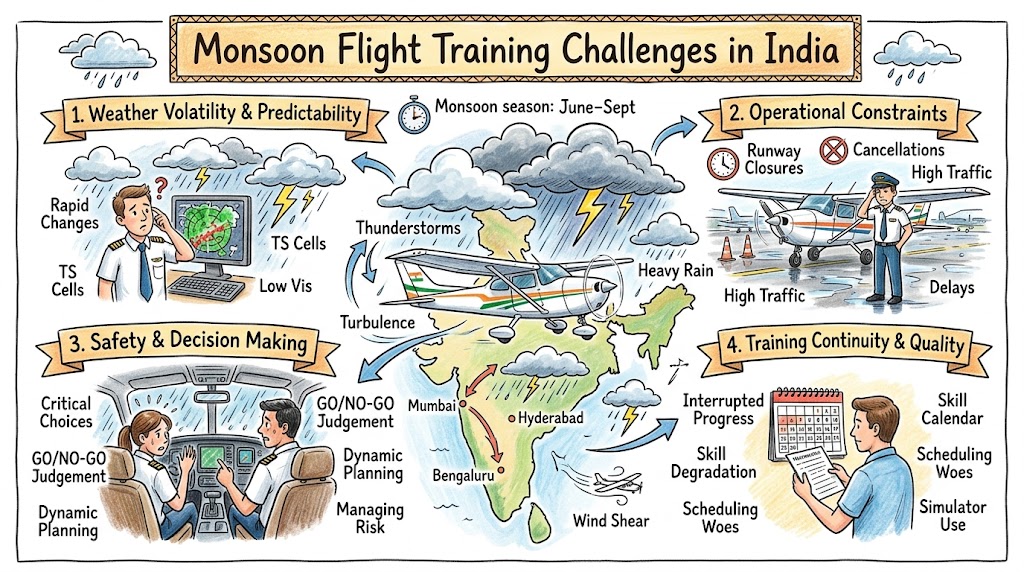
Monsoon flight training challenges in India include reduced visibility, low clouds, thunderstorms, crosswinds, wet runways, aircraft maintenance delays and irregular training schedules. These conditions can affect safety, training continuity, living expenses and the time required to complete a course.
This guide explains how monsoon weather affects student pilots and how trainees can continue making meaningful progress without compromising safety.
Understanding the Indian Monsoon and Aviation
India does not experience identical monsoon weather in every location.
Coastal regions may receive long periods of heavy rain and high humidity. Central India may experience active rain spells separated by clearer periods. Northern India can face a combination of rain, haze, thunderstorms and gusty winds. Northeastern areas may receive intense and frequent rainfall, while some western regions may have comparatively fewer rainy days.
The intensity of the monsoon can also change from one week to another. A location may experience several days of poor weather followed by a useful flying window. This makes flexibility especially important for flight-training organisations and students.
For aviation purposes, pilots do not rely only on general weather applications. Indian aviation meteorological information includes current reports such as METAR and SPECI, forecasts such as TAF and TREND, and warnings including wind-shear warnings and SIGMET information. IMD is responsible for civil-aviation meteorological services in India through its aviation weather network.
The weather at the training aerodrome, nearby navigation areas, alternate aerodromes and the planned route must all be considered before a flight.
Major Monsoon Flight Training Challenges in India
Reduced Visibility
Visibility is one of the first factors affected by monsoon weather.
Heavy rain can make it difficult to see the runway, surrounding terrain, reporting points and other aircraft. Mist, haze and moisture may continue reducing visibility even after the heaviest rain has stopped.
Visual flight training depends on maintaining adequate outside references. If those references cannot be seen clearly, basic handling, circuit training, solo flying and navigation exercises may be delayed.
A student may look outside and believe the conditions are acceptable. However, the official visibility report, weather trend and conditions along the complete route may tell a different story. The instructor and authorised operational personnel must make the final decision.
Low Cloud Base
The cloud base is the approximate height of the lowest significant cloud layer above the ground.
A low cloud base can restrict the altitude available for safe training. It may affect:
- General handling exercises
- Practice-area operations
- Circuit training
- Cross-country flights
- Forced-landing practice
- Navigation exercises
- Solo flying
A low cloud base is not dangerous only because an aircraft may enter cloud. It can also reduce the margin between the aircraft, surrounding terrain, obstacles and the required training altitude.
Flying underneath progressively lowering cloud can create pressure to continue at an unsuitable height. Safe training requires conservative decision-making rather than trying to complete an exercise at any cost.
Thunderstorms and Cumulonimbus Clouds
Thunderstorms are among the most serious monsoon aviation hazards.
They can produce severe turbulence, lightning, hail, icing, strong updrafts and downdrafts, heavy precipitation and low-level wind shear. Dangerous conditions may exist inside, below and around a thunderstorm.
A small training aircraft should never be used to demonstrate how close a pilot can safely fly to a storm. Instrument-flying ability does not make thunderstorm penetration safe.
During monsoon season, instructors may cancel training because of storm cells located near the aerodrome, along the planned route or close to the practice area. A flight may also be delayed when storms are forecast to develop during the expected training period.
A student should treat a thunderstorm cancellation as a safety lesson rather than an inconvenience.
Strong and Gusty Winds
Monsoon weather can bring rapid changes in wind speed and direction.
Strong winds may affect aircraft control during taxiing, take-off, circuit operations and landing. Gusts can cause changes in airspeed and flight path, requiring quicker and more accurate control inputs.
Crosswinds are especially important during training. Every aircraft, student and training organisation operates within defined limitations and safety margins. A wind that may be manageable for an experienced instructor may not be appropriate for a first solo student.
Wind conditions may therefore lead to:
- Dual training instead of solo flying
- A change of runway
- Delayed circuit training
- Cancellation of take-off and landing practice
- Shorter training sessions
- Increased instructor supervision
Wind Shear and Microbursts
Wind shear is a rapid change in wind speed, direction or both over a relatively short distance. Low-level wind shear is particularly important because it can affect an aircraft close to the ground during take-off or landing.
A microburst is a concentrated downdraft that spreads outward after reaching the ground. It can create sudden and significant changes in the wind experienced by an aircraft.
A student pilot may not have the experience to identify or manage these conditions safely. When wind-shear warnings, storm activity or rapidly changing winds are present, the safest training decision may be to remain on the ground.
Wet and Waterlogged Runways
Rain can leave standing water on a runway.
A wet runway may reduce braking effectiveness and increase the distance required to slow the aircraft. Water may also affect directional control, particularly when combined with crosswinds or poor surface conditions.
Small airfields may require additional runway inspections or may temporarily restrict operations after intense rainfall. Taxiways, parking areas and grass surfaces can also become soft or waterlogged.
The existence of rain does not automatically make a runway unusable. The actual decision depends on runway condition, aircraft performance, aerodrome procedures, weather intensity and the judgement of authorised personnel.
Turbulence
Monsoon turbulence may be associated with thunderstorms, developing clouds, gust fronts, strong winds and convective activity.
For a beginner, even moderate turbulence can make it difficult to maintain altitude, heading and airspeed. It can also cause airsickness, anxiety and fatigue.
Training in light turbulence can sometimes help students improve aircraft-control skills. However, conditions must remain appropriate for the aircraft, exercise and student experience.
There is an important difference between controlled learning in manageable conditions and unnecessary exposure to hazardous weather.
Rapidly Changing Weather
One of the most difficult monsoon challenges is how quickly conditions can change.
A morning may begin with acceptable visibility and light winds. Within a short period, low clouds, heavy rain or thunderstorms may develop near the aerodrome.
This can lead to:
- Delayed departures
- Early return to the airfield
- Diversion planning
- Shortened exercises
- Cancellation after the student has completed preparation
- Changes from solo to dual training
Students should therefore understand that receiving a flight slot does not guarantee that the flight will take place.
Aircraft Maintenance and Availability
High humidity, moisture and repeated exposure to rain can increase the attention required for aircraft inspections and maintenance.
Possible concerns include:
- Water entering poorly sealed areas
- Moisture around electrical components
- Corrosion monitoring
- Contaminated or damp cabin areas
- Tyre and brake inspections
- Pitot-static system protection
- Additional cleaning and drying
- Delays caused by hangar limitations
Not every rain shower creates a maintenance problem. However, when an aircraft becomes unavailable, the effect can spread across several students because training aircraft are normally shared.
Airport and Air Traffic Delays
Weather affects more than the training aircraft.
Commercial traffic, military activity, runway changes, air traffic restrictions and airport procedures may reduce the training slots available to a flying school. During poor weather, controllers may need to increase spacing between aircraft or prioritise certain operations.
At controlled airports, a student may be fully prepared but unable to depart because of traffic management or runway restrictions.
This is one reason students should investigate the actual operating environment of a flying school rather than considering only its advertised fleet size.
How Monsoon Weather Affects Training Exercises
| Training Exercise | Possible Monsoon Challenge | Effect on Training | Common Safety Response |
|---|---|---|---|
| Basic handling | Turbulence, low clouds and poor visibility | Reduced practice-area access | Delay, shorten or move the exercise |
| Circuit training | Crosswinds, wet runway and low cloud base | Fewer take-offs and landings | Dual flying or cancellation |
| First solo | Gusts, changing winds and visibility | Solo authorisation may be postponed | Continue supervised dual practice |
| Cross-country navigation | Storm cells and widespread low clouds | Route may become unsuitable | Reschedule or select an approved alternative |
| Instrument training | Convective weather and severe turbulence | Instrument conditions may still be unsafe | Use simulator or remain on the ground |
| Night flying | Rain, poor visibility and limited visual references | Greater workload and reduced situational awareness | Reschedule for suitable conditions |
| Skill test | Weather below required operating conditions | Test may not begin or may be discontinued | Coordinate a new test date |
| Emergency practice | Low cloud base or wet surface | Exercise cannot be completed safely | Conduct briefing or simulator practice |
| Landing practice | Crosswind, standing water and wind shear | Increased landing risk | Use instructor limits and runway-condition checks |
Impact on Student Pilot Training Schedules
Monsoon weather can make flight-training schedules unpredictable.
A student may be allocated several flights in one week but complete only one or two. Another week may offer a period of stable weather in which several flights are completed.
This irregularity affects continuity. Flying skills improve through repetition, and long gaps can require revision before moving to the next exercise.
Common scheduling effects include:
- Postponed first solo flights
- Delayed navigation exercises
- Reduced aircraft utilisation
- A queue of students waiting for suitable conditions
- Difficulty coordinating examiners and aircraft
- Repeated changes to accommodation or travel plans
- Additional revision flights after long gaps
- Delayed licence applications or checks
The total duration of training depends on more than the monsoon. Aircraft availability, maintenance, instructor availability, airport traffic, student performance, administrative processing and flying-school management are equally important.
DGCA’s FTO-ranking framework recognises operational factors such as average training-completion time, aircraft utilisation, student-to-aircraft ratio and student-to-instructor ratio. This shows why students should examine operational capacity rather than relying only on a promised completion period.
How Monsoon Delays Can Affect Training Costs
Rain does not necessarily change the hourly flying rate. However, weather delays can increase the overall cost of remaining at a training location.
| Expense Category | Possible Effect of Monsoon Delays | Budgeting Tip |
|---|---|---|
| Accommodation | Additional weeks or months of rent | Keep a separate extension fund |
| Food | Longer stay increases daily expenses | Set a realistic monthly allowance |
| Local transport | More journeys to and from the aerodrome | Use monthly transport planning |
| Refresher flying | Long gaps may require revision | Ask how refresher flights are billed |
| Simulator sessions | Additional practice may be recommended | Confirm whether simulator fees are separate |
| Travel | Tests and flights may be rescheduled | Avoid unnecessary non-refundable bookings |
| Documentation | Delays may affect validity planning | Track medical and document dates |
| Aircraft rates | Rates may change over a long course | Read the fee-revision policy |
| Ground classes | Extra sessions may carry charges | Confirm what the original fee includes |
Students should not assume that the lowest advertised flying rate will produce the lowest overall training cost.
A school with better aircraft availability, manageable student ratios and productive ground-training arrangements may provide more predictable progress, even when its hourly rate appears higher.
Regional Differences in Monsoon Flight Training
Coastal Areas
Coastal aerodromes may experience persistent rain, high humidity, strong winds and rapidly moving weather systems. Heavy rainfall can affect runway availability and maintenance planning.
Central India
Central India may experience active monsoon spells followed by useful periods of improved weather. Training schedules can therefore depend on how efficiently a school uses short flying windows.
Northern India
Northern locations can face thunderstorms, haze, rain, gusty winds and seasonal visibility changes. Conditions may differ greatly between plains, desert areas and locations near the Himalayan region.
Northeastern India
Frequent rainfall, low clouds, terrain and rapidly changing visibility can create significant planning challenges. Local experience and conservative route selection are particularly important.
Western India
Some western locations may receive intense rain, while drier areas may have comparatively more flying opportunities. However, strong winds, thunderstorms and local weather systems can still interrupt operations.
Southern India
Conditions vary between the west coast, interior plateau and east coast. The timing and influence of different seasonal weather systems can create different training patterns.
Mountainous Regions
Clouds can obscure terrain and reduce safe operating space. Mountain weather may change rapidly, making local knowledge and strict weather limits essential.
No region should be described as completely weather-proof. Students should ask for aerodrome-specific information instead of depending on broad regional claims.
Visual Flight Rules and Instrument Training
Visual Flight Rules, commonly called VFR, refer to operations conducted with sufficient visual conditions for pilots to maintain the required outside references.
Instrument Flight Rules, or IFR, involve flying primarily by reference to cockpit instruments under the applicable procedures and clearances.
Most beginner training depends heavily on visual conditions, especially during:
- Initial aircraft handling
- Circuit training
- First solo
- Visual navigation
- Forced-landing practice
- Precautionary-landing demonstrations
Instrument training is an essential part of professional pilot development, but it does not make every cloud or weather system safe.
There is a major difference between controlled instrument training and entering a thunderstorm. A pilot may be capable of flying without outside visual references while still being unable to safely manage severe turbulence, hail, lightning, wind shear or powerful vertical air movements.
Weather Knowledge Students Can Develop During Monsoon
Monsoon season can become a valuable learning period when students use non-flying time properly.
METAR
A METAR provides routine observed weather information for an aerodrome. Students should learn to identify wind, visibility, significant weather, cloud information, temperature, dew point and pressure.
SPECI
A SPECI is a special weather report issued when significant changes occur between routine observations.
TAF
A Terminal Aerodrome Forecast describes expected weather conditions at an aerodrome during a stated period.
SIGMET
A SIGMET provides information about significant en-route weather that can affect aircraft safety. In India, SIGMET information for the flight information regions is issued through the responsible meteorological watch offices.
Weather Radar
Radar imagery helps pilots and instructors understand the location, movement and intensity of precipitation. However, students should not interpret a mobile weather image as permission to operate without an official briefing.
Cloud Recognition
Students should learn to distinguish ordinary cloud development from towering cumulus and cumulonimbus clouds associated with strong convection.
Go or No-Go Decision-Making
The most important weather skill is not memorising codes. It is knowing when conditions exceed the safe limit for the aircraft, exercise or student.
How Flying Schools Manage Monsoon Operations
A well-managed flight-training organisation may use several methods to reduce disruption.
Early-Morning Flying
Some locations offer more stable weather early in the day. Schools may start flying soon after first light to use the available window before convective activity increases.
Frequent Weather Monitoring
Conditions must be reviewed before and during operations. A morning briefing may no longer be sufficient if weather changes rapidly.
Flexible Training Allocation
When cross-country flying is unsuitable, a student may complete circuits, instrument practice, simulator training or ground instruction instead.
Conservative Cancellation Decisions
A professional flying school should not pressure instructors or students to fly simply to improve utilisation figures.
Aircraft Inspections
Aircraft exposed to rain and humidity may require additional attention before being released for flight.
Runway Checks
The condition of the runway, taxiway and parking area may be evaluated after heavy rainfall.
Simulator and Ground-School Planning
Structured alternatives help students continue progressing when aircraft cannot fly.
Not every school has identical facilities or procedures. Students should ask specific questions before enrolling.
Productive Activities During Weather Cancellations
A cancelled flight should have a replacement learning objective.
Students can use the time to:
- Review the planned flight exercise
- Practise radio communication
- Study aircraft limitations
- Revise emergency procedures
- Decode METAR and TAF reports
- Complete navigation calculations
- Prepare operational flight plans
- Review charts and airspace
- Practise cockpit flows
- Use an approved simulator
- Study human performance
- Revise DGCA examination subjects
- Discuss previous flight errors with an instructor
- Conduct a detailed post-weather briefing
A disciplined student can use monsoon ground time to reduce workload when flying resumes.
Monsoon Flight Training Safety Checklist
Before every planned flight:
- Review authorised and current weather information.
- Study the complete route, not only the departure aerodrome.
- Check the cloud base, visibility, wind, forecast and warnings.
- Understand the instructor’s weather limits.
- Review aircraft and runway limitations.
- Ask questions when a weather report is unclear.
- Never pressure an instructor to approve the flight.
- Keep alternate plans ready.
- Protect licences, logbooks and electronic equipment from rain.
- Record cancelled flights and reasons.
- Use the cancelled slot for structured learning.
- Review personal fitness, fatigue and stress.
The decision to remain on the ground is often evidence of good airmanship.
Common Mistakes During Monsoon Training
Treating Every Cancellation as Wasted Time
A weather cancellation can teach practical meteorology, risk management and professional patience.
Comparing Progress With Other Students
Students at another aerodrome may have different weather, aircraft availability, instructors and operating restrictions.
Ignoring Meteorology
Some trainees focus only on flying hours. Poor weather understanding can later become a major operational weakness.
Planning an Unrealistic Completion Date
A training plan should include reasonable flexibility for weather, maintenance, tests and administration.
Keeping No Emergency Budget
Students who budget only for the advertised course amount may struggle when accommodation and living expenses continue.
Taking a Complete Break From Study
Long gaps without theory revision can reduce both confidence and cockpit performance.
Pressuring the Instructor
A student should never attempt to influence a safety decision by discussing money already spent, travel bookings or training deadlines.
Believing IFR Means Thunderstorms Are Safe
Instrument skills allow flight without external visual references under suitable procedures. They do not remove the physical dangers of severe weather.
Selecting a School Only by Advertised Duration
The number of serviceable aircraft, instructors, active students and usable flying days is more informative than a marketing promise.
Questions to Ask a Flying School Before Joining
Before paying a substantial fee, ask:
- How many students are currently active?
- How many training aircraft are serviceable on an average day?
- What is the student-to-aircraft ratio?
- What is the student-to-instructor ratio?
- How many flying days were available during the previous monsoon?
- How are cancelled flights reallocated?
- Is simulator training available?
- Are ground classes held on non-flying days?
- How frequently are aircraft unavailable for maintenance?
- What are the accommodation costs during an extension?
- Are refresher flights charged separately?
- How are rate revisions handled?
- Does the school operate from a busy controlled airport?
- How are students informed about cancellations?
- Can current students share their experience of monsoon operations?
Request written answers where possible.
Advantages of Training During Monsoon
Monsoon training is not entirely negative.
Possible benefits include:
- Better understanding of practical meteorology
- Exposure to real weather briefings
- Stronger go or no-go judgement
- Experience interpreting changing forecasts
- More time for theory preparation
- Improved patience and discipline
- Greater respect for operating limitations
- Better understanding of wind and runway conditions
These benefits exist only when training remains within approved limitations and is supervised responsibly.
Disadvantages of Monsoon Training
The main disadvantages include:
- Fewer predictable flying days
- Delayed solo and navigation flights
- Longer accommodation requirements
- Loss of skill continuity
- More schedule changes
- Increased emotional frustration
- Possible aircraft maintenance delays
- Difficulty coordinating skill tests
- Higher indirect living costs
- Uncertain course-completion dates
Students should consider both safety and financial readiness before choosing a joining date.
Monsoon Training Versus Dry-Season Training
| Factor | Monsoon Training | Dry-Season Training |
|---|---|---|
| Weather predictability | Often lower | Usually more stable, depending on location |
| Flight availability | May be irregular | May be more consistent |
| Visibility | Can reduce during rain and low cloud | May still be affected by haze or fog |
| Schedule continuity | More interruptions possible | Better continuity may be possible |
| Weather learning | Strong practical exposure | Less frequent exposure to monsoon hazards |
| Living-cost risk | Higher if training extends | Potentially easier to estimate |
| Airport congestion | May reduce during poor weather but cause backlogs later | More flights may compete for slots |
| Wind experience | Variable and gusty conditions possible | Depends on season and location |
| Solo opportunities | May be delayed | May be more frequent |
| Ground-study time | Usually greater | Flying schedule may leave less study time |
Neither season is universally better. The best period depends on the aerodrome, local climate, school capacity and the student’s personal circumstances.
Practical Budget and Timeline Planning
Add a Time Buffer
Do not build employment, examination or travel commitments around the shortest advertised completion period.
Maintain an Extension Fund
Keep separate funds for accommodation, food, local transport and possible revision flights.
Track Training Progress
Maintain a weekly record showing:
- Flights planned
- Flights completed
- Weather cancellations
- Maintenance cancellations
- Instructor cancellations
- Exercises completed
- Current weaknesses
- Next training objective
Monitor Document Validity
Keep track of medical certification, examination results, licences, identity documents and other time-sensitive requirements. Always verify current requirements through official DGCA channels because regulations and procedures can change. DGCA itself advises users to confirm critical licensing and training information through official sources before making commitments or payments.
Avoid Non-Refundable Plans
Skill tests and important flights can be delayed. Flexible bookings can reduce unnecessary losses.
Review Progress With the Instructor
A regular discussion can help identify whether delays are caused by weather alone or by aircraft availability, student preparation, scheduling or other operational factors.
Illustrative Student Scenario
Rohan joins a flying school expecting to complete his planned flying phase within a tightly calculated period.
During the first month, he progresses steadily through basic handling and circuit exercises. The monsoon then becomes active. Several flights are cancelled because of low cloud, poor visibility and nearby thunderstorms.
Rohan initially becomes frustrated. His accommodation budget was based on the shortest completion estimate, and he begins comparing his progress with students training in another state.
After discussing the situation with his instructor, he changes his approach.
He creates a weekly plan that includes:
- Two meteorology revision sessions
- Radio-communication practice
- Simulator exercises
- Navigation preparation
- Aircraft-system revision
- Post-flight review
- A separate living-expense budget
When suitable weather returns, Rohan is better prepared for each flight. He completes briefings faster, understands the weather reports more clearly and makes fewer procedural mistakes.
His training still takes longer than his original estimate, but the delay does not become completely unproductive.
This fictional example shows that students cannot control the weather, but they can control their preparation, budgeting and response to disruption.
Frequently Asked Questions
Can flight training continue during the monsoon in India?
Yes. Flight training can continue when weather, runway condition, aircraft availability and operational limitations are suitable. Monsoon does not mean that every flight will be cancelled.
Is monsoon season unsafe for student pilots?
Monsoon weather can introduce additional hazards, but training remains safe when the school, instructor and student follow appropriate limitations and conservative decision-making.
Why are flights cancelled even when it is not raining heavily?
The decision may be based on low clouds, poor visibility, crosswinds, thunderstorms nearby, runway condition, weather along the route or expected deterioration.
Can student pilots fly near thunderstorms?
Student pilots should not attempt to operate near hazardous thunderstorm activity. Thunderstorms can produce severe turbulence, hail, lightning, heavy rain and wind shear.
Does monsoon training increase CPL costs?
It can increase indirect expenses if the training period extends. Accommodation, food, transportation, refresher flights and rescheduled travel may increase the total budget.
Which exercises are most affected?
Solo circuits, visual navigation, cross-country flying, emergency exercises and skill tests can be heavily affected by poor visibility, low clouds and strong winds.
Can simulator hours replace cancelled aircraft hours?
Simulator training can improve procedures, instrument skills and decision-making, but it does not automatically replace all required aircraft experience. Credit depends on the approved device, course structure and applicable rules.
Should students join a flying school during monsoon?
Joining during monsoon can be reasonable when the student has a flexible timeline, adequate budget and access to productive ground or simulator training. The decision should be based on location-specific information.
How can students avoid losing skills?
Regular simulator sessions, chair flying, checklist practice, technical revision and instructor briefings can help maintain knowledge. A revision flight may still be required after a long gap.
Do all Indian flying schools experience equal delays?
No. Weather patterns, runway drainage, aircraft availability, traffic, maintenance support and student numbers vary between locations.
What weather reports should a student understand?
A student should gradually learn METAR, SPECI, TAF, TREND forecasts, SIGMET information, wind-shear warnings and relevant aerodrome warnings.
Can crosswinds delay a first solo?
Yes. An instructor may decide that the wind exceeds the student’s demonstrated ability or the limits established for solo operations.
How much extra time should students keep?
There is no universal figure. Students should ask the specific flying school for recent completion data and seasonal flying records, then keep a reasonable personal buffer.
What is the most important monsoon flying lesson?
The most important lesson is that completing a flight is never more important than making a safe decision.
Conclusion
Monsoon flight training challenges in India can include low visibility, thunderstorms, strong winds, wet runways, aircraft delays, irregular schedules and higher living expenses. However, a student who maintains a flexible timeline, prepares an additional budget, studies aviation weather, uses cancelled days productively and respects instructor decisions can continue progressing. In professional aviation, good judgement is more valuable than rushing to complete flying hours.

