
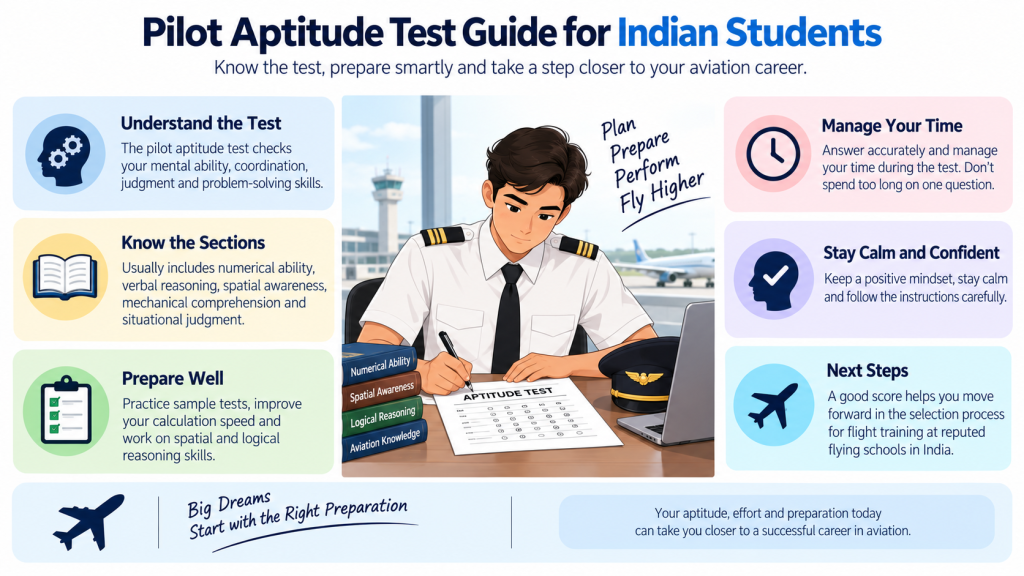
Introduction
A pilot aptitude test evaluates several abilities that can be useful during flight training, such as concentration, memory, reasoning, coordination, and decision-making. For Indian students planning a career in aviation, understanding these assessments can make preparation more structured and less stressful. Aptitude tests are different from regular school or college examinations because they often focus on how you process information and respond to different tasks. This guide explains the skills commonly assessed and practical ways to prepare.
What Is a Pilot Aptitude Test?
A pilot aptitude test is an assessment designed to evaluate certain cognitive and coordination skills that may be relevant to aviation training. Depending on the organization conducting the assessment, the test may include several different sections.
Unlike a traditional academic examination, an aptitude test does not necessarily depend on memorizing a large amount of information. Instead, it can assess how quickly and accurately you understand information, identify patterns, remember details, solve problems, and manage more than one task.
The exact format differs between organizations. Some assessments may be computer-based, while others may involve different combinations of reasoning, memory, coordination, and reaction exercises.
Students should therefore check the specific requirements and instructions provided by the organization conducting their assessment.
What Skills Are Tested in a Pilot Aptitude Test?
Different aptitude assessments can evaluate different abilities. However, several skill areas commonly appear in aviation-related assessments.
Numerical Reasoning
Numerical reasoning involves working with numbers and solving problems logically. Questions may require basic calculations, number sequences, comparisons, or identifying numerical relationships.
You do not always need advanced mathematics for these exercises. Strong knowledge of basic arithmetic and the ability to calculate accurately under time pressure can be useful.
Logical Reasoning
Logical reasoning tests your ability to recognize relationships and reach a conclusion from available information.
For example, you may need to identify the next item in a sequence or determine which option follows a particular pattern.
Regular reasoning practice can help you become more comfortable with these question types.
Spatial Awareness
Spatial awareness is the ability to understand the position and movement of objects in relation to one another.
This skill has practical relevance in aviation because pilots regularly work with directions, positions, distances, instruments, maps, and three-dimensional situations.
Spatial reasoning exercises may involve rotating shapes mentally, identifying different orientations, or understanding movement from different perspectives.
Memory
Pilots need to process and remember information while performing other tasks. Aptitude assessments may therefore include exercises that test short-term or working memory.
A student might need to remember a sequence of numbers, symbols, locations, or other information and recall it shortly afterward.
Memory can be improved through regular practice rather than relying only on last-minute preparation.
Concentration
Flight training requires sustained attention. Aptitude assessments may test how well you can maintain concentration while completing repetitive or time-sensitive tasks.
Distractions, fatigue, and rushing can affect performance, so developing good concentration habits can be valuable.
Reaction Speed
Some assessments may include tasks that measure how quickly you respond to specific visual or other signals.
Reaction speed is not simply about pressing a button as quickly as possible. Accuracy also matters. Practicing controlled responses can help you avoid unnecessary mistakes.
Multitasking
Aviation involves managing several pieces of information at the same time. Certain aptitude assessments may therefore include exercises that require candidates to monitor or respond to multiple inputs.
The purpose is generally to understand how candidates handle competing information rather than simply testing how fast they can complete one isolated task.
Hand-Eye Coordination
Some assessments may evaluate coordination between visual information and physical responses.
Computer-based coordination exercises can require you to control an object, follow a moving target, or respond to changing visual information.
Why Pilot Aptitude Tests Matter for Indian Students
Pilot training involves much more than learning how to operate an aircraft. Students gradually develop knowledge and skills related to navigation, communication, meteorology, aircraft systems, procedures, decision-making, and flight operations.
An aptitude assessment can provide information about certain abilities that may support learning in these areas.
However, an aptitude test should not be treated as a complete measure of someone’s potential as a pilot. Students develop through training, practice, instruction, experience, and disciplined study.
A student who finds one section difficult can identify that weakness and work on the underlying skill.
What Types of Questions Can Students Expect?
There is no single universal pilot aptitude test used by every aviation organization. The content depends on the organization, training program, airline, or assessment provider.
Depending on the assessment, students may encounter exercises involving:
- Number sequences
- Basic numerical calculations
- Pattern recognition
- Logical relationships
- Spatial reasoning
- Memory recall
- Attention and concentration
- Reaction-based exercises
- Coordination tasks
- Multiple information streams
- Basic technical or mechanical reasoning
For example, a numerical exercise may ask you to identify a missing number in a sequence. A spatial exercise might require you to determine how an object looks after rotation.
The best approach is to become familiar with different types of reasoning tasks rather than attempting to memorize specific answers.
How to Prepare for a Pilot Aptitude Test
Good preparation does not have to involve studying for many hours every day. Consistent and focused practice can be more useful.
Practice Mental Mathematics
Spend some time regularly working on basic calculations without immediately depending on a calculator.
Practice percentages, ratios, multiplication, division, averages, and simple calculations. Focus on becoming both accurate and reasonably quick.
Improve Your Reasoning Skills
Solve logical puzzles, sequences, patterns, and reasoning exercises.
When you make a mistake, do not simply check the correct answer. Understand why your original answer was wrong. This helps you recognize similar patterns later.
Work on Memory
Try simple memory exercises involving numbers, letters, symbols, or sequences.
You can gradually increase the amount of information you need to remember. The objective is to improve your ability to retain and recall information accurately.
Practice Spatial Exercises
Use reasoning exercises that involve shapes, directions, rotations, and visual patterns.
Try to visualize changes mentally before selecting an answer. With regular practice, many students become more comfortable with spatial problems.
Develop Concentration
Practice completing tasks without constantly switching between activities.
Reading carefully, solving timed reasoning exercises, and completing focused practice sessions can help build concentration.
Practice Under Time Limits
Timing can change how you approach aptitude questions.
After becoming comfortable with the basics, introduce time limits. This helps you learn how to maintain accuracy while working at a reasonable pace.
Review Your Mistakes
Keep track of the types of questions that cause difficulty.
For example, you may discover that you perform well in numerical reasoning but struggle with spatial questions. That information allows you to spend more preparation time where it is needed.
A Simple Preparation Routine for Students
Students can create a manageable routine instead of attempting to prepare everything at once.
Start with around 20–30 minutes of focused practice and gradually increase the difficulty.
A simple routine could include:
- Mental mathematics: Practice basic calculations and numerical sequences.
- Reasoning: Solve logical and pattern-based questions.
- Memory: Practice remembering short sequences and information.
- Spatial awareness: Work on rotation, direction, and visual reasoning exercises.
- Concentration: Complete exercises without unnecessary distractions.
- Timed practice: Attempt mixed questions under a time limit.
- Mistake review: Identify recurring errors and practice those areas again.
The exact amount of preparation time depends on the student’s current ability and the requirements of the assessment.
Common Mistakes Students Should Avoid
Focusing on Only One Skill
A student may spend all their time practicing mathematics while ignoring memory, reasoning, concentration, or spatial awareness.
A balanced approach is more useful because aptitude assessments can contain several different skill areas.
Prioritizing Speed Over Accuracy
Trying to answer every question extremely quickly can result in avoidable mistakes.
First develop accuracy. Then gradually improve your speed through timed practice.
Practicing Only Untimed Questions
Untimed practice can help you understand the question format, but it may not prepare you for the pressure of a timed assessment.
Introduce time limits once you understand the basic concepts.
Ignoring Weak Areas
It is tempting to practice only the sections you already find easy.
Instead, use practice tests to identify areas that need improvement and give those areas additional attention.
Panicking After a Mistake
Making one mistake does not necessarily mean the entire assessment is lost.
Continue working through the remaining tasks and follow the instructions carefully.
Preparing Only at the Last Minute
Trying to improve concentration, memory, reasoning, and calculation speed in a few days can be difficult.
Regular practice over a longer period gives you more opportunities to identify and improve weaknesses.
Assuming Good Academic Marks Are Enough
Strong academic performance can be helpful, but aptitude testing may measure abilities that are not directly reflected in school or college examinations.
Students should prepare specifically for the assessment rather than assuming that academic results alone will determine their performance.
Important Considerations Before Taking the Test
Before preparing, find out exactly which assessment you need to take.
Different airlines, flight schools, training organizations, and assessment providers may use different formats and requirements. A preparation method that applies to one assessment may not completely match another.
Read the official instructions carefully.
If the assessment takes place online, check whether the organization specifies requirements relating to the computer, internet connection, browser, camera, microphone, or testing environment.
Students should also understand whether the assessment is timed, whether practice tests are provided, and whether there are specific instructions about breaks or permitted materials.
On the day of the test, adequate rest and a quiet environment can help you concentrate. Avoid experimenting with unfamiliar preparation techniques immediately before the assessment.
Most importantly, use the current instructions supplied by the organization conducting your test rather than relying entirely on older information found online.
Pilot Aptitude Test Preparation Tips for Indian Students
Indian students preparing for pilot training can build several useful habits before taking an aptitude assessment.
Build a regular practice schedule: Short, consistent sessions can be easier to maintain than occasional long study sessions.
Strengthen basic mathematics: Make sure you are comfortable with everyday calculations, percentages, ratios, averages, and numerical relationships.
Improve English comprehension: Where an assessment includes verbal or language-based tasks, practice reading questions carefully and understanding instructions.
Practice computer-based exercises: If your assessment is computer-based, become comfortable reading information and responding through a computer interface.
Work on accuracy first: Once your answers become consistent, gradually work on speed.
Use varied practice: Do not depend on only one type of puzzle or question.
Simulate test conditions: Practice some sessions in a quiet environment and use time limits where appropriate.
Review your performance: Record recurring mistakes and focus on the skills behind them.
What If You Find the Test Difficult?
Finding an aptitude test difficult does not automatically mean that you cannot pursue pilot training.
Different people have different strengths. One student may be comfortable with numerical questions but struggle with spatial reasoning, while another may have the opposite experience.
Use difficult practice sections as an opportunity to identify specific skills that need more attention.
If you receive a result from an actual assessment, follow the organization’s instructions about the next steps. Requirements and opportunities to retake or proceed can vary, so avoid assuming that the same process applies everywhere.
Students should also remember that aptitude testing is only one part of the broader pilot-training journey. Academic preparation, medical eligibility, flight training, theoretical knowledge, discipline, communication, and practical experience can all form part of the overall pathway.
Frequently Asked Questions
1. What is a pilot aptitude test?
A pilot aptitude test is an assessment that may evaluate skills such as numerical reasoning, logical thinking, memory, concentration, spatial awareness, reaction, and coordination. The exact skills tested depend on the organization and assessment.
2. Is a pilot aptitude test difficult for Indian students?
The difficulty varies from one assessment to another and depends on the student’s existing skills and familiarity with the test format. Regular practice can help students become more comfortable with different types of questions.
3. What subjects are included in a pilot aptitude test?
Aptitude tests may include numerical, logical, verbal, spatial, memory, concentration, coordination, and reaction-based exercises. Not every test includes all of these areas.
4. Can I prepare for a pilot aptitude test at home?
Yes, many general aptitude skills can be practiced at home using reasoning exercises, mental mathematics, memory activities, and timed practice. However, students should always prepare according to the requirements of their specific assessment.
5. How much time should I spend preparing?
There is no universal preparation period. Your required preparation time depends on your current abilities, the test format, and the areas where you need improvement. Consistent practice is generally more useful than last-minute preparation.
6. Does the test include mathematics?
Some pilot aptitude assessments include numerical reasoning or basic mathematical exercises. The level and format can vary, so students should check the requirements of their particular assessment.
7. Does English ability matter in aptitude testing?
It can matter when the assessment includes verbal reasoning, reading comprehension, instructions, or communication-related tasks. Students should be comfortable reading and understanding test instructions accurately.
8. What should I do if I perform poorly in a practice test?
Review your mistakes and identify the underlying skill that needs improvement. Instead of repeatedly taking the same test, practice that particular skill and then try a different set of questions.
9. Are all pilot aptitude tests the same?
No. Different airlines, flight schools, training organizations, and assessment providers can use different tests, formats, scoring systems, and requirements.
10. How can I improve my concentration before the test?
Develop regular focused-practice sessions, reduce distractions, maintain a consistent sleep routine, and gradually practice completing timed tasks without frequently switching between activities.
Conclusion
Preparing for a pilot aptitude test is not simply about answering questions as quickly as possible. It involves developing a combination of reasoning, numerical ability, memory, concentration, spatial awareness, coordination, and controlled decision-making.
Indian students can make their preparation more effective by understanding the assessment format, practicing different skill areas, reviewing mistakes, and gradually becoming comfortable with timed exercises. Since aptitude tests vary between organizations, always give priority to the current instructions provided by the organization conducting your assessment.
A structured preparation approach can help students enter the assessment with a clearer understanding of what to expect and which skills they need to practice.

