Introduction
A mobile phone must identify a network before it can connect to mobile services. It needs to recognize the operator, follow network rules, and check whether it can access the available service.
Telecom systems use several identifiers to support this process. The Mobile Country Code (MCC), Mobile Network Code (MNC), and Public Land Mobile Network (PLMN) are three important terms in this area.
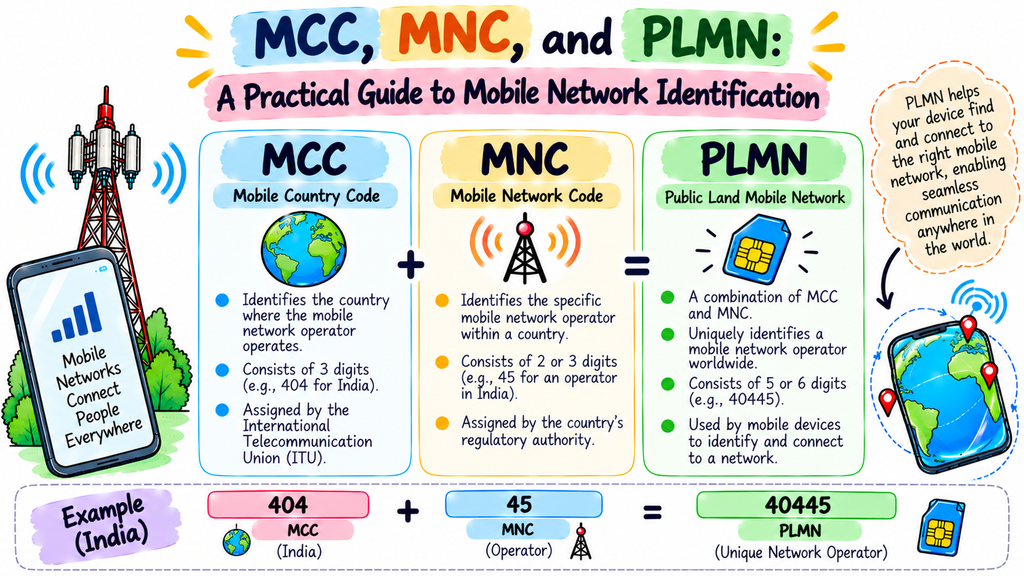
Each term has a different meaning. MCC identifies a country or geographical numbering assignment. MNC distinguishes a mobile network within the relevant MCC arrangement. PLMN describes the public mobile network, and its identifier combines MCC and MNC.
These concepts help explain how phones select networks, how roaming works, and how telecom teams investigate connection issues.
The Building Blocks of Mobile Network Identity
Mobile networks need clear identifiers because several operators may offer service in the same region. A phone may also detect networks from different operators when a user travels.
MCC and MNC provide key information that helps devices and telecom systems distinguish those networks. The PLMN concept describes the public mobile network that the combined identifier represents.
Here is a quick overview:
- MCC: Mobile Country Code, normally a three-digit code.
- MNC: Mobile Network Code, usually two or three digits, depending on the numbering plan.
- PLMN: Public Land Mobile Network, which provides public mobile communication services.
- PLMN identifier: A combination of MCC and MNC that identifies a particular network within the applicable numbering system.
These terms work together, but they do not mean the same thing.
MCC: Identifying the Country-Code Assignment
The Mobile Country Code helps mobile devices and telecom systems identify the country or geographical numbering assignment associated with a network.
An MCC normally contains three digits. Systems use it as one part of the network’s identity.
Where MCC Helps
MCC supports several mobile network tasks, including:
- Recognizing a network’s country-code assignment.
- Supporting mobile network selection procedures.
- Helping telecom systems process roaming information.
- Assisting engineers who review network settings.
- Providing context during connectivity troubleshooting.
However, MCC does not identify a phone’s exact physical location. It relates to the network’s numbering assignment, not the precise position of a user.
MNC: Distinguishing One Mobile Network From Another
The Mobile Network Code works with MCC to distinguish a mobile network within the relevant numbering arrangement.
MNC length can vary. Some numbering plans use two digits, while others use three. Devices and telecom systems must follow the correct format when they interpret these values.
Why Operators Need MNC
Imagine that several mobile operators serve customers in the same country. The MCC may identify the same country-code assignment for those networks, while their MNC values distinguish the operators’ networks.
This distinction helps systems interpret network information correctly.
Telecom engineers may check MNC values when they investigate registration failures, review SIM settings, or test roaming behavior. They must also consider other network information because MNC alone may not identify the network fully.
PLMN: Understanding the Public Mobile Network
PLMN stands for Public Land Mobile Network. It refers to a public mobile telecommunications network that offers services such as voice calls, text messages, and mobile data.
A PLMN identifier combines the MCC and MNC. Mobile devices and telecom systems use this combination to distinguish a network from other networks.
PLMN Versus PLMN Identifier
The difference is straightforward:
| Term | Meaning |
|---|---|
| PLMN | The public mobile network itself |
| PLMN identifier | The MCC and MNC combination that identifies the network |
This distinction helps when reading network diagnostics, examining technical records, or discussing mobile network configuration.
Comparing MCC, MNC, and PLMN
The following comparison shows how each term contributes to mobile network identification.
| Detail | MCC | MNC | PLMN |
|---|---|---|---|
| Full name | Mobile Country Code | Mobile Network Code | Public Land Mobile Network |
| Main purpose | Identifies the relevant country or geographical numbering assignment | Distinguishes a network within the MCC arrangement | Describes a public mobile network |
| Format | Normally three digits | Two or three digits, depending on the numbering plan | The network identifier uses MCC and MNC |
| Relationship | Works with MNC | Works with MCC | Uses the combined identifier |
| Common applications | Network identification and configuration | Operator distinction and troubleshooting | Mobile service delivery and network identification |
Remember that PLMN describes the network, while the PLMN identifier represents it through the MCC and MNC combination.
How Mobile Devices Use Network Identifiers
A phone can detect several mobile networks, but it must evaluate which options it can use. Network identifiers help the device distinguish available networks during supported selection procedures.
The phone also checks other factors, including its SIM or eSIM profile, operator settings, network compatibility, and service availability.
Selecting a Network
When a phone searches for mobile service, it detects nearby networks and evaluates them according to its configuration and the operator’s rules.
The device may choose its home network or a permitted roaming partner. MCC and MNC help it recognize the available networks, but other selection rules also influence the decision.
Registering With an Operator
After selecting a network, the phone attempts to register. The operator checks whether the subscriber can access its services.
A device may recognize a network but still fail to register. For example, the operator may reject access because of subscription restrictions or roaming permissions. Poor coverage or technical incompatibility can also prevent a connection.
International Roaming and Network Identification
International roaming lets mobile subscribers use supported partner networks while travelling outside their home operator’s coverage area.
When a traveller enters another country, the phone searches for compatible networks. MCC and MNC help the device identify the available operators.
The home operator and visited network also use roaming agreements, subscriber records, and network procedures to manage access.
Network identification alone cannot guarantee roaming service. The subscriber needs a suitable plan, the operators must support the roaming arrangement, and the device must work with the available network technology.
Before travelling, users should review their roaming settings, plan limits, device compatibility, and destination coverage.
MCC, MNC, and eSIM Technology
An eSIM lets users install and manage supported mobile profiles digitally instead of inserting a removable SIM card. However, eSIM technology still relies on mobile network identification.
When a device uses an eSIM profile, network selection and registration procedures use the relevant profile settings and available network information. MCC and MNC help the device distinguish networks during these processes.
Before buying an eSIM plan, users should check:
- Countries and regions covered by the plan.
- Supported local operators and roaming partners.
- Data allowances and service restrictions.
- Device and network compatibility.
- Activation requirements and validity periods.
Users can explore eSIM options through esimglobo.com/. They should review the plan details carefully because coverage and operator access vary by provider and destination.
How Telecom Professionals Use These Codes
MCC, MNC, and PLMN information supports day-to-day telecom work. Engineers, network testers, and service teams may review these details as part of several tasks.
Network Configuration
Telecom teams check network identifiers when they configure or verify supported mobile network settings. Correct values help systems distinguish the intended network.
Roaming Support
Operators use network identity information as part of roaming procedures. They also check subscriber authorization and agreements between operators before providing service.
Connectivity Testing
Test teams may examine network identifiers to confirm that a device detects the expected network. They can compare the results with device settings and test records.
IoT Deployments
Connected sensors, meters, vehicles, and industrial devices often use mobile networks to transmit data. Network identifiers help these devices recognize available operators and follow their connection settings.
Technical Troubleshooting
When a device cannot connect, engineers may review MCC, MNC, and PLMN information alongside signal strength, SIM settings, registration messages, and device compatibility. This broader review helps them narrow down the cause of the problem.
Ways to Find Mobile Network Information
The available methods depend on the phone model, operating system, modem, and mobile operator. Some devices display basic network details, while others require diagnostic tools.
Users and technical teams can try these options:
Check the phone settings. Look for mobile network, SIM, or cellular information. Some devices provide only limited technical details.
Use supported diagnostic tools. Certain network-testing applications can display additional information about the connected network.
Review device logs. Technical teams can inspect supported modem or system logs to investigate registration and network selection behavior.
Contact the mobile operator. The operator can confirm relevant network details and help investigate service problems.
Consult device documentation. Manufacturers may explain how to access cellular diagnostics on specific models.
Always verify code information through a reliable source before using it in a technical configuration. An unverified code list may contain outdated or incorrectly formatted entries.
Mistakes That Can Cause Confusion
People often mix up MCC, MNC, and PLMN because these terms appear together in network information. Understanding a few common errors can prevent misunderstandings.
- Treating MCC as a location tracker: MCC relates to a country or geographical numbering assignment. It does not reveal someone’s exact location.
- Using MNC without the correct MCC context: The combined identifier normally needs both values to distinguish the intended network.
- Calling PLMN only a code: PLMN refers to the public mobile network. The PLMN identifier represents that network through MCC and MNC.
- Assuming network detection guarantees service: A phone may detect a network but lack permission to register.
- Ignoring MNC length: Numbering plans may use two or three digits, so systems must preserve the correct format.
- Trusting every online example: Verify network codes before using them in real configurations or technical reports.
Frequently Asked Questions
What is an MCC in a mobile network?
MCC means Mobile Country Code. It normally contains three digits and identifies the country or geographical numbering assignment associated with a mobile network.
How does an MNC identify an operator?
MNC means Mobile Network Code. It distinguishes a mobile network within the relevant MCC arrangement and may contain two or three digits.
What does PLMN mean?
PLMN stands for Public Land Mobile Network. It describes a public mobile network that provides services such as voice calls, messaging, and mobile data.
How do MCC and MNC form a PLMN identifier?
The MCC provides the country-code assignment, while the MNC distinguishes the network within that arrangement. Together, they form the PLMN identifier.
Can MCC show a user’s exact location?
No. MCC identifies a country or geographical numbering assignment. It does not reveal the user’s precise physical position.
Do mobile phones use these identifiers when roaming?
Yes. MCC and MNC help phones and telecom systems identify networks during roaming procedures. However, operator agreements, subscriber permissions, coverage, and device compatibility also affect access.
Does an eSIM use MCC and MNC?
Yes. eSIM-enabled devices use network identification as part of supported network selection and registration procedures. The exact behavior depends on the device, profile, and operator.
Why might a phone detect a network but fail to connect?
The operator may not authorize the subscriber, the roaming plan may not support the network, or the device may lack compatible technology. Coverage and network settings can also affect registration.
Do MCC and MNC have fixed lengths?
MCC normally uses three digits. MNC may use two or three digits, depending on the applicable numbering plan.
Final Thoughts
Mobile networks rely on clear identification to help devices and operators manage connections. MCC, MNC, and PLMN each play a distinct role in that process.
MCC identifies the relevant country or geographical numbering assignment. MNC distinguishes a network within that arrangement. PLMN describes the public mobile network, and its identifier combines the two codes.
These concepts support network selection, roaming, eSIM connectivity, IoT services, and technical troubleshooting. Understanding their differences makes mobile network information easier to read and explain.
Still, a network identifier does not guarantee access. A successful connection also depends on operator authorization, service coverage, device compatibility, and network rules.