
Introduction
Multi-engine training is an important step for Indian pilots who want to move from basic single-engine flying to more advanced aircraft operations. Most student pilots begin their journey on single-engine training aircraft. These aircraft are good for learning basic flying skills, navigation, takeoff, landing, radio communication, and emergency handling.
But professional aviation often requires a higher level of skill. Multi-engine aircraft have more power, more systems, more cockpit workload, and different emergency procedures. This is why multi-engine training becomes valuable for CPL holders, CPL aspirants, and pilots preparing for airline, charter, corporate, or advanced flying roles.
This Multi-Engine Training Guide for Indian Pilots explains what multi-engine training means, who should take it, what skills are taught, how Indian flight schools usually conduct it, and what mistakes students should avoid.
What Is Multi-Engine Training?
Multi-engine training teaches pilots how to fly aircraft with more than one engine. In most training environments, this usually means a twin-engine aircraft.
A single-engine aircraft has one engine. If that engine fails, the pilot must follow emergency procedures and prepare for a forced landing. In a multi-engine aircraft, the aircraft may continue flying with one engine operating, but this creates a new challenge. The pilot must control asymmetric thrust, manage aircraft performance, identify the failed engine, and follow correct emergency procedures.
This makes multi-engine flying more demanding. It is not only about having two engines. It is about understanding how the aircraft behaves when both engines are working and how it behaves when one engine is not working.
Why Multi-Engine Training Matters for Indian Pilots
Multi-engine training is important because it develops professional flying discipline. It teaches pilots to think ahead, manage workload, follow checklists, and handle emergencies in a structured way.
For Indian pilots, this training is useful in several career stages. CPL aspirants may use it to strengthen their licence profile. Fresh CPL holders may take multi-engine training to prepare for airline selection or type rating. Pilots interested in charter, corporate aviation, or advanced aircraft operations may also benefit from this training.
Multi-engine experience also helps students understand aircraft systems better. They learn about engine controls, propeller systems, fuel management, electrical systems, hydraulic systems, performance planning, and emergency decision-making.
Some Indian flight training providers describe DGCA-oriented multi-engine training as involving minimum multi-engine aircraft training hours, while other FTOs advertise higher standard packages depending on aircraft, training goal, and future type-rating preparation. This is why students should confirm the latest requirement with DGCA/eGCA and the selected flight school before payment.
Who Should Take Multi-Engine Training?
Multi-engine training is suitable for pilots who have already built basic flying confidence and want to move toward advanced flying.
It is useful for:
- CPL aspirants in the final phase of training
- Fresh CPL holders
- Pilots preparing for airline assessment
- Pilots planning for type rating
- Pilots interested in charter or corporate flying
- Students who want to improve aircraft systems knowledge
- Pilots who want to build stronger emergency-handling skills
However, students should not rush into multi-engine training too early. Strong single-engine flying skills are important before moving to a twin-engine aircraft.
Basic Eligibility Before Multi-Engine Training
Eligibility may vary depending on the flight school, aircraft type, licence stage, and DGCA process. In general, a student should have a strong foundation in single-engine flying before starting multi-engine training.
Common requirements may include:
- Valid pilot licence or suitable training stage
- Medical fitness as required for training
- Basic single-engine flying experience
- Flight school approval
- Instructor recommendation
- Ground school preparation
- Knowledge of aircraft systems
- Understanding of performance basics
- Proper documentation and logbook records
Students should always check the latest DGCA, eGCA, and FTO requirements before joining any multi-engine training program.
Key Skills Learned During Multi-Engine Training
Twin-Engine Aircraft Handling
The first major skill is learning how a twin-engine aircraft feels in flight. Multi-engine aircraft may be faster, heavier, and more powerful than single-engine training aircraft.
Students learn how to manage pitch, power, trim, speed, and aircraft attitude smoothly.
Engine Start and Shutdown Procedures
Multi-engine aircraft require proper engine start and shutdown procedures. Students learn how to start engines safely, monitor engine instruments, manage engine temperature, and follow checklist discipline.
Power Management
In multi-engine flying, power management is very important. Students learn how both engines must be balanced and monitored. Incorrect power handling can affect aircraft control and performance.
Takeoff and Landing
Multi-engine takeoff and landing require good planning and smooth control. Students learn how to maintain runway centerline, manage power, monitor engine performance, and handle higher approach speeds.
Engine Failure Handling
This is one of the most important parts of multi-engine training. Students learn how to identify an engine failure, maintain control, secure the affected engine, and continue or discontinue flight depending on the situation.
Asymmetric Thrust Control
When one engine produces power and the other does not, the aircraft may yaw or turn toward the failed engine side. This is called asymmetric thrust. Students learn how to control this using rudder, bank angle, airspeed, and correct procedure.
VMC Awareness
VMC means minimum control speed. It is a critical concept in multi-engine training. Students learn why speed control is important and why flying below safe control speed during engine-out conditions can be dangerous.
Single-Engine Approach and Landing
Students practice how to approach and land safely with one engine inoperative under instructor supervision. This builds confidence and emergency discipline.
Multi-Engine Navigation
Multi-engine aircraft may cover distance faster than basic single-engine trainers. Students learn better planning, timing, fuel calculation, and navigation management.
Emergency Procedures
Multi-engine training includes several emergency scenarios such as engine failure after takeoff, engine failure during cruise, abnormal indications, rejected takeoff, and single-engine landing.
Single-Engine vs Multi-Engine Aircraft Training
Single-engine training focuses on basic aircraft control, visual flying, navigation, circuits, landings, and emergency handling with one engine.
Multi-engine training adds more complexity. The pilot must manage two engines, more systems, higher speed, and more cockpit workload.
Here is a simple comparison:
| Area | Single-Engine Training | Multi-Engine Training |
|---|---|---|
| Aircraft Power | One engine | Two engines |
| Cockpit Workload | Lower | Higher |
| Emergency Focus | Forced landing after engine failure | Engine-out control and decision-making |
| Systems Knowledge | Basic to moderate | More detailed |
| Speed | Usually lower | Usually higher |
| Career Use | Foundation training | Advanced professional training |
Both types of training are important. Single-engine flying builds the base. Multi-engine flying builds advanced confidence.
Common Challenges During Multi-Engine Training
Managing Cockpit Workload
Many students feel busy during the first few multi-engine flights. There are more checks, more systems, and faster aircraft responses. Good preparation helps reduce this pressure.
Understanding Engine-Out Procedures
Engine failure handling in a twin-engine aircraft must be learned properly. Students should not memorize procedures blindly. They must understand the reason behind each step.
Handling Asymmetric Thrust
This is one of the biggest challenges. If one engine loses power, the aircraft may become difficult to control without correct rudder input and speed management.
Learning Aircraft Systems
Multi-engine aircraft may have more complex fuel, electrical, propeller, and engine systems. Students must take ground classes seriously.
Higher Training Cost
Multi-engine aircraft are usually more expensive to operate than single-engine aircraft. Fuel, maintenance, instructor cost, and aircraft availability can increase training expenses.
Limited Aircraft Availability
Not every flight school has enough multi-engine aircraft. Students may face waiting time due to aircraft maintenance, weather, instructor availability, or scheduling issues.
How Flight Schools in India Conduct Multi-Engine Training
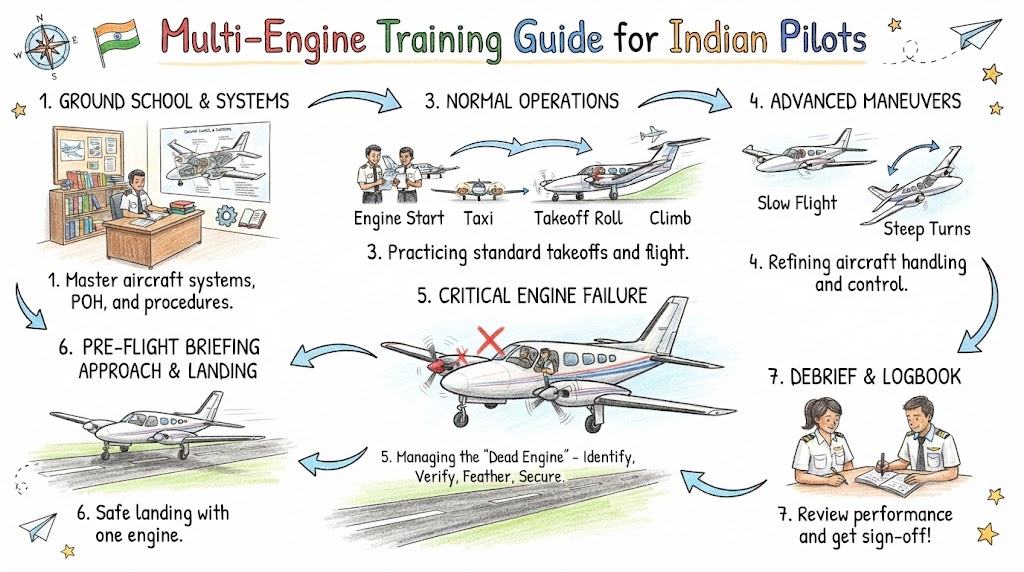
Indian flight schools usually conduct multi-engine training in a structured way.
Ground School
Students first learn aircraft systems, performance, limitations, emergency procedures, checklists, and multi-engine aerodynamics.
Simulator or Procedure Practice
Some schools may use simulator or procedure practice sessions if available. This helps students understand engine-out procedures before flying the actual aircraft.
Dual Flying With Instructor
Students begin with instructor-led flying. The instructor demonstrates normal operations, aircraft handling, and emergency procedures.
Takeoff and Landing Practice
Students practice normal takeoffs, landings, go-arounds, and circuit flying in a multi-engine aircraft.
Engine Failure Exercises
Under safe and controlled conditions, instructors teach engine failure recognition, control, checklist use, and single-engine handling.
Assessment or Check
After training, students may undergo an assessment, skill check, or endorsement-related process as required by the school and regulator.
Logbook Entry
Every flight must be recorded properly in the pilot logbook. Aircraft type, flight time, dual time, training details, and instructor verification should be accurate.
Important Documents and Records Students Should Maintain
Proper documentation is very important in aviation. Students should maintain:
- Pilot logbook
- Medical certificate
- Licence documents
- Flight training records
- Instructor endorsements
- Aircraft type details
- Multi-engine flight time records
- Ground training completion records
- Exam or assessment documents
- FTO training completion certificate, if issued
A small mistake in documentation can create problems during licence work, endorsement, type rating, or airline application. Students should update records immediately after every flight.
Safety Tips for Multi-Engine Training
Prepare Before Every Flight
Do not enter the cockpit without preparation. Review aircraft systems, checklist flow, emergency actions, speeds, and lesson objectives before the flight.
Respect Checklist Discipline
Multi-engine aircraft require strong checklist habits. Never depend only on memory. Use the checklist as trained by your instructor.
Understand, Do Not Just Memorize
Many students memorize engine failure procedures but do not understand them. A good pilot understands why each action is required.
Maintain Correct Airspeed
Airspeed is very important during engine-out conditions. Poor speed control can reduce aircraft safety margins.
Listen to Instructor Guidance
Multi-engine training can feel intense at first. Stay calm and follow your instructor step by step.
Avoid Overconfidence
Having two engines does not mean the aircraft is automatically safer in every situation. A poorly handled engine failure can become dangerous. Training, discipline, and decision-making matter most.
Study Aircraft Limitations
Know the aircraft’s speed limits, weight limits, engine limits, and performance limitations. This knowledge helps pilots make safer decisions.
Common Mistakes Students Should Avoid
Treating Multi-Engine Aircraft Like Single-Engine Aircraft
A twin-engine aircraft requires different thinking. Students must respect the extra workload and system complexity.
Weak Ground Preparation
Ground knowledge is very important. Without understanding systems and performance, flying lessons become harder.
Poor Rudder Control
During asymmetric thrust, rudder control is critical. Students must practice coordinated control carefully.
Ignoring Performance Calculations
Weight, temperature, runway length, climb performance, and density altitude matter in multi-engine training. Students should not ignore performance planning.
Checklist Shortcuts
Skipping checklist items can create serious problems. Multi-engine flying needs disciplined checklist use.
Panic During Engine Failure Practice
Engine failure practice is a training exercise. Students should remain calm, maintain aircraft control, and follow procedure.
Not Asking Questions
If something is unclear, ask your instructor. Aviation training is not about pretending to know everything. It is about learning correctly.
Benefits of Multi-Engine Training
Multi-engine training gives several long-term benefits to Indian pilots.
It helps pilots build professional confidence. It improves aircraft handling, system knowledge, emergency response, cockpit discipline, and decision-making.
It also gives students a better understanding of the kind of thinking required in advanced aviation roles. Airline and charter flying require strong procedure-based habits. Multi-engine training supports that mindset.
For pilots planning type rating, multi-engine training can provide useful exposure before moving into larger aircraft and simulator-based training.
Practical Preparation Checklist
Before starting multi-engine training, students should review:
- Current licence status
- Medical validity
- DGCA/eGCA requirement
- FTO approval and aircraft availability
- Training cost estimate
- Aircraft type used for training
- Instructor experience
- Ground class schedule
- Simulator availability, if any
- Logbook and documentation process
- Training completion timeline
- Refund and rescheduling policy
This checklist helps students avoid confusion before enrollment.
FAQs on Multi-Engine Training for Indian Pilots
1. What is multi-engine training?
Multi-engine training teaches pilots how to fly aircraft with more than one engine, usually a twin-engine aircraft. It includes normal flying, engine management, emergency handling, and single-engine operations.
2. Is multi-engine training required for Indian pilots?
It depends on the pilot’s licence goal, career path, endorsement requirement, and future type-rating plan. Students should confirm the latest DGCA/eGCA and FTO requirements before joining.
3. Is multi-engine training difficult?
It can feel challenging at first because the aircraft is faster and the workload is higher. With ground preparation and instructor guidance, students can learn it step by step.
4. What is the most important skill in multi-engine training?
Engine-out handling is one of the most important skills. Pilots must learn how to maintain control, identify the failed engine, manage speed, and follow procedures.
5. Can fresh CPL holders take multi-engine training?
Yes, many fresh CPL holders consider multi-engine training to build advanced skills and prepare for future airline or type-rating stages. Eligibility should be checked with the selected FTO.
6. Why is asymmetric thrust important?
Asymmetric thrust happens when one engine produces power and the other does not. The aircraft may yaw toward one side, so the pilot must use correct control inputs and maintain safe speed.
7. How should students choose a flight school for multi-engine training?
Students should check aircraft availability, instructor experience, DGCA-related process, cost clarity, maintenance standards, scheduling, documentation support, and student feedback.
8. Does multi-engine training guarantee an airline job?
No. Multi-engine training can improve skills and strengthen a pilot profile, but it does not guarantee airline selection. Airline hiring depends on many factors, including exams, interviews, simulator checks, medical fitness, communication, and market demand.
9. What documents are needed for multi-engine training?
Common documents include licence records, medical certificate, logbook, identity proof, training records, and FTO forms. Exact documents may vary by school and DGCA process.
10. What is the best advice before starting multi-engine training?
Study aircraft systems properly, understand emergency procedures, prepare before every flight, follow checklists, and never rush the training just to complete hours.
Final Thoughts
Multi-engine training is a major step in the journey of Indian pilots. It is not just about flying an aircraft with two engines. It is about learning better control, stronger discipline, deeper system knowledge, and safer emergency handling.
For CPL aspirants and fresh pilots, multi-engine training can improve confidence and prepare them for advanced aviation opportunities. But it should be done at the right time, with proper preparation, a good instructor, and a reliable flight school.
Students should remember one simple rule: multi-engine flying rewards preparation. The more seriously you study systems, speeds, checklists, and emergency procedures, the better your training experience will be.
For readers of pilotsindia.com, multi-engine training should be seen as a professional development step. It builds the mindset needed for safer, sharper, and more responsible flying.

