
Introduction
Flying an aircraft is a dream for many students, aviation lovers, working professionals, and travel enthusiasts. For some people, aviation is a career goal. For others, flying is a passion, hobby, or personal achievement. A Private Pilot License in India is one of the most important first steps for anyone who wants to legally fly an aircraft for non-commercial purposes.
A Private Pilot License, also known as PPL, allows a person to fly an aircraft privately after completing the required training, medical fitness, examinations, and licensing process. In India, pilot licensing is regulated by the Directorate General of Civil Aviation, commonly known as DGCA. DGCA is the official civil aviation regulator responsible for safety and aviation licensing in India.
This guide explains how to apply for a Private Pilot License in India, including eligibility, documents, medical requirements, flying school selection, training process, examinations, cost, duration, and common mistakes to avoid.
What is a Private Pilot License?
A Private Pilot License is an aviation license that allows an individual to fly an aircraft for personal or recreational purposes. It is not meant for paid commercial flying. A PPL holder can fly as pilot-in-command of an aircraft, subject to license privileges, ratings, aircraft category, and DGCA rules.
A PPL is suitable for people who want to:
- Fly for personal interest
- Build aviation knowledge
- Join flying clubs
- Experience aircraft handling
- Begin a future path toward Commercial Pilot License
- Understand aviation before making a full career commitment
It is important to understand that a PPL is different from a Commercial Pilot License. A PPL is mainly for private flying, while a CPL is required for professional paid flying.
Why Choose a Private Pilot License in India?
A Private Pilot License gives you the opportunity to enter the aviation world in a structured and legal way. Many aspiring pilots choose PPL because it gives them practical flying experience without immediately committing to full commercial pilot training.
A PPL can be useful for:
- Aviation enthusiasts who want to fly aircraft legally
- Students who want to understand pilot training before CPL
- Professionals who want flying as a personal achievement
- People interested in aircraft ownership or flying clubs
- Future commercial pilots who want to build confidence early
For many students, PPL works as a foundation before moving toward CPL training. It helps build basic flying skills, aviation discipline, navigation knowledge, radio communication confidence, and aircraft handling ability.
Who Can Apply for a Private Pilot License in India?
To apply for a Private Pilot License in India, an applicant must meet DGCA requirements. The DGCA rules mention that an applicant for a Private Pilot Licence should not be less than 17 years of age on the date of application.
Basic eligibility generally includes:
- Minimum age as per DGCA requirement
- Required educational qualification
- Medical fitness
- Ability to understand aviation subjects
- English communication ability
- Completion of flight training
- Passing required examinations
- Successful skill test
Since aviation rules may be updated, students should always verify final requirements through the official DGCA website or eGCA portal before applying. DGCA itself advises users to verify critical details through official DGCA sources.
Role of DGCA in Private Pilot Licensing
DGCA is the main aviation regulatory authority in India. It deals with civil aviation safety, licensing, regulations, aviation standards, and approvals. For pilot licensing, DGCA sets eligibility rules, training requirements, medical standards, examination procedures, and license issuance processes.
For a Private Pilot License in India, DGCA is important because:
- It regulates pilot licensing
- It approves aviation training standards
- It manages licensing through official systems
- It defines medical fitness requirements
- It conducts or supervises aviation examinations
- It issues licenses after requirements are completed
Students should avoid relying only on unofficial sources. The final authority for pilot licensing in India is DGCA.
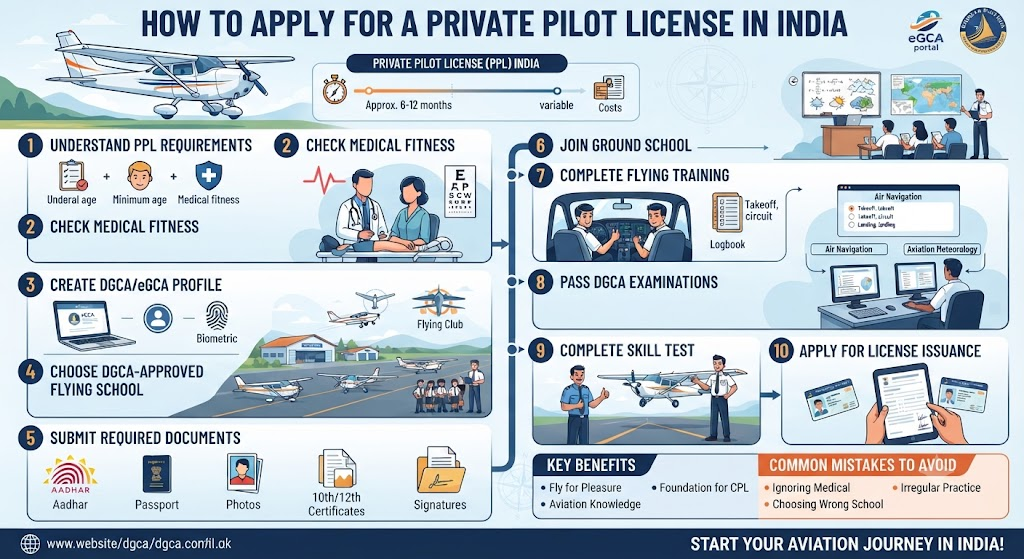
Step-by-Step Process to Apply for a Private Pilot License in India
1- Understand the PPL Requirements
Before joining a flying school, understand what a PPL allows and what it does not allow. A Private Pilot License is not a direct job license. It is mainly for private flying and personal aviation use.
You should review:
- Age requirement
- Medical requirement
- Flying hour requirement
- Ground school subjects
- DGCA exam process
- Skill test process
- Approximate cost
- Training duration
This helps you avoid confusion later.
2- Check Medical Fitness
Medical fitness is one of the most important parts of pilot training. Even if you are academically strong and financially ready, you must be medically fit as per DGCA standards.
For PPL, students generally need a valid aviation medical certificate as required by DGCA. Medical checks may include vision, hearing, general health, fitness, and other aviation-related health standards.
You should complete your medical process early because medical delays can affect training plans.
3- Create or Use Your DGCA/eGCA Profile
DGCA uses digital systems for many aviation services. The eGCA portal is used for civil aviation services, licensing-related processes, and applicant records. The official DGCA website provides access to eGCA services and support information.
Before applying for licensing services, students may need to create or maintain their digital aviation profile with accurate personal details, documents, photograph, signature, and educational information.
Always ensure that your name, date of birth, address, and document details match across all records.
4- Choose a DGCA-Approved Flying School
Selecting the right flying school is one of the most important decisions in your PPL journey. Do not choose a school only because it is cheap or close to your city.
Check these points before admission:
- DGCA approval status
- Aircraft availability
- Instructor quality
- Safety record
- Training schedule
- Maintenance standards
- Ground school support
- Student feedback
- Weather conditions at location
- Fee transparency
- Hostel or accommodation support
- Simulator availability, if applicable
A good flying school should clearly explain the training structure, fee breakup, aircraft type, instructor availability, and expected timeline.
5- Submit Required Documents
After choosing a flying school and starting your application process, you will need to submit documents for verification. Document requirements may vary depending on DGCA portal process and flying school requirements.
Common documents include:
- Aadhaar card
- Passport, if available
- PAN card
- Class 10 certificate
- Class 12 certificate, if applicable
- Birth proof
- Address proof
- Passport-size photographs
- Digital signature
- Medical certificate
- School admission documents
- Identity proof
Keep scanned copies ready in proper size and format.
6- Join Ground School
Ground school teaches the theory behind flying. Many students think pilot training is only about aircraft handling, but aviation theory is equally important.
Ground school subjects may include:
- Air Regulations
- Aviation Meteorology
- Air Navigation
- Aircraft Technical Knowledge
- Flight Planning
- Human Performance
- Radio Communication
- Basic Aerodynamics
- Aircraft Systems
Strong ground knowledge helps you become a safer and more confident pilot.
7- Complete Flying Training
Flying training is the practical part of your PPL journey. You will learn how to operate an aircraft under instructor supervision.
Training usually includes:
- Aircraft familiarization
- Pre-flight inspection
- Taxiing
- Takeoff
- Straight and level flight
- Climbing and descending
- Turns
- Circuit flying
- Landing practice
- Emergency procedures
- Navigation flying
- Solo flying
- Cross-country flying
Your training flights will be recorded in your pilot logbook. Keep your logbook accurate and updated.
8- Pass DGCA Examinations
To obtain a Private Pilot License in India, you must clear required DGCA examinations. These exams test your understanding of aviation theory, safety, navigation, regulations, weather, and aircraft knowledge.
Prepare seriously for DGCA exams. Do not treat them as a formality. Strong theory knowledge helps in real flying situations.
Study tips:
- Follow DGCA syllabus
- Attend ground classes regularly
- Solve previous question papers
- Understand concepts instead of memorizing
- Revise aviation regulations carefully
- Practice navigation calculations
- Study weather charts and aviation meteorology basics
9- Complete Skill Test
After completing required training and exams, you must demonstrate your flying skills. A skill test is a practical flying assessment where an authorized examiner checks whether you can safely operate the aircraft.
The skill test may include:
- Pre-flight checks
- Aircraft handling
- Takeoff
- Navigation
- Turns
- Landing
- Emergency handling
- Communication
- Decision-making
- Safety awareness
The examiner evaluates your practical ability, confidence, discipline, and safety mindset.
10- Apply for License Issuance
After completing medical, ground school, flying hours, examinations, and skill test, you can apply for the issuance of your Private Pilot License through the required DGCA process.
Before submission, verify:
- Personal details
- Medical validity
- Exam results
- Flying hours
- Skill test record
- Logbook accuracy
- Document uploads
- Fee payment
- Flying school endorsements
Once DGCA processes and approves the application, the license is issued as per official procedure.
Documents Required for Private Pilot License in India
The exact document list may vary depending on the current DGCA process, but applicants should generally keep the following ready:
Identity Proof
Aadhaar card, passport, voter ID, or other accepted government identity proof may be required to verify identity.
Age Proof
Class 10 certificate, birth certificate, or passport may be used to confirm date of birth.
Educational Documents
Class 10 and Class 12 certificates may be required depending on training and licensing requirements.
Address Proof
Aadhaar card, passport, bank statement, utility bill, or other accepted address proof may be needed.
Medical Certificate
A valid aviation medical certificate is required to prove medical fitness.
Photographs
Recent passport-size photographs are commonly required for application and records.
Digital Signature
A scanned digital signature may be needed for online application processes.
Training Records
Flying school records, logbook entries, and instructor endorsements are important for license processing.
Medical Requirements for PPL in India
Medical fitness is compulsory for pilot training. Aviation medical checks ensure that the applicant is physically and mentally fit to fly safely.
Medical checks may include:
- Vision test
- Hearing test
- General physical examination
- Blood pressure check
- Medical history review
- Fitness assessment
- Other tests as required by aviation medical standards
Students with eyesight issues should not panic immediately. Many aviation medical standards allow correction within permitted limits. However, the final decision depends on DGCA medical standards and authorized medical examiners.
Complete your medical process early to avoid delays.
How to Choose the Best Flying School for PPL
Choosing the right flying school can affect your cost, training quality, confidence, and timeline.
Before joining, ask these questions:
- Is the school approved by DGCA?
- How many aircraft are operational?
- What aircraft types are used for PPL training?
- How many instructors are available?
- What is the average training duration?
- Are there hidden charges?
- Is ground school included?
- What is the student-to-aircraft ratio?
- How is aircraft maintenance managed?
- What is the safety record?
- Are weather conditions suitable for regular flying?
- Does the school help with DGCA documentation?
Avoid choosing a school only because it advertises low fees. Low cost is useful only when training quality, safety, aircraft availability, and transparency are also strong.
Flight Training Requirements
Flight training for PPL builds basic aircraft handling skills. Students first fly with an instructor and later progress toward solo flying after gaining confidence and meeting safety standards.
Training usually includes:
Dual Flying
This means flying with an instructor. The instructor teaches aircraft handling, procedures, communication, and emergency response.
Solo Flying
After sufficient training, the instructor may authorize you to fly solo. Solo flying is a major milestone in every pilot’s journey.
Circuit Training
Circuit training teaches takeoff, pattern flying, approach, and landing. It helps students develop judgment and landing confidence.
Navigation Flying
Navigation exercises teach route planning, map reading, heading control, time calculation, and fuel planning.
Emergency Training
Students learn how to respond to abnormal and emergency situations such as engine issues, forced landing planning, and communication problems.
Logbook Maintenance
Every flight must be recorded correctly in the pilot logbook. Incorrect or incomplete logbook records can delay licensing.
Ground School Subjects for PPL
Ground school gives you the theoretical foundation needed for safe flying.
Common subjects include:
Air Regulations
This covers aviation rules, airspace, licensing requirements, flight rules, and operational procedures.
Aviation Meteorology
This teaches weather patterns, clouds, wind, visibility, pressure, temperature, and weather-related flight decisions.
Air Navigation
This covers maps, charts, compass use, headings, tracks, distance, time, speed, and route planning.
Aircraft Technical Knowledge
This explains aircraft systems, engine basics, instruments, controls, fuel systems, electrical systems, and aircraft limitations.
Radio Telephony
This helps students learn aviation communication, standard phraseology, and radio discipline.
Human Performance
This covers fatigue, decision-making, stress, situational awareness, and pilot limitations.
Cost of Private Pilot License in India
The cost of getting a Private Pilot License in India varies depending on the flying school, aircraft type, fuel cost, location, number of flying hours, exam fees, medical fees, and extra training needs.
Common cost components include:
- Admission fee
- Ground school fee
- Flying hour charges
- Instructor charges
- Medical examination fee
- DGCA exam fee
- Study material
- Uniform
- Logbook
- Headset, if required
- Accommodation
- Travel
- License application fee
- Miscellaneous charges
Students should always request a complete written fee structure before joining. Ask whether taxes, fuel surcharge, exam support, documentation, and extra flying are included.
How Long Does It Take to Get a PPL in India?
The time required to complete a Private Pilot License in India varies from student to student.
Factors that affect duration include:
- Weather conditions
- Aircraft availability
- Instructor availability
- Student performance
- Medical clearance
- DGCA exam schedule
- Documentation delays
- Flying school efficiency
- Student consistency
A focused student training at a well-managed flying school may complete faster, while delays can happen due to weather, aircraft maintenance, medical issues, or examination scheduling.
Common Mistakes to Avoid
1- Choosing a Flying School Without Proper Research
Do not join a school only because of attractive advertising. Verify approval, aircraft availability, and training quality.
2- Ignoring Medical Fitness
Some students pay admission fees before checking medical fitness. Complete medical checks early.
3- Poor Financial Planning
Pilot training can involve additional expenses. Always keep a buffer budget.
4- Delaying Documents
Mismatch in name, date of birth, or document details can create delays.
5- Not Taking Ground School Seriously
Flying skill is important, but theory knowledge is essential for safe aviation.
6- Irregular Flying Practice
Long gaps between flights can slow progress and increase cost.
7- Not Maintaining Logbook Properly
Your logbook is an official record of your flying experience. Keep it accurate.
Tips to Successfully Get a Private Pilot License
- Start with DGCA requirement research
- Complete medical checks early
- Choose a reliable flying school
- Keep all documents ready
- Attend ground classes seriously
- Fly regularly
- Revise after every lesson
- Maintain a clean logbook
- Ask instructors for feedback
- Prepare for DGCA exams in advance
- Stay disciplined and safety-focused
Difference Between PPL and CPL
| Point | Private Pilot License | Commercial Pilot License |
|---|---|---|
| Purpose | Private and recreational flying | Professional paid flying |
| Career Use | Not for airline jobs directly | Required for commercial pilot jobs |
| Training Level | Basic to intermediate | Advanced professional training |
| Medical Requirement | As per DGCA PPL standards | Higher professional medical standards |
| Cost | Lower than CPL | Higher than PPL |
| Flying Privileges | Private flying | Commercial flying |
| Best For | Aviation enthusiasts and beginners | Career pilots |
What Can You Do After Getting a PPL?
After receiving a Private Pilot License, you can continue your aviation journey in several ways.
You may:
- Fly privately within license privileges
- Join aviation clubs
- Build confidence in aircraft handling
- Continue toward Commercial Pilot License
- Learn advanced ratings
- Explore aviation as a long-term career
- Gain deeper aviation knowledge
A PPL is not the final destination for everyone. For many students, it is the beginning of a larger aviation journey.
FAQs
1- What is a Private Pilot License in India?
A Private Pilot License in India is a license that allows a person to fly an aircraft for private or recreational purposes. It is issued after completing DGCA requirements, medical fitness, flying training, examinations, and skill test. It does not allow paid commercial flying.
2- Who can apply for a PPL in India?
Applicants who meet DGCA eligibility requirements can apply for a PPL in India. The applicant must meet age, medical, training, examination, and documentation requirements. DGCA rules mention that a PPL applicant should not be less than 17 years of age on the date of application.
3- Is DGCA approval necessary for PPL training?
Yes, DGCA approval is very important. Since DGCA regulates civil aviation safety and licensing in India, students should choose aviation training that follows DGCA requirements and standards.
4- Can I become an airline pilot with only a PPL?
No. A PPL is not enough for airline pilot jobs. To work as a professional paid pilot, you generally need a Commercial Pilot License and other required ratings, training, and airline selection qualifications.
5- Is medical fitness compulsory for PPL?
Yes. Medical fitness is compulsory because flying requires good health, vision, hearing, judgment, and physical fitness. Students should complete medical checks early to avoid training delays.
6- How much does a Private Pilot License cost in India?
The cost varies by flying school, aircraft type, fuel charges, location, number of flying hours, exam fees, and extra training needs. Students should request a full written fee estimate from the flying school before admission.
7- How long does it take to get a PPL?
The duration depends on weather, aircraft availability, instructor schedule, student performance, exam timing, and documentation. Consistent training usually helps students complete faster.
8- Can I apply for PPL after Class 12?
Yes, many students explore PPL after school. However, applicants must meet DGCA eligibility, age, medical, training, and examination requirements.
9- Is English required for pilot training?
Yes. Aviation communication, manuals, radio communication, and examinations require English understanding. Good English communication helps students during training and flight operations.
10- Can PPL help me later for CPL?
Yes. PPL can help students build basic aviation knowledge and flying confidence before moving toward CPL. However, CPL has separate requirements and higher professional standards.
11- What subjects are taught in PPL ground school?
Common subjects include Air Regulations, Aviation Meteorology, Air Navigation, Aircraft Technical Knowledge, Radio Telephony, Flight Planning, and Human Performance.
12- Where should I verify official PPL rules?
You should verify official rules through DGCA’s official website and eGCA portal. DGCA is the regulatory authority for civil aviation safety and licensing in India.
Conclusion
Applying for a Private Pilot License in India is an exciting and disciplined journey. It requires proper planning, medical fitness, document readiness, ground school study, flying training, DGCA examinations, and a practical skill test.
The most important step is to start correctly. Understand DGCA requirements, choose a reliable flying school, complete your medical checks early, prepare your documents carefully, and stay consistent throughout training.
A Private Pilot License is more than a certificate. It is your entry into the world of aviation. Whether you want to fly for passion or use it as a foundation for a future commercial pilot career, the PPL journey builds confidence, discipline, technical knowledge, and real flying experience.
For aspiring pilots in India, this is one of the best ways to begin a serious and meaningful aviation journey.
SEO Keywords
Private Pilot License in India, PPL India, DGCA PPL, pilot license India, how to get PPL in India, flight training India, pilot training India, flying school India, DGCA medical, private pilot course
Long-Tail Keywords
how to apply for private pilot license in India, DGCA private pilot license process, documents required for PPL in India, cost of PPL training in India, best flying school for PPL India, private pilot license eligibility India, PPL medical requirements India, how long does PPL take in India, PPL vs CPL in India, step by step PPL application India
Image Alt Text Suggestions
- Private Pilot License training in India
- Student pilot learning to fly aircraft in India
- DGCA Private Pilot License application process
- Flying school aircraft for PPL training
- Pilot student completing pre-flight inspection
- Private Pilot License India step-by-step guide
- Aviation ground school class for student pilots
- PPL flight training aircraft in India
- Student pilot cockpit training session
- DGCA pilot license documents checklist
Image Caption Suggestions
- A Private Pilot License helps aviation enthusiasts begin their flying journey in India.
- PPL training includes ground school, flying practice, exams, and skill testing.
- Choosing the right flying school is an important step in pilot training.
- Medical fitness and documentation should be completed before starting flight training.
- A PPL can become the foundation for future commercial pilot training.

