
Introduction
Instrument rating is one of the most important parts of professional pilot training. For Indian pilot aspirants, it is a major step from basic visual flying to advanced cockpit-based flying.
In the beginning, most student pilots learn to fly by looking outside. They use the horizon, runway, ground references, roads, fields, and landmarks. But in real aviation, pilots cannot always depend on outside visibility. Clouds, haze, rain, low visibility, and poor weather can reduce visual references.
This is where instrument flying becomes important. Instrument rating trains a pilot to fly the aircraft safely by using cockpit instruments, navigation aids, radio communication, and standard procedures.
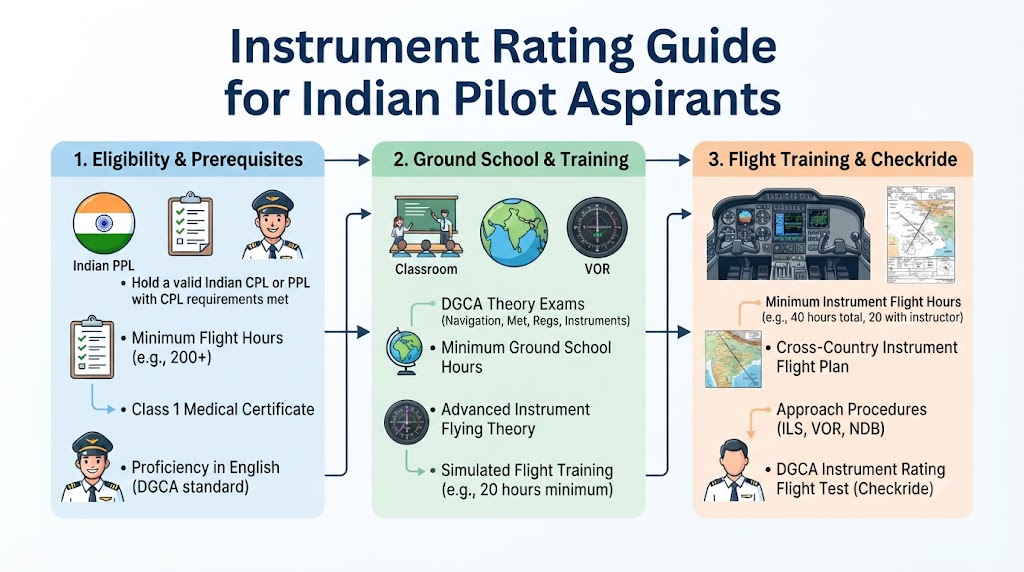
This Instrument Rating Guide for Indian Pilot Aspirants explains what instrument rating means, why it matters, what skills students learn, how flight schools conduct training, and what mistakes beginners should avoid.
What Is Instrument Rating?
Instrument Rating, often called IR, is a qualification that allows a pilot to fly under Instrument Flight Rules, also called IFR.
In simple words, it teaches a pilot to fly without depending only on outside view. The pilot uses instruments such as attitude indicator, altimeter, airspeed indicator, heading indicator, vertical speed indicator, navigation display, and communication equipment.
Instrument flying is not only about reading instruments. It is about discipline, planning, timing, communication, weather understanding, and decision-making.
When visibility is poor, an instrument-rated pilot can operate with better procedural control, subject to aircraft capability, airspace rules, weather minima, and regulatory permissions.
Why Instrument Rating Matters for Indian Pilot Aspirants
Instrument rating is important because professional flying requires more than basic aircraft control. A pilot must be able to handle different weather conditions, busy airspace, ATC instructions, navigation routes, and approach procedures.
For Indian students, this skill is especially useful because flying conditions may include haze, monsoon weather, winter fog, clouds, and changing visibility. A pilot who understands instrument flying becomes more confident and more disciplined.
Instrument rating also helps CPL aspirants build a stronger foundation for airline, charter, corporate, and advanced aviation roles. It improves cockpit discipline and teaches students to follow standard operating procedures.
DGCA’s CPL with Instrument Rating section lists official requirements for applicants, so students should check the latest DGCA/eGCA guidance and FTO instructions before planning training.
Who Should Learn About Instrument Rating?
Instrument rating is useful for many aviation learners, especially:
Student pilots who want to understand advanced flying, CPL aspirants preparing for professional training, fresh CPL holders planning their next step, pilots preparing for airline selection, and aviation students who want to understand IFR operations.
Even if a student is still in early training, learning the basics of instrument flying helps them understand how professional pilots think and operate.
Basic Eligibility Before Instrument Rating Training
Eligibility can vary depending on licence stage, aircraft category, FTO process, and DGCA rules. In general, students should have a strong foundation in basic flying before starting instrument training.
Common requirements may include:
Valid licence or required training stage, valid medical fitness, basic flying experience, flight school approval, ground school preparation, knowledge of navigation and meteorology, understanding of aircraft instruments, and proper logbook records.
Students should not rely only on informal advice. They should confirm current eligibility through DGCA, eGCA, and their approved Flying Training Organisation.
Key Skills Learned During Instrument Rating Training
Instrument Scanning
Instrument scanning means checking cockpit instruments in a proper pattern. The pilot must continuously monitor attitude, altitude, speed, heading, vertical speed, and navigation indications.
A weak instrument scan can cause altitude deviation, heading error, speed variation, or loss of situational awareness.
Attitude Flying
Students learn how small attitude changes affect climb, descent, turn, and level flight. This helps them control the aircraft smoothly without depending on outside references.
IFR Navigation
Instrument rating training teaches students how to navigate using instruments and approved procedures. This may include navigation aids, route tracking, headings, fixes, and approach planning.
Radio Communication
IFR flying requires clear communication with ATC. Students learn to listen carefully, read back instructions correctly, and manage radio workload while flying the aircraft.
Holding Patterns
Holding is a standard IFR procedure used to keep an aircraft within a protected area while waiting for clearance. Students learn entry methods, timing, turns, and altitude discipline.
Instrument Approach Procedures
Instrument approaches are used to guide aircraft toward an airport when visual references are limited. Students learn how to brief, fly, and monitor approach procedures safely.
Weather Awareness
Instrument rating students must understand weather reports, cloud conditions, visibility, wind, thunderstorms, and decision-making limits.
Emergency Handling
Instrument training includes abnormal and emergency situations such as instrument failure, communication problems, navigation confusion, and missed approach decisions.
Visual Flying vs Instrument Flying
Visual flying depends mainly on outside references. The pilot looks outside to maintain orientation, avoid traffic, and navigate visually.
Instrument flying depends mainly on cockpit instruments and procedures. The pilot must trust instruments, follow ATC instructions, and maintain accurate control.
| Area | Visual Flying | Instrument Flying |
|---|---|---|
| Main Reference | Outside view | Cockpit instruments |
| Rules | VFR | IFR |
| Weather Need | Better visibility | Can operate under approved IFR conditions |
| Workload | Lower to moderate | Higher |
| Navigation | Visual landmarks | Instruments and procedures |
| Training Focus | Basic aircraft control | Accuracy and procedure |
Both skills are important. Visual flying builds the foundation. Instrument flying builds professional discipline.
Common Challenges During Instrument Rating
Many Indian students face similar challenges during instrument rating training.
The first challenge is trusting instruments. Sometimes the body may feel that the aircraft is turning or climbing even when instruments show something else. Students must learn to trust the instruments, not body sensation.
The second challenge is workload. Students must fly, navigate, communicate, read instruments, follow procedures, and think ahead at the same time.
The third challenge is approach briefing. Many students try to fly an approach without fully understanding it. This can lead to confusion during descent, turns, timing, or missed approach.
Other common challenges include weak radio communication, poor heading control, altitude deviations, over-controlling the aircraft, and lack of weather understanding.
How Flight Schools in India Conduct Instrument Rating Training
Indian flight schools usually conduct instrument rating training in a structured way.
Ground School
Students study IFR rules, navigation, meteorology, instruments, radio procedures, approach charts, and emergency actions.
Simulator or Procedure Training
Some schools may use approved simulators or procedure trainers. This helps students practice instrument scan, radio calls, navigation, and approaches before flying the actual aircraft.
Dual Flying With Instructor
Students fly with an instructor and practice instrument flying under supervision. The instructor may use view-limiting methods or simulated instrument conditions as per training procedure.
Navigation Exercises
Students learn to fly routes, maintain heading, track navigation aids, and manage timing and fuel planning.
Approach Practice
Students practice different types of instrument approaches depending on aircraft, airport, approval, and training syllabus.
Assessment or Skill Check
After training, students may need to complete required checks as per DGCA and FTO procedure.
Logbook Entry
All instrument training must be recorded properly in the pilot logbook. Simulator time, aircraft time, dual time, and instrument time should be entered accurately.
Important Documents and Records
Students should maintain proper documents throughout training.
Important records include pilot logbook, medical certificate, licence documents, flight training records, instructor endorsements, simulator records if applicable, ground class records, instrument flying hour records, and check documents.
Good documentation is very important for licence work, future airline applications, and training verification.
Safety Tips for Instrument Rating Students
Prepare Before Every Lesson
Study the lesson before entering the aircraft or simulator. Know the objective, procedure, route, approach, and emergency actions.
Trust Instruments
During instrument flying, body sensation can mislead you. Trust the cockpit instruments and cross-check them regularly.
Do Not Chase the Instruments
Many beginners over-control the aircraft. Make small corrections and wait for the aircraft response.
Brief Every Approach
Before flying an approach, understand altitude, heading, timing, descent profile, missed approach, and communication requirements.
Improve Radio Practice
Radio workload can become stressful. Practice standard calls and readbacks regularly.
Respect Weather
Instrument rating does not mean a pilot can fly in every weather condition. Aircraft limits, pilot skill, weather minima, and regulations must always be respected.
Follow Checklists
Checklist discipline is very important in IFR flying. Do not skip steps or rely only on memory.
Common Mistakes Students Should Avoid
Students should avoid poor instrument scan, weak preparation, memorizing without understanding, ignoring weather study, poor radio communication, not briefing approaches, over-controlling the aircraft, depending too much on outside view, and failing to update logbook correctly.
One of the biggest mistakes is rushing training only to complete hours. Instrument flying needs understanding, practice, and discipline.
Benefits of Instrument Rating
Instrument rating builds strong cockpit discipline. It improves aircraft control, navigation accuracy, communication, weather judgment, and decision-making.
It also helps students prepare for advanced aviation environments where procedure-based flying is very important. Airline and commercial operations require pilots to follow instructions accurately and manage workload professionally.
For Indian pilot aspirants, instrument rating is not just a licence add-on. It is a mindset shift from basic flying to professional flying.
Practical Preparation Checklist
Before starting instrument rating training, students should check:
Training eligibility, medical validity, DGCA/eGCA requirements, FTO approval, aircraft or simulator availability, instructor experience, training cost, ground school plan, logbook process, approach training availability, and assessment requirements.
This helps students avoid confusion and plan training properly.
FAQs on Instrument Rating for Indian Pilot Aspirants
1. What is instrument rating?
Instrument rating is a pilot qualification that allows flying under Instrument Flight Rules using cockpit instruments and approved procedures.
2. Is instrument rating important for CPL aspirants in India?
Yes, it is important for professional pilot training and helps build skills needed for commercial aviation environments.
3. Is instrument flying difficult?
It can feel difficult at first because students must trust instruments and manage higher workload. With practice, it becomes more natural.
4. Can instrument rating guarantee an airline job?
No. It improves skills and supports pilot training, but airline selection depends on many factors.
5. What should I study before instrument rating training?
Study basic instruments, navigation, meteorology, radio communication, IFR procedures, and aircraft systems.
6. What is the biggest mistake during instrument training?
Poor instrument scanning is one of the most common mistakes. Students must learn to scan instruments smoothly and regularly.
7. Do Indian flight schools use simulators for instrument training?
Some flight schools use approved simulators or procedure trainers, depending on availability and approval.
8. Why is weather knowledge important for instrument rating?
Weather affects visibility, clouds, wind, thunderstorms, and flight safety. Instrument pilots must understand weather before making decisions.
9. What documents should students maintain?
Students should maintain logbook, medical certificate, licence records, instructor endorsements, simulator records, and flight training documents.
10. What is the best advice for instrument rating students?
Do not rush. Study properly, trust your instruments, follow procedures, and ask your instructor whenever something is unclear.
Final Thoughts
Instrument rating is one of the most valuable steps for Indian pilot aspirants. It teaches students how to fly with discipline, accuracy, and confidence when outside visibility is limited.
It improves instrument scan, navigation, communication, weather awareness, and decision-making. These are not only exam skills. They are real aviation skills.
For readers of pilotsindia.com, instrument rating should be seen as a serious professional training stage. Prepare well, follow instructor guidance, respect DGCA requirements, and focus on safety before speed.

