
Introduction
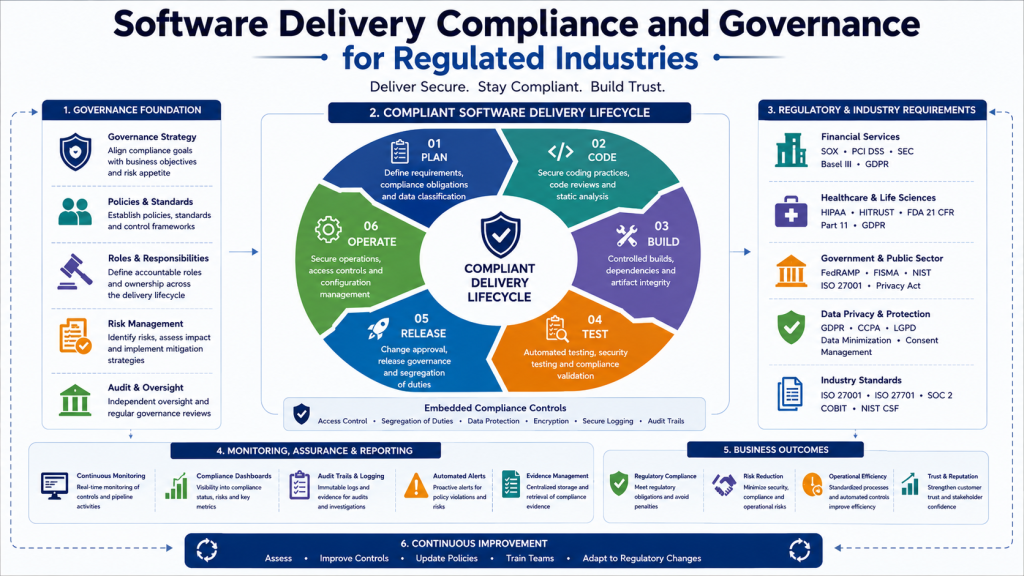
Organizations operating in highly regulated industries face unique software delivery challenges. Whether in banking, healthcare, insurance, telecommunications, government, manufacturing, or critical infrastructure, engineering teams must deliver software quickly while maintaining strict compliance, security, reliability, and auditability. Every code change, deployment, infrastructure modification, and release decision must meet internal governance policies as well as industry and regulatory requirements.
While modern engineering teams rely on tools such as GitHub, Jenkins, Jira, Kubernetes, Terraform, and observability platforms, using these tools alone does not ensure compliance or engineering governance. Organizations need visibility into how software is developed, tested, secured, released, and monitored throughout its lifecycle.
This is where Software Delivery Compliance and Governance becomes essential.
SCMGalaxy OS is a Software Delivery Governance Platform that helps enterprises assess, score, govern, and continuously improve their complete software delivery lifecycle—from source code to production. It enables engineering leaders, security teams, consultants, and enterprise architects to perform DevOps Maturity Assessment, Software Delivery Maturity Assessment, SCM Maturity Assessment, CI/CD Maturity Assessment, Release Management Maturity Assessment, DevSecOps Maturity Assessment, Observability and SRE Maturity Assessment, and AI Code Governance Platform evaluations while generating actionable 30/90/180-day transformation roadmaps.
Learn more at https://os.scmgalaxy.com/.
Why Governance Is Critical in Regulated Industries
Regulated industries cannot rely on speed alone. Every software delivery process must demonstrate accountability, traceability, consistency, and security.
Engineering teams are expected to answer questions such as:
- Who approved this code change?
- Was the deployment properly tested?
- Were security controls applied?
- Are release processes standardized?
- Can configuration changes be audited?
- Are development environments governed?
- Is AI-generated code reviewed before production?
- Are operational risks continuously monitored?
Without structured governance, organizations may experience compliance failures, security incidents, operational disruptions, audit findings, and increased business risk.
Software Delivery Governance helps eliminate these challenges by creating measurable standards across the engineering lifecycle.
Challenges Faced by Regulated Organizations
Organizations operating under strict compliance requirements often manage hundreds of applications, multiple engineering teams, cloud environments, third-party integrations, and complex deployment pipelines.
Common challenges include:
- Inconsistent development standards
- Weak repository governance
- Manual approval processes
- Limited visibility into engineering maturity
- Poor release documentation
- Security gaps within CI/CD pipelines
- Configuration drift
- Inadequate production monitoring
- Limited audit readiness
- Difficulty governing AI-assisted software development
These challenges increase operational risk while making compliance more difficult to maintain.
Moving Beyond Engineering Tools
Many organizations have invested in industry-leading engineering platforms.
These may include:
- GitHub
- Jenkins
- Jira
- Kubernetes
- Terraform
- Container platforms
- Artifact repositories
- Monitoring solutions
- Security scanners
Although these tools improve engineering productivity, they do not measure engineering maturity or governance.
Organizations require a governance platform that evaluates how effectively these technologies work together and whether engineering processes satisfy business, operational, and compliance expectations.
SCMGalaxy OS: Governance Above the Toolchain
SCMGalaxy OS functions as the operating system for enterprise software delivery governance.
Rather than replacing engineering tools, it evaluates their effectiveness across the complete software delivery lifecycle.
The platform enables organizations to:
- Measure engineering maturity
- Identify governance gaps
- Assess operational risks
- Benchmark engineering capabilities
- Generate maturity scores
- Produce executive dashboards
- Deliver consultant-ready reports
- Build structured transformation roadmaps
This provides engineering leadership with measurable insights into software delivery health instead of isolated tool metrics.
Explore the platform at https://os.scmgalaxy.com/.
Core Areas of Software Delivery Compliance Assessment
DevOps Maturity Assessment
Regulated industries require consistent engineering practices across all teams.
A DevOps Maturity Assessment evaluates:
- Collaboration
- Automation
- Process consistency
- Deployment governance
- Operational readiness
- Engineering culture
- Continuous improvement
Organizations gain visibility into how mature and standardized their DevOps practices have become.
Software Delivery Maturity Assessment
A Software Delivery Maturity Assessment examines the end-to-end software delivery lifecycle.
It evaluates:
- Planning
- Development
- Build automation
- Testing
- Deployment
- Operations
- Governance
- Continuous improvement
This assessment identifies gaps that may introduce operational or compliance risks.
SCM Maturity Assessment
Source code represents one of an organization’s most valuable assets.
An SCM Maturity Assessment evaluates:
- Repository governance
- Branch protection
- Version control standards
- Code ownership
- Pull request governance
- Code review quality
- Repository security
These practices strengthen engineering consistency while improving audit readiness.
Software Configuration Management Platform Assessment
Configuration consistency is essential for maintaining stable production environments.
A mature Software Configuration Management Platform supports:
- Infrastructure versioning
- Environment consistency
- Configuration governance
- Change tracking
- Deployment reproducibility
- Configuration auditing
This reduces operational risk while improving compliance.
CI/CD Maturity Assessment
Continuous delivery requires governance as well as automation.
A CI/CD Maturity Assessment evaluates:
- Pipeline reliability
- Automated testing
- Deployment governance
- Approval workflows
- Quality gates
- Rollback readiness
- Environment management
- Pipeline security
Organizations strengthen delivery confidence while maintaining regulatory controls.
Release Management Maturity Assessment
Release governance is particularly important in regulated industries.
A Release Management Maturity Assessment evaluates:
- Release planning
- Change approval
- Risk analysis
- Deployment scheduling
- Production validation
- Rollback procedures
- Audit documentation
- Release consistency
These practices improve deployment reliability while supporting compliance requirements.
DevSecOps Maturity Assessment
Security must be integrated throughout software development.
A DevSecOps Maturity Assessment evaluates:
- Secure coding
- Dependency management
- Secret management
- Vulnerability scanning
- Infrastructure security
- Container security
- Compliance automation
- Security governance
Organizations reduce security risks while maintaining delivery speed.
Observability and SRE Maturity Assessment
Operational reliability is essential for regulated environments.
An Observability and SRE Maturity Assessment evaluates:
- Monitoring coverage
- Log management
- Distributed tracing
- Alert quality
- Incident response
- Service reliability
- Operational governance
- Continuous monitoring
This improves system resilience and operational transparency.
AI Code Governance Platform
Many engineering organizations now use AI-assisted development tools.
However, regulated industries require additional governance around:
- AI-generated code
- Human approval
- Security validation
- Compliance reviews
- Development accountability
- Responsible AI usage
SCMGalaxy OS supports these requirements through its AI Code Governance Platform, helping organizations adopt AI while maintaining engineering governance.
Governance Supports Regulatory Readiness
Strong software delivery governance makes regulatory readiness significantly easier.
Organizations gain:
- Better engineering visibility
- Consistent development standards
- Improved documentation
- Controlled release processes
- Stronger security governance
- Measurable engineering maturity
- Executive reporting
- Improved audit preparation
- Reduced operational risk
Instead of reacting to audits, organizations continuously improve their engineering governance.
Continuous Improvement Through Structured Roadmaps
Software delivery governance should evolve continuously.
SCMGalaxy OS generates practical 30/90/180-day transformation roadmaps based on assessment results.
First 30 Days
Immediate priorities include:
- Repository governance
- Access management
- Source code security
- Engineering standards
- Initial governance improvements
Next 90 Days
Organizations strengthen:
- CI/CD governance
- DevSecOps automation
- Release management
- Platform engineering
- Monitoring capabilities
Following 180 Days
Long-term transformation focuses on:
- Enterprise governance
- Advanced observability
- AI governance
- Organization-wide standardization
- Executive engineering reporting
- Continuous maturity measurement
These structured roadmaps help organizations transform software delivery through measurable improvements.
Business Benefits
Organizations implementing structured software delivery governance achieve significant operational improvements.
Benefits include:
- Improved engineering maturity
- Better compliance readiness
- Faster and safer software releases
- Reduced operational risk
- Stronger security posture
- Higher deployment confidence
- Better executive visibility
- Improved engineering productivity
- Continuous organizational learning
- Sustainable software delivery improvement
Governance enables organizations to balance innovation with operational control.
Supporting Every Engineering Stakeholder
Software Delivery Governance creates value across the enterprise.
CTOs
Gain strategic visibility into engineering maturity, governance effectiveness, and software delivery performance.
DevOps Leaders
Improve automation, pipeline consistency, and engineering standardization.
Platform Engineering Teams
Strengthen platform governance and developer experience.
Security Teams
Evaluate DevSecOps maturity while improving software security controls.
SRE Teams
Enhance operational reliability through structured observability assessments.
Enterprise Architects
Measure software delivery maturity across multiple business units using standardized governance frameworks.
Consultants
Perform professional client assessments, generate executive reports, identify governance gaps, and deliver structured transformation roadmaps.
Why SCMGalaxy OS Is the Right Governance Platform
SCMGalaxy OS enables organizations to continuously assess and improve software delivery through measurable governance.
As a comprehensive Software Delivery Governance Platform, it supports:
- DevOps Maturity Assessment
- Software Delivery Maturity Assessment
- SCM Maturity Assessment
- Software Configuration Management Platform evaluation
- CI/CD Maturity Assessment
- Release Management Maturity Assessment
- DevSecOps Maturity Assessment
- Observability and SRE Maturity Assessment
- AI Code Governance Platform assessment
Rather than focusing solely on engineering metrics, SCMGalaxy OS transforms software delivery into a governed, measurable, and continuously improving business capability.
Visit https://os.scmgalaxy.com/ to learn more.
Frequently Asked Questions (FAQs)
1. What is software delivery compliance and governance?
Software delivery compliance and governance is the practice of establishing policies, processes, and controls to ensure that software is developed, tested, deployed, and maintained in accordance with regulatory requirements, industry standards, and organizational policies. It helps organizations deliver secure, reliable, and auditable software.
2. Why is compliance important in regulated industries?
Regulated industries such as healthcare, finance, government, and pharmaceuticals must comply with strict legal and industry requirements. Strong compliance practices reduce security risks, protect sensitive data, support successful audits, avoid regulatory penalties, and maintain customer trust.
3. What are the key components of software delivery governance for regulated industries?
A robust governance framework includes secure development standards, change management, release governance, CI/CD controls, access management, audit logging, automated compliance checks, risk management, documentation, security testing, and continuous monitoring throughout the software delivery lifecycle.
4. How does governance improve software quality and compliance?
Governance standardizes development workflows, enforces quality gates, automates policy validation, and ensures consistent review and approval processes. This reduces defects, minimizes compliance violations, improves traceability, and increases confidence in software releases.
5. What role does automation play in compliance-focused software delivery?
Automation helps enforce governance by performing continuous testing, security scanning, policy validation, Infrastructure as Code verification, compliance reporting, vulnerability assessment, and deployment approvals. Automated controls improve accuracy while reducing manual effort and human error.
6. How can organizations integrate security into compliant software delivery?
Organizations should adopt DevSecOps practices that embed security throughout the software development lifecycle. This includes secure coding standards, automated vulnerability scanning, secrets management, identity and access controls, continuous monitoring, audit trails, and regular compliance assessments.
7. Which industries benefit the most from software delivery compliance and governance?
Industries with strict regulatory requirements—including financial services, healthcare, insurance, government, defense, pharmaceuticals, telecommunications, energy, and critical infrastructure—benefit significantly from strong software delivery governance and compliance frameworks.
8. What are the common challenges in implementing software delivery governance for regulated industries?
Organizations often face challenges such as complex regulatory requirements, legacy systems, fragmented development tools, manual compliance processes, balancing innovation with compliance, maintaining detailed audit records, and ensuring consistent policy enforcement across multiple teams.
9. How can organizations measure the effectiveness of software delivery compliance?
Success can be measured using metrics such as audit readiness, compliance pass rates, deployment success rate, security incident reduction, vulnerability remediation time, change failure rate, policy compliance, documentation completeness, mean time to recovery (MTTR), and release quality.
10. What are the best practices for maintaining software delivery compliance and governance?
Best practices include establishing clear governance policies, automating compliance validation, integrating security into CI/CD pipelines, maintaining comprehensive audit trails, implementing role-based access controls, conducting regular risk assessments, continuously monitoring compliance metrics, training development teams, and reviewing governance processes to adapt to evolving regulatory requirements.
Conclusion
Software delivery compliance and governance are essential for organizations operating in regulated industries where security, reliability, auditability, and operational consistency are critical. Modern engineering teams require more than powerful development tools—they need structured governance that continuously measures engineering maturity, identifies risks, and drives measurable improvement across the software delivery lifecycle.
SCMGalaxy OS empowers enterprises to achieve this through comprehensive assessments covering DevOps, software delivery, source code management, software configuration management, CI/CD, release management, DevSecOps, observability, SRE, and AI-assisted development. By combining maturity scoring, governance insights, executive reporting, and structured 30/90/180-day transformation roadmaps, SCMGalaxy OS helps regulated organizations build secure, compliant, scalable, and continuously improving software delivery ecosystems.

