
Introduction
A Private Pilot Licence is one of the most popular entry points for people who want to learn flying for personal, recreational, or future aviation goals. Many aspiring pilots in India begin their aviation journey by understanding the PPL eligibility criteria before joining a flying school.
A PPL allows a person to fly an aircraft as a private pilot, but it does not allow commercial flying for salary or compensation. It is suitable for aviation enthusiasts, students, private aircraft owners, and learners who want to build a foundation before moving toward advanced pilot training.
Before starting training, students must understand the basic eligibility requirements, medical fitness, educational expectations, flight training process, documents, and practical steps involved. This guide explains the PPL eligibility criteria in India in simple and clear language.
What Is a Private Pilot Licence?
A Private Pilot Licence is a pilot licence that allows the holder to fly an aircraft for private purposes. It is not meant for paid flying jobs, airline operations, or commercial aviation work.
With a PPL, a pilot can usually:
- Fly for personal travel
- Build flying experience
- Continue toward advanced ratings
- Learn safe aircraft operation
- Develop aviation confidence
- Use it as a foundation for further pilot training
A PPL is often the first serious step for people who want to experience real flying beyond ground-based aviation learning.
Why Choose a PPL?
Many students and aviation enthusiasts choose a PPL because it provides a strong foundation in flying. It teaches aircraft control, navigation, weather understanding, communication, safety, and decision-making.
A PPL can be useful for:
- Personal flying
- Recreational aviation
- Aviation hobby development
- Building confidence in aircraft handling
- Understanding pilot responsibilities
- Preparing for commercial pilot training
- Learning aviation discipline
For many learners, a PPL is not only a licence but also a complete introduction to the world of aviation.
PPL Eligibility Criteria in India
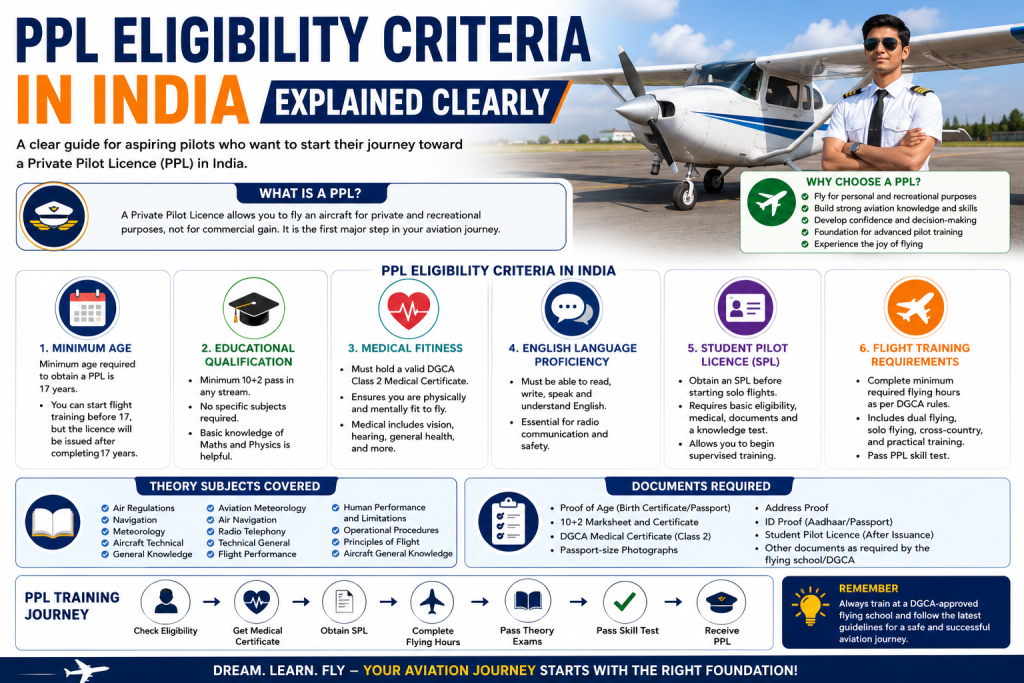
PPL eligibility in India generally includes age, education, medical fitness, language ability, documents, and training requirements. Exact rules can change, so students should confirm the latest requirements with an approved flying school and the relevant aviation authority before applying.
Minimum Age Requirement
The minimum age requirement is one of the first things students should check. A candidate must meet the required age criteria for student pilot training and for obtaining a Private Pilot Licence.
Students may begin certain parts of training earlier, but the licence can only be issued after meeting the required age standard. Since aviation rules may be updated, always verify the current age requirement with the flight school before beginning the process.
Educational Qualification
For PPL training, the educational requirement is usually more basic than commercial pilot training. A college degree is generally not required for a Private Pilot Licence.
However, students should have enough education to understand:
- Aviation theory
- Basic mathematics
- Aircraft performance
- Navigation
- Weather concepts
- Safety procedures
- Radio communication
- Flight planning
Useful subjects include:
- Mathematics
- Physics
- English
- Geography
- Computer basics
Even if advanced education is not mandatory, strong academic preparation helps students complete ground school and flight training more confidently.
Medical Fitness
Medical fitness is extremely important in aviation. A pilot must be physically and mentally fit to operate an aircraft safely.
Medical fitness checks may include:
- Vision
- Hearing
- General health
- Cardiovascular fitness
- Neurological health
- Mental fitness
- Physical coordination
Students should complete the required aviation medical examination before investing heavily in flight training. Medical approval helps confirm that the candidate is fit to continue pilot training.
English Language Proficiency
English is widely used in aviation communication, aircraft manuals, checklists, weather reports, and air traffic control instructions. A private pilot must be able to understand and communicate clearly.
English skills help with:
- Reading aviation documents
- Understanding ground school lessons
- Communicating with instructors
- Following air traffic control instructions
- Handling safety communication
- Understanding aircraft checklists
A student does not need perfect English, but clear communication is essential for safe flying.
Student Pilot Licence Requirement
Before progressing toward a PPL, students may need to complete student pilot requirements. A Student Pilot Licence allows a trainee to begin supervised flying and build basic aviation experience.
The SPL process may include:
- Basic eligibility check
- Medical fitness
- Knowledge assessment
- Flight school enrollment
- Instructor supervision
- Basic aviation understanding
The Student Pilot Licence helps ensure that a beginner is ready to start flight training safely under professional guidance.
Flight Training Requirements
PPL training includes both ground school and practical flight instruction. Students learn the theory of flying and then apply that knowledge in the aircraft with an instructor.
Flight training usually includes:
- Ground classes
- Aircraft familiarization
- Dual flying with instructor
- Solo flying after approval
- Circuit training
- Takeoff and landing practice
- Navigation exercises
- Cross-country flying
- Emergency procedures
- Flight planning
- Radio communication practice
The training is designed to build skill step by step, from basic handling to safe independent flying.
Theory Subjects Covered During PPL Training
Ground school is an important part of PPL training. It prepares students for written exams, safe flying, and practical decision-making.
Common theory subjects include:
Air Regulations
This subject teaches aviation rules, pilot responsibilities, airspace procedures, and legal requirements related to flying.
Aviation Meteorology
Meteorology teaches weather, clouds, wind, visibility, pressure, thunderstorms, and how weather affects flight safety.
Air Navigation
Navigation teaches students how to plan routes, read charts, calculate headings, understand distance and time, and fly safely from one place to another.
Aircraft Technical Knowledge
This subject covers aircraft structure, engines, instruments, systems, controls, and basic maintenance awareness.
Aviation Safety
Safety training helps students understand risk management, emergency procedures, human factors, and safe decision-making.
Radio Communication Basics
Radio communication teaches students how to speak clearly with air traffic control, understand instructions, and use correct aviation phraseology.
Flying Hour Requirements
Flying hours are an important part of PPL training. Students must complete the required practical flying experience before applying for the licence.
Flying hours may include:
- Dual instruction hours
- Solo flying hours
- Cross-country flying
- Circuit and landing practice
- Navigation training
- Emergency procedure practice
- Skill preparation flights
The exact number of required flying hours may vary based on current rules, training performance, and aviation authority requirements. Students should confirm the latest flying hour requirement directly with an approved flying school before enrollment.
Skill Test and Licence Application
After completing the required training and exams, the student must pass a practical skill test. This test checks whether the candidate can safely operate the aircraft as a private pilot.
The skill test may include:
- Pre-flight inspection
- Flight planning
- Takeoff
- Climb
- Straight and level flight
- Turns
- Navigation
- Emergency procedures
- Approach and landing
- General aircraft handling
- Oral questions
After successful completion, the candidate can apply for the Private Pilot Licence with the required documents and approvals.
Documents Required for PPL Application
Students should keep documents ready before and during training. Common documents may include:
- Educational certificates
- Identity proof
- Address proof
- Medical certificate
- Passport-size photographs
- Flight school application form
- Training records
- Flying logbook
- Examination results
- Skill test records
- Other documents required by the authority or school
Incomplete documentation can delay the licence process, so students should stay organized from the beginning.
Common Mistakes Applicants Make
Many applicants face delays or confusion because they do not prepare properly before joining a flying school.
Common mistakes include:
- Ignoring medical fitness before enrollment
- Choosing a flying school without research
- Not understanding total training cost
- Poor English communication preparation
- Weak ground school study habits
- Incomplete documents
- Not asking about aircraft availability
- Assuming PPL allows paid flying
- Not confirming current rules
- Expecting training to be completed instantly
Avoiding these mistakes can save time, money, and frustration.
Tips for Aspiring Private Pilots
Aspiring private pilots should prepare carefully before joining a flight school.
Useful tips include:
- Research approved flying schools
- Complete medical checks early
- Improve English communication
- Learn basic aviation terms
- Strengthen mathematics and physics basics
- Prepare a realistic budget
- Ask about aircraft availability
- Understand fee structure clearly
- Speak with current students if possible
- Stay disciplined during training
- Follow instructor guidance
- Keep all documents organized
Good preparation helps students complete PPL training more smoothly.
Benefits of Obtaining a PPL
A Private Pilot Licence gives students valuable aviation knowledge and practical flying experience.
Benefits include:
- Ability to fly privately
- Strong aviation foundation
- Better understanding of aircraft
- Confidence in flight operations
- Preparation for advanced training
- Personal achievement
- Improved discipline and decision-making
- Exposure to real aviation procedures
For many aviation enthusiasts, earning a PPL is a major milestone.
Career Path After a PPL
A PPL itself does not allow commercial flying, but it can become the foundation for further aviation training.
Possible next steps include:
- Commercial Pilot Licence
- Instrument rating
- Multi-engine rating
- Night rating where applicable
- Flight instructor pathway
- Advanced aircraft training
- Aviation management or operations roles
Students who want a professional aviation career should plan their next training steps carefully after completing the PPL.
Key Takeaways
- A PPL allows private flying, not commercial flying for payment.
- Eligibility includes age, education, medical fitness, English ability, and training requirements.
- A college degree is generally not required for PPL training.
- Medical fitness should be checked before major financial investment.
- Ground school and flight training are both important.
- Flying hour requirements should be verified with an approved flying school.
- PPL can be a foundation for advanced pilot training.
- Proper preparation helps students avoid delays and mistakes.
FAQs
1. What is the minimum age for obtaining a PPL in India?
The minimum age requirement depends on current aviation rules and licence standards. Students should confirm the latest age requirement with an approved flying school before starting training.
2. Do I need mathematics and physics to get a PPL?
Mathematics and physics are very helpful for understanding navigation, aircraft performance, weather, and flight planning. They may not always be required at an advanced level, but basic knowledge is important.
3. Is a college degree required for a PPL?
A college degree is generally not required for a Private Pilot Licence. However, basic education and the ability to understand aviation theory are important for successful training.
4. What medical certificate is needed?
A candidate must complete the required aviation medical examination as per applicable rules. The type of medical certificate should be confirmed with the flying school before enrollment.
5. Can I start flight training before completing my education?
This depends on the rules, age, school policy, and licence requirements. Some students may begin learning early, but they must meet eligibility criteria before licence issue.
6. How long does PPL training usually take?
Training duration depends on aircraft availability, weather, student progress, instructor schedule, exam completion, and documentation. Regular flying and strong preparation can help reduce delays.
7. Can a PPL holder fly internationally?
International flying depends on licence privileges, aircraft registration, destination rules, airspace permissions, and regulatory requirements. PPL holders should get proper guidance before planning international flights.
8. Can I earn money with a PPL?
No. A PPL is meant for private and recreational flying. It does not allow the holder to fly commercially for salary, hire, or compensation.
9. What is the difference between SPL and PPL?
A Student Pilot Licence allows a trainee to learn flying under supervision. A Private Pilot Licence allows the holder to fly privately after completing the required training, exams, and skill test.
10. What should I do before joining a flying school?
Before joining, check medical eligibility, confirm current requirements, compare approved flying schools, understand fees, ask about aircraft availability, and prepare all documents properly.
Conclusion
Understanding PPL eligibility criteria in India is the first step toward a safe and successful flying journey. A Private Pilot Licence is ideal for aviation enthusiasts, recreational flyers, and students who want to build a strong foundation before advanced pilot training.
Before enrolling, aspirants should check age requirements, education, medical fitness, English communication, student pilot requirements, flying hours, exams, and documents. Since aviation rules may change, it is always wise to confirm the latest requirements with an approved flying school and the relevant aviation authority.
With proper preparation, discipline, medical fitness, and quality flight training, earning a PPL can become a meaningful and rewarding milestone in your aviation journey.

