
Introduction
Simulator training is one of the most useful learning tools for Indian student pilots. It gives students a safe place to practice cockpit procedures, radio communication, instrument flying, emergencies, navigation, and decision-making before doing everything in a real aircraft.
For many beginner pilots, the first few flights can feel busy. There are checklists, instruments, radio calls, instructor instructions, aircraft control, weather, runway awareness, and traffic. A simulator helps students slow down the learning process and understand each step clearly.
This Simulator Training Guide for Indian Student Pilots explains what simulator training means, why it matters, how Indian flight schools use simulators, what skills students learn, and what mistakes they should avoid.
What Is Simulator Training?
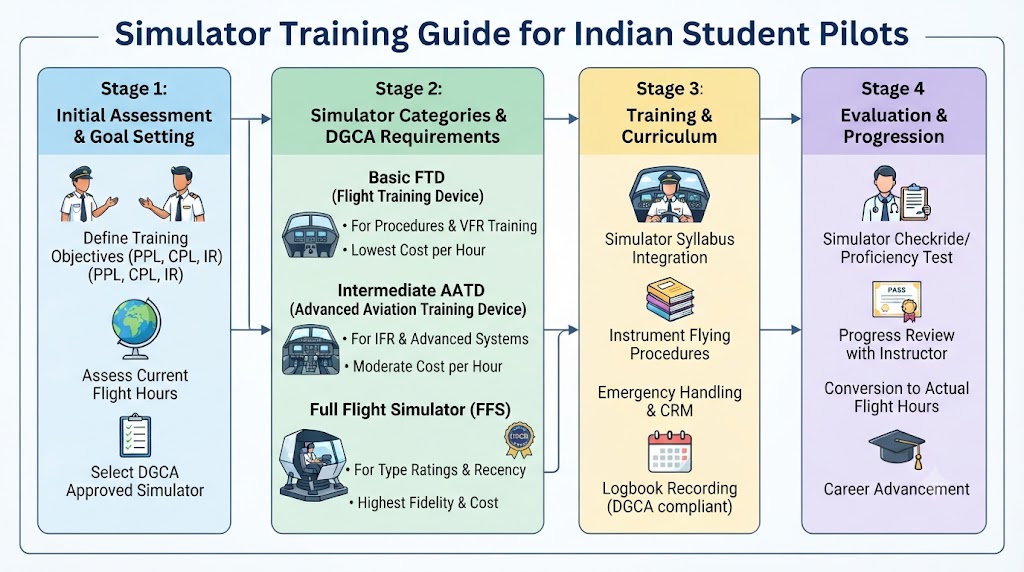
Simulator training means practicing flying procedures in a flight simulation device instead of an actual aircraft. A simulator may look like a cockpit, show aircraft instruments, and allow students to practice different flight situations.
It can be used for basic cockpit familiarisation, checklist practice, instrument scanning, emergency handling, radio calls, navigation, and approach procedures.
Simulator training supports real aircraft training. It helps students prepare better, but it should not be treated as a complete replacement for actual flying unless allowed under applicable DGCA/FTO rules.
Why Simulator Training Matters for Indian Student Pilots
Simulator training matters because it builds confidence. A beginner can sit in a simulator, understand cockpit layout, practice normal procedures, and repeat mistakes without the pressure of real flight.
It is also cost-effective compared to aircraft flying. Aircraft training involves fuel, maintenance, instructor time, airport charges, and scheduling. Simulator practice can help students make better use of actual aircraft hours.
For Indian CPL aspirants, simulator training is especially useful for instrument flying preparation, radio confidence, navigation practice, and emergency procedure learning.
It also helps students prepare for advanced stages like instrument rating, multi-engine training, airline assessment, and type-rating style cockpit discipline.
Who Should Use Simulator Training?
Simulator training is useful for many types of aviation students.
Beginner student pilots can use it to understand cockpit layout and basic procedures. CPL aspirants can use it to improve instrument scan, navigation, and communication. Students preparing for instrument flying can use it to practice IFR-style discipline.
Fresh CPL holders may also use simulator sessions to prepare for airline assessment, crew coordination basics, and procedure-based flying.
Students who struggle with radio calls, checklists, navigation, or workload management can benefit a lot from structured simulator practice.
Basic Requirements Before Simulator Training
Students do not need to be experts before using a simulator, but they should come prepared.
Before simulator training, students should have:
- Basic aviation knowledge
- Instructor briefing
- Clear lesson objective
- Understanding of cockpit instruments
- Checklist awareness
- Basic radio communication knowledge
- Flight school approval
- Proper training record process
Students should also confirm whether simulator hours are only for practice or whether any portion is approved for licence credit. This depends on DGCA rules, FTO approval, device approval, and the specific training requirement.
Key Skills Learned During Simulator Training
Cockpit Familiarisation
Students learn where important instruments, switches, controls, radios, and checklists are located. This reduces confusion during real aircraft flying.
Checklist Discipline
Simulator sessions help students practice checklist flow repeatedly. This builds good habits before entering the actual aircraft.
Instrument Scanning
Students learn how to scan instruments such as attitude indicator, altimeter, airspeed indicator, heading indicator, vertical speed indicator, and navigation instruments.
Radio Communication
Many Indian students feel nervous about radio calls. Simulator training gives them a safe place to practice standard calls, readbacks, and ATC-style communication.
Navigation Practice
Students can practice route tracking, headings, timing, turns, checkpoints, and basic navigation planning.
Emergency Procedures
Simulators are useful for practicing engine failure, instrument failure, electrical problems, radio issues, missed approach, and abnormal situations.
Circuit Practice
Students can practice takeoff, climb, downwind, base, final approach, landing setup, and go-around procedures.
Instrument Approach Practice
For advanced students, simulators can help practice approach briefing, descent planning, missed approach, and workload management.
Workload Management
Simulator training teaches students how to fly, navigate, communicate, and think ahead at the same time.
Simulator Training vs Real Aircraft Flying
Simulator training and real aircraft flying are both important, but they are not the same.
| Area | Simulator Training | Real Aircraft Flying |
|---|---|---|
| Cost | Usually lower | Higher |
| Safety | Good for emergency practice | Real aircraft environment |
| Weather | Can be controlled | Real weather conditions |
| Physical Feel | Limited or simulated | Actual aircraft movement |
| Repeat Practice | Easy to repeat lessons | Depends on time, weather, aircraft |
| Training Use | Procedure and skill practice | Real flying experience |
A simulator is excellent for learning procedures. A real aircraft is essential for learning actual aircraft feel, weather handling, landing judgment, and real-world decision-making.
Types of Simulator Practice Useful for Indian Students
Basic Cockpit Practice
This helps beginners understand instruments, switches, seating position, controls, and cockpit flow.
Procedure Training
Students can practice checklists, start-up flow, taxi briefing, takeoff briefing, cruise checks, approach briefing, and shutdown procedures.
Instrument Flying Practice
Simulator sessions help students practice flying by instruments without relying on outside visual references.
Emergency Practice
Emergencies can be practiced safely in a simulator. This helps students stay calm and follow procedures.
Navigation Route Practice
Students can practice route planning, headings, turns, timing, radio calls, and position awareness.
Radio Call Practice
Simulator training can improve confidence in communication, especially for students who feel nervous speaking on radio.
Approach and Landing Preparation
Students can understand approach path, flap setting, speed control, and go-around procedure before practicing in real aircraft.
Airline Assessment Preparation
Fresh CPL holders may use simulators to practice cockpit discipline, basic crew coordination, and structured flying habits.
Common Challenges During Simulator Training
Some students do not take simulator training seriously because they know it is not a real aircraft. This is a mistake. Poor habits learned in a simulator can affect real flying.
Another common challenge is over-controlling. Students may make large control inputs instead of smooth corrections.
Some students also fly randomly without a lesson objective. A simulator session should have a clear goal, such as radio practice, instrument scan, emergency handling, or approach procedure.
Students may also expect the simulator to feel exactly like a real aircraft. It will not always feel the same. The purpose is to learn procedures, discipline, and decision-making.
How Indian Flight Schools Use Simulators
Indian flight schools may use simulators in different ways depending on their approval, equipment, training syllabus, and aircraft fleet.
A typical simulator training process includes:
- Ground briefing
- Lesson objective
- Cockpit setup
- Instructor-led demonstration
- Student practice
- Repeated correction
- Scenario-based training
- Debriefing
- Training record entry, if applicable
Some schools use simulators for instrument flying, emergency procedures, navigation, multi-engine preparation, and airline-readiness practice.
Before joining any program, students should ask whether the simulator is approved, what type of training it supports, and whether any hours are counted officially.
Important Records and Training Notes
Students should maintain proper records for simulator sessions.
Important records may include:
- Date of session
- Simulator type
- Lesson topic
- Instructor name
- Skills practiced
- Mistakes noted
- Improvement points
- Training record entry
- Logbook entry, if applicable and permitted
Even if a simulator session does not count toward official hours, personal notes are still useful. They help students track progress and avoid repeating mistakes.
Safety and Learning Tips for Students
Prepare Before Every Session
Do not enter the simulator without knowing the lesson objective. Study the procedure before the session.
Follow Checklists
Use checklists seriously. Simulator training is a good place to build correct habits.
Practice Radio Calls
Speak clearly and follow standard communication format. Do not wait until real aircraft flying to fix radio fear.
Ask Questions
If you do not understand an instrument, procedure, or instructor correction, ask immediately.
Review Mistakes
The debriefing is one of the most important parts of simulator training. Write down mistakes and correct them in the next session.
Use Simulator for Weak Areas
If you struggle with navigation, radio calls, instrument scan, or emergencies, use simulator time to improve those areas.
Do Not Skip Real Aircraft Learning
Simulator practice is helpful, but real aircraft flying is still essential. Use both together for better training.
Common Mistakes Students Should Avoid
Thinking All Simulator Hours Count as Flying Hours
This is a major mistake. Simulator hours may or may not count depending on DGCA rules, device approval, and FTO process. Always verify before assuming.
Treating Simulator Like a Game
A simulator is a training tool. Students should use it professionally.
Flying Without Objective
Every session should have a goal. Random flying does not build strong pilot skills.
Ignoring Instructor Briefing
The briefing explains what to practice and what to avoid. Skipping it reduces training value.
Not Practicing Emergencies Properly
Emergency practice is one of the biggest benefits of simulation. Students should take it seriously.
Not Reviewing Debrief Notes
Repeating the same mistake again and again wastes time and money.
Expecting Real Aircraft Feel
A simulator may not fully match real aircraft feel. Students should understand its purpose and limitations.
Benefits of Simulator Training
Simulator training gives many benefits to Indian student pilots.
It builds confidence before real aircraft lessons. It reduces cockpit fear. It improves checklist discipline, instrument scanning, radio communication, navigation, and emergency response.
It also allows repeated practice. In a real aircraft, time is limited and cost is high. In a simulator, students can repeat the same procedure until they understand it better.
Simulator training also supports instrument flying preparation. Students can learn to trust instruments, maintain heading and altitude, and manage cockpit workload.
For fresh CPL holders, simulator practice can help develop a professional cockpit mindset before airline assessment or advanced training.
Practical Checklist Before Choosing Simulator Training
Before paying for simulator training, students should ask:
- Is the simulator approved for any official training credit?
- What type of simulator is used?
- Who will instruct the session?
- What skills will be practiced?
- Will I receive a briefing and debriefing?
- Will training records be maintained?
- Does the session support my CPL, IR, or skill-building goal?
- Are the costs clear?
- Is the simulator suitable for beginner or advanced training?
- Will I get feedback after each session?
These questions help students avoid confusion and choose better training.
FAQs on Simulator Training for Indian Student Pilots
1. What is simulator training for student pilots?
Simulator training is practice done in a flight simulation device to learn cockpit procedures, instruments, radio communication, navigation, and emergencies.
2. Does simulator training replace real aircraft flying?
No. Simulator training supports real aircraft flying but does not fully replace actual flight training unless specific credit is allowed by applicable DGCA/FTO rules.
3. Are simulator hours counted for CPL in India?
Some approved simulator time may be accepted for specific training requirements, but students must verify the latest DGCA/eGCA and FTO rules before assuming any credit.
4. Is simulator training useful for beginners?
Yes. It helps beginners understand cockpit layout, checklists, radio calls, and basic flying procedures before real aircraft lessons.
5. Can simulator training help with instrument flying?
Yes. Simulators are very useful for instrument scanning, IFR-style navigation, approach practice, and workload management.
6. Is simulator training cheaper than aircraft flying?
Usually, simulator training costs less than actual aircraft flying. It can help students prepare better and use aircraft hours more effectively.
7. What mistakes should students avoid in simulator training?
Students should avoid treating it like a game, flying without a lesson objective, ignoring checklists, and assuming all simulator hours count officially.
8. Do Indian flight schools use simulators?
Many Indian flight schools use simulators or procedure trainers, depending on their approval, training syllabus, and available equipment.
9. What should I practice in a simulator?
You can practice cockpit familiarisation, checklist flow, radio calls, navigation, instrument flying, emergency procedures, and approach preparation.
10. What is the best advice for simulator training?
Take it seriously, prepare before each session, follow checklists, ask questions, and review your mistakes after every lesson.
Final Thoughts
Simulator training is a valuable part of pilot education. For Indian student pilots, it can make real aircraft training smoother, safer, and more productive.
It helps students practice procedures, communication, navigation, instrument flying, and emergency handling in a controlled environment. It also improves confidence and reduces cockpit pressure.
However, students must use simulators correctly. They should not assume that every simulator hour counts for licence requirements. They should verify DGCA/eGCA rules, FTO approval, and simulator status before relying on it officially.
For readers of pilotsindia.com, the best approach is simple: use simulator training with discipline, clear goals, instructor guidance, and proper records. When used properly, it can become one of the strongest learning tools in a student pilot’s journey.

