
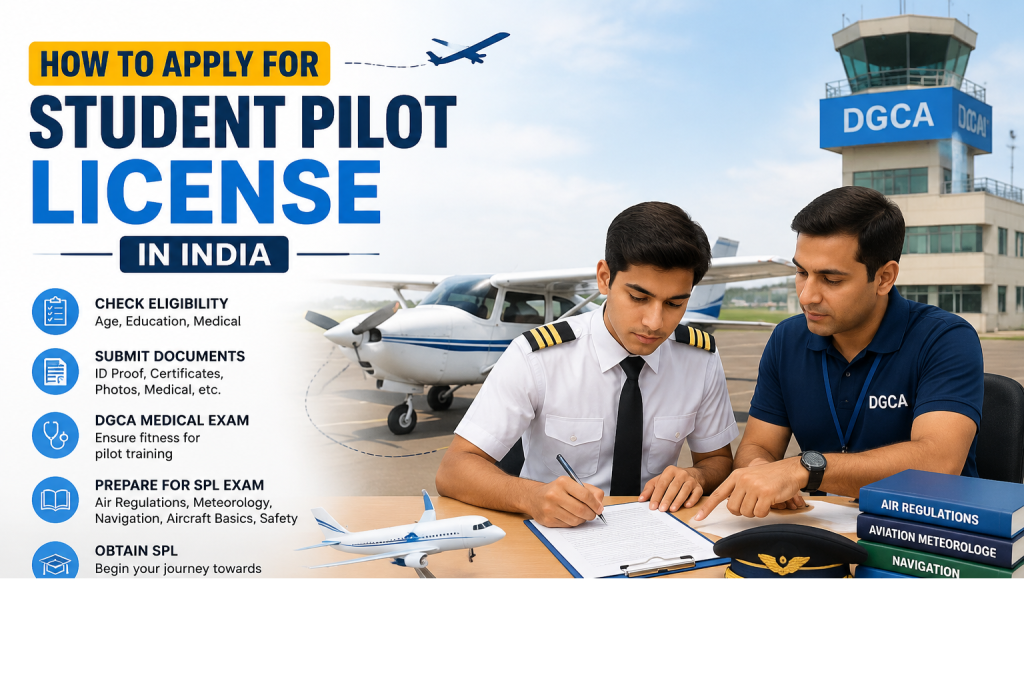
Introduction
Becoming a pilot is a dream for many students in India. The aviation industry attracts young learners, career changers, and aviation enthusiasts because it offers a professional career path, global exposure, discipline, and the excitement of flying. But before a student can begin serious flight training, the first important step is understanding the licensing process.
A Student Pilot License, commonly called SPL, is the starting point for anyone who wants to learn flying in India. It allows an aspiring pilot to begin training under the guidance of approved instructors and move forward toward higher pilot licenses such as PPL and CPL.
This guide explains how to apply for a Student Pilot License in India, including eligibility, documents, medical requirements, examination process, cost, mistakes to avoid, and the career path after SPL.
What is a Student Pilot License?
A Student Pilot License is an entry-level pilot license issued for students who want to begin flying training. It is the first formal step in the pilot training journey.
The Directorate General of Civil Aviation, commonly known as DGCA, regulates civil aviation safety, licensing, and flight training standards in India.
An SPL helps a student:
- Begin flight training
- Learn aircraft basics
- Understand aviation rules
- Train under instructor supervision
- Progress toward Private Pilot License or Commercial Pilot License
In simple words, SPL is your official entry ticket into the world of pilot training.
Why Do You Need an SPL?
A Student Pilot License is important because it gives legal recognition to your training journey. Without following the proper licensing process, a student cannot move smoothly through structured pilot training.
You need an SPL because:
- It is the first official license for aspiring pilots
- It allows you to begin practical flight training
- It helps you understand aviation discipline and safety
- It prepares you for advanced pilot licenses
- It is part of the regulated pilot training process in India
The SPL is not the final license to become an airline pilot, but it is the foundation on which your aviation career begins.
Eligibility Criteria for Student Pilot License in India
Before applying for an SPL, students should check whether they meet the basic eligibility requirements.
Minimum Age
The usual minimum age requirement for applying for a Student Pilot License in India is 16 years. Some flying schools may guide students based on their internal admission process and training schedule.
Educational Qualification
Many flying schools accept students who have completed at least Class 10 for SPL-level training. However, students planning to move toward a Commercial Pilot License should complete Class 12 with Physics and Mathematics or meet equivalent subject requirements later.
Medical Fitness
Medical fitness is very important in aviation. Students must complete the required DGCA medical process before progressing in pilot training. DGCA medical standards are used to assess whether the applicant is physically and mentally fit for flying duties.
English Communication
Aviation communication is commonly done in English. Students should be able to read, understand, and communicate clearly in English.
Flying School Enrollment
Students generally apply for SPL through a DGCA-approved flying training organization or recognized flying school. DGCA rules and requirements related to flight crew licensing and training are published under Civil Aviation Requirements.
Documents Required for SPL Application
| Document | Purpose |
|---|---|
| Aadhaar Card or Passport | Identity verification |
| Birth Certificate or Class 10 Certificate | Proof of age |
| Educational Certificates | Academic eligibility proof |
| Passport-size Photographs | Application and record purpose |
| Address Proof | Residential verification |
| Medical Certificate | Proof of medical fitness |
| Flying School Admission Form | Enrollment confirmation |
| Police Verification or Security Clearance, if required | Character and background verification |
| eGCA Profile Details | DGCA online service access |
| Fee Payment Proof | Application or processing record |
Students should confirm the exact document list with their selected flying school because requirements may vary slightly based on school process and DGCA portal updates.
Step-by-Step Process to Apply for a Student Pilot License in India
Step 1: Choose a DGCA-Approved Flying School
The first step is to choose a recognized flying training organization. This is very important because your training records, application support, examination guidance, and license process depend heavily on the flying school.
Before selecting a school, check:
- DGCA approval status
- Aircraft availability
- Instructor experience
- Safety record
- Training cost
- Student reviews
- Location and accommodation
- Ground school support
Do not choose a flying school only because it is cheap. In aviation, safety, training quality, and regulatory compliance matter more than low fees.
Step 2: Check Eligibility Requirements
Once you shortlist a flying school, confirm whether you meet the age, education, communication, and medical requirements.
Students should also ask the school about:
- SPL process
- Ground classes
- Examination format
- Medical guidance
- Training timeline
- Total expected cost
This helps avoid confusion later.
Step 3: Complete DGCA Medical Examination
Medical fitness is one of the most important parts of pilot training. A student must complete the required medical examination from approved medical authorities as guided by DGCA and the flying school.
The medical process may include checks related to:
- Vision
- Hearing
- General health
- Blood pressure
- Medical history
- Fitness for flying duties
Students should be honest during the medical process. Hiding medical issues can create serious problems later in the pilot licensing journey.
Step 4: Prepare and Submit Documents
After medical clearance and school enrollment, students must submit their documents to the flying school or upload them through the required DGCA/eGCA process where applicable.
Keep scanned copies of all documents ready. Make sure your name, date of birth, address, and other details are consistent across documents.
Step 5: Create or Use eGCA Profile
DGCA uses digital systems for many licensing and aviation-related services. Students may need an eGCA profile for license-related applications and records.
Make sure your mobile number, email address, identity details, and documents are accurate. Incorrect details can delay the application.
Step 6: Prepare for SPL Examination
The SPL examination checks your basic understanding of aviation. DGCA’s SPL syllabus includes aviation subjects such as air regulations, aircraft basics, meteorology, navigation, and safety-related knowledge.
Common SPL subjects include:
- Air Regulations
- Aviation Meteorology
- Aircraft Basics
- Navigation
- Aviation Safety
- General Aviation Knowledge
Some schools may conduct oral or written assessments as part of the SPL process.
Step 7: Appear for the SPL Exam
After preparation, students appear for the SPL exam as guided by the flying school. The exam is usually basic compared to advanced DGCA pilot exams, but students should still prepare seriously.
A good preparation strategy includes:
- Attending ground classes
- Reading aviation basics
- Understanding safety rules
- Practicing oral questions
- Learning basic aircraft terms
- Revising meteorology and navigation concepts
Step 8: Verification and Approval
After the exam and document submission, the flying school and concerned authorities verify the applicant’s records. If everything is correct, the SPL application moves forward for approval.
Students should regularly follow up with the flying school and keep copies of all submitted documents.
Step 9: Receive Student Pilot License
Once approved, the student receives the Student Pilot License or confirmation through the applicable process. After this, the student can continue structured flying training under approved supervision.
Step 10: Begin Flight Training
After obtaining SPL, students can focus more seriously on practical flight training. This includes learning cockpit discipline, aircraft handling, takeoff and landing basics, radio communication, navigation basics, and safety procedures.
DGCA Medical Examination for SPL
The DGCA medical examination ensures that a student is fit to train as a pilot. Since flying requires alertness, coordination, decision-making, and physical fitness, medical approval is essential.
Students should prepare by:
- Sleeping properly before the exam
- Carrying all required documents
- Wearing spectacles if prescribed
- Sharing correct medical history
- Avoiding last-minute confusion
- Following the medical examiner’s instructions
Medical fitness is not just a formality. It protects the student, instructor, aircraft, and aviation safety system.
SPL Examination Subjects
The SPL exam is designed to test basic aviation awareness. It helps ensure that students understand important flying concepts before entering deeper practical training.
Air Regulations
This covers basic aviation rules, important terms, airport discipline, air traffic procedures, and safety-related regulations.
Aviation Meteorology
Students learn about weather, clouds, wind, visibility, pressure, temperature, and how weather affects flying.
Aircraft Basics
This includes basic aircraft parts, controls, engine knowledge, instruments, and flight principles.
Navigation
Navigation introduces students to direction, maps, routes, distance, and basic flight planning.
Aviation Safety
Safety is the heart of aviation. Students learn how to follow procedures, avoid risks, and respect instructor guidance.
How Long Does the SPL Process Take?
The SPL process timeline can vary depending on the flying school, medical appointment availability, document readiness, examination schedule, and verification process.
A general timeline may look like this:
| Stage | Approximate Time |
| Flying school selection | A few days to a few weeks |
| Document preparation | A few days |
| Medical examination | Varies by appointment availability |
| Ground class preparation | Depends on school schedule |
| SPL examination | As scheduled by the school |
| Verification and approval | Varies by process |
Students who prepare documents early and complete medical requirements on time usually experience a smoother process.
Cost of Obtaining an SPL in India
The cost of SPL can vary by flying school, location, medical process, and administrative requirements.
| Expense | Approximate Cost |
| Medical Examination | Varies |
| Application or Registration Fee | Varies |
| Ground Classes | Varies by flying school |
| SPL Examination Fee | Varies |
| Documentation and Miscellaneous Cost | Varies |
| Flying School Administrative Charges | Varies |
Students should directly confirm the latest fee structure with their chosen flying school because aviation training costs can change.
Common Mistakes to Avoid
Many students face delays because they do not understand the process properly. Avoid these common mistakes:
- Choosing a flying school without checking approval status
- Submitting incomplete documents
- Delaying the medical examination
- Ignoring eGCA profile accuracy
- Not preparing for the SPL exam
- Assuming SPL automatically makes you a professional pilot
- Not asking about total training cost
- Missing communication from the flying school
- Using inconsistent name or date of birth details
- Depending only on informal advice
Aviation is a regulated career path. Small mistakes in documents or eligibility can create unnecessary delays.
Tips for a Smooth SPL Application
To make your SPL application easier, follow these tips:
- Start with a DGCA-approved flying school
- Keep all documents ready in advance
- Complete medical requirements early
- Create a proper study plan
- Attend ground classes seriously
- Ask questions whenever confused
- Keep scanned copies of documents
- Maintain correct email and mobile details
- Follow official and school instructions
- Stay patient during verification
The better prepared you are, the smoother your pilot training journey becomes.
Benefits of Getting Your SPL Early
Getting your Student Pilot License early helps you build confidence and clarity.
Key benefits include:
- Early start in aviation training
- Better understanding of pilot career path
- Faster movement toward practical flying
- Improved discipline and aviation awareness
- Strong foundation for PPL or CPL
- More confidence during flight school training
For serious students, SPL is not just a document. It is the first real step toward becoming a pilot.
Career Path After SPL
After obtaining a Student Pilot License, students can continue training and move toward higher licenses.
The usual path is:
Student Pilot License
↓
Private Pilot License
↓
Commercial Pilot License
↓
Type Rating
↓
Airline Pilot or Professional Aviation Career
Students who want to become airline pilots generally aim for a Commercial Pilot License and later complete type rating for specific aircraft.
Frequently Asked Questions
1. What is the minimum age for a Student Pilot License in India?
The usual minimum age for SPL in India is 16 years. However, students should confirm current eligibility with their selected flying school before applying. Flying schools can also guide students based on training schedule and document requirements.
2. Is Class 12 compulsory for SPL?
Class 12 is not always required only for the SPL stage, as many schools may accept students after Class 10 for basic student pilot licensing. However, Class 12 with Physics and Mathematics is important for students planning to move toward a Commercial Pilot License.
3. Is medical fitness required for SPL?
Yes, medical fitness is required in pilot training. Students must complete the medical process as guided by DGCA rules and the flying school. Medical fitness ensures that the student is suitable for flight training and aviation safety responsibilities.
4. Can I apply for SPL directly online?
Some parts of the licensing and record process may involve DGCA’s digital systems such as eGCA. However, students usually complete the SPL journey with support from a flying school. It is best to ask the selected school for the exact application steps.
5. What subjects are included in the SPL exam?
The SPL exam may include Air Regulations, Aviation Meteorology, Aircraft Basics, Navigation, Aviation Safety, and general aviation knowledge. The exam checks whether the student understands basic flying concepts before progressing in training.
6. How much does a Student Pilot License cost in India?
The cost varies depending on flying school, location, medical examination, ground classes, examination fees, and administrative charges. Students should request a complete fee breakdown from the flying school before admission.
7. Is SPL enough to become an airline pilot?
No, SPL is only the first step. To become an airline pilot, students usually need to complete further training, obtain a Commercial Pilot License, build required flying experience, and complete type rating for airline aircraft.
8. Which flying school should I choose for SPL?
Choose a DGCA-approved flying school with good aircraft availability, trained instructors, transparent fees, proper ground classes, and a strong safety culture. Do not select a school only based on low cost.
9. Can foreign students apply for SPL in India?
Foreign students may be able to apply depending on visa, documentation, security clearance, and DGCA/flying school requirements. They should contact the flying school directly for the latest process and document list.
10. What should I do after getting SPL?
After getting SPL, continue your flight training under instructor supervision. Focus on ground knowledge, practical flying skills, safety procedures, logbook discipline, and long-term preparation for higher pilot licenses.
Conclusion
Applying for a Student Pilot License in India is the first major step toward building a career in aviation. It introduces students to the discipline, safety standards, basic knowledge, and official process required in pilot training. For beginners, the SPL journey may look technical at first, but with the right flying school, proper documents, medical fitness, and exam preparation, the process becomes much easier.
If you are serious about becoming a pilot, start by researching DGCA-approved flying schools, understanding the requirements, and preparing your documents early. A well-planned SPL application can give you a confident start and help you move smoothly toward advanced pilot training and a future aviation career.

