
Introduction
Many Indian student pilots ask one common question: should I spend more time in simulator training or real aircraft flying?
This question is natural because pilot training in India is expensive, and every student wants to learn properly while also managing cost. Simulator training looks affordable and safe, while real flying gives actual aircraft experience. Both are important, but they do different jobs.
Simulator training helps students practice procedures, radio calls, instrument scanning, emergencies, and cockpit discipline. Real flying teaches aircraft feel, landing judgment, weather awareness, airspace handling, and real-time decision-making.
What Is Simulator Training?
Simulator training means practicing flying skills in a flight simulation device instead of an actual aircraft.
A simulator can help students understand cockpit layout, instruments, switches, checklists, navigation, radio communication, and emergency procedures. It gives a safe place to make mistakes and learn from them.
Students can repeat the same procedure many times. For example, they can practice radio calls, instrument flying, engine failure actions, approach briefing, and landing preparation without using real aircraft fuel or flying time.
However, simulator training should not be treated as a complete replacement for real flying unless it is specifically allowed under approved DGCA/FTO rules.
What Is Real Flying Training?
Real flying training means flying an actual aircraft with an instructor or solo after approval.
In real aircraft flying, students experience true aircraft control, engine sound, wind, weather, runway judgment, traffic awareness, radio pressure, and physical sensations. They learn how an aircraft really feels during takeoff, climb, turns, descent, approach, landing, and go-around.
Real flying is essential because a pilot must eventually operate in the real sky, not only in a training room. Simulator training prepares the mind, but real flying builds actual handling confidence.
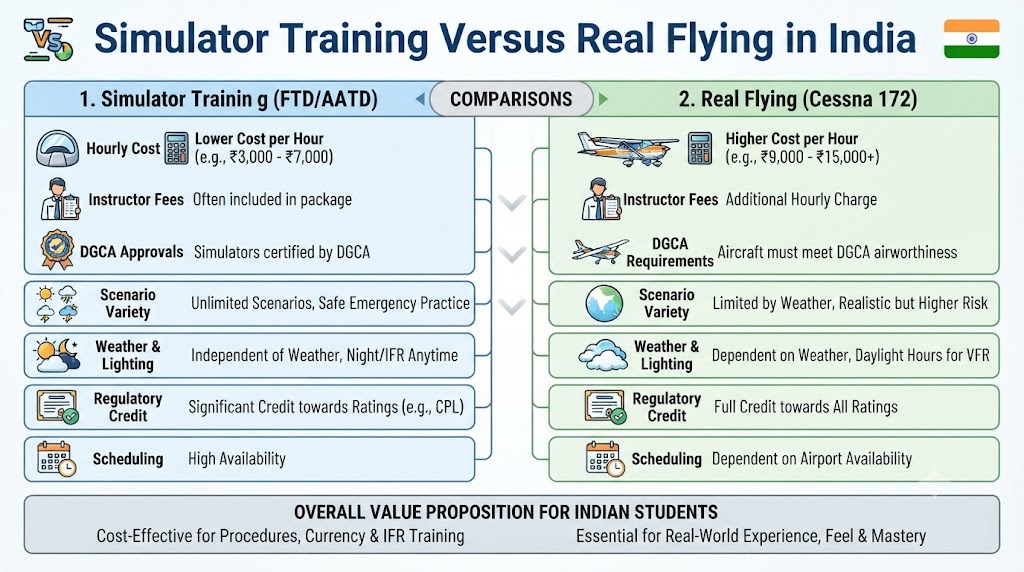
Simulator Training Versus Real Flying: Simple Comparison
| Point | Simulator Training | Real Flying |
|---|---|---|
| Main Purpose | Procedure practice and skill preparation | Actual aircraft handling and experience |
| Cost | Usually lower | Usually higher |
| Safety | Good for emergency practice | Real-world flying environment |
| Weather | Can be controlled or simulated | Real weather conditions |
| Physical Feel | Limited or artificial | Actual aircraft movement |
| Landing Judgment | Helpful for preparation | Essential for real skill |
| Emergency Practice | Can repeat safely | Limited by safety rules |
| Radio Practice | Very useful | Real ATC pressure |
| Licence Credit | Only if approved and allowed | Core flying-hour requirement |
| Best Use | Practice, preparation, confidence | Real flying skill and licence progress |
Both are useful. The best training plan uses simulator training for preparation and real flying for actual skill development.
Why Simulator Training Is Useful for Indian Students
Simulator training is useful because it gives students a safe learning environment.
A beginner can sit in a simulator and learn where instruments are placed, how checklists flow, how radio calls are made, and how different procedures work.
It is also helpful for reducing training stress. Many students feel nervous in the cockpit during early flights. Simulator practice can reduce this fear because students already know what to expect.
For Indian CPL aspirants, simulator training is especially helpful for instrument flying, emergency drills, approach procedures, radio communication, and navigation practice.
It can also reduce repeated mistakes in aircraft. If a student understands the procedure in a simulator first, real flying lessons may become more productive.
Why Real Flying Is Still Essential
Real flying cannot be fully replaced because actual aircraft experience is different.
In real flying, the student feels wind correction, turbulence, engine vibration, runway slope, aircraft response, landing flare, visibility changes, and traffic movement. These things are difficult to fully understand in a simulator.
Real flying also teaches emotional control. A student must manage pressure, communicate with ATC, follow instructor commands, handle real weather, and make decisions in the actual aviation environment.
Takeoff and landing skills especially need real aircraft practice. A simulator can help with understanding, but real landing judgment comes from actual flying experience.
Which One Should Students Choose First?
For most beginners, simulator training can be useful before or alongside aircraft flying. It helps students understand cockpit basics, checklists, radio calls, and lesson flow.
But students should not delay real flying too much. Real aircraft experience is necessary for confidence and licence progress.
The best approach is balanced training. Use the simulator to prepare and correct weak areas. Use the aircraft to build real flying skill.
A student should ask the instructor: “Which skill should I practice in the simulator before my next aircraft lesson?” This makes simulator time more useful.
DGCA, FTO Rules, and Simulator Hour Credit
Simulator-hour credit is an important topic in India. Students should not assume that every simulator hour counts toward licence requirements.
DGCA’s CPL reference mentions that some instrument time may be completed on an approved simulator, but this depends on the specific rule, simulator approval, training purpose, and FTO process. Students must verify the latest DGCA/eGCA and flight school requirements before relying on simulator hours for licence planning.
This is very important because an unapproved or unsuitable simulator may still be useful for practice, but it may not count officially.
Before paying for simulator training, students should ask:
- Is this simulator approved for official training credit?
- What type of training can it be used for?
- Will the time be entered in training records?
- Will it count toward my licence requirement?
- Who will sign or verify the session?
- Is the FTO authorised to provide this training?
A clear answer before training can prevent confusion later.
Cost Difference Between Simulator and Real Flying
Real aircraft flying is usually more expensive because it includes aircraft fuel, maintenance, instructor cost, airport charges, insurance, and operational expenses.
Simulator training is usually cheaper because it does not involve actual aircraft operation. This makes it useful for repeated practice.
However, students should not choose simulator training only because it is cheaper. The goal is not to avoid real flying. The goal is to use simulator training to make real flying better.
A smart student uses simulator sessions to fix weak areas before spending expensive aircraft hours.
Best Uses of Simulator Training
Simulator training is best for:
Radio communication practice, checklist discipline, cockpit familiarisation, instrument scanning, emergency drills, navigation practice, approach briefing, missed approach practice, weather scenario discussion, and airline assessment preparation.
It is also useful when weather delays aircraft flying. Instead of wasting the day, students can use simulator time to improve procedures.
Best Uses of Real Flying
Real flying is best for:
Aircraft handling, takeoff practice, landing practice, circuit flying, cross-country flying, solo confidence, weather awareness, runway judgment, traffic awareness, and real-time decision-making.
Real flying also teaches students how the aircraft actually behaves in changing wind, temperature, visibility, and runway conditions.
Common Mistakes Students Make
One common mistake is thinking that simulator training is the same as real flying. It is not. Simulator training is helpful, but it has limits.
Another mistake is treating the simulator like a game. Students should follow checklists, radio discipline, and instructor instructions seriously.
Some students also assume all simulator hours count for licence requirements. This is risky. Only approved simulator time under applicable rules and FTO process may be counted.
Another mistake is choosing training only based on price. Cheap training without proper structure may not help much.
Students should also avoid flying without a lesson objective. Every simulator or aircraft session should have a clear purpose.
How Indian Students Can Balance Both
Indian student pilots should use both simulator training and real flying wisely.
Before a difficult aircraft lesson, use the simulator to understand the procedure. After a weak aircraft lesson, use the simulator to correct mistakes. Before instrument flying, use the simulator to build scan and radio confidence.
For example, if a student struggles with radio calls, they can practice in the simulator first. If they struggle with landing flare, they must get more real aircraft practice because landing judgment needs actual flying.
A balanced training plan saves time, improves confidence, and makes learning more effective.
Practical Training Plan for Students
A useful approach can be:
Start with cockpit familiarisation in the simulator. Then begin real aircraft lessons. Use simulator sessions for checklists, radio calls, instrument scan, and emergency practice. Use real flying for takeoffs, landings, circuits, navigation, solo flying, and cross-country experience.
After each real flight, write down weak areas. Then use the simulator to practice those weak areas before the next aircraft lesson.
This method helps students learn faster without wasting aircraft time.
FAQs on Simulator Training Versus Real Flying in India
1. Is simulator training better than real flying?
No. Simulator training and real flying serve different purposes. Simulator training is good for practice and preparation, while real flying is essential for actual aircraft handling.
2. Can simulator training replace aircraft flying in India?
Not fully. Simulator training may support some approved training requirements, but real aircraft flying remains essential for pilot training and licence progress.
3. Do simulator hours count for CPL in India?
Only approved simulator time may count for specific requirements under applicable DGCA/FTO rules. Students should verify this before assuming credit.
4. Why is real flying more expensive than simulator training?
Real flying includes aircraft fuel, maintenance, instructor cost, airport charges, insurance, and operational expenses. Simulator training usually costs less because no real aircraft is flown.
5. Should beginners use a simulator before first flight?
Yes, it can be helpful. A simulator can teach cockpit layout, checklists, and basic procedures before the student enters the actual aircraft.
6. Can simulator training improve radio communication?
Yes. Students can practice radio calls, readbacks, and communication flow in a simulator before facing real ATC pressure.
7. Is simulator training useful for emergency practice?
Yes. Emergencies can be practiced safely and repeatedly in a simulator, which is one of its biggest benefits.
8. Can simulator training help reduce pilot training cost?
It can help reduce repeated mistakes and make aircraft lessons more productive, but it should not be used as a shortcut to avoid required real flying.
9. What should students ask before joining simulator training?
They should ask whether the simulator is approved, what skills will be taught, whether hours count officially, who will instruct, and whether records will be maintained.
10. What is the best balance between simulator and real flying?
Use the simulator for preparation, procedures, emergencies, and weak areas. Use real flying for aircraft handling, takeoffs, landings, cross-country flying, and real decision-making.
Final Thoughts
Simulator training and real flying both have value in Indian pilot training. One is not the enemy of the other.
Simulator training builds preparation, confidence, procedure knowledge, and emergency awareness. Real flying builds actual aircraft handling, landing judgment, weather experience, and real pilot confidence.
For Indian student pilots, the best choice is not simulator or aircraft. The best choice is simulator plus aircraft, used correctly.

