
Introduction
Many students dream of becoming pilots, but the pilot training journey can feel confusing in the beginning. Terms like SPL, PPL, and CPL are commonly used in aviation training, but many beginners do not clearly understand what each licence means.
In India, pilot licensing is regulated by the Directorate General of Civil Aviation, commonly known as DGCA. DGCA is the civil aviation authority responsible for aviation safety, licensing, and regulatory oversight in India.
The three common pilot licence stages are:
- SPL: Student Pilot Licence
- PPL: Private Pilot Licence
- CPL: Commercial Pilot Licence
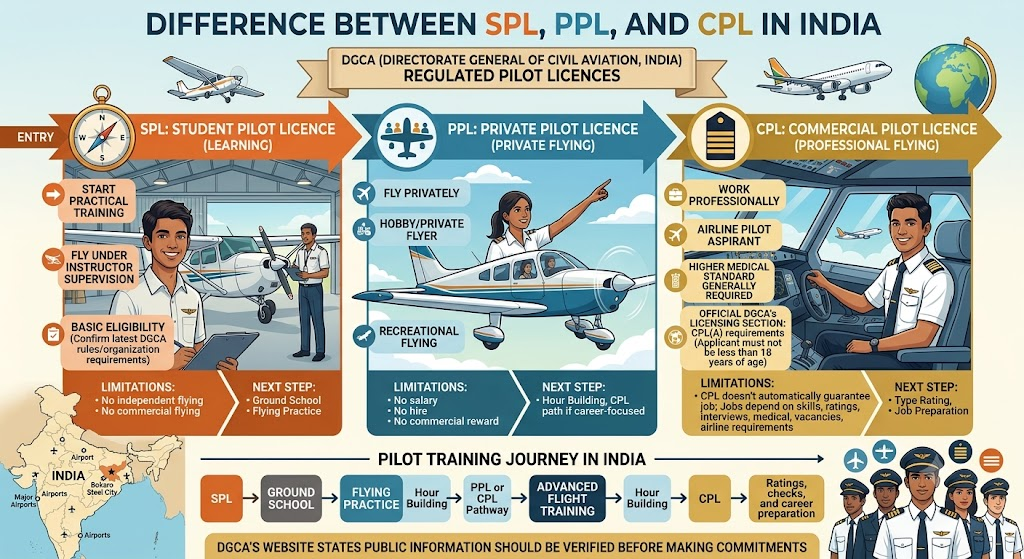
Each licence has a different purpose. SPL is the starting point for flight training, PPL is mainly for private or recreational flying, and CPL is required for pilots who want to fly professionally.
This blog explains the difference between SPL, PPL, and CPL in India in a simple, beginner-friendly way.
What Is a Pilot Licence?
A pilot licence is an official permission that allows a person to operate an aircraft under specific conditions. Just like a driving licence is needed to drive a vehicle, a pilot licence is required to fly an aircraft legally.
Pilot licences exist because aviation requires safety, skill, discipline, and technical knowledge. A person cannot simply learn basic flying and start operating aircraft independently. They must complete training, meet medical standards, pass examinations, and demonstrate practical flying ability.
Different licences exist for different stages of flying. A beginner student needs a different level of permission than a professional pilot who flies passengers, cargo, or charter aircraft.
Overview of SPL, PPL, and CPL
SPL, PPL, and CPL are connected, but they are not the same.
SPL is the basic entry-level licence that allows a student to begin practical flight training under approved supervision.
PPL is for people who want to fly aircraft privately, mainly for personal or recreational purposes.
CPL is for people who want to work as professional pilots and fly commercially.
In simple words:
- SPL is for learning.
- PPL is for private flying.
- CPL is for professional flying.
What Is SPL in India?
SPL stands for Student Pilot Licence. It is usually the first licence a student receives before starting practical flying training.
An SPL allows a student pilot to begin training at an approved flying school. It does not make the student a fully independent pilot. Instead, it allows the student to train under the guidance and supervision of qualified instructors.
Purpose of SPL
The main purpose of SPL is to introduce students to actual flight training. It helps students begin their journey toward higher licences like PPL or CPL.
Who Should Apply for SPL?
SPL is suitable for:
- Students starting pilot training
- Beginners joining a flying school
- Candidates planning for PPL
- Candidates planning for CPL
- Aviation learners taking their first practical step
Basic Eligibility
Eligibility requirements may vary based on updated DGCA rules and flying school procedures. Generally, students must meet age, education, medical, and basic knowledge requirements before beginning flight training.
Students should always confirm the latest requirements directly from DGCA or an approved flying training organization.
Privileges of SPL
An SPL allows a student to:
- Start practical flight training
- Fly under instructor supervision
- Learn basic aircraft handling
- Progress toward private or commercial pilot training
Limitations of SPL
An SPL does not allow a student to fly commercially. It also does not allow independent flying beyond the approved training environment.
It is only the beginning stage of pilot training.
What Is PPL in India?
PPL stands for Private Pilot Licence. It is designed for people who want to fly aircraft for personal or recreational purposes.
A PPL holder can fly as a private pilot, but cannot earn money by flying. This is one of the biggest differences between PPL and CPL.
Purpose of PPL
The purpose of PPL is to allow trained pilots to fly privately. It is suitable for people who love aviation but may not want to become professional airline pilots.
Who Should Choose PPL?
PPL is suitable for:
- Aviation hobbyists
- Private aircraft owners
- Recreational flyers
- Students who want flying experience before CPL
- Individuals who want to fly for personal interest
Skills Learned During PPL Training
PPL training helps students learn:
- Aircraft control
- Takeoff and landing
- Basic navigation
- Radio communication
- Flight planning
- Weather awareness
- Emergency handling
- Airspace awareness
Privileges of PPL
A PPL allows private flying within the privileges and conditions of the licence.
Limitations of PPL
A PPL holder cannot fly for salary, hire, or commercial reward. This means PPL is not enough for airline jobs, charter flying jobs, or other paid pilot roles.
What Is CPL in India?
CPL stands for Commercial Pilot Licence. This is the licence required for pilots who want to fly professionally.
A CPL allows a pilot to work in commercial aviation, subject to additional ratings, training, checks, and employer requirements.
Purpose of CPL
The purpose of CPL is to prepare a pilot for professional flying responsibilities. CPL training is more advanced than SPL and PPL training.
Who Should Choose CPL?
CPL is suitable for:
- Students who want to become airline pilots
- Candidates interested in charter aviation
- Future flight instructors
- Corporate aviation aspirants
- Cargo aviation candidates
- Professional aviation career seekers
CPL Training Focus
CPL training develops advanced skills such as:
- Professional aircraft handling
- Advanced navigation
- Instrument flying knowledge
- Flight planning
- Aviation decision making
- Operational discipline
- Commercial aviation awareness
DGCA’s official licensing section includes Commercial Pilot’s Licence requirements, including that an applicant for a Commercial Pilot’s Licence for aeroplanes must not be less than eighteen years of age.
Difference Between SPL, PPL, and CPL in India
| Point | SPL | PPL | CPL |
|---|---|---|---|
| Full Form | Student Pilot Licence | Private Pilot Licence | Commercial Pilot Licence |
| Main Purpose | Start flight training | Fly privately | Fly professionally |
| Suitable For | Beginners | Recreational/private flyers | Career pilots |
| Commercial Flying | Not allowed | Not allowed | Allowed as per licence privileges |
| Training Level | Basic | Intermediate | Advanced |
| Career Use | First step only | Limited career use | Required for professional pilot jobs |
| Flying Permission | Training environment | Private flying | Commercial flying |
| Medical Requirement | As applicable | As applicable | Higher medical fitness standard generally required |
| Typical Candidate | New student pilot | Hobby/private flyer | Airline or professional pilot aspirant |
| Next Step | PPL or CPL training | CPL if career-focused | Type rating/job preparation |
Pilot Training Journey in India
The journey usually begins with understanding eligibility and medical fitness. After that, students choose a flying school and begin formal training.
A typical pathway may look like this:
SPL
↓
Ground School
↓
Flying Practice
↓
PPL or CPL Pathway
↓
Advanced Flight Training
↓
Hour Building
↓
CPL
↓
Ratings, checks, and career preparation
Not every student follows the same path. Some students may aim only for PPL, while others directly plan a career-focused CPL route.
Skills Developed at Each Licence Stage
Skills Developed During SPL
At the SPL stage, students begin developing aviation discipline. They learn basic aircraft knowledge, safety awareness, cockpit behavior, and the importance of following instructor guidance.
Skills Developed During PPL
At the PPL stage, students develop stronger flying skills. They learn how to control the aircraft, plan flights, communicate on radio, understand weather, and navigate safely.
Skills Developed During CPL
At the CPL stage, students develop professional-level skills. They learn advanced flying, commercial decision making, operational planning, and professional aviation discipline.
Career Opportunities After Each Licence
After SPL
SPL alone does not provide professional career opportunities. It is only the starting point for training.
After PPL
PPL is mainly useful for private flying. It may help aviation enthusiasts gain experience, but it does not allow paid commercial flying.
After CPL
CPL opens the door to professional aviation pathways. Depending on additional training, ratings, experience, and hiring requirements, CPL holders may explore roles in:
- Airlines
- Charter aviation
- Corporate aviation
- Cargo operations
- Flight instruction
- Survey flying
- Aviation training support
A CPL does not automatically guarantee a job. Pilots often need additional ratings, interviews, simulator assessments, and company-specific training.
Which Licence Should You Choose?
Choose SPL if you are just starting pilot training.
Choose PPL if you want to fly for personal interest and do not plan to earn money as a pilot.
Choose CPL if your goal is to build a professional pilot career.
For students in India who want to become airline pilots, CPL is usually the major licensing goal after completing the required training path.
Common Myths About SPL, PPL, and CPL
Myth 1: SPL Is Enough to Become a Pilot
SPL is only the beginning. It allows training, but it does not make you a professional pilot.
Myth 2: PPL Allows Paid Flying
PPL is for private flying. It does not allow a pilot to fly commercially for salary or reward.
Myth 3: CPL Guarantees an Airline Job
CPL is important, but jobs depend on many factors such as skill, ratings, interviews, medical fitness, vacancies, and airline requirements.
Myth 4: Pilot Training Ends After CPL
CPL is a major milestone, but professional pilots continue learning throughout their careers.
Myth 5: All Flying Schools Are the Same
Flying schools can differ in aircraft availability, instructor quality, safety culture, fees, and training timelines. Students should research carefully before joining.
Mistakes Students Should Avoid
Many students make avoidable mistakes while planning pilot training.
Avoid these mistakes:
- Starting without understanding the licence pathway
- Ignoring medical requirements
- Choosing a flying school without research
- Underestimating ground school subjects
- Poor financial planning
- Taking long gaps between flying lessons
- Thinking CPL automatically means airline selection
- Not checking updated DGCA requirements
Aviation training requires patience, discipline, and planning.
Tips for Aspiring Pilots in India
Here are some practical tips for students:
- Understand the difference between SPL, PPL, and CPL.
- Check your medical fitness early.
- Improve English communication.
- Study mathematics and physics concepts seriously.
- Research flying schools carefully.
- Speak to current or former students if possible.
- Plan your budget properly.
- Stay consistent during training.
- Keep all documents organized.
- Follow DGCA updates and official guidance.
DGCA’s website states that its information is made available for public information and that users should verify official information before making commitments.
Frequently Asked Questions
1. What is SPL in India?
SPL stands for Student Pilot Licence. It is generally the first licence for a beginner who wants to start flight training. It allows a student to begin practical flying lessons under approved supervision. SPL is not a professional pilot licence and does not allow commercial flying.
2. What is PPL in India?
PPL stands for Private Pilot Licence. It allows a person to fly aircraft privately, usually for personal or recreational purposes. A PPL holder cannot fly for salary or commercial reward. It is suitable for aviation enthusiasts and private flying.
3. What is CPL in India?
CPL stands for Commercial Pilot Licence. It is required for pilots who want to fly professionally. CPL training is more advanced and prepares students for commercial aviation roles. Additional ratings and checks may still be required for specific jobs.
4. What is the main difference between PPL and CPL?
The main difference is purpose. PPL is for private flying, while CPL is for professional flying. A PPL holder cannot earn money as a pilot, but a CPL holder can pursue paid flying roles as per licence privileges and employer requirements.
5. Is SPL compulsory before CPL?
SPL is commonly part of the early training process because students must begin as learners before progressing to advanced training. The exact process should be confirmed with the selected flying school and latest DGCA guidance.
6. Can I become an airline pilot with PPL?
No, PPL alone is not enough to become an airline pilot. Airline careers generally require CPL, additional ratings, medical fitness, skill checks, interviews, and airline-specific training.
7. Can I earn money with PPL?
No. PPL is not meant for commercial flying. If your goal is to earn money as a pilot, you should plan for CPL and other required qualifications.
8. Which licence is best for beginners?
SPL is the beginning stage for flight training. If your goal is only personal flying, you may progress toward PPL. If your goal is a professional pilot career, you should plan toward CPL.
9. Is CPL difficult?
CPL requires dedication, regular flying practice, strong theoretical knowledge, discipline, and financial planning. It can be challenging, but with consistent effort and good training support, students can complete it successfully.
10. Should I choose PPL or CPL?
Choose PPL if you want to fly privately as a hobby. Choose CPL if your goal is to become a professional pilot. Your decision should depend on your career goal, budget, medical fitness, and long-term aviation plan.
Conclusion
The difference between SPL, PPL, and CPL in India is simple when you understand the purpose of each licence.
SPL is the starting point for student pilots. PPL is for private and recreational flying. CPL is for those who want to build a professional aviation career.
Before joining any flying school, students should understand the licence pathway, check medical eligibility, plan finances, and verify the latest DGCA requirements. With the right guidance and preparation, pilot training becomes easier to understand and more achievable.

