
Introduction
SPL Eligibility Criteria in India is one of the first things every aspiring pilot should understand before starting flight training. A Student Pilot Licence, commonly known as SPL, is usually the first official step for students who want to begin practical flying training at a flying school in India.
The SPL confirms that a student has met basic age, medical, identity, and knowledge requirements before beginning supervised flight training. In India, civil aviation licensing and safety oversight come under the Directorate General of Civil Aviation, commonly known as DGCA.
For students planning a career as a commercial pilot, private pilot, flight instructor, or airline pilot, understanding SPL requirements helps avoid delays during admission and training. It also helps students prepare documents, complete medical fitness checks, and choose the right flying training organisation with better confidence.
What Is a Student Pilot Licence
A Student Pilot Licence is an entry-level pilot licence that allows a student to begin flying training under the supervision of an approved flying instructor. It is not the same as a Private Pilot Licence or Commercial Pilot Licence. Instead, it is the starting point of the flight training journey.
An SPL is important because it allows the student to move from classroom aviation learning to actual aircraft training. Before a student can fly solo or progress further, the flying school must be satisfied that the student meets the required standards.
The SPL is generally useful for:
- Students beginning pilot training
- Aspiring CPL candidates
- PPL learners
- Aviation career seekers
- Students joining flying schools
- Learners preparing for practical flight training
Why Is an SPL Required
An SPL is required because aviation training involves safety, discipline, and regulatory compliance. Flying an aircraft is not like learning an ordinary skill. Even at the student level, aviation requires responsibility, medical fitness, basic theoretical knowledge, and instructor supervision.
The purpose of SPL is to ensure that a student:
- Meets minimum eligibility conditions
- Is medically fit for training
- Has basic aviation awareness
- Can follow safety instructions
- Has proper identity and academic records
- Is ready to begin supervised flight training
Since pilot training is connected with public safety, flying schools and aviation authorities follow structured requirements before allowing students to proceed with practical training.
SPL Eligibility Criteria in India
SPL Eligibility Criteria in India usually includes age, education, medical fitness, language ability, identity verification, and basic aviation knowledge. Students should always confirm the latest requirements with their chosen flying school and official aviation authority before applying.
Minimum Age Requirement
The minimum age for a Student Pilot Licence in India is generally 16 years. This means a student should meet the required age before applying for SPL and beginning relevant flying training activities.
Students who are younger than the minimum age should use the time to prepare academically, improve English communication, study aviation basics, and understand the pilot career path.
Educational Qualification
For SPL, flying schools generally expect students to have completed basic school-level education. For students planning to move toward Commercial Pilot Licence training, Class 12 education with required subjects is important.
DGCA rules mention Class 10 plus 2 with Physics and Mathematics from a recognised board for certain pilot licences. Students who do not have Physics and Mathematics should check approved options for meeting subject requirements before planning a CPL path.
Medical Fitness Requirements
Medical fitness is one of the most important parts of pilot eligibility. Aviation demands good physical and mental fitness because pilots must make quick decisions, handle pressure, communicate clearly, and operate aircraft safely.
For starting pilot training, students generally begin with a DGCA Class II Medical Examination. A Class II medical certificate checks whether the candidate is physically fit for pilot training.
Medical checks may include:
- Vision test
- Hearing test
- General physical examination
- Blood pressure check
- Medical history review
- Basic fitness assessment
- Mental alertness and overall health review
Students planning a commercial pilot career may later need a higher level of medical fitness as they progress toward CPL requirements.
English Language Requirement
English is widely used in aviation communication, documentation, training material, cockpit procedures, and air traffic control communication. A student pilot should be able to read, speak, and understand English clearly.
Good English helps in:
- Understanding aviation theory
- Reading aircraft manuals
- Communicating with instructors
- Practicing radio telephony
- Preparing for exams
- Following safety procedures
Students weak in English should improve communication before joining flight training.
Nationality Requirements
Indian students can apply through recognised flying schools in India. Foreign nationals may have additional documentation and approval requirements depending on the flying school, visa status, and regulatory process.
Students should confirm nationality-related requirements directly with the flying school before admission.
Character and Identity Verification
Flying schools may require identity verification before issuing SPL or allowing training. This helps ensure that the applicant’s details are accurate and match official records.
Students should make sure their name, date of birth, address, and educational records are consistent across documents.
Documents Required for SPL Application
Students should keep all documents ready before applying for SPL. Missing or incorrect documents can delay the admission and training process.
Common documents may include:
- Age proof
- Class 10 certificate
- Class 12 certificate, if applicable
- Identity proof
- Address proof
- Passport-size photographs
- Medical certificate
- Aadhaar card or passport, where applicable
- Flying school application form
- Parent or guardian consent, if required
- Student registration details
- Any forms required by the flying school
Students should carry both original documents and clear copies during admission.
SPL Admission Process Step by Step
The SPL process may vary slightly from one flying school to another, but the general journey is usually similar.
1. Choose a Flying Training Organisation
The first step is selecting a suitable flying training organisation. Students should check approval status, aircraft availability, instructor experience, training environment, fee structure, safety culture, and student support.
2. Complete Registration
After selecting a flying school, students complete the registration or admission process. This may include filling out forms, submitting personal details, and paying applicable registration fees.
3. Submit Documents
Students must submit required documents for verification. The flying school checks academic records, age proof, identity proof, medical documents, and other details.
4. Complete Medical Examination
The student should complete the required medical examination through the prescribed process. A valid medical certificate is important before progressing with flight training.
5. Clear Written or Oral Test
Many flying schools conduct a written or oral test before issuing SPL. This test checks basic aviation awareness and readiness for training.
6. Attend Interview if Required
Some flying schools may conduct an interview to understand the student’s motivation, communication ability, discipline, and seriousness toward aviation training.
7. SPL Issuance
Once the student meets all requirements, the SPL process is completed as per the flying school and applicable regulatory procedure.
8. Begin Flying Training
After receiving SPL and completing the required formalities, the student can begin supervised flying training under qualified instructors.
SPL Entrance Examination
The SPL entrance examination is usually designed to check whether the student understands basic aviation concepts. It is not meant to be extremely difficult, but students should prepare seriously.
Subjects may include:
- Air Regulations
- Basic Aviation Knowledge
- Air Navigation fundamentals
- Aircraft basics
- Aviation safety
- Radio communication basics
- General awareness related to flying
Some flying schools may conduct an oral examination instead of or along with a written test.
Tips to Prepare for SPL Exam
Students can prepare better by following a simple study plan:
- Learn basic aircraft parts
- Understand how an aircraft flies
- Study basic aviation terms
- Read about runway markings
- Learn simple weather concepts
- Practice basic navigation ideas
- Improve English speaking skills
- Understand safety rules
- Ask instructors for recommended study material
- Take mock questions if available
Medical Examination Explained
Medical fitness is essential because aviation is a safety-sensitive profession. A pilot must be physically and mentally capable of handling flight duties.
A DGCA Class II medical examination is generally the first medical step for student pilots. Students should complete it early because medical delays can affect training schedules.
Common reasons for medical concerns may include:
- Uncorrected vision issues
- Hearing difficulty
- Serious medical history
- High blood pressure
- Certain chronic illnesses
- Incomplete medical records
- Undisclosed health conditions
Students should not hide medical information. Honest disclosure helps aviation medical examiners guide candidates properly.
Common Reasons Why SPL Applications Get Rejected
SPL applications may face delays or rejection due to avoidable mistakes. Students should review all requirements carefully before applying.
Common reasons include:
- Incomplete documents
- Incorrect date of birth
- Name mismatch in certificates
- Medical certificate not completed
- Age requirement not met
- Educational documents missing
- Poor communication during oral test
- Incorrect information in forms
- Identity proof mismatch
- Lack of basic aviation preparation
Most of these issues can be avoided with early planning.
Tips to Become Eligible Faster
Students who want to start pilot training smoothly should prepare in advance.
Helpful steps include:
- Arrange documents early
- Complete medical examination on time
- Improve English communication
- Study basic aviation concepts
- Maintain physical fitness
- Choose a reputed flying school
- Keep academic records ready
- Understand the pilot training path
- Speak with instructors before admission
- Avoid last-minute preparation
Good preparation saves time and builds confidence.
SPL vs PPL vs CPL Comparison
| Point | SPL | PPL | CPL |
|---|---|---|---|
| Full Form | Student Pilot Licence | Private Pilot Licence | Commercial Pilot Licence |
| Purpose | Start supervised flying training | Fly privately, subject to rules | Fly professionally as a career |
| Training Stage | Beginner stage | Intermediate private flying stage | Professional pilot stage |
| Minimum Age | Generally 16 years | Higher than SPL | Generally 18 years |
| Medical Requirement | Class II medical usually required | Medical fitness required | Higher medical standards required |
| Flying Privileges | Training under supervision | Private flying privileges | Commercial flying privileges |
| Career Value | First step | Useful for private flying | Required for professional pilot career |
| Typical Progression | SPL to flight training | PPL or CPL path | Airline, charter, instructor, corporate flying |
Career Path After Receiving an SPL
After receiving an SPL, students begin the practical part of their pilot journey. The career path usually moves step by step.
A common pilot training journey includes:
- Student Pilot Licence
- Ground school training
- Dual flying with instructor
- Solo flying
- Flight hour building
- Private Pilot Licence, if chosen
- Commercial Pilot Licence training
- DGCA examinations
- Class I medical for commercial path
- CPL issue
- Type rating, if required
- Airline, charter, corporate, or instructor career path
An SPL is only the beginning. A successful aviation career requires discipline, regular study, flying skill, medical fitness, and professional attitude.
Frequently Asked Questions
1. What is SPL in pilot training?
SPL stands for Student Pilot Licence. It is an entry-level licence that allows a student to begin flying training under supervision. It is usually the first official step in the pilot training journey. Students need SPL before progressing into practical flight training activities at a flying school.
2. What is the minimum age for SPL in India?
The minimum age for SPL in India is generally 16 years. Students should confirm the latest requirement with their selected flying school before applying. If a student is below the required age, they can still prepare by studying aviation basics, improving English, and arranging documents.
3. Is Class 12 required for SPL?
For SPL, basic educational requirements may vary by flying school. However, students planning for a Commercial Pilot Licence should pay close attention to Class 12 requirements, especially Physics and Mathematics. These subjects are important for the professional pilot pathway in India.
4. Is medical fitness compulsory for SPL?
Yes, medical fitness is an important requirement for pilot training. Students usually need to complete a DGCA Class II medical examination before beginning flying training. Medical fitness ensures that the student is physically and mentally suitable for aviation training.
5. Can I become a pilot after 12th in India?
Yes, students can start their pilot journey after completing school education, provided they meet age, medical, academic, and training requirements. Those aiming for CPL should carefully check subject requirements, DGCA rules, and flying school admission conditions before beginning.
6. Is English important for SPL?
Yes, English is very important in aviation. Pilots use English for communication, training material, exams, radio telephony, and aircraft documents. Students should focus on clear speaking, listening, reading, and understanding aviation terminology.
7. What documents are required for SPL?
Common documents include age proof, educational certificates, identity proof, address proof, passport-size photographs, medical certificate, and flying school forms. Some schools may ask for additional documents. Students should verify the exact checklist before applying.
8. Is the SPL exam difficult?
The SPL exam is usually basic, but students should not take it casually. It may include air regulations, aircraft basics, aviation safety, navigation fundamentals, and oral questions. With proper preparation and guidance from the flying school, students can clear it confidently.
9. Can SPL holders fly aircraft alone?
SPL holders can train under approved supervision and may progress toward solo flying only when instructors and training rules permit. Solo flying is not automatic after receiving SPL. It depends on training progress, instructor approval, safety readiness, and applicable procedures.
10. What comes after SPL?
After SPL, students begin structured flying training. They complete dual flying, learn aircraft handling, prepare for solo flying, build flight hours, and progress toward PPL or CPL depending on their career goal. SPL is the first step, not the final licence.
Conclusion
SPL Eligibility Criteria in India is an essential topic for every student who dreams of becoming a pilot. Before joining a flying school, students should clearly understand the minimum age requirement, medical fitness process, educational expectations, document checklist, and basic aviation knowledge needed for SPL.
A Student Pilot Licence gives aspiring pilots their first official entry into practical flight training. It helps ensure that students are medically fit, properly verified, and ready to begin aviation training under supervision.
Students who prepare early can avoid delays and start their flying journey with confidence. By arranging documents, completing medical checks, improving English, studying aviation basics, and choosing the right flying school, aspiring pilots can take a strong first step toward a successful aviation career.
Meta Title: SPL Eligibility Criteria in India Explained Clearly
Meta Description: Learn SPL Eligibility Criteria in India, including age, medical, education, documents, exam process, and pilot training steps.
Suggested URL Slug: spl-eligibility-criteria-in-india
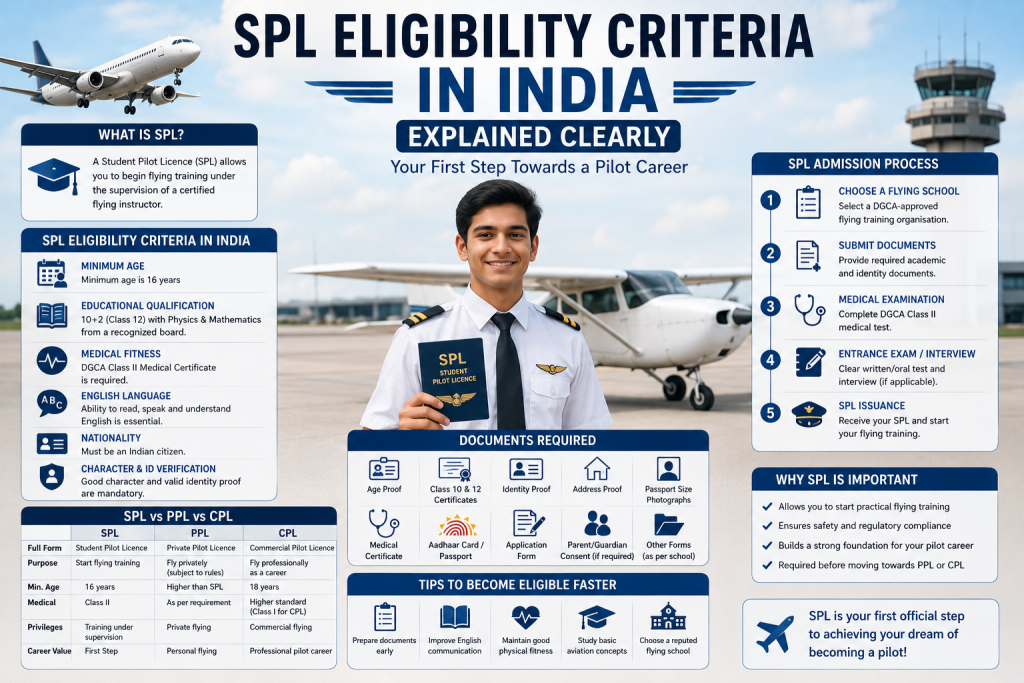
Image Alt Text: SPL Eligibility Criteria in India for student pilots
Image Caption: A clear guide to Student Pilot Licence eligibility in India
Schema Type Recommendation: BlogPosting
5 Internal Blog Ideas related to pilot training:
- How to Become a Pilot in India Step by Step
- DGCA Class II Medical Test Guide for Student Pilots
- CPL Eligibility in India Explained for Beginners
- Best Study Tips for Pilot Ground School Students
- PPL vs CPL in India Complete Comparison
10 SEO Tags:
SPL Eligibility Criteria in India, Student Pilot Licence India, SPL Eligibility, DGCA SPL Requirements, Pilot Training in India, Flying School Admission, Pilot Career in India, DGCA Medical Certificate, Commercial Pilot Eligibility, Become a Pilot in India

