
Introduction
Aviation is one of the fastest-growing and most respected career fields in India. With the increasing demand for air travel, expansion of airlines, and growth of the aviation sector, the need for trained commercial pilots is rising every year. Among all aviation qualifications, the Commercial Pilot License (CPL) is the most important certification for anyone who wants to fly aircraft professionally.
For students and aspiring pilots, understanding CPL is the first step toward building a successful aviation career. This guide explains everything in a simple and structured way, including eligibility, training process, cost, exams, and career opportunities in India.
What is a Commercial Pilot License (CPL)?
A Commercial Pilot License (CPL) is an official certification issued by aviation authorities that allows a person to fly aircraft professionally and earn income as a pilot.
With a CPL, you can:
- Fly passenger aircraft for airlines
- Operate cargo flights
- Work in charter aviation
- Build a professional aviation career
It is the primary license required to become a commercial airline pilot in India.
Eligibility Criteria for CPL in India
To start CPL training in India, candidates must meet basic requirements:
Educational Qualification
- 10+2 from a recognized board
- Physics and Mathematics required at school level (mandatory or equivalent)
Age Requirement
- Minimum 17 years to begin training
- Minimum 18 years for CPL issuance
Medical Fitness
- DGCA Class 1 Medical Certificate required
- Good physical and mental health
- Vision standards must meet aviation requirements
Language Skills
- Basic English communication skills required
- English is used in global aviation communication
Importance of Science Background
Science subjects play an important role in pilot training:
- Physics helps understand aerodynamics and flight principles
- Mathematics is used in navigation and flight calculations
- Logical reasoning improves decision-making in cockpit situations
This is why students with a science background are generally preferred for CPL training.
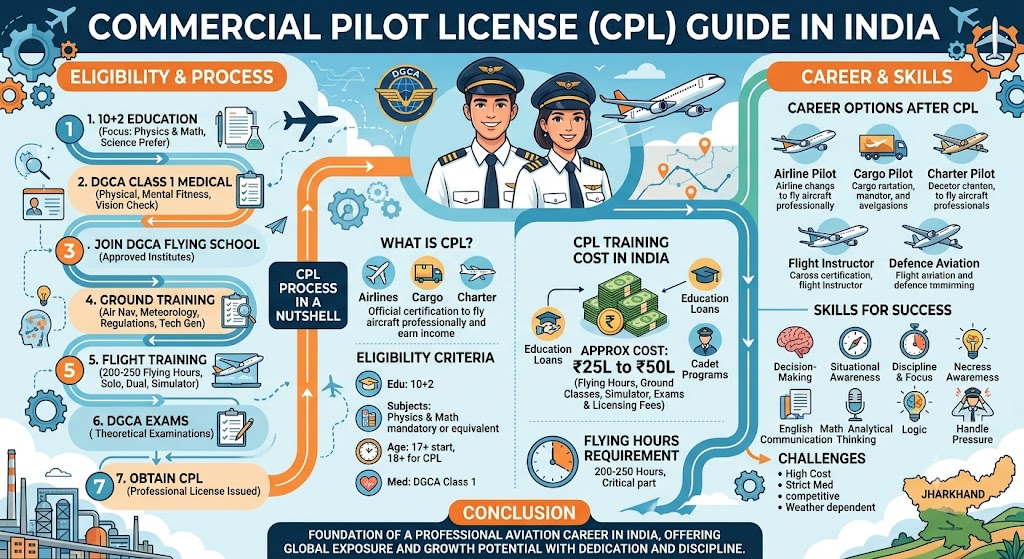
Step-by-Step Process to Get CPL in India
Step 1: Complete 10+2 Education
Focus on Physics and Mathematics subjects.
Step 2: Clear Medical Examination
Obtain DGCA Class 1 Medical Certificate.
Step 3: Join a Flying School
Enroll in a DGCA-approved aviation training institute.
Step 4: Ground Training
Study subjects like:
- Air Navigation
- Meteorology
- Air Regulations
- Technical General
Step 5: Flight Training
Complete approximately 200–250 flying hours.
Step 6: DGCA Exams
Clear all required theoretical examinations.
Step 7: Obtain CPL
After successful completion, you receive your Commercial Pilot License.
Flying Hours Requirement
To qualify for CPL in India, students must complete:
- Around 200–250 flying hours
- Dual and solo flight training
- Simulator sessions (if included by institute)
Flying hours are a critical part of becoming a professional pilot.
DGCA Rules and Examination System
The Directorate General of Civil Aviation (DGCA) governs pilot training in India.
To obtain CPL, candidates must:
- Pass written examinations
- Complete required flight training hours
- Clear medical fitness standards
- Train at DGCA-approved flying schools
DGCA ensures safety and standardization in aviation training.
Cost of CPL Training in India
CPL training requires a major financial investment.
- Approximate cost: ₹25 lakhs to ₹50 lakhs
This includes:
- Flying training hours
- Ground classes
- Simulator training
- Examination and licensing fees
Students often use education loans or cadet pilot programs for financial support.
Career Options After CPL
After obtaining a CPL, multiple career paths are available:
Airline Pilot
Fly passenger aircraft for domestic and international airlines.
Cargo Pilot
Operate freight aircraft for logistics companies.
Flight Instructor
Train new student pilots in aviation academies.
Charter Pilot
Fly private jets for business or VIP travel.
Defence Aviation
Join Indian Air Force or government aviation services through selection exams.
Skills Required to Become a Successful Pilot
To succeed in aviation, pilots must develop:
- Strong decision-making ability
- Situational awareness
- Discipline and focus
- English communication skills
- Mathematical and analytical thinking
- Ability to handle pressure
Challenges in CPL Training
CPL training is rewarding but comes with challenges:
- High training cost
- Strict medical requirements
- Competitive selection process
- Continuous exams and training
- Weather dependency for flying hours
Despite challenges, aviation remains a highly respected career.
FAQs
1. What is CPL in simple words?
CPL is a license that allows you to fly aircraft professionally and earn money as a pilot.
2. How long does CPL training take in India?
It usually takes between 2 to 3 years depending on training progress and flying hours completion.
3. What is the minimum qualification for CPL?
10+2 with Physics and Mathematics is required or must be completed through equivalent qualification.
4. Is CPL training expensive in India?
Yes, it typically costs between ₹25 lakhs to ₹50 lakhs depending on the institute.
5. Can I become a pilot without Physics and Maths?
Physics and Mathematics are generally required, but some students complete them through additional courses.
6. What is DGCA in aviation?
DGCA is the government authority that regulates pilot licensing and aviation safety in India.
7. Can girls become commercial pilots in India?
Yes, aviation is open equally to both male and female candidates.
8. What jobs can I get after CPL?
You can become an airline pilot, cargo pilot, instructor, or charter pilot.
9. Is CPL enough to join airlines?
CPL is required, but airlines may also ask for additional type rating training.
10. Is pilot career good in India?
Yes, it is a high-growth, respected, and globally recognized career.
Conclusion
The Commercial Pilot License is the foundation of a professional aviation career in India. It allows aspiring pilots to operate aircraft commercially and opens multiple career opportunities in airlines, cargo operations, instruction, and charter aviation.
Although CPL training requires dedication, financial planning, and strict discipline, the rewards are highly valuable in terms of career growth, global exposure, and earning potential. With proper guidance and commitment, aspiring pilots can successfully achieve their CPL and build a strong and respected aviation career.

