
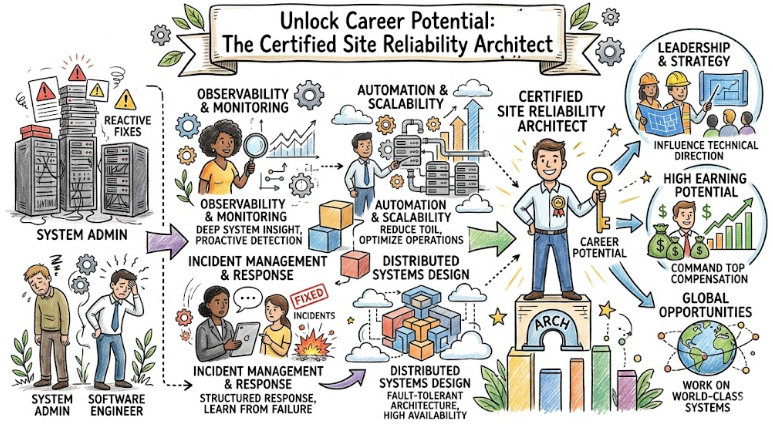
Introduction
The Certified Site Reliability Architect program is a high-level technical roadmap designed for those who want to master the structural design of resilient systems. This guide is written for software professionals and infrastructure leads who aim to transition from tactical troubleshooting to strategic system governance. By pursuing this specialized training at sreschool, engineers learn to build platforms that can withstand the unpredictable nature of global scale operations.
In today’s landscape, where service downtime directly impacts market valuation and user trust, this guide helps you navigate the complex world of modern system architecture. It clarifies the relationship between development speed and operational stability, providing a clear path for those wanting to reach the pinnacle of their engineering careers. By the end of this resource, you will have the clarity needed to decide how this certification aligns with your professional aspirations in a cloud-centric world.
What is the Certified Site Reliability Architect?
The Certified Site Reliability Architect is a professional designation that recognizes an individual’s ability to design and govern large-scale distributed systems. It moves beyond basic scripting and automation, focusing instead on the high-level blueprints that ensure service durability. This certification represents a shift toward engineering production-ready systems where reliability is a core architectural requirement rather than an operational afterthought.
Unlike traditional academic courses, this program emphasizes real-world scenarios and production-focused learning to bridge the gap between theory and practice. It aligns with modern enterprise practices by teaching engineers how to implement sophisticated guardrails like automated failovers and global traffic management. The certification exists to produce leaders who can translate business uptime requirements into robust technical architectures that perform consistently under heavy load.
Who Should Pursue Certified Site Reliability Architect?
This certification is ideally suited for senior software engineers, cloud architects, and veteran DevOps practitioners who are responsible for critical infrastructure. It is designed for those who have already mastered the basics of automation and are now looking to influence the structural integrity of their entire organization. Security specialists and data platform leads also find this path beneficial, as it provides a framework for building high-availability environments that protect data and services.
While beginners with a strong grasp of Linux and networking can use this as a long-term career target, it is primarily aimed at experienced professionals and engineering managers. In the global tech market, and specifically within India’s massive digital economy, there is a severe shortage of architects who can design systems with 99.99% reliability. Whether you are leading a small startup or managing a fleet of microservices for a multinational, this certification provides the mental models needed for high-level technical leadership.
Why Certified Site Reliability Architect is Valuable in the Current Market and Beyond
The current market is seeing a massive surge in complexity as organizations migrate to multi-cloud and microservices environments. This certification remains valuable because it focuses on the fundamental laws of distributed computing which remain constant even as specific cloud tools evolve. It empowers professionals to stay relevant by teaching them how to build resilient systems that are not tied to a single vendor or version.
The return on time investment for this credential is substantial, as it opens doors to principal engineering and technical director roles. Enterprise adoption of site reliability principles is no longer a luxury; it is a necessity for survival in a digitally-driven world. By earning this architect-level validation, you demonstrate a commitment to engineering excellence that translates into higher compensation, greater job security, and the ability to lead high-stakes technical projects.
Certified Site Reliability Architect Certification Overview
The program is officially delivered through the portal at Certified Site Reliability Architect and is hosted on sreschool. It utilizes a multi-level assessment approach that prioritizes hands-on design capability over rote memorization. Candidates are evaluated on their ability to solve complex architectural puzzles and their understanding of how various system components interact during failure modes.
The certification structure is practical and transparent, offering a clear hierarchy of learning from foundational concepts to advanced strategic leadership. Ownership of the curriculum is maintained by industry experts who ensure the content reflects current production-grade engineering standards. This practical approach ensures that the certification holds significant weight during technical interviews and internal promotion cycles, as it proves a candidate can actually build what they design.
Certified Site Reliability Architect Certification Tracks & Levels
The certification is divided into three distinct tiers: Foundation, Professional, and Advanced. Each tier corresponds to a specific stage of professional development, starting with the core vocabulary of reliability and moving toward complex system blueprints. The Foundation level is for those establishing a baseline, while the Professional level focuses on the implementation of observability and incident response automation.
The Advanced level is the true architect tier, focusing on global-scale resilience and chaos engineering strategies. Beyond these levels, students can explore specialization tracks like DevSecOps, FinOps, and DataOps to broaden their horizontal expertise. This modular design ensures that as your career progresses, you can continually update your credentials to match the specific needs of your role or organization.
Complete Certified Site Reliability Architect Certification Table
| Track | Level | Who it’s for | Prerequisites | Skills Covered | Recommended Order |
|---|---|---|---|---|---|
| Core SRE | Foundation | New Engineers, Leads | Basic IT Knowledge | SLOs, SLIs, Toil, Culture | 1 |
| Core SRE | Professional | SREs, DevOps Engineers | 2+ Years Experience | Observability, Incidents | 2 |
| Core SRE | Advanced | Architects, Senior Leads | Professional Cert | Resilience, Chaos, Scaling | 3 |
| DevSecOps | Specialist | Security Leads | Foundation Level | Security Automation | 4 |
| FinOps | Specialist | Cloud Economists | Foundation Level | Cost-aware Design | 5 |
| DataOps | Specialist | Data Architects | Foundation Level | Pipeline Reliability | 6 |
Detailed Guide for Each Certified Site Reliability Architect Certification
Certified Site Reliability Architect – Foundation Level
What it is
This entry-level certification confirms an individual’s grasp of the core concepts that define site reliability engineering. It ensures that the candidate is fluent in the language of reliability and understands the cultural shift required to implement SRE practices.
Who should take it
Software developers, junior systems administrators, and technical managers who want to understand the foundational metrics of service health. It is the ideal starting point for anyone moving into a reliability-focused role.
Skills you’ll gain
- Defining and measuring Service Level Objectives (SLOs)
- Calculating Error Budgets for risk management
- Identifying and reducing manual operational toil
- Understanding the difference between SRE and DevOps
- Participating in blameless culture and post-mortems
Real-world projects you should be able to do
- Create a basic reliability dashboard for an internal service.
- Draft an Error Budget policy for a new feature launch.
- Document a manual workflow to prepare it for automation.
Preparation plan
- 7 Days: Focus on the core definitions found in the SRE handbook and practice metric calculations.
- 30 Days: Complete introductory labs on monitoring and attend community webinars.
- 60 Days: Implement basic SLI tracking on a personal project using open-source tools.
Common mistakes
- Confusing SLOs with SLAs (Service Level Agreements).
- Assuming SRE is just another name for a SysAdmin role.
Best next certification after this
- Same-track option: Professional SRE
- Cross-track option: DevSecOps Foundation
- Leadership option: Technical Team Lead
Certified Site Reliability Architect – Professional Level
What it is
The Professional level validates the technical execution of SRE duties in a high-pressure production environment. It proves that the candidate can build observability pipelines and manage complex incidents with a high degree of automation.
Who should take it
DevOps engineers and SREs with at least two years of experience. This is for the practitioner who is responsible for the daily uptime and performance of critical enterprise platforms.
Skills you’ll gain
- Building full-stack observability (Logs, Metrics, Traces)
- Designing automated self-healing and alerting systems
- Mastering incident command and coordination
- Performing capacity planning and resource optimization
- Conducting deep-dive root cause analysis for major outages
Real-world projects you should be able to do
- Build an end-to-end monitoring system for a microservices cluster.
- Automate a multi-region failover for a critical database.
- Lead a post-mortem for a simulated production failure.
Preparation plan
- 7 Days: Review advanced networking and distributed systems theory.
- 30 Days: Engage in hands-on labs focusing on Kubernetes and observability tools.
- 60 Days: Participate in live incident simulations and refine automation scripts.
Common mistakes
- Setting up too many non-actionable alerts, leading to alert fatigue.
- Focusing on tool implementation rather than the reliability outcome.
Best next certification after this
- Same-track option: Advanced Architect
- Cross-track option: FinOps Specialist
- Leadership option: SRE Manager Certification
Certified Site Reliability Architect – Advanced Level
What it is
The Advanced level is the pinnacle of the technical track, focusing on global-scale resilience and architectural governance. It validates the ability to design systems that are inherently robust against catastrophic failure modes.
Who should take it
Principal engineers, Reliability Architects, and senior technical leads who define the long-term engineering strategy for their organization.
Skills you’ll gain
- Designing for resilience using circuit breakers and bulkheads
- Executing chaos engineering experiments in production safely
- Managing global traffic and regional failover strategies
- Leading cultural transformation at the enterprise level
- Advanced performance tuning for massive distributed systems
Real-world projects you should be able to do
- Architect a global-scale application with a 99.999% availability target.
- Conduct a chaos engineering experiment to test system recovery.
- Create a company-wide reliability roadmap and budget.
Preparation plan
- 7 Days: Study high-level architectural patterns from major cloud-native companies.
- 30 Days: Focus on the safety protocols of chaos engineering and automated testing.
- 60 Days: Conduct a thorough architectural review of a major production service and present improvements.
Common mistakes
- Introducing chaos engineering before basic observability is mature.
- Designing overly complex systems that are hard to maintain.
Best next certification after this
- Same-track option: SRE Research Fellow
- Cross-track option: Cloud Solutions Architect
- Leadership option: Chief Technology Officer
Choose Your Learning Path
DevOps Path
The DevOps path focuses on the speed and quality of the delivery pipeline, ensuring that software moves from development to production without friction. Integrating the architect curriculum here ensures that this speed does not compromise the stability of the environment. This path is ideal for engineers who want to manage the entire lifecycle of an application, from the initial build to long-term production maintenance. It emphasizes the “you build it, you run it” mentality while providing the metrics to prove success at scale.
DevSecOps Path
The DevSecOps path is for professionals who believe that security is an essential part of reliability. By following this path, you learn how to automate security checks and compliance guardrails within the SRE framework. This ensures that your systems are not only available but also secure and compliant with industry standards. It is a critical path for engineers working in data-sensitive industries like finance or healthcare, where a security breach is considered a catastrophic reliability failure.
SRE Path
The SRE path is the specialized route for those who want to be the ultimate authority on system uptime and performance. This path focuses purely on the science of reliability, moving from foundational concepts to advanced chaos engineering and resilient architecture. It is designed for those who enjoy solving complex distributed systems puzzles and building the automation that keeps global services running. This path leads to roles such as Principal SRE or Reliability Architect in major technology organizations globally.
AIOps Path
The AIOps path is a forward-looking specialization that uses machine learning and artificial intelligence to enhance operational efficiency. In this path, you learn how to apply algorithmic analysis to massive amounts of telemetry data to predict and prevent failures. This path moves beyond traditional threshold-based alerting to more intelligent, proactive monitoring. It is ideal for SREs who are interested in data science and want to build self-healing systems that learn from past incidents and patterns in production traffic.
MLOps Path
The MLOps path focuses on the reliability and scalability of machine learning models in production environments. Unlike traditional software, ML models require specific monitoring for data drift and model decay, which can be managed using SRE principles. This path teaches you how to build pipelines that ensure models are deployed reliably and remain accurate over time. It is a critical specialization as more companies integrate AI into their core products and require those services to be always available and performant for their users.
DataOps Path
The DataOps path focuses on the reliability and quality of data pipelines, which are the lifeblood of modern analytics-driven companies. You apply the architect framework to ensure that data flows smoothly, accurately, and without latency from sources to consumers. This path is ideal for data engineers who want to implement better observability and incident response for their data platforms. It ensures that the data warehouse or data lake is as resilient as any other mission-critical application within the enterprise infrastructure.
FinOps Path
The FinOps path combines the technical discipline of SRE with financial accountability and cloud cost optimization. You learn how to build reliable systems that are also economically efficient, treating “cost” as another metric to be balanced against performance and availability. This path is highly valued by management, as it ensures the organization is getting the best possible return on its cloud investment. It involves managing trade-offs between high availability and infrastructure spend, a key skill for any senior engineer.
Role → Recommended Certified Site Reliability Architect Certifications
| Role | Recommended Certifications |
|---|---|
| DevOps Engineer | SRE Foundation, SRE Professional |
| SRE | Foundation, Professional, Advanced |
| Platform Engineer | SRE Professional, Advanced Architect |
| Cloud Engineer | SRE Foundation, Cloud Provider Professional |
| Security Engineer | SRE Foundation, DevSecOps Professional |
| Data Engineer | SRE Foundation, DataOps Professional |
| FinOps Practitioner | SRE Foundation, FinOps Professional |
| Engineering Manager | SRE Foundation, Leadership Advanced |
Next Certifications to Take After Certified Site Reliability Architect
Same Track Progression
For those who have completed the initial levels, the best next step is to pursue deep specializations in niche areas like Resilience Engineering or Advanced Chaos Engineering. These certifications focus on the edge cases of reliability, teaching you how to prepare for catastrophic failures. Staying in the same track allows you to develop the deep, specialized knowledge required for principal-level roles where you are the final authority on system stability and architectural patterns for the entire organization.
Cross-Track Expansion
If you have mastered the core SRE principles, expanding into DevSecOps or FinOps provides a broader “T-shaped” skill set. Understanding how security and cost impact reliability makes you a much more versatile architect and a more valuable asset to the business. Cross-track expansion is particularly useful for those looking to move into Platform Engineering roles, where you are responsible for building the tools and frameworks that other developers use to maintain their own service reliability.
Leadership & Management Track
For those looking to move away from individual contributor roles, transitioning into a leadership track is the logical next step. This involves certifications in Engineering Management, Agile Leadership, or Technical Product Management. Your background as a Certified Site Reliability Architect gives you the technical credibility to lead engineers, while leadership training provides the soft skills needed to manage stakeholders and steer organizational strategy. This is the path toward becoming a VP of Engineering or CTO.
Training & Certification Support Providers for Certified Site Reliability Architect
DevOpsSchool
DevOpsSchool is a major leader in the technical training space, offering a wide array of programs focused on SRE and DevOps methodologies. They provide a mix of live instructor-led sessions and self-paced learning that is highly regarded for its practical depth and industry relevance. Their curriculum for the Certified Site Reliability Architect is designed by industry veterans who focus on real-world application rather than just exam theory. Students benefit from access to extensive lab environments where they can practice complex scenarios. With a strong presence in India and a global reach, they have helped thousands of professionals transition into high-paying reliability roles through their structured and supportive learning ecosystem that emphasizes long-term skill retention and technical mastery.
Cotocus
Cotocus has built a reputation for delivering high-end, intensive technical bootcamps that focus on the most demanding areas of cloud-native engineering and site reliability. Their support for the architect program is characterized by a “learn by doing” philosophy, where students spend the majority of their time in hands-on laboratories. They specialize in teaching the technical intricacies of Kubernetes, Prometheus, and automated infrastructure management at scale. For engineers who want a deep, technical immersion that prepares them for the realities of production operations, Cotocus provides the expert guidance and realistic environments needed to master the science of reliability and succeed in the most challenging enterprise technical environments globally and locally.
Scmgalaxy
Scmgalaxy is a community-driven training platform that has been a cornerstone of the DevOps and SRE community for over a decade. They offer a wealth of resources, including specialized training tracks for the Certified Site Reliability Architect designation that are constantly updated. Their unique strength lies in their vast library of tutorials, webinars, and open-source contributions that help students stay ahead of the curve. Scmgalaxy focuses on providing a holistic view of the software delivery lifecycle, ensuring that architects understand how their role interacts with development and configuration management. Their training programs are designed to be accessible to all skill levels while providing the depth required for advanced professional certification and sustained career growth.
BestDevOps
BestDevOps provides a highly focused and efficient training experience for professionals who need to master SRE principles quickly without compromising on quality or depth. Their support for the Certified Site Reliability Architect certification is built around clear, concise instruction and outcome-oriented learning that saves time. They pride themselves on removing the “fluff” from technical training and focusing on the skills that have the most significant impact on production reliability. Their mock exams and study guides are meticulously crafted to reflect the current requirements of the certification. This makes BestDevOps an ideal choice for busy engineers who need a streamlined path to professional validation and a deeper understanding of modern engineering practices.
devsecopsschool
devsecopsschool is the premier training provider for engineers who want to master the intersection of security and reliability in their architectures. Their curriculum for the Certified Site Reliability Architect includes specialized modules on security automation, compliance-as-code, and secure infrastructure design. They teach students how to treat security as a first-class citizen of reliability, ensuring that systems are robust against both failures and attacks. For professionals working in high-security environments, devsecopsschool offers the specialized knowledge and laboratory environments needed to build and manage resilient, secure platforms. Their training is highly regarded for its technical rigor and its focus on the most critical security challenges facing modern engineering teams today.
sreschool
sreschool is the primary institution dedicated exclusively to the advancement of site reliability engineering as a professional discipline. They provide the most direct and comprehensive support for the Certified Site Reliability Architect program, offering a curriculum that is perfectly aligned with the official certification standards. Because they focus solely on SRE, their training programs offer a level of depth and specialization that is hard to find elsewhere. Students benefit from working with expert practitioners who are at the forefront of the reliability field. sreschool provides the ideal environment for mastering the SRE mindset, from basic foundations to advanced chaos engineering, making it the top choice for serious SRE professionals worldwide.
aiopsschool
aiopsschool is a forward-thinking training provider that focuses on the integration of artificial intelligence and machine learning into the SRE workflow. Their support for the Certified Site Reliability Architect certification includes cutting-edge modules on predictive monitoring, automated root cause analysis, and AI-driven incident remediation. They prepare engineers for the future of operations, where intelligent systems help manage the complexity of hyperscale environments. By following the aiopsschool path, professionals gain a unique competitive advantage, mastering the tools and techniques that are defining the next generation of operations. Their training is technical, innovative, and focused on the practical application of AI in real-world production systems.
dataopsschool
dataopsschool addresses the specific reliability challenges found in the world of big data and analytics pipelines. Their training support for the Certified Site Reliability Architect program includes specialized tracks for data engineers and database administrators. They teach how to apply SRE principles like SLOs and observability to data pipelines and storage systems, ensuring that data is as reliable and performant as any other part of the application stack. For professionals managing large-scale data platforms, dataopsschool provides the specialized knowledge and hands-on labs needed to ensure data integrity and availability. Their training is essential for organizations that rely on data-driven decision-making and require high availability for their infrastructure.
finopsschool
finopsschool provides the essential link between engineering reliability and financial accountability in the cloud. Their support for the Certified Site Reliability Architect certification includes a deep focus on cost optimization and cloud financial management. They teach students how to build reliable systems that are also economically efficient, managing the trade-offs between performance and spend. This training is vital for senior engineers and managers who need to justify their infrastructure costs to the business. By following the finopsschool curriculum, professionals learn how to maximize the ROI of their cloud investment while maintaining the high standards of reliability required for modern digital services and enterprise-scale production.
Frequently Asked Questions (General)
1. How difficult is the Certified Site Reliability Architect exam?
The exam is considered high-difficulty because it requires you to apply architectural principles to complex, realistic scenarios rather than just answering definition-based questions.
2. What is the main benefit of being a certified architect?
It validates your ability to lead technical strategy and design resilient systems, which leads to higher-level roles like Principal Engineer or Technical Director.
3. Is there a prerequisite for the foundation level?
No, the foundation level is designed to be the entry point for anyone with a basic understanding of software development and IT operations.
4. How long does the certification stay valid?
The certification is usually valid for two to three years, after which you are encouraged to recertify to stay current with evolving industry standards.
5. Is the exam proctored online?
Yes, you can take the certification exam from your home or office through a secure online proctoring service provided by the certification body.
6. How much time should I spend studying for the Professional level?
Most candidates spend 60 to 90 days of consistent study and hands-on practice to prepare for the Professional level assessment.
7. Does the certification focus on a specific cloud provider like AWS?
No, the program is vendor-neutral and focuses on universal reliability principles that can be applied to any cloud or on-premise environment.
8. Can I get a digital badge for my LinkedIn profile?
Yes, upon successful completion, you will receive a digital badge and a certificate that can be shared across professional social networks.
9. Are there labs included in the training?
Yes, the training support usually includes hands-on labs where you can practice setting up observability, automation, and incident response systems.
10. Is the certification recognized in India?
Yes, it is highly recognized in India’s tech hubs and is often used by companies as a benchmark for hiring senior SRE and DevOps talent.
11. What is the passing score for the exams?
The passing score is typically set at 70%, but it can vary slightly depending on the specific level and assessment methodology used.
12. How do I choose the right track for my career?
You should choose a track based on your current role and your long-term career goals, whether you want to focus on security, finance, or pure reliability.
FAQs on Certified Site Reliability Architect
1. How does this architecture cert differ from a standard SRE cert?
A standard cert focuses on tactical execution and tools, while the architect cert focuses on the structural design and strategic governance of the entire system.
2. Will this help me move into a leadership role?
Yes, the advanced and leadership tracks are specifically designed to prepare senior engineers for the cultural and strategic responsibilities of management.
3. Does it cover chaos engineering?
Chaos engineering is a core component of the Advanced level, teaching you how to inject failure safely to test system resilience.
4. How are SLOs and Error Budgets tested?
You will be asked to design SLOs for specific business scenarios and demonstrate how you would use Error Budgets to make engineering decisions.
5. Is observability a major part of the curriculum?
Yes, observability is the foundation of the Professional level, covering everything from basic monitoring to complex distributed tracing and log analysis.
6. Does the cert cover Kubernetes?
While tool-agnostic, Kubernetes is frequently used as the primary platform for demonstrating self-healing and scaling principles in the hands-on labs.
7. What is the value for an engineering manager?
Managers gain a framework for setting realistic engineering targets and a technical vocabulary to lead their SRE teams effectively.
8. How does it handle multi-cloud reliability?
The curriculum teaches patterns for designing systems that can fail over across regions or cloud providers to ensure maximum availability.
Final Thoughts: Is Certified Site Reliability Architect Worth It?
From the perspective of a mentor who has seen systems fail in every way imaginable, the Certified Site Reliability Architect is one of the most practical investments you can make. The industry has moved beyond the point where simple automation is enough; we now need engineers who can think deeply about the structure of our digital world. This certification provides you with that specific structural mindset.
It is not just about the digital badge—it is about the confidence that comes from knowing you can handle a global-scale outage and design systems that prevent them from happening. Whether you are in India or working globally, the skills validated by this program are the bedrock of modern technical leadership. If you are ready to take full ownership of system reliability and lead your organization toward a more stable future, this is the path to take.

