
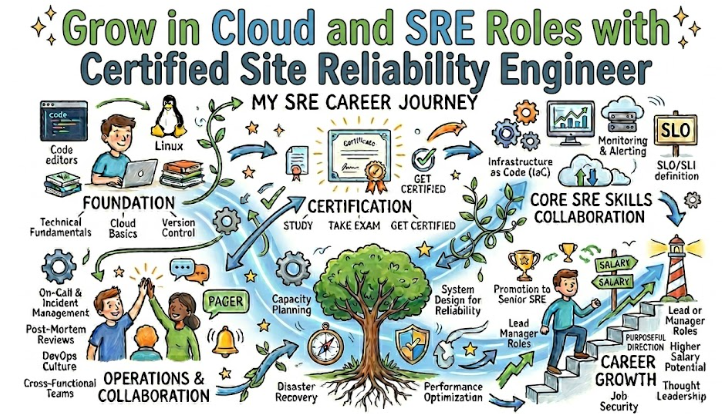
Introduction
The Certified Site Reliability Engineer program is a specialized curriculum designed to validate an engineer’s ability to maintain high-scale system stability. This comprehensive guide is written for software professionals and technical leaders who want to navigate the transition from traditional operations to modern reliability engineering. By engaging with the resources provided by sreschool, candidates can develop the precise competencies required to manage distributed systems in a cloud-native world.
As organizations increasingly adopt complex microservices architectures, the demand for verified reliability expertise has skyrocketed. This guide serves as a career roadmap, helping you evaluate the strategic importance of this certification within the broader context of DevOps and platform engineering. It offers a practical look at how this credential impacts your professional standing, enabling you to make data-driven decisions about your learning journey and technical specialization.
What is the Certified Site Reliability Engineer?
The Certified Site Reliability Engineer represents a standard of technical mastery for those tasked with ensuring that digital services remain available, performant, and scalable. It exists because modern infrastructure requires more than just manual intervention; it demands a software-engineering approach to operations. This certification prioritizes production-focused methodologies over purely academic theory, ensuring that practitioners are prepared for the high-pressure reality of live system management.
This program aligns with the industry’s shift toward “Operations as Code,” where reliability is treated as a fundamental feature of the product rather than an afterthought. It validates that a professional can bridge the gap between feature development and system stability using metrics-driven frameworks. By focusing on real-world workflows, the certification ensures that engineers are equipped to handle large-scale enterprise environments where downtime is not an option.
Who Should Pursue Certified Site Reliability Engineer?
This certification is designed for software engineers who want to specialize in the operational lifecycle of their code, as well as DevOps practitioners looking to formalize their reliability skills. It is equally valuable for platform engineers, systems architects, and security professionals who need to understand how resilience is built into every layer of the stack. Even data engineers and cloud specialists find it relevant, as reliability is the core foundation of every digital service today.
The program caters to a global audience, with specific relevance to the rapidly expanding tech ecosystems in India and other major technical hubs. Beginners can use the foundation level to establish a strong career starting point, while experienced engineers and managers can use the advanced levels to validate their strategic leadership. Ultimately, anyone responsible for the health of production systems will find this curriculum essential for mastering the art of modern systems management.
Why Certified Site Reliability Engineer is Valuable in the Current Market and Beyond
The current market places a premium on professionals who can guarantee system uptime in increasingly volatile and complex cloud environments. This certification remains valuable because it focuses on universal architectural patterns and reliability philosophies that do not expire when specific tools change. Enterprise adoption of SRE practices is growing across all sectors, from finance to retail, ensuring that certified professionals have access to a wide range of career opportunities.
Investing in this credential provides a long-term return on time, as it positions an engineer as a high-value asset capable of reducing operational costs and minimizing downtime. As systems become more automated, the human element of SRE remains critical for designing the guardrails that prevent catastrophic failures. By earning this certification, you stay relevant in a competitive landscape, proving that you possess the advanced skills necessary to lead the next generation of resilient engineering teams.
Certified Site Reliability Engineer Certification Overview
The Certified Site Reliability Engineer program and is hosted on sreschool. The program uses a practical assessment methodology that evaluates a candidate’s ability to solve real-world architectural and operational challenges. This approach ensures that the certification acts as a true indicator of technical competence rather than just a test of theoretical memory.
The structure of the certification is modular, offering a clear progression from foundational concepts to high-level strategic management. Ownership of the curriculum is held by industry experts who continuously update the material to reflect the latest production standards and cloud-native practices. This ownership model ensures that the certification remains vendor-neutral, providing skills that are applicable across various cloud platforms and on-premise infrastructures alike.
Certified Site Reliability Engineer Certification Tracks & Levels
The certification is categorized into three primary levels: Foundation, Professional, and Advanced, allowing for a structured career evolution. The Foundation level focuses on the basic building blocks of SRE, such as terminology and core metrics. The Professional level deepens technical expertise in observability and automation, while the Advanced level targets those responsible for large-scale resilience strategy and organizational leadership.
Beyond the vertical levels, specialized tracks allow engineers to broaden their skills in areas like DevSecOps, FinOps, or AI-driven operations. These specializations ensure that the Certified Site Reliability Engineer can adapt to the specific needs of their organization, whether that involves cost optimization or security-first reliability. Each track is designed to mirror real-world roles, providing a clear map for moving from an individual contributor to a technical lead or architect.
Complete Certified Site Reliability Engineer Certification Table
| Track | Level | Who it’s for | Prerequisites | Skills Covered | Recommended Order |
| Core SRE | Foundation | New SREs, Developers | Basic Linux | SLOs, SLIs, Toil, SRE Mindset | 1 |
| Core SRE | Professional | DevOps Professionals | Foundation Cert | Observability, Incident Management | 2 |
| Core SRE | Advanced | Senior Architects | Professional Cert | Chaos Engineering, Resilience | 3 |
| DevSecOps | Specialist | Security Engineers | Foundation Cert | Security Automation, Compliance | 4 |
| FinOps | Specialist | Cloud Analysts | Foundation Cert | Cost Optimization, Forecasting | 4 |
| AIOps | Specialist | AI Professionals | Professional Cert | Predictive Monitoring, ML Models | 5 |
Detailed Guide for Each Certified Site Reliability Engineer Certification
Certified Site Reliability Engineer – Foundation
What it is
The Foundation certification validates a practitioner’s understanding of the fundamental principles that define site reliability engineering. It ensures that the candidate is proficient in the vocabulary and culture required to work within an SRE-focused team.
Who should take it
This is an entry-point for software developers, junior systems administrators, and technical managers who need to align with SRE practices. It is ideal for those starting their transition into modern operations.
Skills you’ll gain
- Differentiating between SRE and traditional DevOps methodologies.
- Defining and monitoring Service Level Indicators (SLIs).
- Establishing Service Level Objectives (SLOs) and Error Budgets.
- Identifying operational toil and understanding how to reduce it.
- Participating in blameless post-mortem cultures.
Real-world projects you should be able to do
- Design a basic reliability report for a standard web application.
- Draft an Error Budget policy for a non-critical internal service.
- Map a manual workflow to identify candidates for automation.
Preparation plan
- 7 Days: Study the core SRE handbook definitions and familiarize yourself with metrics terminology.
- 30 Days: Complete foundational labs on monitoring and participate in community discussions on culture.
- 60 Days: Implement basic SLI tracking on a personal project and review several case studies of system failures.
Common mistakes
- Treating SLOs as rigid targets rather than management tools for balancing risk.
- Focusing exclusively on tools while ignoring the cultural shifts required for SRE.
Best next certification after this
- Same-track option: Professional SRE
- Cross-track option: DevOps Foundation
- Leadership option: Technical Team Lead
Certified Site Reliability Engineer – Professional
What it is
The Professional certification validates the technical ability to implement and scale reliability practices in production environments. It proves that the candidate can manage complex incidents and build robust observability pipelines.
Who should take it
This is for mid-level engineers with at least two years of experience who are responsible for the day-to-day stability of critical business services.
Skills you’ll gain
- Configuring advanced observability with logs, metrics, and traces.
- Designing and implementing automated incident response triggers.
- Facilitating blameless post-mortems and root cause analysis.
- Performing capacity planning based on historical performance data.
- Writing automation scripts to handle self-healing system requirements.
Real-world projects you should be able to do
- Set up a multi-layered observability stack for a microservices cluster.
- Build an automated failover system for a critical database component.
- Lead the response and documentation for a simulated high-priority outage.
Preparation plan
- 7 Days: Review distributed systems theory and advanced networking protocols.
- 30 Days: Engage in hands-on labs focusing on Kubernetes and observability suites.
- 60 Days: Practice incident command roles and develop automation for common failure modes.
Common mistakes
- Creating alert systems that are too noisy, resulting in alert fatigue.
- Neglecting the documentation of automation scripts, making them hard to maintain.
Best next certification after this
- Same-track option: Advanced SRE
- Cross-track option: DevSecOps Specialist
- Leadership option: SRE Manager
Certified Site Reliability Engineer – Advanced
What it is
The Advanced certification validates the expertise required to architect resilient systems and lead enterprise-wide reliability initiatives. It focuses on high-level strategic design and advanced testing methodologies.
Who should take it
This is intended for principal engineers, reliability architects, and senior technical leads who own the long-term reliability roadmap of an organization.
Skills you’ll gain
- Designing systems for high availability using advanced resilience patterns.
- Planning and executing chaos engineering experiments in production.
- Managing global traffic and implementing multi-region disaster recovery.
- Shaping the engineering culture to prioritize reliability at the executive level.
- Architecting cloud-native solutions that are robust against regional failures.
Real-world projects you should be able to do
- Architect a global-scale application with a 99.99% availability target.
- Conduct a chaos engineering experiment to test a system’s “blast radius.”
- Create an organizational reliability budget and staffing model for SRE.
Preparation plan
- 7 Days: Study global system design patterns and complex failure mode analysis.
- 30 Days: Focus on the ethics and safety protocols of chaos engineering.
- 60 Days: Perform an architectural audit of a major production service and propose improvements.
Common mistakes
- Attempting chaos engineering before the system has reached professional-level observability.
- Designing overly complex architectures that exceed the team’s ability to manage them.
Best next certification after this
- Same-track option: SRE Research Fellow
- Cross-track option: Cloud Solutions Architect
- Leadership option: Chief Technology Officer
Choose Your Learning Path
DevOps Path
The DevOps path focuses on the speed and quality of the delivery pipeline, ensuring that software moves from code to production efficiently. Integrating the Certified Site Reliability Engineer curriculum ensures that this speed is balanced with the stability required for enterprise success. This path is ideal for engineers who want to manage the entire lifecycle of an application, from the first build to the final deployment. It teaches practitioners how to build “production-ready” features from day one.
DevSecOps Path
The DevSecOps path is for those who believe that security and reliability are two sides of the same coin. By following this path, you learn to automate security audits and compliance checks within the SRE framework. This ensures that your reliable systems are also protected against external threats and internal vulnerabilities. It is a critical path for those working in sectors like banking or healthcare, where a breach is just as catastrophic as a system outage.
SRE Path
The SRE path is the specialized route for engineers who want to become the ultimate authority on system uptime. This path focuses purely on the science of reliability, moving from foundational terminology to advanced resilience architecture. It is designed for those who enjoy solving complex puzzles and building the automation that keeps the internet running. Following this path leads to roles such as Principal SRE or Reliability Architect in major global technology organizations.
AIOps Path
The AIOps path is a forward-looking specialization that uses machine learning and artificial intelligence to enhance operational efficiency. By leveraging the Certified Site Reliability Engineer framework, you learn how to use algorithmic analysis to predict failures before they happen. This path involves building intelligent monitoring systems that can automatically filter noise and identify the root cause of an issue. It is perfect for engineers who are interested in the intersection of data science and systems engineering.
MLOps Path
The MLOps path addresses the unique reliability challenges associated with maintaining machine learning models in production. Unlike traditional software, ML models require continuous monitoring for data drift and performance decay. This path teaches you how to apply SRE principles like SLOs and automation to the ML lifecycle. It ensures that the artificial intelligence services your company relies on are as stable and predictable as any other part of the technical stack.
DataOps Path
The DataOps path focuses on the reliability and performance of data pipelines, ensuring that the business always has access to high-quality data. Applying SRE principles here means managing data latency, accuracy, and availability through automated testing and monitoring. This path is essential for organizations that rely on real-time data for decision-making. It prepares data engineers to handle the scale and complexity of modern data warehouses and streaming platforms with an SRE mindset.
FinOps Path
The FinOps path combines the technical discipline of SRE with financial accountability and cloud cost management. You learn to build systems that are not just reliable, but also economically sustainable. This path involves managing the trade-offs between system performance and infrastructure spend, ensuring that your organization gets the most value from its cloud investment. It is a highly valued skill set for senior engineers who need to justify their architectural choices to business stakeholders.
Role → Recommended Certified Site Reliability Engineer Certifications
| Role | Recommended Certifications |
| DevOps Engineer | SRE Foundation, SRE Professional |
| SRE | Foundation, Professional, Advanced |
| Platform Engineer | SRE Professional, Advanced |
| Cloud Engineer | SRE Foundation, Cloud Provider Professional |
| Security Engineer | SRE Foundation, DevSecOps Specialist |
| Data Engineer | SRE Foundation, DataOps Specialist |
| FinOps Practitioner | SRE Foundation, FinOps Specialist |
| Engineering Manager | SRE Foundation, SRE Leadership |
Next Certifications to Take After Certified Site Reliability Engineer
Same Track Progression
For those who have mastered the core SRE levels, the next step is to pursue deep specializations in niche areas like Resilience Engineering or advanced Chaos Engineering. These certifications focus on the edge cases of large-scale systems and the human factors involved in incident response. Staying within the SRE track allows you to become a recognized global expert in the science of reliability, opening doors to principal-level positions in the world’s leading technology companies.
Cross-Track Expansion
If you have a strong foundation in reliability, expanding into areas like DevSecOps or DataOps can make you a more versatile engineer. Understanding how security and data integrity impact system uptime allows you to solve problems that span across different teams and departments. This “T-shaped” skill set is highly prized by employers, as it allows you to act as a bridge between specialized units and take on broader architectural responsibilities within the organization.
Leadership & Management Track
For engineers who want to move into people management, transitioning to a leadership track is a natural progression. This involves certifications in Engineering Management or Agile Leadership, which complement your technical SRE background. Your experience with Certified Site Reliability Engineer gives you the technical credibility to lead high-performing teams, while leadership training provides the soft skills needed for strategic planning and organizational growth. This path often leads to roles like VP of Engineering or Chief Technology Officer.
Training & Certification Support Providers for Certified Site Reliability Engineer
DevOpsSchool
DevOpsSchool is a prominent leader in the field of technical training, providing a robust platform for engineers looking to master the Certified Site Reliability Engineer curriculum. They offer a deep well of resources, including live instructor-led sessions and self-paced learning modules that cater to a global audience. Their approach is heavily focused on practical implementation, ensuring that students can take the concepts of SLOs and error budgets and apply them directly to their professional roles. With a strong presence in the Indian market, they have successfully trained thousands of professionals, helping them transition into high-paying SRE and DevOps positions through their community-driven support and comprehensive laboratory environments.
Cotocus
Cotocus has established itself as a premier destination for high-end technical bootcamps specifically tailored for the site reliability engineering domain. Their training philosophy centers on intensive, hands-on learning that mimics the challenges found in real-world production environments. For candidates pursuing the Certified Site Reliability Engineer designation, Cotocus provides the technical depth required to master complex tools like Kubernetes, Prometheus, and Terraform. Their trainers are often active practitioners who bring the latest industry trends into the classroom. This ensures that students are not just learning for an exam, but are becoming elite engineers capable of managing the world’s most demanding digital infrastructures with confidence and technical precision.
Scmgalaxy
Scmgalaxy is a widely recognized community and training hub that has been at the forefront of the DevOps and SRE movement for years. They offer extensive support for the Certified Site Reliability Engineer certification through a vast library of tutorials, webinars, and specialized training programs. Their unique strength lies in their massive community of practitioners, which provides a supportive network for students as they navigate their learning path. Scmgalaxy focuses on the technical intricacies of configuration management and reliability, making it an excellent resource for those who want to understand the “how” behind the “what.” Their training programs are designed to be accessible yet technically rigorous for all.
BestDevOps
BestDevOps provides streamlined and highly effective training paths for professionals aiming to achieve the Certified Site Reliability Engineer credential. They focus on delivering the most critical knowledge in a clear and concise format, making them an ideal choice for busy engineers who need to maximize their study time. Their curriculum is strictly aligned with industry needs, focusing on the outcomes that matter most to enterprise employers. By emphasizing the SRE mindset alongside technical tool mastery, BestDevOps ensures that their graduates are well-prepared to lead reliability initiatives within their organizations. Their support includes detailed study guides and mock assessments that accurately reflect the difficulty of the official certification.
devsecopsschool
devsecopsschool is the primary resource for engineers who want to integrate security deeply into their reliability engineering career. Their support for the Certified Site Reliability Engineer certification is unique because it emphasizes the “secure-by-design” philosophy. They provide specialized training that teaches how to maintain system uptime while also defending against modern cyber threats. Their labs often involve automated security testing and compliance-as-code within the SRE framework. For professionals working in high-compliance sectors, devsecopsschool offers the perfect blend of reliability and security training, ensuring that their students are equipped to protect the integrity and availability of their organization’s most critical digital assets at all times.
sreschool
sreschool is the flagship institution dedicated exclusively to the advancement of site reliability engineering as a professional discipline. As the host and primary provider for the Certified Site Reliability Engineer program, they offer the most direct and comprehensive learning experience available. Every aspect of their training, from the foundational modules to the advanced chaos engineering labs, is crafted by expert SREs. This singular focus allows sreschool to offer deeper insights and more realistic simulation environments than generalist training providers. Students here benefit from a curriculum that is always at the cutting edge of the industry, ensuring their skills are immediately applicable in the most sophisticated production environments worldwide.
aiopsschool
aiopsschool is a forward-thinking provider that focuses on the intersection of artificial intelligence and systems operations. Their training for the Certified Site Reliability Engineer includes specialized modules on how AI can be used to enhance traditional SRE practices. They teach students how to build and manage AIOps platforms that can automatically detect anomalies and predict potential system failures. This training is essential for SREs who want to lead the move toward more autonomous and self-healing infrastructure. By choosing aiopsschool, professionals gain a competitive edge in the market, mastering the intelligent automation technologies that are quickly becoming the standard for managing hyperscale systems in the modern cloud era.
dataopsschool
dataopsschool addresses the growing need for reliability in the world of big data and analytics. Their support for the Certified Site Reliability Engineer certification is tailored specifically for those managing data pipelines and large-scale data platforms. They teach how to apply SRE principles like error budgets and observability to data flows, ensuring that the business has consistent access to accurate information. Their curriculum is a blend of traditional SRE and advanced data engineering, making it unique in the market. Graduates from dataopsschool are prepared to handle the specific failure modes of data systems, ensuring that their organization’s data infrastructure is as resilient as its application stack.
finopsschool
finopsschool provides the critical link between technical reliability and financial efficiency. Their support for the Certified Site Reliability Engineer certification involves teaching engineers how to optimize cloud costs without sacrificing performance or uptime. They focus on the concept of “cost-aware reliability,” where infrastructure spend is treated as a core technical metric. This training is vital for senior engineers and managers who are responsible for large cloud budgets. By following the finopsschool path, SREs learn to make architectural decisions that are not only technically sound but also economically sustainable, making them highly valuable contributors to their organization’s overall business strategy and long-term financial health.
Frequently Asked Questions (General)
1. Is the Certified Site Reliability Engineer exam difficult?
The difficulty level is moderate to high, as it requires both a solid understanding of SRE theory and the ability to solve practical, scenario-based technical problems.
2. How long does it take to prepare for the certification?
Most candidates spend between 30 and 60 days preparing, depending on their existing experience with DevOps, Linux, and cloud-native technologies.
3. What are the prerequisites for the Foundation level?
There are no formal prerequisites, but having a basic knowledge of the software development lifecycle and command-line interfaces is highly recommended.
4. How much does the certification help in salary negotiations?
Certified SREs often command 20-30% higher salaries compared to traditional operations roles due to the high demand and specialized nature of the skill set.
5. Is the certification recognized globally?
Yes, the Certified Site Reliability Engineer designation is recognized by major technology firms and enterprises across the globe, including the US, Europe, and India.
6. Can I take the exam online?
Yes, the exam is typically proctored online, allowing you to take it from the comfort of your home or office anywhere in the world.
7. Does the certification focus on a specific cloud provider?
No, the certification is vendor-neutral and focuses on principles that are applicable to AWS, Azure, Google Cloud, and on-premise environments.
8. How long is the certification valid?
The certification is usually valid for two to three years, after which you may need to recertify to show your knowledge is up to date.
9. What is the format of the exam?
The exam format usually includes multiple-choice questions, scenario-based assessments, and at higher levels, hands-on lab exercises to test technical proficiency.
10. Are there any study groups for this certification?
Yes, providers like sreschool and Scmgalaxy have large communities where candidates can join study groups and share resources during their preparation.
11. Is this certification suitable for managers?
Yes, the Foundation and Leadership tracks are specifically designed to help managers understand the metrics and culture needed to lead successful SRE teams.
12. What resources are provided for preparation?
Candidates typically get access to study guides, mock exams, video tutorials, and hands-on lab environments depending on the training provider they choose.
FAQs on Certified Site Reliability Engineer
1. How does this differ from a DevOps certification?
This certification focuses specifically on the “science of reliability” and production operations, whereas DevOps often focuses more on the development and delivery pipeline.
2. Is coding required for this certification?
A basic ability to read and write scripts for automation (like Python or Bash) is required, especially for the Professional and Advanced levels.
3. How does the certification handle incident management?
Incident management is a core pillar, covering everything from initial response and communication to conducting deep-dive blameless post-mortems for continuous improvement.
4. Does it cover Kubernetes in detail?
While not a Kubernetes cert, K8s is frequently used in the labs as the primary platform for demonstrating scaling, self-healing, and observability principles.
5. How are SLOs and Error Budgets tested?
Candidates are often tested on their ability to calculate these metrics and make engineering decisions based on the remaining budget for a given service.
6. Is there a focus on the human side of engineering?
Yes, the certification emphasizes the cultural aspects of SRE, including blamelessness, psychological safety during incidents, and the reduction of manual toil.
7. Can I move from a developer role to SRE with this?
Absolutely, many developers use this certification to gain the operational expertise needed to take full ownership of their code in production environments.
8. What is the main benefit for an organization?
Organizations benefit from reduced downtime, faster incident recovery, and a more efficient engineering culture that prioritizes long-term system stability over quick fixes.
Final Thoughts: Is Certified Site Reliability Engineer Worth It?
From the perspective of a senior mentor who has witnessed the shift from physical data centers to serverless architecture, the Certified Site Reliability Engineer is one of the most practical investments an engineer can make. The industry has moved beyond simple automation; we are now in an era where reliability is the ultimate differentiator for any digital business. This certification provides you with a structured, unbiased framework to master that challenge.
It is not just about the digital badge on your profile; it is about the shift in mindset. You learn to stop fighting fires and start building the systems that prevent them. Whether you are in India or working globally, the skills validated by this program will remain at the core of technical excellence for the foreseeable future. If you are serious about your career in the cloud-native world, the path to becoming a site reliability engineer is both a challenging and highly rewarding journey.

