
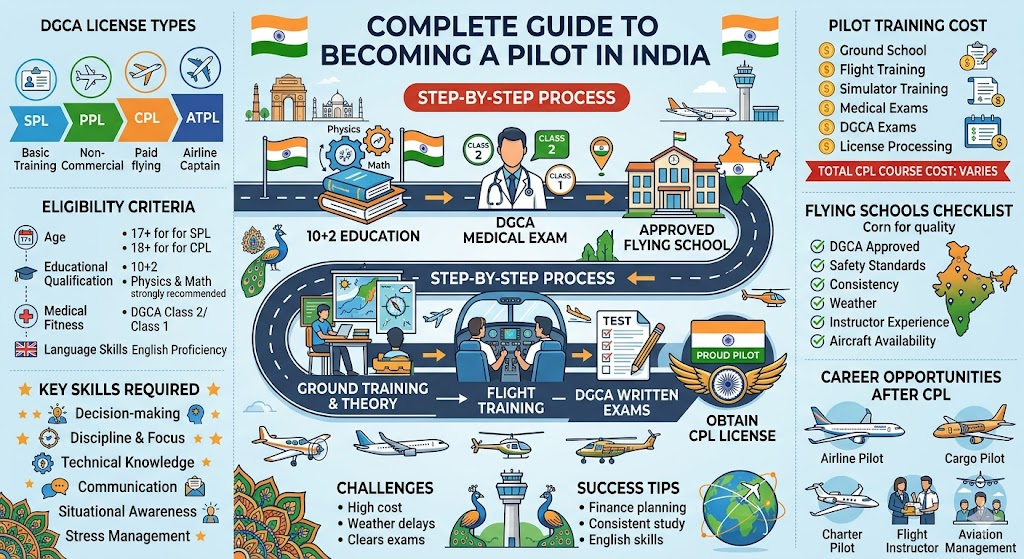
Introduction
Becoming a pilot in India is one of the most exciting and respected career choices for students who dream of flying. With the rapid growth of aviation in India, increasing air traffic, and expanding airline networks, the demand for trained pilots continues to rise steadily.
A pilot career is not just about flying an aircraft—it is about discipline, responsibility, technical knowledge, and quick decision-making. From commercial airlines to cargo operations and charter flights, pilots play a crucial role in keeping aviation safe and efficient.
This guide explains everything a beginner needs to know about how to become a pilot in India, including eligibility, training steps, DGCA licenses, costs, skills, and career opportunities. If you are planning a future in aviation, this blog will give you a clear roadmap.
Types of Pilot Licenses in India (DGCA)
In India, pilot licensing is regulated by the Directorate General of Civil Aviation (DGCA). There are different levels of pilot licenses depending on your experience and career goals.
| License Type | Full Form | Purpose | Career Stage |
|---|---|---|---|
| SPL | Student Pilot License | Basic training permission | Beginner stage |
| PPL | Private Pilot License | Non-commercial flying | Hobby/private flying |
| CPL | Commercial Pilot License | Paid flying jobs | Professional pilot career |
| ATPL | Airline Transport Pilot License | Senior airline captain level | Advanced airline career |
Key Insight:
Most students aiming for airlines start with SPL, progress to CPL, and eventually upgrade to ATPL with experience.
Eligibility Criteria to Become a Pilot in India
Before starting pilot training in India, students must meet certain requirements.
Age Requirements
- Minimum age usually starts around 17 years for SPL
- CPL eligibility typically begins at 18+
Educational Qualification
- 10+2 education is required
- Physics and Mathematics are strongly recommended
Medical Fitness
- DGCA Class 2 Medical: initial stage
- DGCA Class 1 Medical: required for CPL and airline career
Language Skills
- English proficiency is essential for aviation communication
Step-by-Step Process to Become a Pilot in India
Step 1: Complete 10+2 Education
A strong foundation in science subjects helps in understanding aviation concepts.
Step 2: DGCA Medical Examination
Students must pass Class 2 and later Class 1 medical fitness tests.
Step 3: Join DGCA-Approved Flying School
Choose a certified flight training organization in India.
Step 4: Ground School Training
Covers theory subjects such as:
- Air navigation
- Meteorology
- Air regulations
- Aircraft systems
Step 5: Flight Training
Students learn:
- Takeoff and landing
- Navigation flying
- Emergency handling
- Solo flight operations
Step 6: DGCA Examinations
Written exams test theoretical knowledge required for CPL.
Step 7: Obtain CPL License
After completing required flight hours and exams, students receive a Commercial Pilot License (CPL).
Pilot Training Cost in India
Pilot training is a major investment and varies depending on flying school and training duration.
| Cost Component | Description | Estimated Range |
|---|---|---|
| Ground School | Theory classes | Varies / N/A |
| Flight Training | Aircraft rental + instructor | Varies / N/A |
| Simulator Training | Practice sessions | Varies / N/A |
| Medical Exams | DGCA medical tests | Varies / N/A |
| DGCA Exams | Written & licensing tests | Varies / N/A |
| License Processing | Certification fees | Varies / N/A |
Key Insight:
Total CPL course in India cost depends on training hours, aircraft type, and institute structure.
Best Flying Schools in India (Overview Style)
India has several DGCA-approved flying training organizations. Instead of ranking schools, students should focus on:
- DGCA approval status
- Aircraft availability
- Instructor experience
- Safety standards
- Training consistency
- Weather conditions at base location
Tip:
A good flying school is one that ensures consistent flying hours and strong exam support.
Skills Required to Become a Pilot
A successful aviation career requires both technical and soft skills:
- Strong decision-making ability
- Clear communication skills
- High discipline and focus
- Situational awareness
- Technical understanding of aircraft systems
- Stress management under pressure
Career Opportunities After CPL in India
After completing pilot training in India, students can explore multiple career paths.
Airline Pilot
Work with airlines like IndiGo, Air India, Akasa Air, etc.
Cargo Pilot
Transport goods and logistics across domestic and international routes.
Charter Pilot
Fly private or business charter aircraft.
Flight Instructor
Train new student pilots and build flight experience.
Aviation Management
Work in airline operations, airport planning, or aviation support roles.
Challenges in Pilot Training
Becoming a pilot is rewarding but comes with challenges:
- High training cost
- Competitive job market
- Weather-related delays in flying
- Difficulty in clearing DGCA exams
- Limited aircraft availability in some schools
- Time required to build flight hours
Tips to Become a Successful Pilot
- Start planning finances early
- Choose DGCA-approved schools carefully
- Focus on consistent training
- Prepare seriously for DGCA exams
- Improve English communication skills
- Stay disciplined and patient throughout training
- Build strong theoretical understanding
Frequently Asked Questions (FAQs)
1. How to become a pilot in India after 12th?
You must complete 10+2 with Physics and Mathematics, pass DGCA medical exams, join a flying school, complete training, and obtain a CPL license.
2. What is the minimum qualification for pilot training in India?
10+2 education with Physics and Mathematics is recommended for pilot training in India.
3. How much does it cost to become a pilot in India?
The cost varies depending on flying school, aircraft, and training hours. Exact figures differ, so it is best to check institute-wise details.
4. What is DGCA in aviation?
DGCA (Directorate General of Civil Aviation) is the regulatory authority for civil aviation in India.
5. What is CPL in aviation?
CPL (Commercial Pilot License) allows a pilot to fly aircraft professionally and earn a salary.
6. Is pilot training difficult in India?
It requires discipline, study, practice, and commitment, but structured training makes it achievable.
7. Can arts students become pilots in India?
Yes, but Physics and Mathematics must be completed at 10+2 level.
8. What is the age limit to become a pilot in India?
Students can start training around 17–18 years, depending on license type.
9. Which is the best pilot license to start with?
Students begin with SPL, then progress to PPL and CPL.
10. Is medical fitness required for pilots?
Yes, DGCA Class 2 and Class 1 medical fitness are mandatory.
11. How long does it take to become a pilot in India?
It usually depends on training consistency, flight hours, and exam completion.
12. What are job options after CPL in India?
Airline pilot, cargo pilot, charter pilot, flight instructor, and aviation roles.
Conclusion
Becoming a pilot in India is a structured journey that requires dedication, proper training, and strong commitment. From completing basic education to earning a Commercial Pilot License under DGCA rules, every step builds the skills needed for a professional aviation career.
While the process involves effort and financial investment, the rewards are significant—global travel opportunities, respected career growth, and the unique experience of flying aircraft.
With the right planning, discipline, and training school, any aviation aspirant can successfully build a future in aviation. If your dream is to become a pilot, the best time to start is now.

