
Introduction
Cross-country flying is one of the most important stages in pilot training. It is the point where a student pilot starts moving beyond local flying and begins learning real-world navigation, flight planning, weather awareness, radio communication, and decision-making.
For Indian pilot students, cross-country flying is not only about flying from one place to another. It is about learning how to think like a responsible pilot. A student must plan the route, understand weather conditions, calculate fuel, identify checkpoints, communicate with ATC, maintain situational awareness, and record the flight correctly in the logbook.
During early training, students mostly practice takeoff, landing, circuits, basic handling, and emergency procedures near the training aerodrome. Cross-country flying takes the student one step further. It teaches how to manage a complete flight from departure to destination.
This Cross-Country Flying Guide for Indian Pilot Students explains the meaning, importance, planning process, common mistakes, safety tips, and logbook recording methods in simple language.
What Is Cross-Country Flying?
Cross-country flying means flying from one aerodrome, airport, or location to another using planned navigation.
In simple words, it is a flight where the pilot does not remain only in the local training area. The pilot follows a planned route, identifies checkpoints, monitors time and fuel, communicates with air traffic services when required, and reaches a planned destination or returns after completing a navigation route.
A cross-country flight may include:
- Departure from the home aerodrome
- Route navigation
- Visual checkpoints
- Heading and distance calculation
- Weather monitoring
- Radio communication
- Fuel monitoring
- Arrival at another aerodrome
- Return to the base aerodrome
- Logbook entry after flight
For a student pilot, cross-country flying is a major confidence-building exercise.
Why Cross-Country Flying Matters for Indian Pilot Students
Cross-country flying is important because it develops practical skills that cannot be fully learned during local circuit flying.
1. Navigation Skill Development
Navigation is one of the most important pilot skills. During cross-country flying, students learn how to follow a route, maintain heading, identify landmarks, and check whether they are on track.
2. CPL and PPL Training Progress
Cross-country flying is an important part of pilot training. Students preparing for PPL or CPL need to understand navigation, route planning, airspace awareness, and flight documentation.
3. Real-World Flying Confidence
Local flying teaches aircraft control. Cross-country flying teaches complete flight management. It helps students feel more confident while flying away from the home aerodrome.
4. Flight Planning Practice
Before every cross-country flight, students must plan the route, fuel, time, weather, checkpoints, and alternate options. This builds planning discipline.
5. Weather Decision-Making
Weather can affect route, visibility, wind correction, fuel, and safety. Cross-country flights teach students how to check weather before departure and monitor changes during flight.
6. Radio Communication Improvement
During cross-country flying, students may communicate with ATC, approach, tower, or other traffic services depending on the route. This improves radio confidence.
7. Airspace Awareness
A student pilot must understand controlled airspace, restricted areas, danger areas, and airport procedures. Cross-country flying builds this awareness.
8. Pilot-in-Command Responsibility
Solo cross-country flights teach students responsibility. The student must manage route, time, fuel, communication, and decision-making carefully.
9. Logbook and Flying Hour Tracking
Cross-country hours should be recorded properly in the pilot logbook. These records help track training progress and documentation readiness.
When Do Student Pilots Start Cross-Country Flying?
Student pilots usually start cross-country flying after they have developed basic flying skills.
Before starting cross-country training, students generally learn:
- Aircraft familiarization
- Straight and level flight
- Climbing and descending
- Turns
- Stall recovery
- Takeoff and landing
- Circuit flying
- Emergency procedures
- Basic radio communication
- Local area flying
- Navigation basics
The exact stage depends on the flying school, instructor assessment, student confidence, weather conditions, aircraft availability, and training syllabus.
A student should never rush into cross-country flying. It should begin only when the instructor is satisfied that the student can handle the aircraft safely and understand basic navigation.
Types of Cross-Country Flights
Cross-country flying can happen in different forms during training.
Dual Cross-Country Flight
A dual cross-country flight is completed with an instructor. This is usually the first stage of cross-country training.
The instructor helps the student understand:
- Route planning
- Checkpoint identification
- Radio calls
- Wind correction
- Arrival procedures
- Emergency planning
Dual cross-country flights are very useful because students can learn under guidance.
Solo Cross-Country Flight
A solo cross-country flight is completed by the student alone after instructor approval.
This is a major milestone. It shows that the student has developed enough skill, judgment, and confidence to manage the flight independently.
During solo cross-country flying, the student must be extra careful with planning, weather, fuel, communication, and navigation.
Local Navigation Flight
A local navigation flight may involve flying to nearby checkpoints and returning to base. It is often used to introduce students to navigation without going very far.
This helps students build confidence before longer routes.
Long Cross-Country Flight
A long cross-country flight covers a longer route and may include multiple checkpoints or destination points.
This type of flight teaches endurance, planning, fuel management, and continuous situational awareness.
Day Cross-Country Flight
Most beginner cross-country flights are conducted during daytime. Day flying gives better visibility and easier landmark identification.
Night Cross-Country Flight
Night cross-country flying is more advanced. It requires stronger planning, instrument awareness, lighting identification, and radio discipline.
Students should attempt night cross-country flying only as per training syllabus and instructor approval.
Check or Assessment Cross-Country Flight
A check or assessment cross-country flight may be conducted to evaluate the student’s navigation skill, planning ability, communication, and decision-making.
Skills Needed Before Cross-Country Flying
Before starting cross-country flying, student pilots should build some important skills.
Map Reading
Students should understand how to read aeronautical charts, identify routes, locate airports, and mark checkpoints.
Basic Navigation
Students must understand heading, track, distance, speed, time, and position awareness.
Heading and Track Understanding
Heading is where the aircraft nose is pointing. Track is the actual path over the ground. Wind can push the aircraft away from the planned track, so students must learn correction.
Distance and Time Calculation
A student should know how to estimate flight time between checkpoints using distance and groundspeed.
Fuel Planning Basics
Fuel planning is critical. Students should know how much fuel is required for the planned route, reserve, taxi, and possible diversion as per school procedures.
Weather Interpretation
Students should understand basic weather conditions such as visibility, wind, clouds, rain, and temperature.
Radio Communication
Clear radio communication is important during departure, route flying, arrival, and emergency situations.
Circuit Joining Procedures
When arriving at another aerodrome, the student must know how to join the circuit safely according to the procedure taught by the instructor.
Emergency Planning
A student should know what to do in case of weather change, route confusion, communication failure, or engine problem.
Situational Awareness
The student must always know the aircraft’s position, altitude, direction, fuel status, and next action.
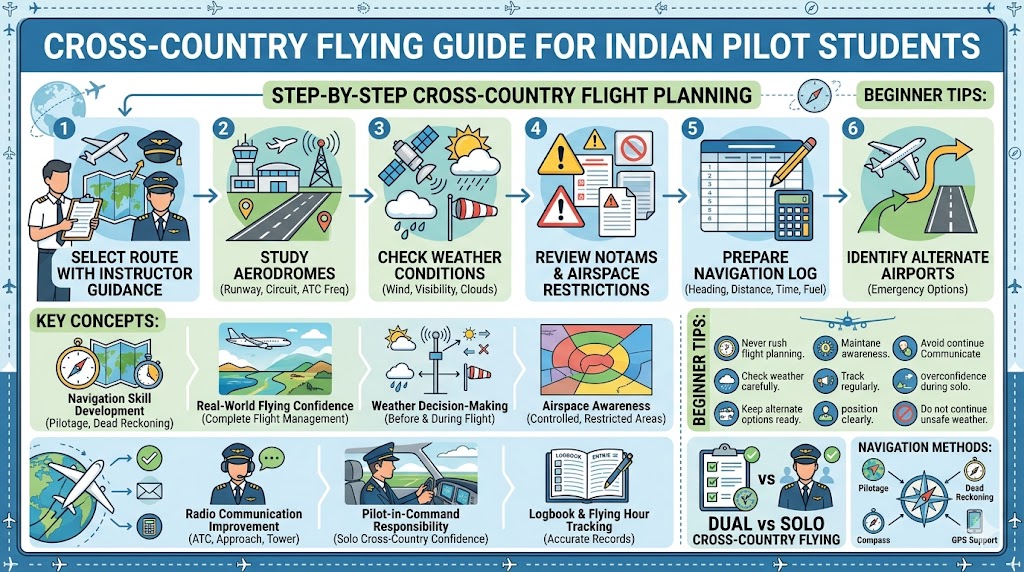
Step-by-Step Cross-Country Flight Planning
Good cross-country flying begins before takeoff. Planning is the foundation of safety.
Step 1: Select the Route With Instructor Guidance
The route should be selected with the instructor. The instructor considers student experience, weather, airspace, aircraft performance, and training objective.
Step 2: Study Departure and Destination Aerodromes
Students should understand runway direction, circuit pattern, elevation, radio frequency, local procedures, and possible traffic.
Step 3: Check Weather Conditions
Weather should be checked carefully before departure. Important points include:
- Visibility
- Wind direction
- Wind speed
- Cloud base
- Rain or thunderstorm risk
- Temperature
- Forecast changes
If the weather is not suitable, the flight should be delayed or cancelled as per instructor guidance.
Step 4: Review NOTAMs and Airspace Restrictions
NOTAMs provide important information about airport, runway, navigation aids, airspace restrictions, and temporary changes.
Students should not ignore NOTAMs during planning.
Step 5: Prepare Navigation Log
A navigation log helps the pilot track route, heading, distance, estimated time, fuel, and checkpoints.
Step 6: Calculate Distance, Heading, and Estimated Time
Students should calculate distance between checkpoints, planned heading, estimated time, and expected arrival time.
Step 7: Plan Fuel Requirement
Fuel planning should include trip fuel, reserve fuel, taxi fuel, and any extra fuel required as per school or instructor instructions.
Step 8: Mark Checkpoints on the Route
Checkpoints help confirm that the aircraft is on the correct route. Good checkpoints may include rivers, highways, railway lines, towns, lakes, or large landmarks.
Step 9: Prepare Radio Communication Notes
Students can prepare important radio calls before the flight. This reduces pressure during actual flying.
Step 10: Review Emergency Landing Options
Before departure, students should identify possible safe areas along the route in case an emergency landing becomes necessary.
Step 11: Complete Instructor Briefing
The instructor briefing should cover route, weather, fuel, emergency plan, communication, destination procedure, and student doubts.
Step 12: Carry Required Documents and Charts
Students should carry all required training documents, charts, navigation logs, checklists, and notes as per flying school process.
Important Documents and Tools
During cross-country flying, students may need several documents and tools. The exact requirement depends on the flying school and approved procedure.
Common items include:
- Pilot logbook
- Student pilot documents
- Aircraft documents as per school process
- Route chart or map
- Navigation log
- Flight plan if required
- Weather briefing
- NOTAM information
- Aircraft checklist
- Headset
- Kneeboard
- Pen and backup notes
- Stopwatch or timing device
- Water bottle for longer flights
Students should always follow their flying school’s approved documentation and dispatch process.
Navigation Methods Used in Cross-Country Flying
A good pilot should understand different navigation methods. Students should not depend only on one method.
Pilotage
Pilotage means navigating by looking outside and identifying landmarks such as roads, rivers, towns, lakes, and railway lines.
Dead Reckoning
Dead reckoning means using heading, speed, distance, and time to estimate aircraft position.
Compass Navigation
Compass navigation uses magnetic heading to maintain direction. Students must understand wind correction and compass limitations.
GPS Support
GPS is useful, but students should not depend only on it. GPS can support navigation, but manual navigation skills are still very important.
Radio Navigation Basics
Radio navigation uses navigation aids where available. Students may learn basic use of VOR, NDB, DME, or other systems depending on aircraft and training syllabus.
Visual Checkpoints
Visual checkpoints are fixed points on the ground used to confirm route progress. Students should choose checkpoints that are easy to identify from the air.
Common Challenges During Cross-Country Flying
Cross-country flying can be exciting, but it also brings challenges.
Wind Drift
Wind can push the aircraft away from the planned track. Students must learn to correct heading.
Weather Changes
Weather may change during flight. Visibility, wind, cloud, or rain can affect safety and planning.
Radio Communication Pressure
Students may feel nervous while talking to ATC. Preparation and practice help reduce this pressure.
Checkpoint Identification Difficulty
Some landmarks may look different from the air. Students should choose clear and large checkpoints.
Route Confusion
If the student loses track of position, they should stay calm, follow training procedures, and communicate when required.
Fuel Planning Errors
Poor fuel planning can become dangerous. Students should understand fuel requirements clearly before departure.
Airspace Awareness Issues
Students must know the airspace they are flying through and follow the required procedures.
Destination Joining Confusion
Arriving at a new aerodrome can be challenging. Students should study joining procedures before departure.
Student Nervousness
Nervousness is common during the first cross-country flights. Proper preparation builds confidence.
Time Management
Students must monitor estimated time, actual time, and fuel status throughout the flight.
Safety Tips for Indian Student Pilots
Safety should always come before training targets.
- Never rush flight planning.
- Always follow instructor guidance.
- Check weather carefully.
- Keep alternate options ready.
- Maintain situational awareness.
- Use checklist discipline.
- Communicate clearly.
- Track position regularly.
- Monitor fuel and time.
- Avoid overconfidence during solo cross-country.
- Review emergency procedures before departure.
- Do not continue into unsafe weather.
- Ask questions during briefing if anything is unclear.
A safe cross-country flight begins with a calm and prepared pilot.
How to Record Cross-Country Hours in Logbook
Cross-country flights should be recorded properly in the pilot logbook. A clear logbook helps track training progress and documentation.
Students should record:
- Date of flight
- Aircraft type
- Aircraft registration
- Departure aerodrome
- Destination aerodrome
- Route
- Dual or solo status
- PIC time if applicable
- Flight duration
- Instructor signature
- Remarks
Example remarks may include:
- Dual cross-country navigation
- Solo navigation route
- First cross-country flight
- Route planning exercise
- Diversion practice
- Radio communication practice
Students should follow flying school and DGCA-related documentation guidance while recording cross-country hours.
Cross-Country Flight Planning Table
Here is a simple sample table for beginner understanding.
| Route | Distance | Planned Time | Checkpoints | Fuel Plan | Weather Status | Instructor Approval | Remarks |
|---|---|---|---|---|---|---|---|
| Base to Nearby Aerodrome | 80 NM | 50 min | Highway, river, town | As briefed | Suitable | Yes | Dual navigation |
| Base to Checkpoint and Return | 60 NM | 40 min | Lake, railway line | As briefed | Suitable | Yes | Local navigation |
| Base to Destination and Return | 120 NM | 1 hr 30 min | Town, bridge, road junction | As briefed | Suitable | Yes | Solo cross-country preparation |
This table is only a sample. Actual planning must be done with instructor guidance and approved school procedures.
Dual vs Solo Cross-Country Flying
| Point | Dual Cross-Country Flying | Solo Cross-Country Flying |
|---|---|---|
| Instructor Presence | Instructor is onboard | Student flies alone |
| Responsibility | Shared under instructor supervision | Student carries more responsibility |
| Confidence Level | Good for learning and correction | Builds independence |
| Decision-Making | Instructor guides decisions | Student applies learned decisions |
| Radio Communication | Instructor can assist if needed | Student handles communication |
| Navigation | Instructor teaches and corrects | Student follows planned route |
| Logbook Entry | Recorded as dual time | Recorded as solo/PIC if applicable |
| Best For | Learning route flying | Proving independent readiness |
Both stages are important. Dual flying teaches the process, while solo flying builds confidence and responsibility.
Mistakes Student Pilots Should Avoid
Cross-country flying requires preparation. Students should avoid these common mistakes.
1. Poor Route Planning
Do not start with incomplete route planning. Know your route, checkpoints, heading, distance, and destination procedure.
2. Ignoring Weather Changes
Weather can change quickly. Students should check weather before flight and remain alert during flight.
3. Depending Only on GPS
GPS is helpful, but students should also understand map reading, compass navigation, and visual checkpoints.
4. Not Calculating Fuel Properly
Fuel planning should never be casual. Always follow instructor and school procedures.
5. Missing Checkpoints
If a checkpoint is missed, stay calm. Use your training, identify the next point, and communicate when necessary.
6. Weak Radio Preparation
Students should revise radio calls before departure. This improves confidence.
7. Not Understanding Destination Procedures
Before flying to another aerodrome, understand runway, circuit, radio frequency, joining procedure, and local instructions.
8. Not Briefing Emergency Options
Emergency options should be reviewed before flight. This includes diversion, precautionary landing areas, and communication actions.
9. Incomplete Logbook Entry
After the flight, the logbook should be completed accurately with route, duration, dual or solo status, and instructor signature.
10. Overconfidence After First Solo
Completing one solo cross-country does not mean a student should become overconfident. Every flight needs fresh planning and discipline.
How Cross-Country Flying Helps During CPL Training
Cross-country flying plays an important role in CPL training because it builds real operational confidence.
It helps CPL students develop:
- Navigation discipline
- Route planning ability
- Weather judgment
- Radio confidence
- Fuel planning habit
- Airspace awareness
- Decision-making ability
- Logbook accuracy
- Professional flying mindset
CPL training is not only about collecting flying hours. It is about becoming a safe and responsible pilot. Cross-country flying teaches students how to manage the complete flight environment.
A student who takes cross-country training seriously becomes better prepared for advanced flying, skill tests, and future professional aviation training.
Real-Life Example
Imagine a student pilot named Aarav training at a flying school in India. His instructor schedules a dual cross-country flight from the base aerodrome to a nearby destination and back.
Before the flight, Aarav studies the route on the chart. He marks checkpoints such as a highway, river, and town. He prepares a navigation log, checks the weather, reviews NOTAMs with his instructor, and practices radio calls.
During the flight, he identifies checkpoints, checks time, monitors heading, and communicates as instructed. At first, he feels nervous, but as the flight continues, his confidence improves.
After landing, Aarav updates his logbook with aircraft details, route, dual time, flight duration, instructor signature, and remarks.
This flight helps him understand that cross-country flying is not just about reaching another place. It is about planning, discipline, awareness, and safe decision-making.
Final Cross-Country Flying Checklist
Use this checklist before and after a cross-country flight:
- Route planned
- Weather checked
- NOTAM reviewed
- Fuel calculated
- Checkpoints marked
- Navigation log prepared
- Radio calls revised
- Documents checked
- Aircraft checklist reviewed
- Instructor briefing completed
- Destination procedure understood
- Emergency options reviewed
- Alternate plan discussed
- Time and fuel monitoring planned
- Logbook updated after flight
A checklist reduces mistakes and improves confidence.
FAQs
1. What is cross-country flying in pilot training?
Cross-country flying means flying from one aerodrome or location to another using planned navigation, checkpoints, weather checks, fuel planning, and communication.
2. Why is cross-country flying important for Indian student pilots?
It helps student pilots develop navigation skills, planning discipline, weather awareness, radio confidence, and real-world flying judgment.
3. When can a student pilot start cross-country flying?
A student usually starts cross-country flying after learning basic aircraft handling, takeoff, landing, circuits, emergency procedures, and navigation basics. The exact stage depends on instructor approval.
4. What is the difference between dual and solo cross-country flying?
Dual cross-country flying is done with an instructor. Solo cross-country flying is done alone after instructor approval.
5. Is cross-country flying required for CPL training in India?
Cross-country flying is an important part of pilot training and CPL progress. Students should confirm the latest DGCA and flying school requirements from official sources.
6. What documents are needed for cross-country flying?
Students may need pilot documents, route chart, navigation log, weather briefing, NOTAM details, checklist, and other documents as per flying school procedure.
7. Can student pilots use GPS during cross-country flights?
Yes, GPS can support navigation, but students should not depend only on GPS. Manual navigation skills are very important.
8. How are cross-country hours recorded in the logbook?
They should be recorded with date, aircraft type, registration, route, dual or solo status, flight duration, instructor signature, and remarks.
9. What are common mistakes during cross-country flying?
Common mistakes include poor route planning, weak weather checking, fuel calculation errors, missing checkpoints, poor radio preparation, and incomplete logbook entries.
10. How can students prepare for their first cross-country flight?
Students should study the route, mark checkpoints, check weather, review NOTAMs, prepare a navigation log, revise radio calls, and complete a detailed instructor briefing.
Conclusion
Cross-country flying is a major learning stage for Indian pilot students. It helps students move beyond local flying and develop real-world skills in navigation, planning, communication, weather awareness, fuel management, and decision-making.
For CPL and PPL aspirants, cross-country flying is not just another training exercise. It is a professional habit-building stage. Every route planned, every checkpoint identified, every radio call made, and every logbook entry completed teaches responsibility.
Student pilots should approach every cross-country flight with preparation, patience, and respect for safety. With proper instructor guidance and disciplined planning, cross-country flying becomes one of the most valuable experiences in pilot training.
A good pilot does not simply fly the aircraft. A good pilot plans, thinks, communicates, verifies, and records every flight properly.

