
Introduction
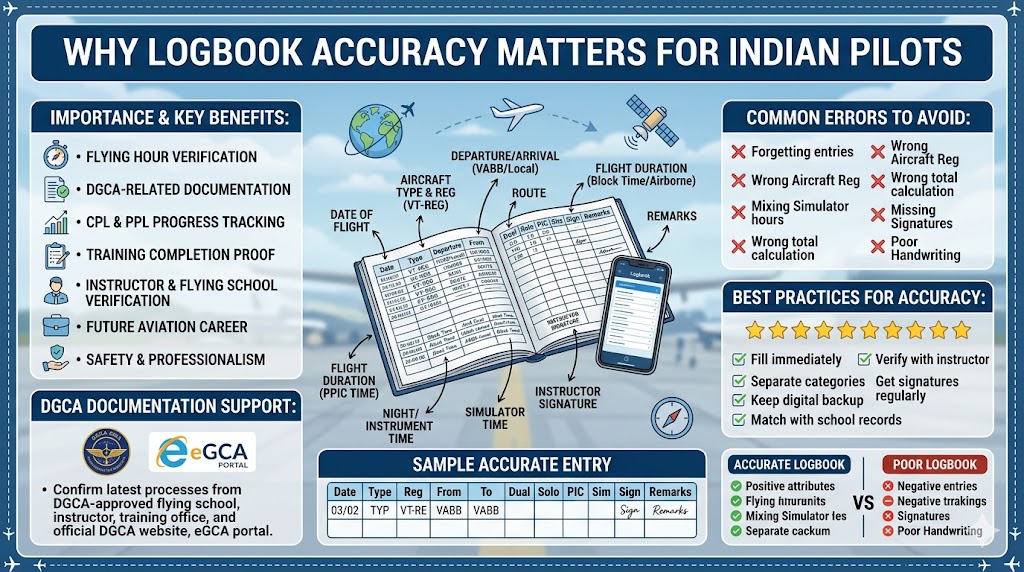
A pilot logbook is not just a record book. It is an important aviation document that proves a pilot’s flying experience, training progress, aircraft exposure, and professional discipline.
For Indian pilots, especially student pilots and CPL aspirants, logbook accuracy matters from the first day of flight training. Every flight entry tells a story: when the flight happened, which aircraft was flown, how long the flight lasted, whether it was dual or solo, and what training exercise was completed.
Even a small mistake in a logbook can create confusion later. Wrong aircraft registration, missing instructor signature, incorrect flying hour total, or unclear handwriting may become a problem during training review, flying school verification, or license-related documentation.
That is why every student pilot must understand why logbook accuracy matters for Indian pilots. A neat and accurate logbook shows that the pilot is serious, disciplined, and responsible.
What Is a Pilot Logbook?
A pilot logbook is a detailed record of a pilot’s flying experience. It contains important information about every flight completed during training or professional flying.
A pilot logbook usually records:
- Date of flight
- Aircraft type
- Aircraft registration
- Departure airport
- Arrival airport
- Route
- Flight duration
- Dual flying time
- Solo flying time
- Pilot-in-command time
- Cross-country time
- Night flying time
- Instrument flying time
- Simulator time
- Instructor name and signature
- Training exercise
- Remarks
For a student pilot, the logbook works like a progress report. It helps the student, instructor, and flying school understand how much training has been completed and what is still pending.
For a professional pilot, the logbook becomes a long-term aviation career record.
Why Logbook Accuracy Matters for Indian Pilots
Logbook accuracy is important because aviation depends on records, discipline, and trust. A pilot’s flying experience should be clear, correct, and easy to verify.
1. Flying Hour Verification
Flying hours are one of the most important parts of pilot training. Students need to track how many hours they have completed and in which category.
For example, a student may need to track:
- Total flying hours
- Dual flying hours
- Solo flying hours
- PIC hours
- Cross-country hours
- Night flying hours
- Instrument flying hours
- Simulator hours
If these hours are not recorded accurately, the student may not know the real training progress.
2. DGCA-Related Documentation
Indian pilots must follow flying school and DGCA-related documentation processes carefully. An accurate logbook helps during license-related preparation and flying hour verification.
Students should always confirm the latest documentation process from their DGCA-approved flying school, instructor, training office, and official DGCA or eGCA sources.
3. CPL and PPL Progress Tracking
A student training for PPL or CPL must know what has already been completed and what is still pending. Accurate logbook entries make this easier.
For example, if a CPL student has completed several solo flights but has not recorded them properly, it may create confusion during final review.
4. Training Completion Proof
A logbook helps prove that a student has completed required flight exercises. It also shows whether the training was done with an instructor, solo, at night, or during cross-country flying.
5. Instructor and Flying School Verification
Instructor signatures and flying school records are important. Your logbook should match the school’s records.
If your logbook shows one total and the school records show another, it may take time to correct the mismatch.
6. Future Aviation Career Records
A clean logbook is useful beyond student training. It becomes part of a pilot’s professional record when applying for advanced training, airline preparation, type rating, or other aviation opportunities.
7. Safety and Professionalism
Accurate logbook maintenance is also a sign of safety culture. A pilot who records details carefully is more likely to pay attention to procedures, planning, and responsibility.
8. Personal Confidence
When your logbook is accurate, you feel confident about your training progress. You know exactly how many hours you have completed and what you need to focus on next.
How Logbook Accuracy Supports DGCA Documentation
For Indian pilots, logbook accuracy is closely connected with documentation discipline. Flying experience should be recorded clearly and verified properly.
DGCA-related documentation may involve checking flying hours, training records, instructor verification, and other supporting documents. Because aviation rules and processes may change, students should not depend only on informal advice.
Indian student pilots should confirm important details from:
- DGCA-approved flying training organization
- Chief Flight Instructor
- Flight instructor
- Training office
- Official DGCA website
- eGCA portal guidance
The safest approach is simple: write every logbook entry correctly, get it verified on time, and keep your records organized from the beginning.
Key Logbook Details That Must Be Accurate
Every logbook field has importance. Students should not treat any entry casually.
Date of Flight
The flight date must be correct. Wrong dates can create confusion when matching logbook entries with school records.
Aircraft Type
The aircraft type shows which model was flown. For example, a student may train on aircraft such as Cessna, Tecnam, Diamond, or other training aircraft depending on the flying school.
Writing the correct aircraft type helps show actual aircraft experience.
Aircraft Registration
Aircraft registration identifies the exact aircraft used for the flight. Even one wrong letter or number can create confusion.
Students should check the aircraft registration carefully before writing it.
Departure and Arrival Airport
The logbook should clearly mention where the flight started and ended. For local training flights, the departure and arrival location may be the same.
For navigation or cross-country flights, this information becomes even more important.
Route
The route helps show the path flown, especially during cross-country training. A clear route entry helps instructors and training offices review navigation experience.
Flight Duration
Flight duration must be recorded accurately according to the flying school’s accepted method. Students should confirm the duration from official school records before entering it.
Dual Flying Time
Dual flying time means the student flew with an instructor. This should be entered in the correct column.
Solo Flying Time
Solo flying time means the student flew alone after instructor approval. Solo time should always be tracked separately from dual time.
Pilot-in-Command Time
PIC time should be entered carefully and only when applicable. Students should ask their instructor how PIC time should be recorded.
Cross-Country Time
Cross-country time should be recorded separately because it shows navigation and route flying experience.
Night Flying Time
Night flying time should be clearly entered when training is done during approved night flying conditions.
Instrument Flying Time
Instrument flying time should be recorded separately because it is different from normal visual flying.
Simulator Time
Simulator time should not be mixed with actual aircraft flying time. It should be entered in a separate column or section.
Instructor Name and Signature
Instructor signature verifies the entry. Missing signatures can create problems later, so students should get entries signed regularly.
Training Exercise
The logbook should mention what was practiced during the flight, such as circuit training, stalls, navigation, forced landing practice, or instrument flying.
Remarks
The remarks section can include useful notes like first solo, check flight, navigation exercise, landing practice, or instructor feedback.
Common Logbook Errors Indian Student Pilots Make
Many logbook problems happen because students delay entries or do not check details properly.
1. Forgetting to Enter Flights on Time
Some students fly multiple sorties and update the logbook later. This increases the chance of missing details.
The best practice is to update the logbook immediately after every flight.
2. Writing Wrong Aircraft Registration
Aircraft registration errors are common. Students should check the aircraft number carefully before writing it.
3. Mixing Simulator Hours With Actual Flying Hours
Simulator training is useful, but it should be recorded separately. Mixing simulator hours with actual aircraft hours can create confusion.
4. Incorrect Total Flying Hour Calculation
Manual calculation mistakes can affect future totals. Students should recheck calculations regularly.
5. Missing Instructor Signature
Unsigned entries may create verification issues. Students should not leave multiple pages unsigned.
6. Poor Handwriting
A logbook should be readable. If handwriting is unclear, reviewers may not understand the entry properly.
7. Not Separating Dual and Solo Hours
Dual and solo hours have different meanings. They should not be mixed.
8. Not Recording Route Properly
For cross-country flights, route details are important. Writing vague route information may reduce clarity.
9. Overwriting Entries Without Proper Correction
Students should avoid overwriting. If a correction is needed, they should follow the flying school’s correction method.
10. Not Matching Logbook With Flying School Records
Your logbook should match school records. Regular checking helps avoid last-minute confusion.
Impact of Inaccurate Logbook Entries
Inaccurate logbook entries can create several problems for student pilots and professional pilots.
Flying School Record Mismatch
If the logbook does not match the flying school’s records, the student may need to spend extra time correcting entries.
CPL or PPL Documentation Confusion
Wrong entries can create confusion during license-related documentation preparation. This may delay the student’s progress.
Poor Training Progress Tracking
If hours are not recorded accurately, the student may not know which training areas are complete and which are pending.
Instructor Verification Problems
Missing or delayed signatures can make verification difficult, especially if the instructor is unavailable later.
Loss of Confidence
A student with unclear records may feel stressed near the end of training. A clean logbook gives confidence.
Future Career Record Issues
A pilot’s logbook may be reviewed in future training or aviation career stages. Poor records can leave a weak impression.
Accurate Logbook vs Poor Logbook
| Accurate Logbook | Poor Logbook |
|---|---|
| Entries are neat and readable | Entries are unclear or messy |
| Flight dates are correct | Dates may be missing or wrong |
| Aircraft registration is accurate | Aircraft registration may be incorrect |
| Dual, solo, PIC, and simulator hours are separate | Different hour types are mixed |
| Instructor signatures are complete | Signatures are missing |
| Totals are checked regularly | Totals may be wrong |
| Matches flying school records | Does not match school records |
| Easy for documentation review | Creates confusion during review |
| Shows professionalism | Shows careless record-keeping |
| Gives confidence to the pilot | Creates stress and delay |
Best Practices for Maintaining Logbook Accuracy
Accurate logbook maintenance is a habit. Here are practical tips for Indian student pilots.
Fill the Logbook Immediately After Every Flight
Do not wait for the end of the week. Update the logbook after landing and debriefing.
Verify Details With Your Instructor
Ask your instructor if you are unsure about flight duration, PIC time, exercise name, or remarks.
Check Aircraft Registration Before Writing
Always check aircraft registration from the aircraft, flight sheet, or school record.
Use the Correct Time Format
Follow the time format used by your flying school. Do not create your own style.
Separate Flying Hour Categories
Keep dual, solo, PIC, cross-country, night, instrument, and simulator hours separate.
Get Signatures Regularly
Do not wait until the end of training. Get instructor signatures on time.
Avoid Overwriting
If a correction is needed, follow the approved process given by your flying school.
Keep Digital Backup
Take photos or scans of completed logbook pages. You can also maintain a spreadsheet backup.
Match Entries With Flying School Records
Compare your logbook with flying school records regularly. Fix differences early.
Review Totals Weekly
Check your total flying hours every week. This helps avoid calculation mistakes.
Manual and Digital Backup for Accuracy
Indian student pilots should maintain their official logbook carefully. Along with that, a digital backup is very useful.
A digital backup may include:
- Photos of logbook pages
- Scanned PDF copies
- Google Sheets or Excel file
- Digital flying hour tracker
- Cloud storage folder
- Backup on external drive
However, digital backup should support official records. It should not replace the required logbook or flying school documentation unless accepted by the flying school or authority.
A good system is to maintain both:
- Physical logbook for official and instructor-verified entries
- Digital backup for quick review and safety
This reduces the risk of losing important records.
Sample Accurate Logbook Entry Format
Here is a simple sample format for student understanding.
| Date | Aircraft Type | Registration | From | To | Dual Time | Solo Time | PIC Time | Simulator Time | Instructor Sign | Remarks |
|---|---|---|---|---|---|---|---|---|---|---|
| 05 Jan | Cessna 172 | VT-ABC | Local | Local | 1.0 | 0 | 0 | 0 | Yes | Circuit practice |
| 08 Jan | Cessna 172 | VT-ABC | Local | Local | 0.8 | 0 | 0 | 0 | Yes | Stall recovery |
| 12 Jan | Cessna 172 | VT-XYZ | Local | Local | 0 | 0.6 | 0.6 | 0 | Yes | Solo circuit |
| 15 Jan | Simulator | N/A | N/A | N/A | 0 | 0 | 0 | 1.0 | Yes | Instrument scan |
This is only a sample format. Students should follow the format used by their flying school.
How Logbook Accuracy Helps During CPL Training
CPL training involves many flying hour categories. Students must track their progress carefully.
Accurate logbook records help CPL students understand:
- Total hours completed
- Dual hours completed
- Solo hours completed
- PIC hours completed
- Cross-country training status
- Night flying status
- Instrument flying progress
- Simulator training record
- Pending training requirements
- Instructor verification status
A student with an accurate logbook can plan training better. They can discuss progress with their instructor and avoid last-minute surprises.
For example, if a student knows that night flying or cross-country hours are still pending, they can plan those flights earlier instead of waiting until the end.
Real-Life Example
Imagine a student pilot named Karan training at a flying school in India. In the beginning, he updates his logbook casually. Sometimes he forgets to enter aircraft registration. Sometimes he writes the total hours later.
After a few weeks, his instructor checks the logbook and finds missing signatures and unclear entries. Karan realizes that these mistakes can create problems during CPL documentation.
He starts following a better routine. After every flight, he writes the date, aircraft type, registration, route, flight duration, dual or solo time, and training exercise. He gets the instructor’s signature on time and updates a spreadsheet backup every week.
By the time he reaches the final stage of training, his records are clean and easy to verify. He avoids last-minute stress because he maintained logbook accuracy from the beginning.
This example shows why accurate records are important for every Indian student pilot.
Final Logbook Accuracy Checklist
Use this checklist after every flight:
- Date checked
- Aircraft type entered
- Aircraft registration confirmed
- Departure and arrival points written
- Route recorded correctly
- Flight duration verified
- Dual, solo, or PIC category marked
- Simulator time kept separate
- Training exercise written
- Instructor signature taken
- Remarks added
- Total hours updated
- Digital backup saved
- School record matched regularly
This small habit can prevent major documentation confusion later.
FAQ
1. Why is logbook accuracy important for Indian pilots?
Logbook accuracy is important because it proves flying experience, tracks training progress, supports documentation, and shows professional discipline.
2. What details must be accurate in a pilot logbook?
Important details include date, aircraft type, aircraft registration, route, flight duration, dual time, solo time, PIC time, instructor signature, and remarks.
3. Can incorrect logbook entries affect CPL documentation?
Yes, incorrect or unclear logbook entries can create confusion during CPL documentation preparation and flying hour verification.
4. Who verifies a student pilot logbook?
Usually, the flight instructor or authorized flying school personnel verifies student pilot logbook entries.
5. Should simulator time be recorded separately?
Yes, simulator time should be recorded separately from actual aircraft flying time to avoid confusion.
6. What is the best time to update a pilot logbook?
The best time is immediately after every flight, once the flight details are fresh and the instructor is available for verification.
7. Should student pilots keep digital backups?
Yes, student pilots should keep digital backups such as scanned copies, photos, or spreadsheets along with the official logbook.
8. What happens if aircraft registration is written incorrectly?
Wrong aircraft registration can create mismatch issues with flying school records. It should be corrected properly with instructor guidance.
9. How often should logbook totals be checked?
Students should check logbook totals weekly and compare them with flying school records.
10. Is logbook accuracy important for future airline careers?
Yes, a clean and accurate logbook reflects professionalism and can support future training, type rating, and aviation career records.
Conclusion
Logbook accuracy is a sign of professionalism. For Indian pilots, especially student pilots and CPL aspirants, an accurate logbook is essential for flying hour tracking, training progress, instructor verification, and DGCA-related documentation preparation.
A pilot logbook should be neat, correct, complete, and regularly verified. Students should update it after every flight, separate different types of flying hours, get signatures on time, and keep digital backups.
A careless logbook can create confusion. A clean logbook gives confidence.
From the first day of pilot training, Indian student pilots should treat their logbook as an important aviation career document. Good logbook habits today can support a smoother and more professional aviation journey tomorrow.

