
Introduction
Modern IT operations are becoming more complex every day. Businesses now depend on cloud platforms, microservices, containers, monitoring tools, automation pipelines, security systems, and large-scale digital applications. As these systems grow, IT teams receive thousands of alerts, logs, metrics, and events from different tools.
For DevOps engineers, SRE teams, cloud engineers, and IT operations professionals, this creates a major challenge. It is no longer easy to manually identify every issue, understand the root cause, reduce downtime, and respond quickly. Traditional monitoring tools are useful, but they often create too much alert noise and require manual effort to connect the dots.
This is where AIOps becomes important.
AIOps helps IT teams use artificial intelligence, machine learning, automation, monitoring, and observability to manage modern IT systems more intelligently. It can help detect unusual behavior, reduce unnecessary alerts, identify root causes faster, predict future incidents, and automate basic remediation tasks.
For professionals who want to build a future-ready IT career, learning AIOps is becoming a strong advantage. A certified AIOps engineer does not only understand tools. They also understand IT operations, DevOps automation, monitoring, observability, machine learning basics, and real-world incident management.
This blog explains the complete AIOps learning path for beginners and working professionals who want to build hands-on skills in IT automation.
What is AIOps?
AIOps stands for Artificial Intelligence for IT Operations. In simple words, AIOps means using AI and machine learning to improve the way IT systems are monitored, managed, and automated.
Traditional IT operations depend heavily on manual monitoring. Engineers check dashboards, review logs, respond to alerts, investigate incidents, and take corrective action. This works for small systems, but it becomes difficult when an organization has hundreds or thousands of services running across cloud, hybrid, and on-premises environments.
AIOps helps by collecting data from different IT tools such as:
- Monitoring platforms
- Log management systems
- Cloud platforms
- Application performance monitoring tools
- Infrastructure tools
- Incident management systems
- Security tools
- Automation platforms
After collecting this data, AIOps uses machine learning and analytics to find patterns, detect anomalies, group related alerts, identify root causes, and suggest or trigger actions.
In simple English, AIOps helps IT teams answer questions like:
- Why did this incident happen?
- Which alert is really important?
- Is this behavior normal or unusual?
- Which service is causing the issue?
- Can this problem happen again?
- Can we automate the fix?
AIOps is not about replacing engineers. It is about helping engineers work faster, smarter, and with better context.
Why AIOps Matters for Modern IT Teams
AIOps matters because modern IT environments are too large and fast-changing for manual operations alone. Cloud systems, DevOps practices, containers, APIs, and microservices generate huge amounts of operational data.
Without intelligent systems, teams can easily miss critical signals or waste time on low-priority alerts.
Alert Noise Reduction
One of the biggest problems in IT operations is alert noise. Monitoring tools may generate hundreds or thousands of alerts in a day. Many of these alerts may be duplicates, low priority, or connected to the same root issue.
AIOps helps reduce alert noise by grouping related alerts, identifying duplicate events, and highlighting the alerts that actually need attention.
Faster Incident Detection
AIOps can detect abnormal behavior before a major incident occurs. For example, if CPU usage, memory consumption, latency, or error rates suddenly behave differently from normal patterns, an AIOps system can detect it early.
This helps teams respond before users are seriously affected.
Root Cause Analysis
Finding the root cause of an incident can take time. Engineers may need to check logs, metrics, traces, deployment history, configuration changes, and infrastructure events.
AIOps helps connect these data points and suggest possible causes. This can reduce investigation time and improve incident response.
Predictive Monitoring
AIOps can identify trends and predict future issues. For example, it may detect that disk space is filling up faster than usual or that a service may hit capacity limits soon.
This helps teams take preventive action instead of reacting after failure.
Auto-Remediation
Auto-remediation means automatically fixing known issues using predefined workflows. For example:
- Restarting a failed service
- Scaling infrastructure
- Clearing temporary files
- Rolling back a failed deployment
- Triggering a script to resolve a known problem
AIOps can work with automation tools to perform these actions safely when the problem is known and the fix is approved.
Better Reliability
Reliability is a major goal for DevOps and SRE teams. AIOps supports reliability by improving detection, response, analysis, and prevention. It helps teams maintain stable systems and reduce downtime.
AIOps vs MLOps
Many beginners get confused between AIOps and MLOps. Both use automation, data, and machine learning, but their goals are different.
AIOps focuses on improving IT operations using AI. MLOps focuses on building, deploying, monitoring, and managing machine learning models.
| Area | AIOps | MLOps |
|---|---|---|
| Main Focus | IT operations and automation | Machine learning model lifecycle |
| Primary Users | DevOps engineers, SREs, IT operations teams | Data scientists, ML engineers, AI engineers |
| Main Goal | Improve monitoring, incident response, reliability, and automation | Build, deploy, track, and maintain ML models |
| Data Used | Logs, metrics, traces, alerts, events, tickets | Training data, model data, features, experiments |
| Common Use Cases | Alert correlation, anomaly detection, root cause analysis, auto-remediation | Model training, model deployment, model monitoring, version control |
| Tools Involved | Monitoring, observability, ITSM, automation, cloud tools | ML platforms, pipelines, model registries, experiment tracking tools |
AIOps and MLOps can also work together. For example, an AIOps platform may use machine learning models to detect incidents, and MLOps practices may help manage those models properly.
Core Skills Needed to Learn AIOps
To become skilled in AIOps, you need a mix of IT operations, DevOps, cloud, monitoring, automation, and machine learning knowledge. You do not need to become a data scientist first, but you should understand the basics of how AI and ML support IT operations.
Monitoring and Observability
Monitoring helps you check whether systems are working properly. Observability helps you understand why a system is behaving in a certain way.
AIOps depends heavily on observability data such as:
- Metrics
- Logs
- Traces
- Events
- Alerts
- Service health data
Without good observability, AIOps cannot provide accurate insights.
Log Analysis
Logs contain important details about application behavior, errors, user activity, service failures, and infrastructure issues. AIOps systems often analyze logs to detect anomalies and find patterns.
You should learn how logs are generated, collected, searched, filtered, and analyzed.
Metrics and Traces
Metrics show numerical data such as CPU usage, memory usage, request count, error rate, latency, and throughput.
Traces show how a request moves across different services in a distributed system. This is very useful in microservices environments.
AIOps uses metrics and traces to understand performance issues and service dependencies.
Incident Management
AIOps is closely connected with incident management. You should understand how incidents are reported, prioritized, assigned, investigated, resolved, and reviewed.
Important concepts include:
- Severity levels
- Escalation
- On-call process
- Incident timeline
- Post-incident review
- Root cause analysis
Cloud Basics
Most modern IT systems run on cloud platforms. AIOps engineers should understand basic cloud concepts such as:
- Compute
- Storage
- Networking
- Load balancing
- Auto-scaling
- Cloud monitoring
- Cloud cost management
Python Basics
Python is useful for automation, data analysis, scripting, and basic machine learning tasks. You do not need advanced programming in the beginning, but you should be comfortable with basic Python.
Useful Python skills include:
- Reading files
- Working with APIs
- Handling JSON data
- Writing scripts
- Basic data analysis
- Automating repetitive tasks
Machine Learning Fundamentals
AIOps uses machine learning for anomaly detection, pattern recognition, prediction, classification, and correlation.
You should understand basic ML concepts such as:
- Training data
- Models
- Features
- Classification
- Clustering
- Prediction
- Anomaly detection
- Model accuracy
DevOps and Automation
AIOps is connected with DevOps automation. You should understand CI/CD, infrastructure automation, configuration management, containers, and basic scripting.
Automation is important because AIOps should not only detect problems but also help resolve them faster.
Popular AIOps Use Cases
AIOps is used in many real-world IT operations scenarios. These use cases help teams reduce manual effort and improve system reliability.
Anomaly Detection
Anomaly detection means identifying unusual behavior in systems. For example, if application response time suddenly increases or database errors rise above the normal pattern, AIOps can detect it.
This is useful because traditional threshold-based monitoring may miss unusual patterns that are not clearly defined.
Event Correlation
Modern systems generate many events from different tools. AIOps can connect related events and group them together.
For example, multiple alerts from application servers, databases, and network systems may be related to one root problem. Event correlation helps reduce confusion.
Intelligent Alerting
AIOps can improve alert quality by filtering unnecessary alerts and prioritizing important ones. This helps engineers focus on real incidents instead of wasting time on noise.
Capacity Prediction
AIOps can analyze usage trends and predict when systems may need more resources. This is useful for planning infrastructure capacity and avoiding performance problems.
Self-Healing Infrastructure
Self-healing infrastructure means systems can automatically detect and fix some problems. For example, if a container fails, automation can restart it. If traffic increases, infrastructure can scale automatically.
AIOps supports self-healing by detecting problems and triggering automation workflows.
Incident Automation
AIOps can automate parts of incident response, such as:
- Creating tickets
- Assigning incidents
- Notifying teams
- Running diagnostic scripts
- Collecting logs
- Triggering remediation workflows
This helps reduce response time.
Cloud Cost Visibility
AIOps can help identify unusual cloud usage patterns, unused resources, and cost spikes. This supports better cloud cost management.
Service Reliability Improvement
AIOps helps improve service reliability by detecting issues early, reducing downtime, and improving root cause analysis.
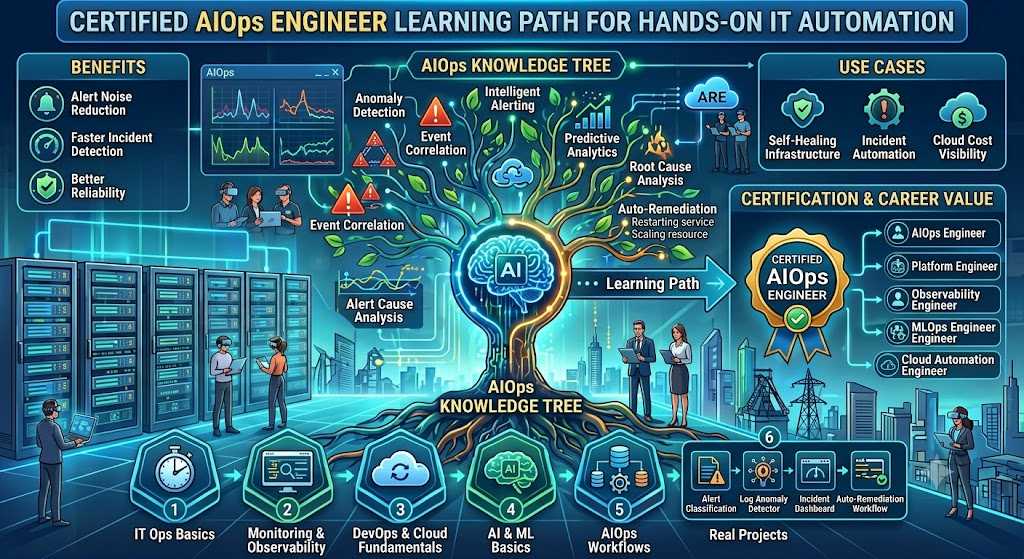
AIOps Learning Roadmap for Beginners
AIOps can feel complex in the beginning because it combines many areas. The best way to learn is step by step.
Step 1: Learn IT Operations Basics
Start with the foundation of IT operations. Understand how systems are managed, monitored, and supported.
Focus on:
- Servers
- Networks
- Applications
- Databases
- Logs
- Alerts
- Incidents
- Service availability
This foundation will help you understand why AIOps is needed.
Step 2: Understand Monitoring and Observability
Next, learn how monitoring and observability work. Study how teams collect metrics, logs, and traces from applications and infrastructure.
You should understand:
- What to monitor
- How alerts are created
- How dashboards are used
- How logs help in troubleshooting
- How traces help in distributed systems
Observability is one of the most important parts of AIOps.
Step 3: Learn DevOps and Cloud Fundamentals
AIOps works closely with DevOps and cloud environments. Learn the basics of:
- CI/CD pipelines
- Containers
- Kubernetes basics
- Infrastructure as code
- Cloud services
- Automation scripts
- Configuration management
This will help you understand how modern systems are built and operated.
Step 4: Learn AI and ML Basics
You do not need to become an advanced machine learning expert, but you should understand how AI and ML are used in IT operations.
Focus on:
- Pattern detection
- Anomaly detection
- Classification
- Prediction
- Clustering
- Data preparation
- Model evaluation
This will help you understand how AIOps platforms analyze operational data.
Step 5: Practice AIOps Tools and Workflows
Once you know the basics, start practicing with AIOps tools and workflows. Learn how to connect monitoring data, analyze alerts, create automation actions, and build dashboards.
Practice areas include:
- Alert correlation
- Log analysis
- Incident workflows
- Automation rules
- Root cause analysis
- Predictive monitoring
The goal is not just to learn tool names. The goal is to understand how tools solve real IT operations problems.
Step 6: Work on Real Projects
Hands-on projects are very important. Real projects help you understand how AIOps works beyond theory.
Start with small projects such as log analysis or alert classification. Then move toward incident prediction and auto-remediation workflows.
Practical experience will make your AIOps certification and career preparation much stronger.
Step 7: Prepare for AIOps Certification
After building basic knowledge and hands-on experience, you can prepare for AIOps certification. AIOps certification helps validate your understanding of concepts, tools, workflows, and practical use cases.
While preparing, focus on both theory and real-world scenarios. A good certified AIOps engineer should understand not only definitions but also how to apply AIOps in live IT environments.
Real-World AIOps Project Ideas
Projects are the best way to build confidence. Here are some practical AIOps project ideas for beginners and intermediate learners.
Alert Classification System
Create a system that classifies alerts based on severity, source, and category. This can help teams understand which alerts need urgent attention.
You can use sample alert data and classify alerts into groups such as critical, warning, informational, application-related, infrastructure-related, or network-related.
Log Anomaly Detector
Build a basic log anomaly detection project. Collect sample logs and identify unusual patterns such as repeated errors, failed login attempts, service failures, or unexpected response codes.
This project helps you understand how AIOps uses logs for early problem detection.
Incident Prediction Dashboard
Create a dashboard that shows system health and predicts possible incidents based on trends. For example, if CPU usage and memory usage are increasing continuously, the dashboard can show a warning.
This project combines monitoring, data analysis, and visualization.
Auto-Remediation Workflow
Build a simple automation workflow that responds to a known issue. For example, if a service is down, the workflow can restart it and send a notification.
This helps you understand how AIOps supports self-healing systems.
Cloud Monitoring Pipeline
Create a cloud monitoring pipeline that collects metrics from cloud resources and displays them in a dashboard. You can also add alert rules and basic anomaly detection.
This project is useful for cloud engineers and DevOps professionals.
Who Should Learn AIOps?
AIOps is useful for many types of IT professionals. It is not limited to one role.
DevOps Engineers
DevOps engineers can use AIOps to improve automation, monitoring, CI/CD reliability, and incident response.
SREs
Site Reliability Engineers can use AIOps to improve service reliability, reduce downtime, analyze incidents, and support SLO-based operations.
Cloud Engineers
Cloud engineers can use AIOps to monitor cloud resources, detect performance issues, manage capacity, and improve cost visibility.
IT Operations Teams
IT operations teams can use AIOps to reduce manual monitoring, improve alert handling, and respond faster to incidents.
Monitoring Engineers
Monitoring engineers can use AIOps to improve alert quality, dashboard design, observability, and event correlation.
Managers
IT managers can use AIOps knowledge to plan better operations strategies, reduce downtime, and improve team productivity.
Freshers Looking for Modern IT Careers
Freshers can learn AIOps to enter modern IT roles that involve DevOps, cloud, automation, monitoring, and AI-driven IT operations.
Common Mistakes Beginners Make
Learning AIOps can be easier if you avoid common mistakes.
Learning Tools Without Concepts
Many beginners start by learning tools directly. Tools are important, but concepts are more important. You should first understand monitoring, logs, metrics, incidents, and automation.
Ignoring Observability Basics
AIOps depends on good observability data. If you do not understand metrics, logs, and traces, it will be difficult to understand AIOps properly.
Depending Only on AI Without Human Review
AIOps can provide strong insights, but human review is still important. Engineers should validate recommendations before taking major actions.
Not Practicing Real Incidents
Theory alone is not enough. You should practice with real or simulated incidents. This will help you understand troubleshooting and root cause analysis.
Skipping Automation Fundamentals
AIOps is not only about detection. It also supports action. If you skip automation basics, you may not understand auto-remediation and self-healing workflows properly.
AIOps Career Opportunities
AIOps creates many career opportunities for professionals who understand IT operations, automation, cloud, and AI-driven monitoring.
AIOps Engineer
An AIOps Engineer works on implementing AIOps solutions, connecting monitoring tools, analyzing operational data, improving alerting, and supporting automation workflows.
MLOps Engineer
An MLOps Engineer focuses on machine learning model deployment, monitoring, and lifecycle management. AIOps and MLOps knowledge can be a strong combination.
Site Reliability Engineer
SREs use AIOps to improve reliability, reduce incidents, monitor services, and automate operational tasks.
Platform Engineer
Platform engineers can use AIOps to improve internal platforms, developer experience, automation, and infrastructure reliability.
Cloud Automation Engineer
Cloud automation engineers can use AIOps for cloud monitoring, scaling, cost visibility, and automated remediation.
Observability Engineer
Observability engineers can use AIOps to improve monitoring strategy, telemetry pipelines, dashboards, and alert intelligence.
Key AIOps Skills and Career Value
| Skill Area | Why It Matters in AIOps |
|---|---|
| Monitoring | Helps track system health and performance |
| Observability | Helps understand why systems behave in a certain way |
| Log Analysis | Supports troubleshooting and anomaly detection |
| Incident Management | Helps manage outages and service issues |
| Cloud Knowledge | Supports modern infrastructure operations |
| Python Basics | Helps with scripting, automation, and data handling |
| Machine Learning Basics | Helps understand anomaly detection and prediction |
| DevOps Automation | Supports auto-remediation and workflow automation |
| Communication | Helps during incident response and team collaboration |
FAQs
1. What is AIOps in simple words?
AIOps means using artificial intelligence and machine learning to improve IT operations. It helps teams monitor systems, detect problems, reduce alert noise, find root causes, and automate responses.
2. Is AIOps only for large companies?
No. Large companies may need AIOps more because they have complex systems, but small and medium teams can also benefit from better monitoring, automation, and incident response.
3. Do I need coding knowledge to learn AIOps?
Basic coding knowledge is helpful, especially Python. You do not need to be an expert programmer in the beginning, but scripting and automation skills are useful.
4. Is machine learning required for AIOps?
You should understand machine learning basics. AIOps uses ML for anomaly detection, prediction, classification, and event correlation. However, you do not need deep data science knowledge to start.
5. What is the difference between AIOps and DevOps?
DevOps focuses on collaboration, automation, CI/CD, and faster software delivery. AIOps focuses on using AI and ML to improve IT operations, monitoring, incident response, and automation.
6. Can freshers learn AIOps?
Yes. Freshers can learn AIOps by starting with IT operations basics, monitoring, cloud fundamentals, DevOps concepts, Python, and basic machine learning.
7. What are the most important AIOps use cases?
Important AIOps use cases include anomaly detection, alert correlation, root cause analysis, predictive monitoring, incident automation, auto-remediation, and cloud cost visibility.
8. Is AIOps certification useful?
AIOps certification can be useful if it helps you validate your knowledge and build structured learning. It is most valuable when combined with hands-on projects and real-world practice.
9. Does AIOps replace IT operations teams?
No. AIOps does not replace IT teams. It helps engineers work faster by reducing manual effort, improving visibility, and supporting better decisions.
10. How should I start learning AIOps?
Start with IT operations basics, then learn monitoring, observability, DevOps, cloud, automation, Python, and machine learning fundamentals. After that, practice real projects and prepare for AIOps certification.
Conclusion
AIOps is becoming an important skill for modern IT professionals because IT systems are now more complex, distributed, and fast-moving than ever before. Traditional monitoring and manual incident response are no longer enough for large-scale cloud, DevOps, and microservices environments.
By learning AIOps, professionals can understand how AI-driven IT operations improve alert management, anomaly detection, root cause analysis, predictive monitoring, auto-remediation, and service reliability.
A good AIOps learning path should not focus only on tools. It should include IT operations basics, monitoring, observability, DevOps automation, cloud knowledge, Python basics, machine learning fundamentals, and hands-on projects.
For DevOps engineers, SREs, cloud engineers, monitoring teams, managers, and freshers, AIOps can open new career opportunities in modern IT operations. With the right roadmap, practical learning, and certification preparation, you can build strong skills for the future of intelligent IT automation.

