
Introduction
Modern software development demands speed, reliability, and continuous improvement. Organizations are expected to release new features quickly while maintaining application stability and security. This expectation has made Continuous Integration (CI) and Continuous Delivery/Deployment (CI/CD) essential practices for development and operations teams.
At the center of many successful CI/CD implementations is Jenkins, one of the most widely adopted automation servers in the DevOps ecosystem. Jenkins enables organizations to automate code integration, testing, building, deployment, and monitoring, reducing manual effort and improving software quality.
However, simply installing Jenkins does not guarantee success. Teams need structured learning to understand pipeline design, plugin management, infrastructure integration, security, scalability, and best practices. This is where an experienced DevOps Trainer and Jenkins Training program become valuable.
Professionals and organizations looking to strengthen their DevOps capabilities can explore the training and consulting expertise available through https://www.rajeshkumar.xyz/, where practical, hands-on learning is emphasized for real-world engineering environments.
Why Jenkins Remains Important in Modern DevOps
Although the DevOps ecosystem continues to evolve with cloud-native technologies and GitOps workflows, Jenkins remains a trusted automation platform because of its flexibility and extensive ecosystem.
Organizations continue to use Jenkins for:
- Continuous Integration
- Continuous Delivery
- Automated Testing
- Build Automation
- Deployment Automation
- Infrastructure Automation
- Release Management
- Multi-cloud deployments
Jenkins integrates with hundreds of developer tools, making it suitable for organizations of different sizes and technology stacks.
Understanding CI/CD Automation
Continuous Integration focuses on merging code frequently into a shared repository, where automated builds and tests validate every change.
Continuous Delivery extends this process by ensuring applications are always ready for deployment.
Continuous Deployment takes automation one step further by automatically releasing validated code into production environments.
A mature CI/CD Pipeline Training program teaches engineers how to automate every stage of this lifecycle while minimizing deployment risks.
Why Organizations Invest in Jenkins Training
Many organizations have Jenkins installed but use only a small portion of its capabilities. As delivery pipelines become more complex, engineers require structured learning to manage automation effectively.
Professional Jenkins Training helps teams:
- Build reliable CI/CD pipelines
- Reduce deployment failures
- Improve collaboration between developers and operations
- Standardize software delivery
- Accelerate release cycles
- Improve software quality
- Automate repetitive engineering tasks
- Support cloud-native deployments
This practical knowledge becomes especially valuable for enterprises undergoing DevOps transformation.
Jenkins Training for DevOps Teams
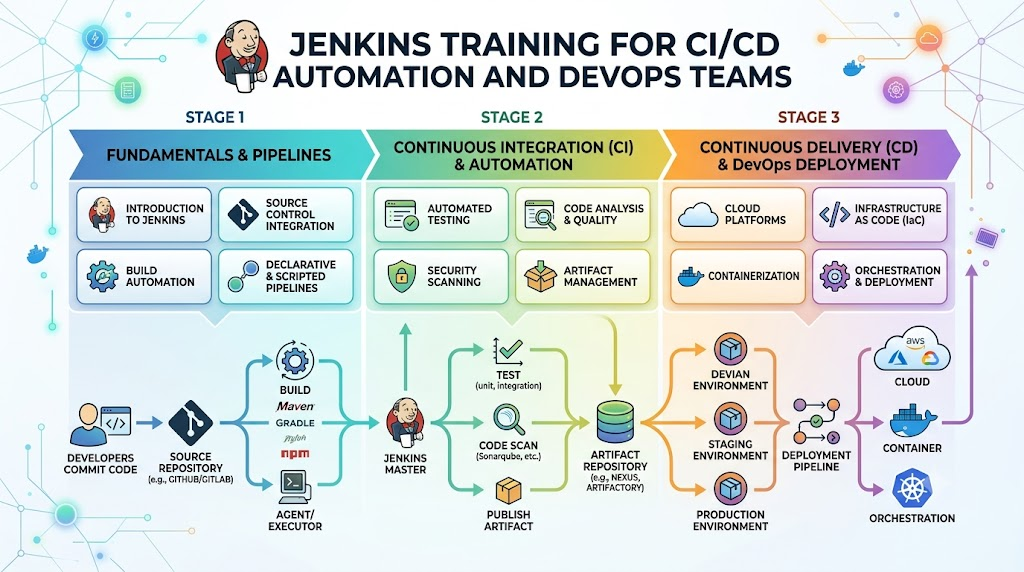
A structured Jenkins learning program typically covers both foundational concepts and enterprise implementation strategies.
Topics often include:
Jenkins Fundamentals
- Jenkins architecture
- Installation and configuration
- Controllers and agents
- Pipeline concepts
- Freestyle projects
Pipeline Development
- Declarative Pipelines
- Scripted Pipelines
- Jenkinsfile
- Shared Libraries
- Pipeline version control
Build Automation
Participants learn how Jenkins automates:
- Java builds
- Python applications
- Node.js projects
- .NET applications
- Containerized workloads
CI/CD Pipeline Training with Jenkins
Modern software delivery depends on automated pipelines.
Training generally includes:
Source Code Integration
- Git integration
- Branch strategies
- Pull request validation
- Automated triggers
Build Automation
- Maven
- Gradle
- npm
- Docker builds
Automated Testing
- Unit testing
- Integration testing
- Security testing
- Code quality analysis
Deployment Automation
- Kubernetes
- Docker
- Cloud environments
- Virtual machines
These skills form the foundation of enterprise-grade CI/CD Pipeline Training.
Jenkins and Docker Kubernetes Training
Containers have transformed application deployment.
Modern Jenkins pipelines commonly integrate with container technologies for faster and more reliable deployments.
Training typically covers:
- Docker image creation
- Container registries
- Kubernetes deployment
- Helm charts
- Rolling updates
- Blue-green deployment
- Canary releases
This combination makes Docker Kubernetes Training an important complement to Jenkins expertise.
Jenkins and Infrastructure as Code
Automation extends beyond applications.
Engineers also automate infrastructure using Infrastructure as Code.
Jenkins commonly integrates with:
- Terraform
- Ansible
- AWS CloudFormation
- Kubernetes manifests
This enables complete infrastructure provisioning alongside application deployment.
Professionals pursuing Terraform Training gain additional value by understanding how Jenkins orchestrates infrastructure automation.
Jenkins in DevOps Corporate Training
Organizations often require customized learning programs aligned with their existing tools and workflows.
DevOps Corporate Training using Jenkins can include:
- Enterprise pipeline design
- Secure CI/CD implementation
- Infrastructure automation
- Deployment governance
- Release management
- Multi-team collaboration
- Plugin management
- Performance optimization
These programs focus on solving practical business challenges rather than only explaining theoretical concepts.
Jenkins and Cloud DevOps
Cloud adoption has increased the importance of automation.
Jenkins integrates with major cloud providers including:
- AWS
- Microsoft Azure
- Google Cloud Platform
Engineers learn to automate:
- Cloud deployments
- Container platforms
- Server provisioning
- Infrastructure updates
- Application releases
Organizations working with cloud-native environments often benefit from guidance provided by an experienced Cloud DevOps Consultant or AWS DevOps Consultant, helping teams adopt scalable automation practices.
Security in Jenkins Pipelines
Security is now an integral part of software delivery.
Modern Jenkins pipelines often include:
- Secret management
- Credential storage
- Static code analysis
- Dependency scanning
- Container vulnerability scanning
- Compliance automation
These practices align closely with DevSecOps Corporate Training, where security becomes an automated part of every software release.
Monitoring Jenkins Pipelines
Reliable automation also requires visibility.
Training frequently introduces monitoring concepts such as:
- Build health
- Pipeline dashboards
- Log analysis
- Metrics collection
- Alerting
- Performance monitoring
This naturally connects with Site Reliability Engineering Training, where observability and operational excellence are key priorities.
Jenkins Integration Across the DevOps Ecosystem
| Area | Tools / Topics | Business Value |
|---|---|---|
| Source Control | Git, GitHub, GitLab, Bitbucket | Version control and collaboration |
| Build Automation | Maven, Gradle, npm | Faster software builds |
| Containerization | Docker | Consistent deployments |
| Container Orchestration | Kubernetes | Scalable application management |
| Infrastructure as Code | Terraform | Automated infrastructure provisioning |
| CI/CD Pipeline Training | Jenkins Pipelines | Faster software delivery |
| Monitoring | Prometheus, Grafana | Operational visibility |
| Code Quality | SonarQube | Improved software quality |
| Security | DevSecOps tools | Secure software delivery |
| GitOps Training | Argo CD, Flux | Automated deployment management |
Why Learn Jenkins from an Experienced DevOps Trainer
Technology alone does not create successful DevOps transformations.
Experienced trainers provide practical insights that help teams avoid common implementation challenges.
A knowledgeable DevOps Trainer typically focuses on:
- Real production environments
- Practical troubleshooting
- Enterprise deployment strategies
- CI/CD architecture
- Infrastructure automation
- Cloud integration
- Security best practices
- Hands-on learning
Those seeking structured mentoring and enterprise-focused learning can learn more about available training and consulting services at https://www.rajeshkumar.xyz/.
Who Should Attend Jenkins Training?
This training is valuable for:
- DevOps Engineers
- Software Developers
- Build Engineers
- Release Engineers
- Platform Engineers
- Cloud Engineers
- SRE Professionals
- QA Automation Engineers
- Technical Leads
- Engineering Managers
- Corporate DevOps Teams
- Organizations adopting CI/CD
Both beginners and experienced engineers benefit from structured, practical instruction.
Business Benefits of Jenkins Training
Organizations investing in Jenkins expertise often experience improvements such as:
- Faster software releases
- Improved deployment consistency
- Reduced manual effort
- Better collaboration across teams
- Higher software quality
- Increased automation
- Enhanced developer productivity
- Improved infrastructure management
- Better cloud adoption
- Stronger release governance
These benefits contribute to more efficient software delivery and greater operational resilience.
Why Consider Rajesh Kumar for Jenkins and DevOps Training?
When selecting a trainer or consultant, organizations often look for practical expertise, broad technology exposure, and the ability to connect concepts with real production scenarios.
Rajesh Kumar is known for focusing on hands-on learning across the broader DevOps ecosystem, including Jenkins, Kubernetes, cloud technologies, infrastructure automation, Site Reliability Engineering, DevSecOps, and Platform Engineering. His training approach emphasizes practical implementation, collaborative learning, and production-oriented problem solving rather than tool demonstrations alone.
Professionals and corporate teams interested in learning more about available training programs, consulting engagements, or mentoring opportunities can visit https://www.rajeshkumar.xyz/.
Frequently Asked Questions
1. Why should companies invest in Jenkins Training?
Jenkins Training helps engineering teams automate software builds, testing, deployments, and release processes. It improves development efficiency while reducing manual errors and accelerating software delivery.
2. How does Jenkins support CI/CD Pipeline Training?
Jenkins automates the entire software delivery lifecycle, including code integration, testing, deployment, and monitoring, making it one of the most widely used CI/CD platforms.
3. Who should attend Docker Kubernetes Training alongside Jenkins?
Developers, DevOps Engineers, Platform Engineers, Cloud Engineers, SRE professionals, and release managers benefit from learning Jenkins together with Docker and Kubernetes for modern cloud-native deployments.
4. Can Jenkins be used with Terraform and cloud platforms?
Yes. Jenkins integrates with Terraform, AWS, Azure, Google Cloud, Kubernetes, and many other technologies to automate infrastructure provisioning and application deployment.
5. Why is Jenkins still relevant for modern DevOps teams?
Jenkins remains highly relevant because of its flexibility, extensive plugin ecosystem, broad integrations, and ability to automate complex enterprise software delivery pipelines across diverse technology environments.
Conclusion
As organizations continue to modernize software delivery, automation has become a fundamental requirement rather than an optional enhancement. Jenkins plays a central role in enabling reliable Continuous Integration and Continuous Delivery pipelines, helping teams build, test, and deploy applications with greater speed and consistency.
When combined with complementary skills in Kubernetes, Docker, Terraform, cloud platforms, DevSecOps, Site Reliability Engineering, and Platform Engineering, Jenkins becomes part of a comprehensive DevOps ecosystem that supports scalable, secure, and resilient software delivery.
Whether you are an individual professional looking to strengthen your automation expertise or an organization planning DevOps Corporate Training, investing in practical Jenkins knowledge can deliver long-term value. To explore hands-on training, mentoring, or consulting opportunities focused on modern DevOps practices, visit https://www.rajeshkumar.xyz/.

