
Introduction
In India, career planning for children is often a family decision, especially for parents who want to ensure a stable and successful future for their child. With the rapid growth of the aviation industry, becoming a pilot has emerged as one of the most attractive and respected career options.
However, many Indian parents still have questions about safety, cost, education requirements, and long-term stability in aviation. This pilot career planning guide for Indian parents is designed to provide clear, practical, and realistic information so that parents can confidently support their child’s aviation dreams.
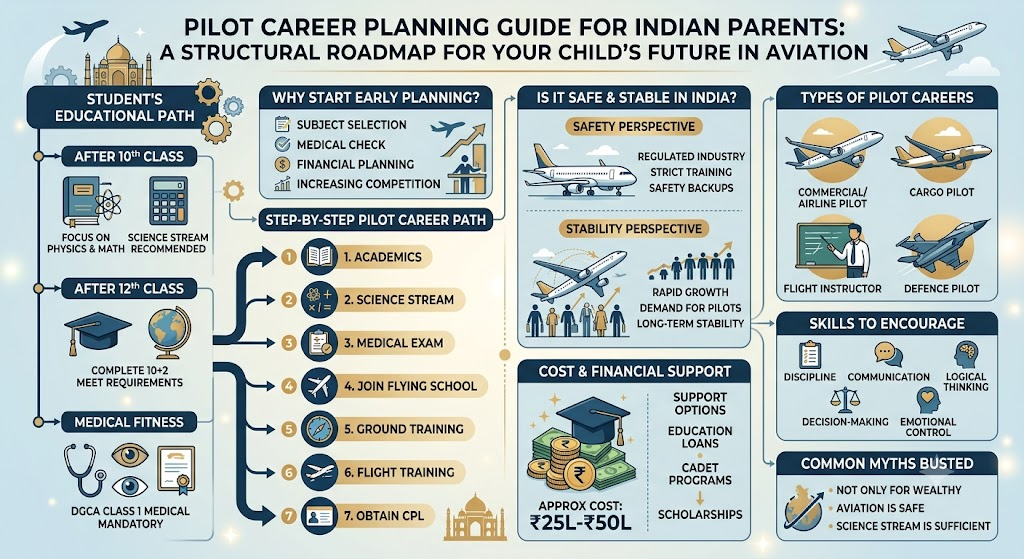
Why Parents Should Consider Pilot Career Planning Early
Pilot training is not something that starts suddenly after college. It requires early planning and structured preparation.
Parents should focus early because:
- Subject selection in school plays a key role (Physics and Mathematics)
- Medical fitness checks are required before training
- Pilot training requires financial planning
- Competition in aviation is increasing every year
Early awareness helps students stay on the correct academic and career path.
Is Pilot Career Safe and Stable in India?
Many parents worry about safety and job stability in aviation.
Safety Perspective
- Aviation is one of the most regulated industries in the world
- Pilots undergo strict training and repeated skill assessments
- Aircraft systems are designed with multiple safety backups
Stability Perspective
- India’s aviation sector is growing rapidly
- New airlines and routes are increasing demand for pilots
- Experienced pilots enjoy strong long-term career stability
Overall, aviation is considered a structured and safe professional field.
Eligibility Roadmap for Students
Parents should understand the basic steps required for pilot training.
After 10th Class
- Choose Science stream (recommended)
- Focus on Physics and Mathematics
After 12th Class
- Complete 10+2 from a recognized board
- Meet subject requirements for aviation training programs
Age Requirement
- Minimum 17 years to begin training
- Minimum 18 years for Commercial Pilot License
Medical Requirement
- DGCA Class 1 medical fitness certificate is mandatory
Importance of Science Stream in Pilot Career
Science subjects play an important role in aviation training.
- Physics helps understand flight principles and aerodynamics
- Mathematics is used in navigation and fuel calculations
- Analytical thinking improves decision-making during flights
Parents are encouraged to support science education for aviation aspirants.
Step-by-Step Pilot Career Path for Students
Parents can guide students through this structured pathway:
Step 1: Complete School Education
Ensure strong academic performance in school.
Step 2: Choose Science Stream
Physics and Mathematics are highly recommended.
Step 3: Medical Examination
Clear DGCA Class 1 medical fitness test.
Step 4: Join Flying School
Enroll in a DGCA-approved aviation academy.
Step 5: Ground Training
Learn aviation theory subjects such as navigation and meteorology.
Step 6: Flight Training
Complete approximately 200–250 flying hours.
Step 7: Obtain CPL
Earn Commercial Pilot License to start professional flying career.
Types of Pilot Career Options
Parents should understand the different aviation career paths available:
Commercial Pilot
Flies passenger and cargo aircraft for airlines and aviation companies.
Airline Pilot
Operates large aircraft such as Airbus and Boeing for commercial airlines.
Cargo Pilot
Transports goods and logistics instead of passengers.
Flight Instructor
Trains new student pilots in aviation academies.
Defence Pilot
Joins Indian Air Force through NDA or AFCAT and flies military aircraft.
Cost of Pilot Training in India
Pilot training requires significant financial investment.
- Approximate cost: ₹25 lakhs to ₹50 lakhs
This includes:
- Flying hours
- Ground classes
- Simulator training
- Examination and licensing fees
Parents often use education loans or cadet programs to manage expenses.
Scholarships and Financial Support Options
Several financial support options are available:
- Education loans from national and private banks
- Airline cadet pilot training programs
- Limited aviation scholarships
Proper planning can make pilot training more affordable.
Skills Parents Should Encourage in Students
Parents play a key role in shaping future pilots.
They should encourage students to develop:
- Discipline and consistency
- Strong English communication skills
- Mathematical and logical thinking
- Confidence and decision-making ability
- Emotional control under pressure
Common Myths About Pilot Career
Myth 1: Pilot career is only for wealthy families
Reality: Loans and cadet programs make it accessible.
Myth 2: It is unsafe to become a pilot
Reality: Aviation is one of the safest and most regulated industries.
Myth 3: Only engineering students can become pilots
Reality: Science stream (Physics and Mathematics) is sufficient.
Career Growth and Salary Overview
Pilot career growth is structured and rewarding:
- Trainee Pilot: Entry stage after CPL
- First Officer: Co-pilot role in airlines
- Captain: Senior pilot with full command responsibilities
With experience, pilots earn high salaries and international opportunities.
FAQs
1. Is pilot career a good option for Indian students?
Yes, it is one of the most respected and high-growth careers in India.
2. What is the minimum qualification required for pilot training?
10+2 with Physics and Mathematics is preferred for aviation training.
3. Is pilot training very expensive in India?
Yes, but financial help like loans and cadet programs are available.
4. How can parents support a pilot career plan?
Parents can help with education choices, finances, and motivation.
5. Is pilot career stable in India?
Yes, the aviation industry is growing and offers strong demand for pilots.
6. Can girls become pilots in India?
Yes, aviation is open to both male and female candidates equally.
7. How long does pilot training take?
It usually takes 2 to 3 years after completing 12th.
8. Is medical fitness important for pilots?
Yes, DGCA Class 1 medical fitness is mandatory.
9. What is the starting salary of a pilot?
It varies, but increases significantly with experience and airline type.
10. Is pilot career risky?
No, aviation is considered one of the safest professional industries.
Conclusion
Pilot career planning for Indian parents requires early awareness, structured guidance, and careful financial planning. While the journey to becoming a pilot involves investment and disciplined training, it also offers one of the most prestigious and rewarding careers in the world.
By supporting children early in academics, especially in science subjects, and encouraging the right training path, parents can help shape a successful aviation career. With the right guidance and preparation, a pilot career can become a realistic and highly rewarding future option for Indian students.

