
Introduction
Pilot training in India is a dream journey for many students who want to build a career in aviation. The idea of flying an aircraft, wearing a pilot uniform, working in a professional cockpit, and travelling to different places attracts thousands of young aspirants every year. But for beginners, the path can feel confusing because pilot training includes many steps such as education, medical fitness, DGCA exams, flying school selection, license types, flying hours, training cost, and career preparation.
Many students ask questions like: Can I become a pilot after 12th? Is Physics and Mathematics compulsory? How much does pilot training cost in India? Which flying school should I choose? What is CPL? What is DGCA? How long does it take to become a pilot? These are important questions, and students should understand the answers before investing time and money.
This beginner guide to pilot training in India explains the complete process in simple language. It is useful for students after 10th, students after 12th, graduates, parents, aviation aspirants, and anyone who wants to understand how pilot training works in India.
What Is Pilot Training?
Pilot training is the process of learning how to operate an aircraft safely and professionally. It includes both theoretical knowledge and practical flying experience. A student pilot does not simply sit in an aircraft and start flying. The training process begins with understanding aviation basics, safety rules, weather, navigation, aircraft systems, communication, and flight procedures.
Pilot training has two major parts:
- Ground school training
- Flying training
Ground school teaches aviation theory. Students learn subjects such as Air Navigation, Aviation Meteorology, Air Regulations, Technical General, Technical Specific, Radio Telephony, Aircraft Systems, and Flight Planning. These subjects help students understand how aircraft fly, how weather affects flying, how pilots navigate, and how aviation rules work.
Flying training is the practical part. Students fly aircraft under instructor supervision and gradually learn takeoff, landing, turning, climbing, descending, navigation, solo flying, cross-country flying, night flying, and emergency procedures.
A good pilot needs both knowledge and skill. Ground school builds the mind of a pilot, while flying training builds the practical confidence of a pilot.
Why Pilot Training Requires Proper Planning
Pilot training is not a small course that can be started casually. It is a serious professional journey that requires planning, discipline, money, time, and commitment. Students and parents should understand the full process before taking admission into a flying school.
Proper planning helps avoid:
- Wrong flying school selection
- Unclear fee structure
- Hidden expenses
- Medical fitness issues
- DGCA exam delays
- Poor documentation
- Training interruptions
- Unrealistic career expectations
- Confusion about license types
- Delays in flying hour completion
Pilot training can be expensive, so students should not make decisions based only on advertisements or social media claims. A clear plan helps students know what to do first, what documents are needed, what exams must be cleared, and what career steps come after training.
Who Can Start Pilot Training in India?
Pilot training in India can be started by different types of students and aviation enthusiasts. The exact training path depends on the student’s goal, education, age, medical fitness, and license requirement.
Pilot training may be suitable for:
- Students after 10th who want to prepare early
- Students after 12th with Physics and Mathematics
- Graduates who meet eligibility requirements
- Career changers interested in aviation
- Aviation enthusiasts who want private flying experience
- Students aiming for commercial pilot careers
- Students interested in airline, charter, cargo, or corporate flying
- Parents researching aviation careers for their children
Students after 10th can begin preparation by choosing the right subjects, improving English communication, building discipline, and learning aviation basics. Students after 12th can begin the practical process by checking medical fitness, researching DGCA requirements, comparing flying schools, and preparing for ground school.
Basic Eligibility for Pilot Training in India
Before starting pilot training, students must understand the basic eligibility requirements. These requirements may vary depending on the license type, but commercial pilot aspirants must pay special attention to education and medical fitness.
Educational Qualification
For students who want to become commercial pilots, 10+2 or equivalent education with Physics and Mathematics is very important. These subjects are required because aviation involves technical understanding, navigation, aircraft performance, speed, distance, weather, and calculations.
Physics and Mathematics
Physics helps students understand aircraft movement, pressure, force, weather, and aerodynamics. Mathematics helps with navigation, distance, speed, fuel planning, and technical calculations. Students who did not study Physics and Mathematics earlier should explore recognized ways to complete these subjects before moving forward with commercial pilot training.
English Communication
English is widely used in aviation communication. Pilots speak with air traffic control, instructors, co-pilots, cabin crew, engineers, examiners, and airline interview panels. Good English communication helps in training, exams, interviews, and professional flying.
Minimum Age
Different pilot licenses have different age requirements. Students can begin aviation awareness early, but license issue and commercial flying eligibility depend on applicable rules. Students should confirm age-related requirements before joining a training program.
Medical Fitness
Medical fitness is one of the most important parts of pilot training. Students must pass required aviation medical checks to confirm they are fit to fly. Vision, hearing, physical health, mental fitness, and overall health are important.
DGCA Requirements
The Directorate General of Civil Aviation regulates civil aviation in India. Students must follow DGCA-related rules for exams, medicals, flying training, license application, documentation, and safety standards.
Types of Pilot Licenses in India
Different pilot licenses serve different purposes. Beginners should understand these license types before starting training.
| License | Full Form | Purpose | Suitable For | Career Use |
|---|---|---|---|---|
| SPL | Student Pilot License | Allows a student to begin basic flying training | Beginners starting pilot training | Training stage |
| PPL | Private Pilot License | Allows private flying, not commercial flying employment | Aviation enthusiasts and private flyers | Personal flying, not airline career |
| CPL | Commercial Pilot License | Allows a pilot to work professionally in commercial flying roles | Students aiming for aviation careers | Airline, charter, cargo, corporate aviation |
| ATPL | Airline Transport Pilot License | Advanced license for experienced pilots | Senior commercial pilots | Captain and higher airline command roles |
For students who want to become professional pilots, the Commercial Pilot License is the most important license. CPL is generally required for airline, charter, cargo, and other commercial flying opportunities.
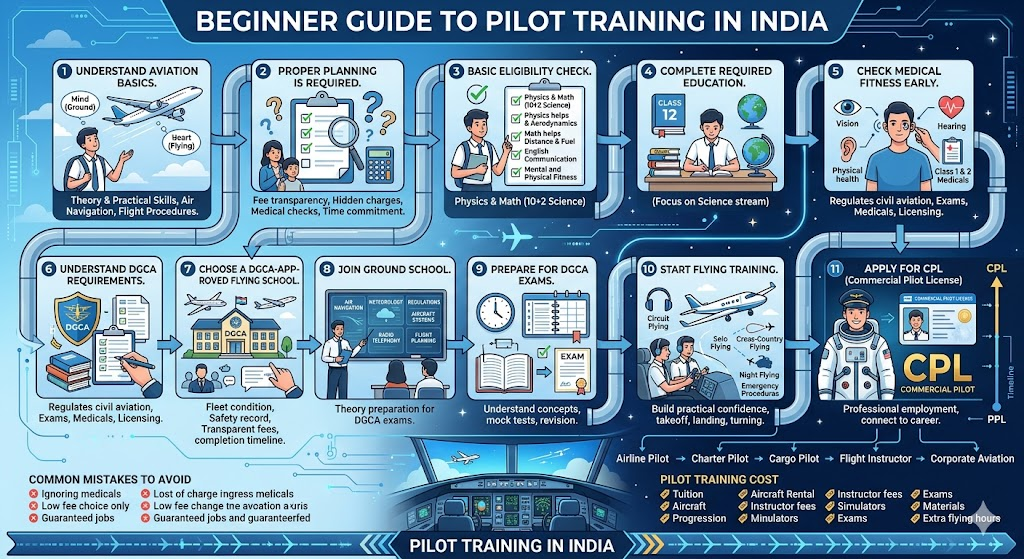
Step-by-Step Pilot Training Process in India
Pilot training becomes easier to understand when it is broken into clear steps. Beginners should follow the process carefully instead of rushing into flying school admission.
Step 1: Complete the Required Education
The first step is to complete 10+2 with Physics and Mathematics if your goal is to become a commercial pilot. Students should also focus on English because communication is very important in aviation.
Students who are still in school should choose the Science stream with Physics and Mathematics. Students who have already completed 12th without these subjects should check recognized options to complete them separately before applying for commercial pilot training.
Strong academic basics make ground school and DGCA exam preparation easier.
Step 2: Check Medical Fitness
Before spending a large amount on pilot training, students should check medical fitness. Aviation medical checks help confirm whether a student is fit to fly.
Class 2 Medical
Class 2 medical is generally an early medical requirement for student pilots. It helps confirm basic fitness for aviation training.
Class 1 Medical
Class 1 medical is required for commercial pilot licensing. Students who want a CPL should take this medical requirement seriously.
Students should not hide medical issues or delay medical checks. Medical fitness should be verified early because training investment is high.
Step 3: Understand DGCA Requirements
DGCA plays a central role in pilot training in India. Beginners should understand DGCA’s role before joining a flying school.
DGCA is connected with:
- Pilot licensing
- Flying school approval
- Aviation medical requirements
- Flight crew examinations
- Training rules
- Flying hour requirements
- Documentation
- Safety standards
Students should learn the basic DGCA process so they do not depend only on informal advice.
Step 4: Choose a DGCA-Approved Flying School
Choosing the right flying school is one of the most important decisions in pilot training. A good flying school can help students complete training smoothly, while a poor choice can create delays and extra cost.
When comparing flying schools, check:
- DGCA approval
- Aircraft availability
- Aircraft condition
- Instructor experience
- Safety record
- Maintenance quality
- Student-to-aircraft ratio
- Flying hour completion timeline
- Fee transparency
- Hidden charges
- Hostel and accommodation
- Weather conditions
- Ground school support
- DGCA exam support
- Student reviews
- Past student feedback
- Career guidance support
Students should not choose a flying school only because of low fees. Safety, aircraft availability, instructor quality, and transparency matter more than cheap pricing.
Step 5: Join Ground School
Ground school is classroom-based aviation learning. It prepares students for DGCA exams and helps them understand the theory behind flying.
Ground school usually includes:
- Air Navigation
- Aviation Meteorology
- Air Regulations
- Technical General
- Technical Specific
- Radio Telephony
- Aircraft Systems
- Flight Planning
Students should take ground school seriously. Good theory knowledge improves flying confidence and helps students perform better in exams and future airline interviews.
Step 6: Prepare for DGCA Exams
DGCA exams are an important part of pilot training in India. These exams test a student’s understanding of aviation rules, navigation, weather, aircraft systems, and technical subjects.
Preparation tips for beginners:
- Start studying early
- Create a subject-wise study plan
- Understand concepts clearly
- Practice previous questions
- Take mock tests
- Revise regularly
- Focus on weak topics
- Avoid last-minute preparation
- Ask instructors for doubt-clearing
- Keep exam documents ready
Students should not treat DGCA exams lightly. Exam delays can slow down the complete training journey.
Step 7: Start Flying Training
Flying training is the practical stage where students learn to fly an aircraft under instructor supervision. This stage is exciting, but it also requires discipline, focus, and patience.
During flying training, students learn:
- Pre-flight checks
- Basic aircraft control
- Taxiing
- Takeoff
- Climbing
- Turning
- Descending
- Landing
- Circuit flying
- Solo flying
- Cross-country flying
- Night flying
- Emergency procedures
- Navigation exercises
Flying training depends on weather, instructor schedule, aircraft availability, maintenance, air traffic conditions, and student progress. Students should stay patient and consistent during this stage.
Step 8: Complete Required Flying Hours
To apply for a Commercial Pilot License, students must complete the required flying hours as per applicable rules. Flying hours must be recorded properly in the student’s logbook.
Students should not focus only on completing hours. The real goal is to become a safe, skilled, and confident pilot. Good flying habits built during training stay with the pilot throughout the career.
Step 9: Complete Radio Telephony Training
Radio Telephony training teaches students how to communicate clearly in aviation. Pilots must speak with air traffic control using standard aviation phraseology.
Radio training helps students improve:
- Clear speaking
- Listening accuracy
- Aviation phraseology
- Emergency communication
- Confidence on radio
- Professional communication discipline
Good radio communication is important for flight safety and professional cockpit performance.
Step 10: Apply for Commercial Pilot License
After completing medical requirements, DGCA exams, flying hours, and documentation, students can apply for a Commercial Pilot License.
Important documents may include:
- Educational certificates
- Medical certificates
- DGCA exam results
- Flying logbook
- Flying school certificates
- Identity proof
- License application documents
- Training records
Students should check all documents carefully before submission. Small errors can delay license processing.
Step 11: Prepare for Type Rating and Jobs
After receiving a CPL, students who want airline careers may need type rating and airline selection preparation.
Type rating is aircraft-specific training. It prepares pilots to operate a particular aircraft type used by airlines. Airline preparation may also include simulator checks, technical interviews, HR interviews, group discussions, psychometric tests, and communication practice.
Students should avoid believing guaranteed job promises. Airline hiring depends on vacancies, skill, training performance, market conditions, interview results, and company requirements.
Ground School Subjects Explained for Beginners
| Subject | What It Means | Why It Matters |
|---|---|---|
| Air Navigation | Learning how pilots find direction and plan routes | Helps pilots fly from one place to another safely |
| Aviation Meteorology | Study of weather related to flying | Helps pilots understand clouds, wind, visibility, and weather risks |
| Air Regulations | Aviation rules and procedures | Helps pilots follow legal and safety requirements |
| Technical General | Basic aircraft systems and technical concepts | Helps students understand how aircraft function |
| Technical Specific | Details of a specific aircraft type used in training | Helps students operate the training aircraft safely |
| Radio Telephony | Aviation communication and phraseology | Helps pilots communicate clearly with air traffic control |
| Aircraft Systems | Study of engine, controls, instruments, and aircraft parts | Helps pilots understand aircraft behavior |
| Flight Planning | Planning route, fuel, time, weather, and safety factors | Helps pilots prepare safe and efficient flights |
Ground school is the foundation of safe flying. A student with strong ground knowledge usually learns flying more confidently.
Flying Training Components Explained
| Training Stage | What Students Learn | Why It Is Important |
|---|---|---|
| Pre-flight Checks | Inspecting aircraft before flight | Ensures aircraft is safe before takeoff |
| Basic Aircraft Control | Using controls for movement | Builds basic handling confidence |
| Takeoff Practice | Learning how to safely take off | One of the most important flying skills |
| Landing Practice | Learning how to land smoothly and safely | Builds safety and aircraft control |
| Circuit Training | Repeated takeoff and landing practice | Improves accuracy and confidence |
| Solo Flying | Flying without instructor after approval | Builds independence and decision-making |
| Cross-Country Flying | Flying between different locations | Builds navigation and route planning skills |
| Night Flying | Flying in low-light or night conditions | Improves instrument awareness and judgment |
| Emergency Procedures | Handling abnormal situations | Prepares students for safety-critical decisions |
| Navigation Exercises | Route planning and position tracking | Builds real-world flying confidence |
Flying training should be treated as a skill-building journey, not just an hour-completion requirement.
Pilot Training Cost in India
Pilot training cost in India varies from student to student and institute to institute. The total cost depends on flying school, aircraft type, fuel cost, city, ground school, DGCA exam preparation, medical checks, accommodation, additional flying hours, and type rating.
Students should ask flying schools for a complete written cost breakdown. They should also plan extra budget because delays, extra practice, accommodation, and exam preparation may increase total expenses.
| Cost Area | What It Includes | Cost Note |
|---|---|---|
| Medical Checks | Class 2 and Class 1 medical process | Varies by medical center and process |
| Ground School | Theory classes and DGCA exam preparation | Varies by institute |
| DGCA Exams | Exam-related expenses and preparation support | Varies / N/A |
| Flying Training | Aircraft flying hours with instructor and solo training | Usually the largest cost component |
| Study Material | Books, charts, notes, and learning tools | Varies by training provider |
| Accommodation | Hostel, food, local travel, and daily expenses | Depends on city and training location |
| Radio Telephony Training | Communication and RTR preparation | Varies by training path |
| Documentation | License application and records | Varies / N/A |
| Extra Flying Hours | Additional practice if required | Depends on student performance |
| Type Rating | Aircraft-specific airline training | Can be a major additional cost |
Students should avoid joining any training program without understanding what is included and what is not included in the fee.
How Long Does Pilot Training Take in India?
The time required for pilot training in India depends on several factors. Some students complete training faster, while others face delays due to weather, exams, aircraft availability, documentation, or financial breaks.
Timeline depends on:
- Weather conditions
- Aircraft availability
- Instructor schedule
- DGCA exam clearance
- Medical approval
- Flying school efficiency
- Student performance
- Financial continuity
- Documentation process
- Maintenance and operational delays
Students should ask flying schools about average completion time, but they should also understand that aviation training can face natural delays. A realistic mindset is better than expecting instant completion.
How to Choose the Right Flying School in India
Flying school selection can affect training quality, cost, timeline, and confidence. Students and parents should compare multiple options before making a decision.
Flying School Checklist
Check the following:
- DGCA approval
- Aircraft fleet condition
- Aircraft availability
- Instructor experience
- Safety record
- Maintenance standards
- Student-to-aircraft ratio
- Fee transparency
- Hidden charges
- Hostel and accommodation
- Ground school support
- DGCA exam support
- Student reviews
- Past student feedback
- Airline preparation support
- Logbook and documentation support
A low fee does not always mean a good choice. A reliable flying school should be safe, transparent, organized, and student-friendly.
Skills Required for Pilot Training
Pilot training requires both technical skills and personal qualities. Students should start building these skills early.
Discipline
Pilots must follow rules, checklists, timings, and procedures. Discipline is the backbone of aviation safety.
Communication
Clear communication is essential in aviation. Students must improve English speaking, listening, and aviation phraseology.
Decision-Making
Pilots must make safe and timely decisions during normal and abnormal situations.
Technical Understanding
Students must understand aircraft systems, weather, navigation, and regulations.
Situational Awareness
Situational awareness means knowing what is happening around the aircraft. It helps prevent mistakes.
Time Management
Pilot training includes classes, flying slots, exams, revision, and documentation. Time management keeps students organized.
Mental Fitness
Aviation training can be stressful. Students must stay calm, patient, and focused.
Physical Fitness
Good health supports medical eligibility and training performance.
Problem-Solving
Pilots must solve problems calmly and practically during flight operations.
Teamwork
Pilots work with instructors, co-pilots, engineers, air traffic controllers, and ground staff.
Leadership
A pilot must take responsibility, communicate confidently, and act professionally.
Common Mistakes Beginners Should Avoid
Beginners should avoid these common mistakes:
- Starting pilot training without medical checks
- Choosing a flying school only by low fees
- Not checking DGCA approval
- Ignoring the total training cost
- Not preparing seriously for DGCA exams
- Weak English communication
- Poor document management
- Believing guaranteed job promises
- Not planning for type rating
- Not speaking to past students
- Depending only on social media information
- Not understanding license types
- Ignoring weather and aircraft availability
- Not maintaining a proper study schedule
- Rushing into admission without comparison
Avoiding these mistakes can save time, money, and stress.
Pilot Training Roadmap After 10th
Students after 10th should focus on preparation rather than rushing into expensive aviation programs. This is the right time to build academic strength, communication skills, discipline, and aviation awareness.
| Stage | Action Plan | Goal |
|---|---|---|
| After 10th | Choose Science stream with Physics and Mathematics | Build eligibility for commercial pilot training |
| Class 11 | Focus on Physics, Mathematics, and English | Strengthen academic foundation |
| Class 12 | Prepare well for board exams and research aviation | Become ready for pilot training decisions |
| Before Training | Learn about DGCA, medicals, flying schools, and cost | Build clarity before investment |
| After 12th | Complete medical checks and compare flying schools | Start the practical training path |
Students after 10th should also improve fitness, confidence, communication, and discipline.
Pilot Training Roadmap After 12th
After 12th, students can begin the practical process if they meet educational eligibility.
| Step | Action | Purpose |
|---|---|---|
| Step 1 | Confirm Physics and Mathematics eligibility | Ensures academic readiness |
| Step 2 | Complete aviation medical checks | Confirms fitness for training |
| Step 3 | Understand DGCA requirements | Builds process clarity |
| Step 4 | Compare flying schools | Helps avoid wrong admission decisions |
| Step 5 | Join ground school | Begins theory preparation |
| Step 6 | Prepare for DGCA exams | Clears licensing knowledge requirements |
| Step 7 | Start flying training | Builds practical aircraft skills |
| Step 8 | Complete flying hours | Meets license training requirements |
| Step 9 | Organize documents | Prevents license delays |
| Step 10 | Apply for CPL | Moves toward professional pilot career |
| Step 11 | Prepare for type rating and jobs | Supports aviation career entry |
Students after 12th should not rush. The right order is eligibility, medical checks, research, budget planning, flying school selection, and training.
Pilot Training Roadmap for Graduates
Graduates can also start pilot training if they meet the required educational and medical eligibility. A graduation degree may help with maturity and backup planning, but commercial pilot training still requires the right academic foundation and medical fitness.
Graduates should check:
- Whether they studied Physics and Mathematics at 10+2 level
- Whether they meet medical fitness standards
- Whether they can commit time for training
- Whether their budget is planned properly
- Whether they understand DGCA exams and licensing
- Whether they are ready for full-time aviation preparation
Graduates who did not study Physics and Mathematics should explore recognized ways to complete these subjects before moving ahead with commercial pilot training.
Career Options After Pilot Training
After pilot training and licensing, students can explore different aviation career paths depending on eligibility, skills, market conditions, and experience.
Airline Pilot
Airline pilots fly passenger aircraft for domestic or international airlines. This is a common goal for CPL holders.
Charter Pilot
Charter pilots fly private aircraft for business travelers, tourists, companies, and special travel needs.
Cargo Pilot
Cargo pilots transport goods, parcels, and essential supplies. This career path supports logistics and commercial transport.
Flight Instructor
Flight instructors train student pilots and help them learn aviation skills. This path can also help pilots build experience.
Corporate Aviation Pilot
Corporate pilots fly private or business aircraft for companies and executives.
Helicopter Pilot
Helicopter pilots work in tourism, rescue, offshore support, emergency operations, and private aviation.
Drone Pilot
Drone pilots work in mapping, surveying, agriculture, media, infrastructure inspection, and logistics.
Aviation Operations
Some aviation professionals work in flight operations, safety, dispatch, training coordination, or aviation management.
International Aviation Opportunities
Some pilots explore international aviation opportunities after meeting license conversion, experience, and regulatory requirements.
Beginner Checklist Before Starting Pilot Training
Use this checklist before starting pilot training:
- Completed 10+2 with Physics and Mathematics
- Checked aviation medical fitness
- Understood SPL, PPL, CPL, and ATPL
- Researched DGCA requirements
- Compared multiple flying schools
- Checked DGCA approval of flying school
- Understood total training cost
- Planned budget with family
- Prepared required documents
- Started improving English communication
- Understood DGCA exam process
- Checked accommodation and living cost
- Spoke to current or past students
- Avoided unrealistic job promises
- Created a realistic training timeline
This checklist helps beginners begin pilot training with clarity and confidence.
FAQs
1- What is pilot training in India?
Pilot training in India is the process of learning aviation theory and practical flying skills to become a trained pilot. It includes ground school, DGCA exams, flying training, medical checks, documentation, and license application. Students who want professional flying careers usually work toward a Commercial Pilot License.
2- How can a beginner start pilot training in India?
A beginner can start by completing the required education, checking medical fitness, understanding DGCA requirements, comparing flying schools, joining ground school, preparing for DGCA exams, and then beginning flying training. It is important to plan budget and documents before admission.
3- Can I start pilot training after 12th?
Yes, students can start pilot training after 12th if they meet educational and medical requirements. Students with Physics and Mathematics can move toward medical checks, flying school research, ground school, DGCA exam preparation, and flying training.
4- Is Physics and Mathematics compulsory for pilot training?
Physics and Mathematics are important for commercial pilot training in India. These subjects help with navigation, weather, aircraft systems, speed, distance, and technical calculations. Students who did not study them earlier should complete them through a recognized route before applying for commercial pilot training.
5- What is DGCA’s role in pilot training?
DGCA regulates civil aviation in India. It is connected with pilot licensing, flying school approval, flight crew examinations, medical standards, training requirements, safety rules, and documentation. Students should understand DGCA-related steps before starting pilot training.
6- Which license is required to become a commercial pilot?
A Commercial Pilot License is required to work as a professional commercial pilot. Students who want airline, charter, cargo, or corporate flying careers generally follow the CPL route after completing required training, exams, medicals, and documentation.
7- What is the difference between PPL and CPL?
PPL stands for Private Pilot License and is mainly used for private flying. CPL stands for Commercial Pilot License and is required for professional flying work. A student aiming for an airline or commercial aviation career usually needs a CPL.
8- What medical test is required for pilot training?
Pilot aspirants generally need aviation medical fitness checks such as Class 2 and Class 1 medicals depending on the training and licensing stage. These checks review physical health, vision, hearing, and overall fitness to fly.
9- What subjects are taught in ground school?
Ground school usually includes Air Navigation, Aviation Meteorology, Air Regulations, Technical General, Technical Specific, Radio Telephony, Aircraft Systems, and Flight Planning. These subjects prepare students for DGCA exams and practical flying.
10- How much does pilot training cost in India?
Pilot training cost in India varies by flying school, aircraft type, fuel cost, ground school, exams, medical checks, accommodation, extra flying hours, and type rating. Students should ask for a complete cost breakdown before admission and plan extra budget for unexpected expenses.
11- How long does pilot training take in India?
The timeline depends on weather, aircraft availability, instructor schedule, DGCA exams, medical approval, student performance, financial continuity, and documentation. Some students complete training faster, while others may take longer due to natural delays.
12- What should I do after completing pilot training?
After completing pilot training and getting the required license, students can prepare for airline selection, type rating, simulator checks, technical interviews, HR rounds, communication improvement, or explore charter, cargo, corporate aviation, and flight instructor opportunities.
Conclusion
Pilot training in India is a structured journey that requires education, medical fitness, DGCA exam preparation, flying school selection, ground school, practical flying, documentation, license application, and career preparation. Beginners should not rush into training without understanding the full process. The right approach is to confirm eligibility, complete medical checks early, compare flying schools carefully, plan the budget, prepare strongly for DGCA exams, and stay disciplined throughout training. A pilot career can be rewarding, but it demands patience, responsibility, technical learning, and continuous improvement. With proper planning and reliable guidance, students can begin their pilot training journey in India with confidence and clarity.

