
Introduction
Becoming a commercial pilot is one of the most exciting aviation career goals for Indian students. Many students dream of flying passenger aircraft, working with airlines, wearing a pilot uniform, and building a respected career in aviation. Commercial aviation also includes cargo flying, charter operations, corporate aviation, flight instruction, and other professional flying opportunities.
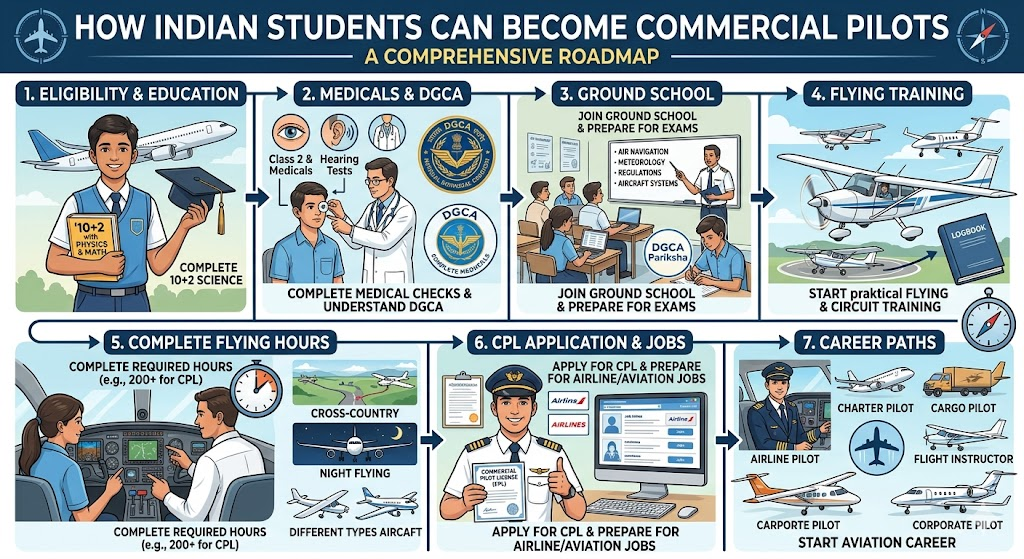
However, becoming a commercial pilot in India requires more than passion. Students must understand educational eligibility, aviation medical checks, DGCA requirements, ground school, flying training, examinations, flying hours, documentation, license application, and career preparation. DGCA’s official Commercial Pilot Licence rule page mentions 10+2 with Physics and Mathematics as an educational requirement for CPL eligibility, and the DGCA Pariksha portal is used for flight crew examinations in India.
This guide explains how Indian students can become commercial pilots in simple and practical language. It is useful for students after 10th, students after 12th, graduates, parents, and beginners who want to understand the complete commercial pilot journey.
What Is a Commercial Pilot?
A commercial pilot is a trained and licensed aviation professional who is allowed to fly aircraft for commercial purposes. This means the pilot can work in roles where flying is part of paid professional aviation operations.
Commercial pilots may work in:
- Passenger airlines
- Cargo airlines
- Charter aviation
- Corporate aviation
- Flight training academies
- Specialized aviation services
A commercial pilot’s work includes much more than flying an aircraft. Pilots must check weather, review flight plans, inspect aircraft documents, communicate with air traffic control, monitor aircraft instruments, follow safety procedures, coordinate with crew members, and handle unexpected situations calmly.
Commercial pilots are different from private pilots. A private pilot usually flies for personal or non-commercial purposes, while a commercial pilot can pursue professional flying roles after meeting licensing, training, medical, and company-specific requirements.
Why Many Indian Students Want to Become Commercial Pilots
Many Indian students are attracted to a commercial pilot career because it combines travel, technology, responsibility, and professional growth. Aviation is also seen as a challenging and respected field.
Common reasons students choose this career include:
- Strong passion for aircraft and flying
- Interest in aviation technology
- Desire for a professional career
- Opportunity to work in airlines, cargo, charter, or corporate aviation
- Exposure to travel and global aviation culture
- Technical and skill-based work environment
- Long-term career progression from first officer to captain
However, students should keep expectations realistic. A commercial pilot career requires high investment, regular learning, medical fitness, strict discipline, and continuous assessment. It is rewarding for serious students, but it should not be chosen only for glamour or salary expectations.
Who Can Become a Commercial Pilot in India?
Indian students can become commercial pilots if they meet the required education, medical, training, examination, and licensing conditions.
This path is suitable for:
- Students after 12th with required subjects
- Graduates who meet eligibility requirements
- Students who are medically fit
- Students willing to complete DGCA exams
- Students ready for flying training
- Students who can plan the financial investment
- Students with strong discipline and communication skills
Students who did not study Physics and Mathematics earlier should check current official eligibility rules and recognized ways to meet the academic requirement before investing in training. Aviation rules and proposals may change, so students should verify the latest requirement before admission.
Basic Eligibility for Commercial Pilot Training
Commercial pilot training has several eligibility factors. Students should check these carefully before joining a flying school.
Educational Qualification
Students aiming for a Commercial Pilot License generally need 10+2 or equivalent education. For CPL eligibility, Physics and Mathematics are important under current DGCA rules.
Physics and Mathematics Requirement
Physics and Mathematics are important because pilot training includes navigation, aircraft performance, weather, speed, distance, fuel planning, pressure, and technical calculations. Students who did not study these subjects should complete them through a recognized route if required.
English Communication Skills
Aviation communication is mainly done in English. Pilots must speak clearly with air traffic control, instructors, co-pilots, cabin crew, engineers, examiners, and airline interview panels. Strong English communication improves safety, confidence, and career readiness.
Age Requirements
Different stages of pilot licensing have different age requirements. For a commercial pilot career, students should confirm the minimum age requirement for CPL issue before planning the timeline. Many training providers mention 18 years as the minimum age for CPL issue, but students should always verify current official requirements before applying.
Medical Fitness Requirements
Medical fitness is one of the most important parts of becoming a pilot. Students must meet aviation medical standards before commercial pilot licensing. Medical checks generally include vision, hearing, physical health, and overall fitness.
DGCA Requirements
DGCA regulates civil aviation in India and is connected with pilot licensing, flying school approval, medical standards, flight crew exams, safety rules, and documentation. Students must follow DGCA-related requirements throughout training.
Commercial Pilot License Explained
A Commercial Pilot License, commonly called CPL, is the key license for students who want to work as professional pilots. Without a CPL, a student cannot generally pursue professional commercial flying roles.
| License Type | Purpose | Who It Is For | Career Use |
|---|---|---|---|
| SPL | Allows students to begin basic pilot training | Beginners starting flying training | Training stage |
| PPL | Allows private flying, not professional commercial flying | Aviation enthusiasts and private flyers | Personal flying |
| CPL | Allows professional commercial flying eligibility | Students aiming for pilot careers | Airline, charter, cargo, corporate aviation |
| ATPL | Advanced license for experienced pilots | Senior airline pilots | Captain and higher command roles |
For Indian students who want airline or commercial aviation careers, CPL is the most important license milestone.
Step-by-Step Guide for Indian Students to Become Commercial Pilots
Step 1: Complete 10+2 Education
The first step is to complete 10+2 education with the required subjects. Physics and Mathematics are especially important for students planning CPL training.
Students still in school should choose Science with Physics and Mathematics. They should also focus on English because communication is very important in aviation.
Students who have already completed school without Physics and Mathematics should check recognized ways to complete these subjects and confirm eligibility before joining a flying school.
Step 2: Understand the Commercial Pilot Career Path
Before starting training, students should understand where CPL can lead. A commercial pilot career is not limited to passenger airlines.
Career paths may include:
- Airline pilot
- Charter pilot
- Cargo pilot
- Corporate aviation pilot
- Flight instructor
- Aviation operations role
- International aviation pathway after meeting required rules
Understanding the career path helps students plan training, type rating, finances, and career expectations more clearly.
Step 3: Complete Aviation Medical Checks
Medical checks should be completed early because pilot training is a major investment.
Class 2 Medical
Class 2 medical is usually an early step for student pilots. It helps confirm basic aviation medical fitness.
Class 1 Medical
Class 1 medical is required for commercial pilot licensing. Students aiming for CPL should take Class 1 medical requirements seriously.
Vision and Physical Fitness
Vision, color perception, hearing, general health, and physical fitness can matter during aviation medical checks.
Mental Fitness
Pilots must stay calm, focused, and responsible. Mental fitness is important because flying requires decision-making under pressure.
Students should not hide health issues or delay medical checks. It is better to confirm fitness before spending heavily on training.
Step 4: Research DGCA Requirements
DGCA is the aviation regulator for civil aviation in India. Students must understand DGCA’s role before joining training.
DGCA is connected with:
- Pilot licensing
- Flying school approvals
- Flight crew examinations
- Medical requirements
- Flying hour rules
- Training standards
- Documentation
- Aviation safety
The DGCA Pariksha portal is used for flight crew examination-related processes, notices, admitted lists, venue lists, and results.
Step 5: Choose a DGCA-Approved Flying School
Choosing the right flying school is one of the biggest decisions in the commercial pilot journey. Students should compare schools carefully and avoid choosing only by low fees.
Check the following:
- DGCA approval
- Aircraft availability
- Aircraft maintenance quality
- Instructor experience
- Safety record
- Student-to-aircraft ratio
- Student-to-instructor ratio
- Flying hour completion timeline
- Transparent fee structure
- Hidden charges
- Hostel and accommodation
- Ground school support
- DGCA exam support
- Student reviews
- Past student feedback
- Documentation support
DGCA has also pushed transparency for flying training organizations by requiring flying schools to display key information such as training duration for 200 hours, aircraft, instructors, examiners, ground school, and simulator availability, which helps students compare options more carefully.
Step 6: Join Ground School
Ground school is the theory part of commercial pilot training. It prepares students for DGCA exams and gives them the knowledge needed for safe flying.
Major subjects include:
- Air Navigation
- Aviation Meteorology
- Air Regulations
- Technical General
- Technical Specific
- Radio Telephony
- Aircraft Systems
- Flight Planning
Ground school helps students understand weather, navigation, aircraft systems, regulations, communication, and flight planning. Strong theory knowledge also helps in airline interviews later.
Step 7: Prepare for DGCA Exams
DGCA exams are an important part of commercial pilot training. Students must prepare seriously because exam delays can slow down the entire journey.
Preparation tips:
- Start early
- Make a subject-wise study plan
- Understand concepts clearly
- Practice previous questions
- Take mock tests
- Revise regularly
- Focus on weak subjects
- Improve aviation vocabulary
- Keep documents ready
- Avoid last-minute study
Students should treat DGCA exams as a core part of pilot training, not as a side activity.
Step 8: Start Flying Training
Flying training is the practical stage where students learn aircraft handling under instructor supervision.
Students learn:
- Pre-flight inspection
- Basic aircraft controls
- Taxiing
- Takeoff
- Climb and descent
- Turns
- Landing
- Circuit flying
- Solo flying
- Cross-country flying
- Night flying
- Emergency procedures
- Navigation exercises
Flying training depends on weather, aircraft availability, instructor schedule, air traffic, maintenance, and student performance. Students should stay patient and consistent.
Step 9: Complete Required Flying Hours
Commercial pilot students must complete required flying hours for CPL eligibility. DGCA’s rule page mentions not less than 200 hours of flight time for CPL-related requirements.
Students must also maintain accurate logbooks and training records. Flying hours are not just numbers; they represent practical skill development. The goal should be to become safe and confident, not just to finish hours quickly.
Step 10: Complete Radio Telephony Training
Radio communication is essential in aviation. Pilots must communicate clearly with air traffic control using proper aviation phraseology.
Radio Telephony training helps students improve:
- Clear speaking
- Listening accuracy
- Standard aviation phraseology
- Emergency communication
- Confidence on radio
- Professional communication discipline
Good communication improves safety and helps students perform better during training, checks, and airline selection.
Step 11: Apply for Commercial Pilot License
After completing medical requirements, DGCA exams, flying hours, and documentation, students can apply for CPL.
Important documents may include:
- Educational certificates
- Medical certificates
- DGCA exam results
- Flying logbook
- Flying school certificates
- Identity proof
- Training records
- License application documents
Students should verify every document carefully before submission. Mistakes in documents can delay the license process.
Step 12: Prepare for Airline and Aviation Jobs
After CPL, students can begin preparing for aviation roles. For airline careers, students may need type rating and selection preparation.
Career preparation may include:
- Type rating planning
- Simulator preparation
- Technical interview preparation
- HR interview practice
- Psychometric test preparation
- Communication improvement
- Group discussion practice
- Crew resource management awareness
- Grooming and professional behavior
Students should avoid anyone promising guaranteed airline jobs. Hiring depends on vacancies, airline requirements, skill, performance, medical fitness, type rating, and market conditions.
Ground School Subjects for Commercial Pilot Students
| Subject | What Students Learn | Why It Matters |
|---|---|---|
| Air Navigation | Direction, route planning, maps, distance, and position tracking | Helps pilots fly safely from one place to another |
| Aviation Meteorology | Weather, clouds, wind, visibility, pressure, and weather risks | Helps pilots make safe weather-related decisions |
| Air Regulations | Aviation rules, procedures, and legal requirements | Helps pilots follow safety and regulatory standards |
| Technical General | General aircraft systems and technical concepts | Builds understanding of aircraft operation |
| Technical Specific | Details of the training aircraft type | Helps students operate a specific aircraft safely |
| Radio Telephony | Aviation communication and phraseology | Helps pilots communicate with air traffic control |
| Aircraft Systems | Engines, instruments, controls, fuel, electrical systems | Helps pilots understand aircraft behavior |
| Flight Planning | Route, fuel, time, weather, and safety planning | Helps pilots prepare safe flights |
Flying Training Stages Explained
| Training Stage | Skills Learned | Purpose |
|---|---|---|
| Pre-flight Checks | Aircraft inspection and safety checks | Ensures aircraft is ready for flight |
| Basic Flying | Aircraft controls, turns, climbs, descents | Builds handling confidence |
| Takeoff and Landing | Safe departure and arrival techniques | Develops core flying ability |
| Circuit Training | Repeated landing and takeoff practice | Improves accuracy and confidence |
| Solo Flying | Flying without instructor after approval | Builds independence and judgment |
| Navigation Training | Route planning and position awareness | Prepares students for real-world flying |
| Cross-Country Flying | Flying between different locations | Builds route management and planning skill |
| Night Flying | Flying in low-light conditions | Builds instrument awareness and judgment |
| Emergency Procedures | Handling abnormal situations | Builds safety and decision-making ability |
Commercial Pilot Training Cost in India
Commercial pilot training cost in India varies widely. Students should not depend only on advertised fees because total cost includes several components.
Cost depends on:
- Flying school
- Aircraft type
- Fuel cost
- Training location
- Ground school
- Medical checks
- DGCA exams
- Accommodation
- Study material
- Extra flying hours
- Radio Telephony training
- Type rating
| Cost Area | What It Includes | Cost Note |
|---|---|---|
| Medical Checks | Class 2 and Class 1 medical process | Varies by medical center and process |
| Ground School | CPL theory classes and DGCA exam preparation | Varies by institute |
| DGCA Exams | Exam-related expenses and preparation | Varies / N/A |
| Flying Training | Aircraft flying hours with instructor and solo flying | Usually the largest cost component |
| Study Material | Books, charts, tools, and learning material | Varies by provider |
| Accommodation | Hostel, food, local travel, and living expenses | Depends on city and training location |
| Radio Telephony Training | Communication and RTR preparation | Varies by training path |
| Documentation | License application and record handling | Varies / N/A |
| Extra Flying Hours | Additional flying practice if needed | Depends on student performance |
| Type Rating | Aircraft-specific airline training | Can be a major additional cost |
Students and parents should ask for a written fee breakdown and keep an extra financial margin for delays or additional requirements.
How Long Does It Take to Become a Commercial Pilot?
The time needed to become a commercial pilot varies from student to student. Some students complete training faster, while others take longer due to natural delays.
Timeline depends on:
- Weather conditions
- Aircraft availability
- Instructor scheduling
- DGCA exam clearance
- Medical approvals
- Flying school efficiency
- Student performance
- Documentation
- Financial continuity
- Maintenance and operational delays
Students should ask flying schools about average completion time, but they should also understand that aviation training can be affected by weather and aircraft availability.
How to Choose the Right Flying School in India
A flying school should be chosen carefully because it affects safety, cost, timeline, and training quality.
Use this checklist:
- Is the school DGCA-approved?
- How many aircraft are available?
- Are aircraft maintained properly?
- Are instructors experienced?
- What is the safety record?
- What is the student-to-aircraft ratio?
- How long do students usually take to complete training?
- Is the fee structure transparent?
- Are there hidden charges?
- Is accommodation available?
- Is ground school included?
- Is DGCA exam support available?
- Are past students satisfied?
- Does the school provide documentation support?
- Does it guide students for career preparation?
Do not choose only by low fees. A low-cost school may become expensive if aircraft availability is poor or training gets delayed.
Skills Required to Become a Commercial Pilot
A commercial pilot needs both technical and personal skills.
Discipline
Pilots must follow rules, checklists, timings, and safety procedures. Discipline is essential in aviation.
Communication
Clear English communication is important for radio calls, cockpit coordination, and airline interviews.
Decision-Making
Pilots must make safe and timely decisions during normal and abnormal situations.
Technical Understanding
Commercial pilots must understand aircraft systems, weather, navigation, regulations, and flight planning.
Situational Awareness
Situational awareness means knowing what is happening around the aircraft at all times.
Leadership
Pilots must take responsibility and act professionally, especially as they grow into senior roles.
Teamwork
Pilots work with co-pilots, cabin crew, engineers, dispatchers, and air traffic controllers.
Problem-Solving
Pilots must solve problems calmly and practically during training and operations.
Time Management
Pilot training includes classes, exams, flying slots, revision, and documentation. Time management helps students stay organized.
Mental Fitness
Pilots must remain calm under pressure and handle feedback, delays, and evaluations maturely.
Physical Fitness
Good health supports medical eligibility and training performance.
Common Mistakes Indian Students Should Avoid
Students should avoid these common mistakes:
- Ignoring medical fitness before admission
- Choosing a flying school only by low fees
- Not checking DGCA approval
- Not understanding DGCA requirements
- Weak DGCA exam preparation
- Poor English communication
- Poor document management
- Believing guaranteed job promises
- Not planning total training cost
- Ignoring type rating cost
- Not speaking with current or past students
- Depending only on social media information
- Not comparing multiple flying schools
- Rushing into admission without research
Avoiding these mistakes can save time, money, and stress.
Commercial Pilot Roadmap After 10th
Students after 10th should focus on early preparation.
| Stage | Action Plan | Goal |
|---|---|---|
| After 10th | Choose Science stream with Physics and Mathematics | Build eligibility for CPL training |
| Class 11 | Focus on Physics, Mathematics, and English | Strengthen academic base |
| Class 12 | Prepare for board exams and learn aviation basics | Become ready for training decisions |
| Before Training | Learn about DGCA, medicals, flying schools, and cost | Build clarity before investment |
| After 12th | Complete medical checks and compare flying schools | Start the practical CPL journey |
Students after 10th should also build discipline, fitness, communication, and confidence.
Commercial Pilot Roadmap After 12th
| Step | Action | Purpose |
|---|---|---|
| Step 1 | Confirm Physics and Mathematics eligibility | Ensures academic readiness |
| Step 2 | Complete aviation medical checks | Confirms fitness for training |
| Step 3 | Understand DGCA requirements | Builds process clarity |
| Step 4 | Compare flying schools | Helps avoid wrong admission decisions |
| Step 5 | Join ground school | Begins theory preparation |
| Step 6 | Prepare for DGCA exams | Clears licensing knowledge requirements |
| Step 7 | Start flying training | Builds practical aircraft skills |
| Step 8 | Complete flying hours | Meets CPL training requirements |
| Step 9 | Organize documents | Prevents license delays |
| Step 10 | Apply for CPL | Moves toward commercial pilot eligibility |
| Step 11 | Prepare for type rating and jobs | Supports aviation career entry |
Commercial Pilot Roadmap for Graduates
Graduates can become commercial pilots if they meet the required educational and medical eligibility. A degree can help with maturity and backup career planning, but CPL training still requires aviation-specific preparation.
Graduates should check:
- Physics and Mathematics eligibility
- Medical fitness
- Budget readiness
- Time commitment
- DGCA exam preparation
- Flying school options
- Career timeline
- Type rating planning
Graduates who did not study Physics and Mathematics earlier should verify recognized ways to meet academic eligibility before joining training.
Career Opportunities After CPL
After CPL, students can explore different aviation career paths depending on eligibility, experience, hiring conditions, and additional training.
Airline Pilot
Many CPL holders prepare for airline selection, simulator checks, type rating, and first officer roles.
Charter Pilot
Charter pilots fly private aircraft for individuals, companies, and special travel needs.
Cargo Pilot
Cargo pilots support logistics and goods transportation.
Flight Instructor
Flight instructors train student pilots and help them develop flying skills.
Corporate Aviation Pilot
Corporate aviation pilots fly private or business aircraft for companies and executives.
International Aviation Opportunities
Some pilots explore international opportunities after meeting license conversion, experience, and regulatory requirements.
Beginner Checklist Before Starting Commercial Pilot Training
Use this checklist before starting:
- Confirmed Physics and Mathematics eligibility
- Completed aviation medical checks
- Understood SPL, PPL, CPL, and ATPL
- Researched DGCA requirements
- Compared flying schools
- Checked DGCA approval
- Understood total training cost
- Planned budget with family
- Prepared educational documents
- Started English communication improvement
- Understood DGCA exam process
- Checked accommodation and living cost
- Spoke to current or past students
- Avoided guaranteed job promises
- Created a realistic training timeline
FAQs
1- How can Indian students become commercial pilots?
Indian students can become commercial pilots by completing the required education, passing aviation medical checks, understanding DGCA requirements, joining a DGCA-approved flying school, completing ground school, clearing DGCA exams, finishing required flying hours, applying for CPL, and preparing for aviation jobs.
2- What qualification is required for CPL in India?
For CPL eligibility, students generally need 10+2 or equivalent education with Physics and Mathematics. They must also meet medical fitness, DGCA exam, flying hour, and documentation requirements.
3- Can I become a commercial pilot after 12th?
Yes, students can begin commercial pilot training after 12th if they meet educational and medical requirements. They should first check medical fitness, understand DGCA rules, compare flying schools, and plan the full training cost.
4- Is Physics and Mathematics compulsory?
Under current DGCA CPL requirements, Physics and Mathematics are important for CPL eligibility. Students who did not study these subjects should verify current rules and complete them through a recognized route if required.
5- What medical test is required?
Students generally need aviation medical checks such as Class 2 and Class 1 medicals depending on the training and licensing stage. These checks review fitness, vision, hearing, and overall health.
6- What is CPL?
CPL stands for Commercial Pilot License. It is the key license required for pilots who want to work in professional commercial flying roles such as airline, charter, cargo, or corporate aviation.
7- What is DGCA’s role?
DGCA regulates civil aviation in India. It is connected with pilot licensing, flying school approval, aviation exams, medical standards, training rules, flying hour requirements, documentation, and safety.
8- How do I choose a flying school?
Choose a flying school by checking DGCA approval, aircraft availability, instructor quality, safety record, maintenance standards, transparent fees, training timeline, ground school support, student reviews, accommodation, and documentation support.
9- How much does commercial pilot training cost?
Commercial pilot training cost varies by flying school, aircraft type, fuel cost, location, ground school, medicals, DGCA exams, accommodation, extra flying hours, and type rating. Students should ask for a complete written cost breakdown before admission.
10- How long does commercial pilot training take?
The timeline depends on weather, aircraft availability, instructor scheduling, DGCA exam clearance, medical approvals, documentation, student performance, and financial continuity. Some students finish faster, while others may take longer due to delays.
11- What happens after getting a CPL?
After getting a CPL, students can prepare for airline selection, type rating, simulator checks, technical interviews, HR interviews, and communication improvement. They may also explore charter, cargo, flight instructor, or corporate aviation roles.
12- Can graduates become commercial pilots?
Yes, graduates can become commercial pilots if they meet educational, medical, DGCA, and training requirements. Graduates should check Physics and Mathematics eligibility, medical fitness, budget, flying school options, and career timeline before starting.
Conclusion
Indian students can become commercial pilots by following a clear and disciplined roadmap. The journey starts with the right education, especially Physics and Mathematics under current CPL eligibility rules, followed by aviation medical checks, DGCA awareness, flying school selection, ground school, DGCA exams, practical flying training, flying hours, documentation, and CPL application. After CPL, students must continue preparing for type rating, simulator assessments, airline interviews, and aviation job opportunities. A commercial pilot career can be rewarding, but it requires patience, financial planning, strong communication, technical learning, and professional discipline. Students should avoid shortcuts, verify information from reliable sources, compare flying schools carefully, and make informed decisions before investing in training.

