
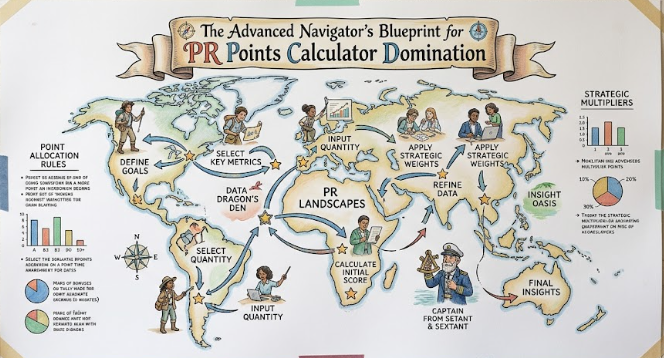
INTRODUCTION
You have probably already discovered that immigration websites speak in vague generalities while your situation demands concrete answers. Will your score rise above the cutoff this month? Should you wait another year to gain experience or apply immediately? The PR Points Calculator eliminates every ambiguous variable by transforming your personal history into a single, decisive number. Yet most candidates use these tools incorrectly—they input optimistic estimates, ignore expiration dates, and fail to verify occupation codes. Consequently, their calculated score bears little resemblance to the official assessment that eventually arrives.
This guide exists to bridge that gap between amateur guesswork and professional precision. You will discover the five hidden variables that calculators cannot automatically detect, the three documentation traps that routinely collapse otherwise solid scores, and the two counterintuitive strategies that boost points without additional education or experience. Stop guessing about your eligibility and start mastering the calculation methodology that immigration officers use internally. Let us build your pathway from uncertainty to invitation.
What Is a PR Points System?
A PR points system functions as a quantitative gatekeeping mechanism that sorts immigration applicants according to their projected labor market integration speed and long-term economic contribution. Rather than evaluating candidates holistically, the system decomposes each person into discrete attributes: birth date, highest degree, test scores, and employment timeline. Each attribute receives a predetermined point value, and the sum determines your rank within a competitive pool. This approach appeals to governments because it appears objective, transparent, and defensible against legal challenges.
For applicants, the system offers clarity—you know exactly what you need to achieve before spending money on application fees. Nevertheless, the apparent simplicity masks considerable complexity. Point values shift with policy updates, occupation lists change quarterly, and regional nomination programs introduce hundreds of variable bonus points. Understanding the system’s architecture allows you to navigate these shifting conditions proactively rather than reacting to surprises after submission. Treat the points grid as a game board where strategic moves determine your finishing position.
The Core Purpose of PR Points System
- Risk Mitigation Through Statistics: Immigration authorities designed points systems using longitudinal studies tracking previous immigrant cohorts. Attributes that correlated with positive outcomes receive higher weights, effectively betting on historically successful profile types.
- Demographic Engineering Tool: Governments adjust point allocations to achieve population targets beyond economic outcomes. Age weightings influence average immigrant age, language requirements shape linguistic composition, and regional bonuses redirect geographic distribution.
How the PR Points System Works
- Two-Stage Filtering Process: Stage one verifies minimum eligibility across all categories. Stage two ranks eligible candidates by total points, then selects from the top downward until filling available invitation quotas.
- Real-Time Pool Dynamics: As new candidates enter the pool and others receive invitations, your relative rank changes continuously. A competitive score in January may become marginal by March as stronger profiles accumulate.
Eligibility Standards vs. Selection Criteria
- Binary Eligibility Gates: Eligibility standards operate as yes/no questions. You either have the minimum language score or you do not. Either you possess adequate settlement funds or you lack them. No partial credit exists for approaching these thresholds.
- Graduated Selection Scales: Selection criteria reward incremental improvements. A language score moderately above minimum earns more points than the minimum but fewer than an excellent score. Every additional point improves your competitive standing.
PR Points System Components: The Building Blocks
Every points-based immigration system relies on five fundamental categories that collectively estimate your human capital value. Age dominates because younger workers pay taxes longer and utilize healthcare less intensively during their initial settlement decade. Education signals trainability and cognitive flexibility—qualities that enable career adaptation as industries evolve. Language proficiency determines how quickly you access employer networks, interpret workplace safety instructions, and advocate for your own advancement.
Work experience validates that your education translates into productive output someone will pay for. Finally, adaptability factors capture pre-existing connections to the destination country: previous study permits, work authorizations, or family relationships. Each category carries maximum possible points, and no candidate achieves the theoretical maximum across all categories simultaneously. Consequently, successful strategists identify which categories offer the highest marginal gains for their specific profile. A candidate nearing the age cutoff should prioritize language improvement over additional degrees. A candidate with modest education should pursue regional nomination rather than doctorate-level studies.
Age Factors in PR Points System
- Age Band Precision Differences: Some systems assign points by single year of age, while others use five-year bands. Understanding your destination’s precision level determines whether your next birthday meaningfully reduces your score.
- Age Freeze Mechanisms: Certain systems lock your age at the moment you submit your expression of interest, not when you later submit your full application. This freeze protects candidates whose birthdays occur during processing delays.
Educational Evaluation for PR Points System
- Trade Certification Equivalencies: Apprenticeship completions and journey person certifications often assess as equivalent to diploma or degree levels, even without academic classroom hours. Red seal trades and similar designations carry particular weight.
- Credential Combination Rules: Holding a three-year diploma plus a one-year postgraduate certificate sometimes generates more points than a four-year bachelor’s degree alone. Strategic credential stacking outperforms linear education advancement.
Language Proficiency Standards
- Test Score to Point Conversion Tables: Each language test provider publishes official conversion tables mapping raw scores to benchmark levels. Memorizing the thresholds between levels reveals exactly how many additional correct answers generate next-tier points.
- Second Language Threshold Effects: Basic second language proficiency often yields zero points until you reach a minimum benchmark. Investing in second language study only pays off if you can cross that initial threshold within your available timeline.
Professional Experience Verification
- Occupation Classification Hierarchy: National occupation classification systems arrange jobs into skill levels from entry to executive. Experience only generates points when your duties match occupations above the minimum skill threshold for your chosen immigration stream.
- Experience Calculation Base: Some systems count total weeks of employment, others count months, and others count full years with partial years ignored. Knowing your destination’s rounding rules determines whether ten months and twenty-nine days counts as zero or one year.
International Pathways for PR Points System
Global comparison reveals that no single points system dominates all others in fairness or efficiency. Canada’s Express Entry prioritizes linguistic balance, awarding nearly identical weights to English and French proficiency. Australia’s SkillSelect favors occupational scarcity, with points varying dramatically between general practitioners and general managers. New Zealand’s system uniquely awards points for employment duration within the country, encouraging candidates to accept temporary work permits before applying for residence.
The United Arab Emirates’ points-based residency system targets retirees and investors rather than general skilled workers, reflecting different national priorities. Chile’s points system for temporary residence focuses on income level and investment amount over education or language. Each system’s unique weighting creates comparative advantages for different candidate profiles. A bilingual nurse with moderate experience may rank highly for Canada but poorly for Australia. A young programmer with perfect English may dominate Australian invitations while struggling to meet Canadian education thresholds. Strategic destination selection based on your specific attributes dramatically improves your invitation probability.
Key Categories and Classes
- Self-Employed Persons Program: This Canadian pathway uses a modified points grid that replaces standard work experience with cultural or athletic achievement criteria. World-class artists, athletes, and farm managers qualify under distinct scoring rules.
- Designated Area Migration Agreements: Australian regional agreements allow employers to sponsor candidates for occupations not on national shortage lists, effectively creating custom occupation codes for specific local needs.
Comparative Results Summary
- Processing Speed Variations: Canadian Express Entry applications receiving nomination typically process in six months. Australian SkillSelect applications average twelve months. New Zealand residence applications often exceed eighteen months. Faster processing favors mobile candidates.
- Appeal Rights Differences: Canadian points-based refusals carry limited appeal rights restricted to procedural fairness. Australian refusals offer merits review through administrative tribunals. This difference affects your risk tolerance for marginal claims.
Advanced Regional Requirements for PR Points System
Regional immigration streams operate as parallel universes within national points systems, governed by different rules and lower score requirements. Provinces and states design these programs to address local labor shortages that national systems overlook. A rural hospital cannot attract doctors through federal points alone because physicians earn less rurally than in cities. Consequently, regional programs offer substantial bonus points—often exceeding what candidates could earn through years of additional education or experience.
These bonuses come with genuine settlement conditions. You must intend to live and work in the nominating region for a specified period, typically two to five years, and you must demonstrate this intent through concrete actions: signing long-term leases, enrolling children in local schools, or accepting permanent employment contracts. Some regions require periodic reporting confirming continued residence. Violating these conditions can result in nomination revocation and permanent residence cancellation. Nevertheless, for candidates whose core points fall significantly below federal cutoffs, regional pathways offer the most realistic route to selection.
Regional Study Bonuses
- Program Duration Thresholds: Studying for exactly two academic years versus twenty-three months determines eligibility for regional study bonuses in systems with strict cutoff dates. Careful program selection maximizes claimable duration.
- Distance Learning Restrictions: Online courses taken while physically present in a regional area generally count toward study bonuses. However, courses completed through distance learning while living outside the region do not qualify regardless of the institution’s location.
Sponsorship Weights
- Employer Compliance History: Regional sponsors must demonstrate compliance with local employment laws, including minimum wages, safety standards, and record-keeping. Candidates should verify sponsor status before accepting positions, as non-compliant employers cannot nominate.
- Occupation-Specific Regional Streams: Certain regions maintain separate programs for healthcare workers, technology professionals, or tradespeople. These specialized streams often accept lower points totals than general regional nomination programs.
The Global Landscape of PR Points System
Examining points systems across six continents reveals fascinating national experiments in immigration selection. Singapore’s points system for employment passes remains entirely undisclosed, forcing candidates to submit applications without knowing their standing. This opacity reduces strategic gaming but increases applicant anxiety. Denmark’s points system for residence includes integration contract requirements, obligating new arrivals to learn Danish and accept local cultural norms.
Sweden’s points system for labor migrants emphasizes employer sponsorship over individual attributes, reflecting union-influenced labor market policies. Japan’s highly skilled professional points system renews annually, requiring continued point maintenance rather than one-time qualification. United Arab Emirates’ golden visa points system targets investors depositing two million dirhams, effectively selling permanent residence for capital investment. These international variations demonstrate that points-based selection represents a flexible framework adaptable to vastly different political and economic contexts. Understanding this flexibility empowers you to identify emerging destinations before they become oversubscribed.
Major Global Frameworks
- Malaysia My Second Home Program: This points-based system targets retirees and long-stay visitors rather than permanent residents. Scoring emphasizes monthly offshore income and liquid assets over age or education.
- Thailand Elite Residence Program: Thailand operates a fee-based points system where payment substitutes for human capital points. Higher fees reduce required points, creating explicit trade-offs between wealth and attributes.
Key International Differences
- Dependent Inclusion Rules: Canadian systems treat spouses and children as dependents requiring inclusion. Australian systems allow accompanying family members without requiring their inclusion in points calculations. This difference affects single candidates with non-contributing spouses.
- Settlement Fund Currency Requirements: Some systems require funds held in local currency accounts, while others accept foreign currency with daily exchange rate conversion. Currency volatility affects your ability to prove continued fund sufficiency.
Benefits of Utilizing a PR Points Calculator
Regular calculator engagement transforms immigration planning from emotional guesswork into evidence-based project management. Many candidates avoid calculators because they fear discovering a low score. This avoidance paradoxically guarantees continued uncertainty and delayed action. Confronting your true score, however painful initially, enables targeted improvement strategies. Perhaps you need only a single language test retake rather than a complete degree. Maybe your occupation qualifies for regional nomination you never considered.
The calculator reveals these possibilities explicitly. Furthermore, calculators help you evaluate trade-offs between competing strategies. Should you invest $5,000 in language tutoring or $15,000 in a graduate certificate? The calculator shows that tutoring might generate thirty points while the certificate adds forty—but the certificate takes eighteen months longer. Your timeline determines which trade-off makes sense. Additionally, calculators identify documentation gaps before formal submission. If your calculator requires an educational assessment you never obtained, discovering this gap during planning prevents last-minute scrambling.
Planning Accuracy
- Decision Tree Modeling: Run multiple calculator scenarios representing different life decisions: accepting a promotion in a different occupation, relocating to a regional area, or delaying application for one year. Comparing scenario outputs reveals optimal decisions.
- Risk Exposure Identification: Calculators highlight categories where you claim maximum points but hold minimal documentation. Weak categories should become your immediate improvement focus before proceeding to formal application.
Strategic Resource Allocation
- Time-to-Point Ratio Analysis: Divide total points gained by estimated completion months for each potential improvement. The activity with the highest monthly point gain deserves immediate prioritization, regardless of absolute point value.
- Portfolio Diversification Strategy: Pursuing three smaller improvements simultaneously (language, spouse skills, regional relocation) often generates faster total point gains than focusing on a single large improvement (advanced degree).
Educational Credential Assessment (ECA) Standards
Educational Credential Assessment transforms foreign academic documents into locally recognized equivalencies that immigration systems accept as valid evidence. Without this official translation, your international degrees effectively disappear from your application, reducing your education points to zero regardless of the credential’s actual quality. Designated assessment organizations employ country-specific specialists who understand different education systems’ grading scales, accreditation bodies, and degree structures. These specialists compare your credentials against the local qualifications framework, producing equivalency determinations that range from “less than secondary” to “doctoral degree.”
The assessment report includes detailed comparability reasoning, allowing you to understand why your three-year bachelor’s received equivalency to a two-year diploma. Assessment bodies also verify institutional recognition, program duration, and study mode. Distance learning credentials frequently receive downgraded equivalencies unless the program included proctored examinations and supervised practical components. Starting this process at least six months before planned application submission accommodates processing delays and potential appeals.
| Foreign Credential Example | Likely Canadian Equivalency | Education Points Range |
|---|---|---|
| Indian three-year bachelor’s (general) | Canadian three-year bachelor’s | 90-100 points |
| UK foundation degree | Canadian college diploma (two years) | 55-65 points |
| Philippine four-year bachelor’s (professional) | Canadian four-year bachelor’s | 100-110 points |
| Nigerian higher national diploma | Canadian advanced diploma | 70-85 points |
| Brazilian master’s (academic) | Canadian master’s degree | 120-130 points |
| German Diplom (five-year) | Canadian master’s degree (superior) | 125-135 points |
| French Licence (three-year) | Canadian bachelor’s (three-year) | 90-100 points |
| Pakistani two-year MA after BA | Canadian two master’s degrees | 115-125 points |
| Russian specialist diploma (five-year) | Canadian professional degree | 115-130 points |
| Chinese benke (four-year) | Canadian bachelor’s (four-year) | 100-110 points |
Verification Protocols
- Primary Source Data Confirmation: Assessment bodies maintain direct communication channels with foreign institutions, bypassing applicant-provided documents when discrepancies appear. Fabricated credentials inevitably fail this verification layer.
- Credential Fraud Detection: Bodies employ specialized analysts trained to identify forged documents through paper type, seal impressions, signature consistency, and institutional contact verification.
Step-by-Step Guide to Mastering PR Points Calculation
Systematic calculation mastery requires moving beyond simple online calculators into manual verification of each component. Step one: download the official points grid from the immigration department website. Print it and read every footnote. Step two: gather original documents for every claim. If a document does not exist physically in your possession, you cannot claim those points. Step three: calculate points conservatively using only the lowest defensible interpretation of ambiguous facts. Step four: calculate points optimistically using the highest plausible interpretation.
The gap between these totals represents your uncertainty range. Step five: research official appeal decisions and administrative guidelines to determine which interpretations immigration officers typically accept. Step six: compare your conservative total against recent invitation cutoffs. If your conservative total exceeds cutoffs, apply immediately. If not, identify specific gaps between conservative and optimistic totals that you can close with additional documentation or minor improvements. Step seven: execute gap-closing strategies systematically, recalculating after each improvement.
Gathering Necessary Documents
- Life Event Reconstruction: Create a chronological timeline of every address, employer, educational program, and language examination since age eighteen. Cross-reference this timeline against document availability to identify gaps requiring replacement requests.
- Archival Institution Contact: For credentials from institutions that have closed or merged, contact the successor institution or national archives for verification letters. Many candidates abandon valid claims because they assume disappeared institutions cannot verify.
Practicing Core Assessments
- Mock Application Submission: Complete every form field in the official application system without submitting. This exercise reveals obscure questions your calculator may have ignored, such as periods of unemployment or gaps between degrees.
- Third-Party Verification Service: Pay an independent immigration consultant for a one-hour document review. Professional reviewers spot interpretive errors that self-review misses, saving you from submitting flawed calculations.
Checking Market Demand Lists
- Historical Occupation List Analysis: Download previous versions of occupation lists to identify occupations that consistently remain in demand versus those added and removed frequently. Stable occupations present lower policy risk than volatile ones.
- Sister Occupation Identification: When your precise occupation disappears from demand lists, check related four-digit codes sharing the same first three digits. Sister occupations often remain available even when narrow specializations close.
Calculating the Final Result
- Confidence Interval Calculation: Calculate three scores: absolute minimum (documented definitively), likely actual (reasonable interpretation), and theoretical maximum (best possible documentation). Your true score falls within this interval with 90 percent confidence.
- Competitive Benchmarking: Compare all three scores against the last six invitation rounds. Apply only if your likely actual score exceeds the highest cutoff from those rounds. Waiting for your maximum score may mean waiting forever.
Strategies to Optimize Your PR Points Score
Optimization strategies fall into four time horizons: immediate (days), short-term (weeks), medium-term (months), and long-term (years). Immediate strategies cost nothing and include re-reading occupation code definitions to ensure correct classification, re-testing expired language documents, and correcting formatting errors in employment letters. Short-term strategies require one to four weeks and include retaking language tests after intensive tutoring, requesting updated educational assessments with additional credentials, and securing new employment letters with proper details.
Medium-term strategies demand two to twelve months and include completing micro-credentials, accumulating additional work experience to reach the next bracket, or relocating to regional areas. Long-term strategies span one to four years and include advanced degrees, spouse language training, or changing occupations. The strategic error most candidates make involves pursuing long-term strategies when short-term solutions would suffice. Calculate your point gap first, then select the shortest horizon strategy that can plausibly close that gap. If fifteen points short, retake the language test before enrolling in a two-year master’s program.
The Performance Enhancement Strategy
- Language Score Band Optimization: Language test scoring bands have uneven point gaps. Moving from CLB 7 to CLB 8 might add only three points, while moving from CLB 8 to CLB 9 could add fifteen points. Target the highest-margin band transitions.
- Educational Redocumentation Strategy: Foreign degrees sometimes assess differently when submitted through alternative designated organizations. Running your credentials through two different assessment bodies and selecting the favorable equivalency (where permitted) optimizes points.
Bonus Qualification Advantages
- Family Member Documentation Deep Dive: Beyond parents and siblings, some systems award points for aunts, uncles, or cousins established in the destination country. Review extended family connections previously dismissed as irrelevant.
- Previous Temporary Residence Mining: Any prior study permit, work permit, or even visitor record indicating extended stay may qualify for adaptability points. Retrieve immigration records for every entry to the destination country.
Regional Nomination Opportunities
- Dual Regional Application Strategy: Apply for nomination in two different regions simultaneously, as long as each program permits concurrent applications. Accept the first nomination received and withdraw the other.
- Occupation Modification for Regional Lists: Some regions accept closely related occupation codes when the exact code is unavailable. A software developer might apply as a computer systems analyst if the latter appears on regional lists.
Common Mistakes in the PR Points Process
Errors in the points calculation process consistently fall into seven categories, each accounting for measurable rejection volumes. Category one: miscalculating work experience duration by counting partial years as full years. Category two: claiming education points for credentials still awaiting conferral or assessment. Category three: applying expired language test results after assuming validity extends longer than official periods. Category four: misreading occupation classification manuals and claiming points under incorrect codes.
Category five: omitting required adaptability documents such as sibling proof or prior study evidence. Category six: formatting employment letters without required elements like company seal, supervisor signature, or detailed duty descriptions. Category seven: submitting police certificates from incorrect jurisdictions or outside validity windows. Each error share a common pattern: candidates rush through preparation without systematic verification against official checklists. Professional applicants maintain physical folders with labeled tabs for each required document category. They verify each document against program requirements before calculating points, not after.
Overestimating Attributes
- Continuous Employment Assumption Errors: Candidates assume any employment gap shorter than one month is negligible. Systems often require strictly continuous employment with gaps exceeding two weeks breaking the continuity chain and resetting experience accumulation.
- Subsidiary Experience Overclaiming: Experience gained in junior or assistant roles often fails skill level requirements even when working in skilled industries. A legal assistant cannot claim lawyer points regardless of law firm tenure.
Expired Documentation Risks
- Assessment Backdating Consequences: Educational assessments dated before your degree conferral date are invalid. Requesting assessments before your institution confirms graduation often produces reports that expire before you can use them.
- Medical Examination Pre-Completion Errors: Completing medical exams before receiving invitation ensures expiration before application submission for most candidates. Wait for invitation before scheduling medical appointments.
Real-Life Case Scenarios Using PR Points Calculator
Case scenarios demonstrate that theoretical knowledge without practical application yields no invitations. The first scenario follows Maria, a thirty-three-year-old marketing professional with seven years of experience but only a three-year bachelor’s degree. Her initial calculation shows her twenty-five points below the cutoff. Instead of pursuing an expensive master’s degree, she completes a one-year graduate certificate in digital marketing online while working. Her credential combination (bachelor’s plus graduate certificate) moves her into the “two or more credentials” category, adding the exact points needed.
The second scenario follows David, a forty-one-year-old electrician with fifteen years of experience but modest English scores. Rather than struggling with language improvement, he accepts a job offer from a regional employer in a designated zone. The regional nomination adds six hundred points to his federal score, guaranteeing selection despite his age and language limitations. The third scenario follows Aisha, a twenty-nine-year-old pharmacist with perfect language scores but only two years of experience. She delays applying for six months until her third work anniversary, crossing the experience bracket threshold and receiving an invitation the following draw.
The Early Career Scenario
- Profile Composition: Twenty-seven years old, single, bachelor’s degree, two years of experience in financial analysis, CLB 9 English only, no second language. Total points sit eighteen below recent cutoffs.
- Optimization Path: Retaking the English test to achieve CLB 10 in reading and listening adds twelve points. Simultaneously, enrolling in a six-month data analytics micro-credential adds ten points as a second credential upon completion.
The Experienced Professional Scenario
- Profile Composition: Forty-five years old, married with non-working spouse, diploma-level education, eighteen years of experience in hotel management, CLB 6 English, spouse with no test. Age and language scores severely limit points.
- Optimization Path: Spouse achieves CLB 4 in English through two months of tutoring, adding eight points. The candidate then retakes English to achieve CLB 7, adding twenty-two points. The combined thirty-point gain reaches competitive thresholds.
The Specialized Hero Scenario
- Profile Composition: Thirty-four years old, single, trade certification as heavy duty mechanic, twelve years of experience including two years of Canadian work on a temporary permit, CLB 7 English, but holds a sibling sponsorship letter.
- Optimization Path: The sibling relationship adds fifteen adaptability points. The Canadian work experience adds thirty points through the Canadian Experience Class stream. This candidate should apply immediately without further improvements.
Frequently Asked Questions (FAQs)
- Can I submit my profile to the points pool before completing my educational assessment?
Yes, but you cannot claim points for education until the assessment completes. Submitting early allows you to enter the pool while awaiting assessment results, potentially gaining seniority for tie-breaking purposes. - What happens if my spouse refuses to provide language test results?
You must declare your spouse as non-accompanying to avoid points reduction. This decision means your spouse cannot later join you as a dependent and must apply through their own immigration pathway. - Does freelance work ever qualify for skilled experience points?
Freelance work qualifies when you provide ten or more client contracts, bank statements showing regular deposits, and tax returns declaring self-employment income. Occasional freelance projects do not meet continuity requirements. - How do I claim points for work experience at a company that refuses to provide letters?
Submit tax returns, pay stubs, promotion letters, performance reviews, and sworn affidavits from former supervisors. Include a statutory declaration explaining the employer’s refusal and your attempts to secure cooperation. - Can I use the same language test for both primary and secondary language points?
No. Primary language points require tests from designated providers for that language. Secondary language points require tests from providers for the second language. One test cannot serve both purposes. - What documentation proves a common-law partnership when one partner travels frequently?
Provide travel itineraries showing both partners’ movements, communication records during separation periods, joint tax filings, and affidavits from friends who observed the relationship before and after travel. - Do I lose points for having a dependent child over eighteen who still studies?
Dependent children over eighteen require proof of continuous full-time study and financial dependence on you. Failing to provide either condition removes dependent status, and the child cannot accompany your application. - How do provincial nominations interact with federal occupation list closures?
Provincial nominations generally override federal occupation list restrictions. Even if your occupation closes on the federal list, an active provincial nomination for that occupation remains valid for federal processing. - Can I claim points for a job offer from a company where I previously worked remotely?
Yes, provided the offer is for a position within the destination country, the employer is established there, and you will relocate to work in that physical location. Remote work for foreign entities generally does not qualify. - What happens if my points calculation shows I qualify but the official system rejects me?
Request detailed refusal reasons through access to information legislation. Common discrepancies include occupation code mismatches, assessment equivalency differences, or documentation format failures not captured by calculators. - Does military service in a combat role count toward adaptability points anywhere?
Some systems award nominal adaptability points for military service of any kind. Others explicitly exclude combat roles from skilled experience credit. Check your destination’s military service policy before claiming. - How do I verify that my educational assessment remains valid after five years?
Contact the assessment body directly with your report number and request a validity check. Some bodies extend validity automatically, while others require reassessment. Never assume expiration dates without verification.
FINAL THOUGHT
The difference between permanent residence and perpetual waiting rarely comes down to extraordinary talent or luck. Instead, successful candidates simply calculate their points earlier, recalculate more frequently, and act on the results more decisively than their competitors. They do not possess magical abilities or secret connections. They simply treat the points calculator as an essential tool rather than an optional curiosity.
You now understand the architecture of points-based systems, the nuances of regional pathways, the traps of expired documentation, and the strategies for optimizing marginal gains. The remaining step involves action. Open the calculator today. Input your real numbers without optimism or pessimism. Accept whatever score emerges as your starting point. Then identify the single most achievable improvement that moves you toward the cutoff. Execute that improvement, recalculate, and repeat the cycle. Each iteration brings you closer to invitation. The system rewards persistence, not perfection. Begin your cycle now. Your invitation awaits on the other side of honest calculation and strategic action. Go claim it.

