
Introduction
The Certified DevSecOps Manager is a specialized leadership credential designed for professionals who aim to bridge the gap between technical security execution and high-level strategic management. This guide is curated for senior engineers, security leads, and technical managers who need to navigate the complexities of modern software delivery while maintaining a robust security posture. As organizations globally move toward a “shift-left” philosophy, understanding how to govern security within a high-velocity environment is no longer a luxury but a requirement. This guide helps you evaluate the ROI of this certification and decide how it fits into your long-term career roadmap through the DevSecOpsSchool platform.
What is the Certified DevSecOps Manager?
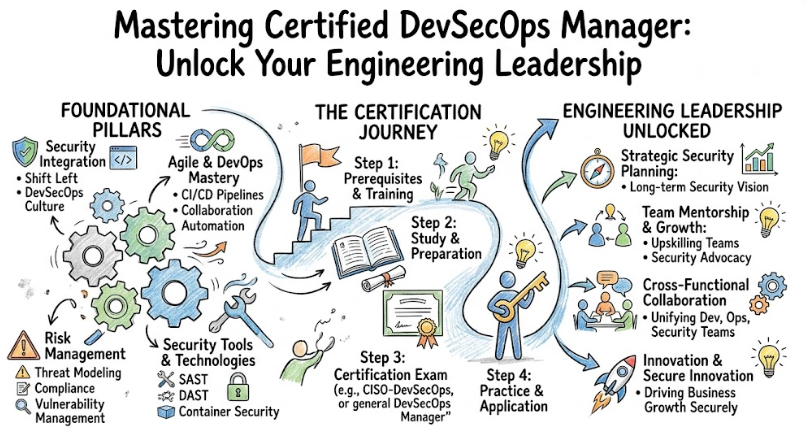
The Certified DevSecOps Manager represents a shift from being a hands-on implementer to becoming a strategic architect of security culture and policy. It exists because technical skills alone are insufficient to scale security across large enterprise teams in the cloud-native era. This program focuses on the orchestration of security tools, the establishment of automated compliance frameworks, and the leadership of cross-functional teams. It aligns with modern engineering workflows by emphasizing how to integrate security gates without hindering the speed of the continuous delivery pipeline.
Who Should Pursue Certified DevSecOps Manager?
This certification is ideal for senior DevOps engineers, Site Reliability Engineers (SREs), and cloud architects who are transitioning into leadership roles. It is equally valuable for security professionals who need to understand the pace of modern software development and for engineering managers who oversee platform teams. In the global market, and particularly within the rapidly maturing tech ecosystem in India, there is a massive demand for leaders who can handle both the “Dev” and the “Sec” at a managerial level.
Why Certified DevSecOps Manager is Valuable and Beyond
The demand for DevSecOps leadership is driven by the increasing frequency of supply chain attacks and the complexity of hybrid-cloud environments. As enterprises adopt Kubernetes, serverless, and multi-cloud strategies, they require managers who can implement consistent security governance. This certification ensures longevity in your career because it focuses on principles and leadership strategies that remain relevant even as specific tools evolve. It provides a high return on investment by positioning you for high-level decision-making roles in the enterprise.
Certified DevSecOps Manager Certification Overview
The program is delivered via Certified DevSecOps Manager modules and is hosted on the DevSecOpsSchool platform. The certification follows a rigorous assessment approach that includes both theoretical knowledge and practical understanding of governance frameworks. It is designed to evaluate a candidate’s ability to build a DevSecOps roadmap, manage organizational risk, and lead cultural change within a technical department. Unlike entry-level certificates, this focuses on the managerial aspect of the security lifecycle.
Certified DevSecOps Manager Certification Tracks & Levels
The certification is structured to support different stages of professional growth, moving from foundational security management to advanced enterprise governance. The levels include Foundation for those new to security leadership, Professional for active practitioners, and Advanced for those managing large-scale organizational transformations. These tracks allow professionals in DevOps, SRE, or FinOps to specialize their security management skills according to their specific domain requirements and career goals.
Complete Certified DevSecOps Manager Certification Table
| Track | Level | Who it’s for | Prerequisites | Skills Covered | Recommended Order |
| Management | Foundation | Aspiring Managers | 3+ years in IT | DevSecOps Culture, Basics | 1st |
| Governance | Professional | Team Leads | Foundation Cert | Policy as Code, Risk Mgmt | 2nd |
| Enterprise | Advanced | Directors/CTOs | Professional Cert | Strategic ROI, Compliance | 3rd |
Detailed Guide for Each Certified DevSecOps Manager Certification
Certified DevSecOps Manager – Foundation Level
What it is
This level validates your understanding of the core pillars of DevSecOps from a non-technical management perspective. It focuses on the “why” and the “how” of security integration in the SDLC for new leaders.
Who should take it
Aspiring leads and project managers who have a technical background but are new to formal security governance and team leadership.
Skills you’ll gain
- Building a security-first culture
- Understanding the DevSecOps toolchain
- Basic threat modeling for managers
- Incident response coordination
Real-world projects you should be able to do
- Designing a basic DevSecOps roadmap for a small team
- Conducting a security gap analysis for an existing CI/CD pipeline
Preparation plan
- 7 Days: Focus on the DevSecOps Manifesto and core terminology.
- 30 Days: Review case studies of successful security integrations.
- 60 Days: Deep dive into compliance standards like ISO 27001 and SOC2.
Common mistakes
- Focusing too much on specific tools rather than the underlying processes.
- Underestimating the cultural challenges of shifting security left.
Best next certification after this
- Same-track: Professional Certified DevSecOps Manager
- Cross-track: Certified SRE Practitioner
- Leadership: ITIL 4 Leader
Certified DevSecOps Manager – Professional Level
What it is
This certification validates your ability to implement and oversee a full-scale DevSecOps program across multiple departments. It proves you can manage both the technology and the people at scale.
Who should take it
Active DevSecOps leads and senior managers who are responsible for the security posture of production environments and delivery pipelines.
Skills you’ll gain
- Managing Policy as Code (PaC) implementations
- Budgeting for security tools and personnel
- Establishing KPIs and metrics for DevSecOps success
- Vendor management and tool selection
Real-world projects you should be able to do
- Implementing an automated compliance monitoring dashboard
- Lead a cross-functional post-mortem for a security incident
Preparation plan
- 7 Days: Refresh knowledge on SCA, SAST, and DAST automation.
- 30 Days: Study legal and regulatory requirements for data privacy.
- 60 Days: Build a full business case for a DevSecOps transformation.
Common mistakes
- Neglecting the financial impact of security tooling (FinOps overlap).
- Failing to align security goals with business delivery timelines.
Best next certification after this
- Same-track: Advanced Certified DevSecOps Manager
- Cross-track: Certified FinOps Professional
- Leadership: CISSP (Certified Information Systems Security Professional)
Choose Your Learning Path
DevOps Path
This path focuses on the seamless integration of security into the existing CI/CD workflows. It is designed for those who want to ensure that speed and safety are not mutually exclusive. Professionals here learn to manage automated gates and developer-friendly security tools to maintain a fast release cycle.
DevSecOps Path
This is the core path for security specialists moving into management. It covers the entire spectrum of the security lifecycle, from threat modeling during design to runtime protection in production. It emphasizes a holistic view of the software supply chain and continuous monitoring.
SRE Path
The SRE path focuses on the intersection of security and reliability. Managers in this track learn how security vulnerabilities impact system availability and how to include security objectives in their Service Level Objectives (SLOs) and Error Budgets to ensure a resilient platform.
AIOps Path
This path explores the use of machine learning to enhance security operations. Managers learn how to oversee AI-driven threat detection systems and how to manage the noise generated by automated security alerts to focus on the most critical risks.
MLOps Path
Focusing on the security of machine learning pipelines, this path is for those managing data science teams. It covers model integrity, data privacy in training sets, and the security of model deployment endpoints to protect the intellectual property of the organization.
DataOps Path
The DataOps path is dedicated to data governance and security management within data pipelines. It addresses how to manage sensitive data access, encryption at rest and in transit, and compliance with global data protection laws like GDPR or CCPA.
FinOps Path
This path connects security management with cloud cost optimization. It helps managers understand the cost of security tools and how to balance the budget between performance, security, and cloud spend to ensure the program remains financially sustainable.
Role → Recommended Certified DevSecOps Manager Certifications
| Role | Recommended Certifications |
| DevOps Engineer | Foundation DevSecOps Manager |
| SRE | Professional DevSecOps Manager |
| Platform Engineer | Governance and Policy Specialist |
| Cloud Engineer | Cloud Security Management |
| Security Engineer | Advanced DevSecOps Leadership |
| Data Engineer | Data Security and Compliance |
| FinOps Practitioner | Security Cost Management |
| Engineering Manager | Enterprise DevSecOps Strategy |
Next Certifications to Take After Certified DevSecOps Manager
Same Track Progression
Deep specialization involves moving toward the Advanced level of the manager track. This path focuses on executive-level leadership, where you are not just managing a team, but setting the security vision for the entire organization and interacting with board-level stakeholders.
Cross-Track Expansion
Broadening your skills into FinOps or SRE is a highly strategic move. A manager who understands how security impacts both the cloud bill and the system’s uptime is incredibly valuable to any modern enterprise seeking to maximize efficiency and resilience in the cloud.
Leadership & Management Track
For those looking to move into C-suite roles like a CISO or CTO, combining this certification with general management training is essential. It helps transition from technical security management to broad business strategy and complex organizational risk management.
Training & Certification Support Providers for Certified DevSecOps Manager
DevOpsSchool
This provider is a pioneer in the DevOps training space, offering a comprehensive curriculum that covers everything from basics to advanced management. They provide expert-led sessions and access to a massive library of resources specifically tailored for the Certified DevSecOps Manager track.
Cotocus
A well-known name in corporate training, Cotocus specializes in providing hands-on lab environments. Their focus is on ensuring that the management principles taught in the certification are backed by a solid understanding of how the underlying tools operate in real time.
Scmgalaxy
This community-driven platform offers deep insights into configuration management and continuous integration. For a DevSecOps manager, their resources provide a unique perspective on how to manage the software supply chain and maintain version control integrity.
BestDevOps
Focusing on quality and career-oriented learning, BestDevOps provides tailored coaching for professionals looking to clear their certifications on the first attempt. Their study materials are frequently updated to reflect the latest trends in the security industry.
devsecopsschool.com
The primary portal for this certification, providing the official curriculum and exam guidelines. It serves as the central hub for candidates to access their coursework, interact with mentors, and join a global network of security professionals.
sreschool.com
While specialized in reliability, this provider offers crucial modules on how security management intersects with site reliability. It is an excellent resource for managers who need to understand the operational impact of security policies.
aiopsschool.com
This platform provides the necessary training for the AIOps path, focusing on how artificial intelligence can be used to automate the governance and monitoring tasks that a DevSecOps manager oversees in complex environments.
dataopsschool.com
This provider focuses on the “Data” in DevSecOps. Their training is essential for managers who are responsible for data-heavy applications and need to ensure that security is integrated into the data engineering process.
finopsschool.com
As cloud costs become a primary concern, this provider teaches managers how to align their security strategies with cloud financial management, ensuring that security implementations are cost-effective and scalable.
Frequently Asked Questions (General)
- How difficult is the Certified DevSecOps Manager exam?
The exam is moderately difficult as it requires a blend of technical knowledge and management intuition. It is not just about memorization; it is about applying principles to scenarios.
- How much time does it take to get certified?
Depending on your experience, it typically takes 4 to 8 weeks of consistent study. If you are already in a leadership role, you might complete it faster.
- Are there any mandatory prerequisites for this certification?
While not strictly enforced for the Foundation level, having 3-5 years of experience in IT, DevOps, or Security is highly recommended for the Professional and Advanced levels.
- What is the return on investment for this certification?
The ROI is high, often leading to salary increases or promotions to leadership roles. It makes you a “T-shaped” professional with both broad and deep skills.
- In what order should I take these certifications?
It is best to start with the Foundation level, move to the Professional level, and then branch out into specializations like SRE or FinOps based on your role.
- Does this certification expire?
Most certifications in this domain require renewal every two to three years to ensure that your skills remain current with the latest technology shifts.
- Is the exam available online or at a center?
The exam is typically delivered online through proctored platforms, allowing you to take it from anywhere in the world.
- Are there lab-based questions in the assessment?
Yes, the professional and advanced levels often include scenario-based questions that test your ability to solve real-world management problems.
- Can I skip the Foundation level?
If you have extensive documented experience in DevSecOps management, some providers may allow you to challenge the Professional level directly.
- How does this compare to a CISSP?
While CISSP is a broad security management cert, this is specifically focused on the high-velocity DevOps and cloud-native ecosystem.
- Is there a community for certified professionals?
Yes, holders of this certification get access to exclusive forums and networking groups through the hosting platforms.
- Are the study materials included in the course fee?
Generally, the course fee includes access to videos, reading materials, and practice exams on the official website.
FAQs on Certified DevSecOps Manager
- What is the core focus of the Certified DevSecOps Manager program?
The program focuses on governance, risk management, and the cultural transformation required to integrate security into the DevOps lifecycle at an enterprise scale.
- Does this certification cover specific tools like Jenkins or GitLab?
It covers the management of these tools within a pipeline, focusing on how to audit them and ensure they are secure, rather than just how to use them.
- Is threat modeling a significant part of the curriculum?
Yes, it is a key component, specifically teaching managers how to lead threat modeling sessions and prioritize the findings within the development backlog.
- How does this help in compliance audits?
It teaches you how to automate the collection of audit evidence, making compliance a continuous process rather than a periodic, manual struggle.
- Is this certification recognized globally?
Yes, it is recognized by major tech firms and service providers worldwide as a standard for DevSecOps leadership competence.
- What is the difference between a DevSecOps Engineer and a DevSecOps Manager?
The engineer focuses on implementing tools and fixing vulnerabilities, while the manager focuses on policy, strategy, budget, and team alignment.
- How does this certification address cloud-native security?
It includes deep dives into managing security for containers, Kubernetes, and serverless architectures from a governance perspective.
- Can a project manager with no coding skills pass this?
It would be difficult without a basic understanding of software development, as the certification requires context on how code moves through a pipeline.
Final Thoughts: Is Certified DevSecOps Manager Worth It?
From a mentor’s perspective, the value of a certification isn’t in the digital badge, but in the structured thinking it provides. The Certified DevSecOps Manager is worth the investment if you are looking to step out of the engine room and onto the bridge.
It gives you the vocabulary to talk to the business about risk and the technical authority to talk to engineers about implementation. In a world where security is everyone’s responsibility but no one’s priority, the industry needs managers who can make security a fundamental part of the delivery process. If you want to be that leader, this is a solid step forward in your professional journey.

