
Introduction
Becoming a pilot is one of the most exciting and respected career choices in India. It offers a combination of technology, responsibility, travel, and high professional growth. However, before entering the cockpit, every aspiring pilot must build a strong foundation in Mathematics and Physics, because aviation is completely based on scientific principles, calculations, and real-time decision-making.
In India, pilot training is regulated by the Directorate General of Civil Aviation (DGCA). This authority ensures that students entering aviation training have the necessary academic background to understand flight principles safely and effectively.
This blog explains the complete maths and physics requirements for Indian pilot aspirants, including syllabus expectations, real-world usage, preparation methods, and FAQs.
✈️ Why Maths and Physics Are Important for Pilots
Flying an aircraft is not just about controlling instruments. It is about understanding how the aircraft behaves in different conditions and making accurate decisions in seconds.
A pilot constantly deals with:
- Speed, distance, and time calculations
- Fuel planning and weight distribution
- Weather interpretation
- Navigation and course correction
- Air pressure and altitude changes
Without strong Maths and Physics skills, handling these responsibilities becomes difficult and unsafe.
📘 Minimum Educational Requirements for Pilot Training in India
To become a pilot in India, students must meet basic eligibility criteria.
✔️ 10+2 Qualification
- Completion of 10+2 (Higher Secondary Education) is mandatory
- Must be from a recognized board
✔️ Compulsory Subjects
- Physics
- Mathematics
These subjects are required because they form the core foundation of aviation training.
✔️ Alternative Pathway
If a student has not studied Physics or Mathematics in school:
- They can complete equivalent subjects through open schooling systems
- Some institutes may require additional bridge courses
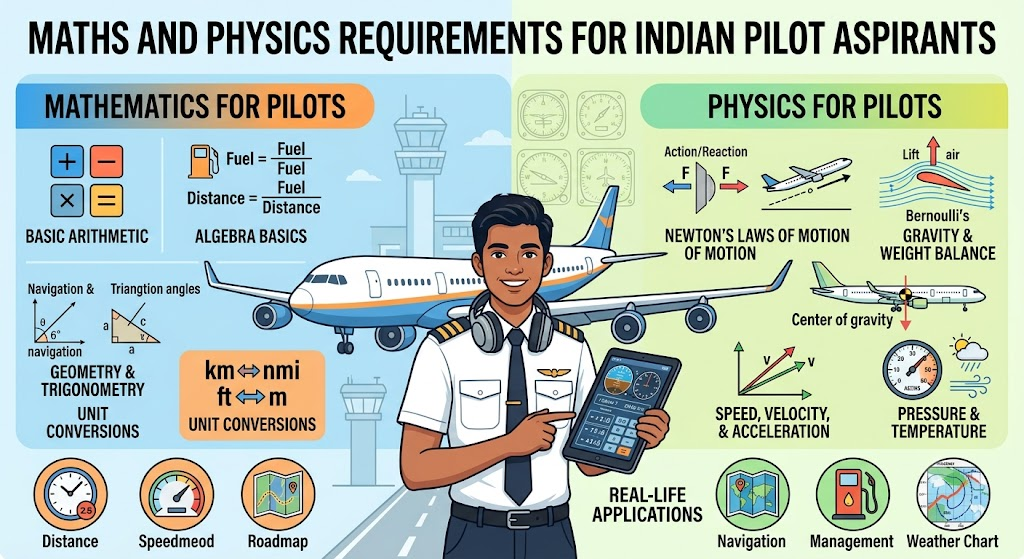
📊 Maths Requirements for Indian Pilot Aspirants
Mathematics is not used in a complex theoretical way in aviation. Instead, it is used in quick, practical, and real-life flight calculations.
➤ Basic Arithmetic
Pilots use:
- Addition and subtraction
- Multiplication and division
- Percentage calculations (fuel, load, etc.)
➤ Algebra Basics
Used in:
- Flight planning formulas
- Fuel consumption calculations
- Time-speed-distance problems
➤ Geometry & Trigonometry
Important for:
- Navigation angles
- Wind correction calculations
- Flight path adjustments
➤ Unit Conversions
Essential conversions include:
- Kilometers ↔ Nautical miles
- Feet ↔ meters
- Liters ↔ kilograms
➤ Time, Speed, Distance
Used for:
- Estimating arrival time
- Fuel requirement planning
- Adjusting speed in changing conditions
🔬 Physics Requirements for Indian Pilot Aspirants
Physics is the science behind how aircraft fly. Every movement in aviation is governed by physical laws.
✈️ Newton’s Laws of Motion
Pilots must understand:
- Why aircraft move forward
- How forces act during takeoff and landing
- Stability and control during flight
🌬️ Bernoulli’s Principle
Explains:
- How wings generate lift
- How air pressure difference enables flight
⚖️ Gravity and Weight Balance
Important for:
- Aircraft loading
- Center of gravity balance
- Safe takeoff and landing
🚀 Speed, Velocity, and Acceleration
Used in:
- Flight control
- Emergency handling
- Takeoff performance
🌡️ Pressure and Temperature
Important for:
- Altitude changes
- Cabin pressurization
- Weather effects on flying
🧭 Real-Life Applications of Maths & Physics in Flying
Maths and Physics are used in every stage of a flight operation.
✈️ Navigation
- Determining direction using coordinates
- Correcting flight path due to wind
⛽ Fuel Management
- Calculating fuel burn rate
- Ensuring emergency fuel reserves
⏱️ Flight Time Calculation
- Estimating arrival time
- Managing delays
🌦️ Weather Analysis
- Understanding turbulence
- Wind speed and direction interpretation
🛬 Takeoff & Landing
- Runway distance calculation
- Required speed and lift calculations
📉 Difficulty Level of Maths and Physics for Pilot Aspirants
❌ Myth:
You need advanced engineering-level Maths and Physics.
✅ Reality:
You only need strong basics and practical understanding.
Pilot training focuses on:
- Logical thinking
- Formula application
- Real-world problem solving
- Speed and accuracy
With regular practice, these subjects become easy to handle.
📚 How to Prepare for Maths and Physics for Pilot Career
📖 Strengthen Basics
- Revise NCERT 10th and 12th level concepts
- Build strong fundamentals
✏️ Practice Daily Calculations
- Mental maths exercises
- Speed-based problem solving
🎯 Learn Through Aviation Examples
- Apply physics to flight situations
- Solve navigation-based maths problems
🧑🏫 Coaching or Self-Study
- Coaching gives structured guidance
- Self-study builds consistency
📝 Mock Tests
- Improve speed
- Understand exam pattern
- Build confidence
🚀 Importance in CPL Training
During Commercial Pilot License (CPL) training, Maths and Physics help in:
- Understanding aircraft systems easily
- Clearing DGCA exams confidently
- Performing better in simulators
- Making quick in-flight decisions
A strong foundation reduces learning difficulty and improves performance.
✈️ Career Impact for Indian Pilot Aspirants
Strong Maths and Physics skills lead to:
- Better aviation understanding
- Faster exam clearance
- Higher confidence in training
- Improved safety awareness
- Strong performance in airline selection
❓ FAQs
1. Is Maths compulsory to become a pilot in India?
Yes, Mathematics is generally required along with Physics in 10+2 for most DGCA-approved pilot training institutes. It helps in understanding navigation, speed calculations, and flight planning.
2. Can I become a pilot without Physics in 12th?
Physics is highly recommended and often mandatory. However, some students can complete it later through open schooling or equivalent courses before joining training institutes.
3. Do pilots need advanced Mathematics like engineering?
No. Pilots only need basic and applied Mathematics such as arithmetic, algebra, trigonometry, and unit conversions used in real-time flight operations.
4. How difficult is Physics for pilot training?
Physics is not very difficult if you focus on fundamentals. Concepts like motion, pressure, and aerodynamics are more important than complex theory.
5. Why is Maths important for pilots?
Maths helps pilots calculate fuel, distance, speed, altitude changes, and flight timing, all of which are essential for safe flying.
6. What Physics topics are most important for pilots?
Important topics include Newton’s laws, Bernoulli’s principle, gravity, motion, pressure, and basic aerodynamics.
7. Can average students become pilots?
Yes. Students with average academic scores can become pilots if they are strong in fundamentals, practice regularly, and clear DGCA exams.
8. Is coaching necessary for Maths and Physics in pilot training?
Coaching is helpful but not mandatory. Many students succeed through self-study with disciplined practice and aviation-focused learning.
9. How long does it take to prepare Maths and Physics for pilot training?
With consistent study, a strong foundation can be built in 6–12 months depending on the student’s starting level.
10. What is the most important skill for pilot aspirants?
Apart from Maths and Physics, logical thinking, decision-making, and situational awareness are equally important for becoming a successful pilot.
🎯 Conclusion
Maths and Physics are the backbone of every pilot’s journey. From calculating fuel and navigation routes to understanding how an aircraft lifts, turns, and lands safely, these two subjects play a crucial role in aviation.
For Indian pilot aspirants, strong fundamentals in Maths and Physics are not just academic requirements—they are essential life skills that directly impact flight safety and decision-making in real-time situations.
The good news is that you don’t need advanced engineering-level knowledge. What truly matters is a clear understanding of basics, regular practice, and the ability to apply concepts in practical aviation scenarios.
If you are serious about becoming a pilot, start strengthening your foundation today. Focus on consistency, build confidence in calculations, and connect your learning with real flying situations.
With dedication and the right preparation, you can successfully clear your training, perform well in DGCA exams, and move closer to your dream of becoming a professional pilot.
The journey may be challenging—but the reward is truly worth it. ✈️

