
Introduction
Aviation continues to attract thousands of students in India who dream of becoming professional pilots. Before stepping into commercial aviation, every aspiring pilot begins their journey with the Student Pilot License (SPL).
The Student Pilot License is the first official certification in the aviation training pathway regulated by the Directorate General of Civil Aviation (DGCA). It allows students to begin structured aviation learning, understand aircraft systems, and prepare for real flight training under supervision.
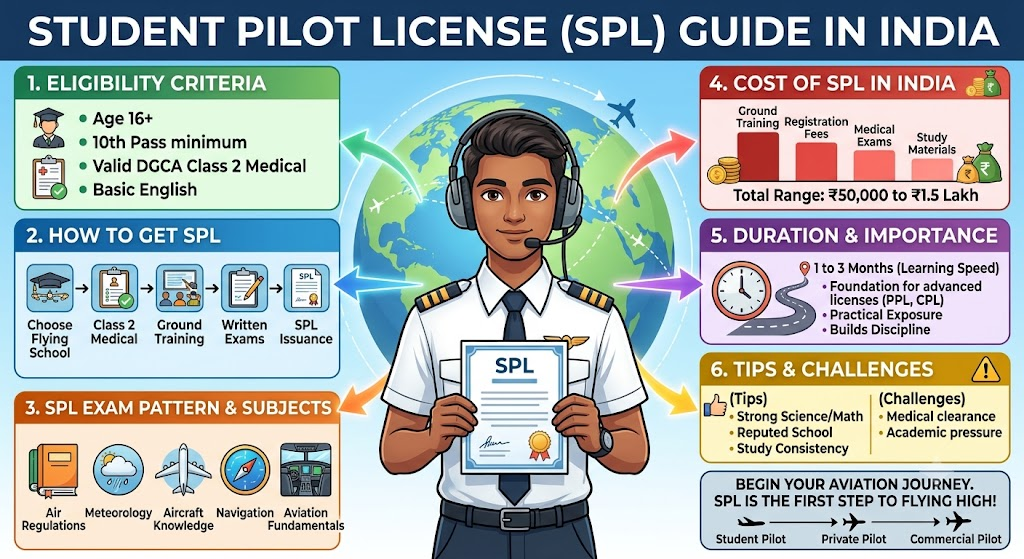
This guide provides a complete overview of the Student Pilot License in India, including eligibility, process, exams, cost, duration, and its importance in building a pilot career.
What is a Student Pilot License?
A Student Pilot License (SPL) is an entry-level aviation certification that allows students to begin formal pilot training under the guidance of a certified flight instructor.
Key Highlights:
First step in the pilot training journey
Required before starting flight training sessions
Governed by DGCA regulations in India
Focuses on basic aviation theory and awareness
Aviation Pathway:
Student Pilot License → Private Pilot License → Commercial Pilot License
Eligibility Criteria for Student Pilot License in India
To apply for SPL in India, candidates must meet basic eligibility conditions:
Age Requirement
Minimum age: 16 years
No strict upper age limit, but medical fitness is mandatory
Educational Qualification
Minimum qualification: 10th pass or 10+2 preferred
Basic understanding of science subjects is helpful
Medical Fitness
Must hold a valid DGCA Class 2 Medical Certificate
Ensures physical and mental fitness for aviation training
Language Requirement
Basic English communication skills are required
Aviation communication follows international English standards
How to Get Student Pilot License in India (Step-by-Step Process)
The process of obtaining SPL is structured and must be followed carefully:
Step 1: Select a DGCA-Approved Flying School
Choose a recognized flying school that provides SPL training and aviation education.
Step 2: Medical Examination
Complete a DGCA Class 2 medical test to ensure fitness for aviation training.
Step 3: Application Submission
Submit required documents and application through the flying school or authorized body.
Step 4: Ground Training
Begin theoretical training covering aviation fundamentals and basic flight knowledge.
Step 5: Written Examination
Appear for SPL written exams conducted under DGCA guidelines or approved institutes.
Step 6: License Issuance
After successful completion of exams and training, the Student Pilot License is issued.
SPL Exam Pattern and Subjects
The SPL examination evaluates basic aviation understanding.
Subjects Covered:
Air Regulations
Aviation Fundamentals
Basic Meteorology
Aircraft Knowledge
Navigation Basics
Purpose of Exam:
To ensure students have foundational knowledge before entering actual flight training.
Cost of Student Pilot License in India
The SPL is the most affordable stage in pilot training.
Estimated Cost Breakdown:
Registration fees: ₹10,000 – ₹25,000
Ground training: ₹30,000 – ₹75,000
Medical examination: ₹5,000 – ₹10,000
Study materials and other expenses: ₹5,000 – ₹15,000
Total Estimated Cost:
₹50,000 to ₹1.5 lakh (approx.)
Duration of SPL Training
Average Duration:
1 to 3 months
Factors Affecting Duration:
Student learning speed
Training schedule consistency
Availability of instructors
Exam preparation time
Importance of Student Pilot License in Aviation Career
The SPL plays a crucial role in shaping an aviation career.
- Entry Point into Aviation
It is the first official step toward becoming a pilot.
- Foundation for Advanced Training
It prepares students for:
Private Pilot License (PPL)
Commercial Pilot License (CPL)
- Builds Basic Aviation Discipline
Helps students understand discipline, safety, and responsibility in aviation.
- Practical Exposure
Introduces students to aircraft systems and cockpit environment.
Challenges in SPL Training
- Academic Pressure
Aviation subjects can be difficult for beginners.
- Medical Clearance
Some students face delays in passing DGCA medical tests.
- Choosing the Right School
Training quality varies across institutes.
- Consistency in Learning
Irregular study or training can delay progress.
Tips for Aspiring Student Pilots
Strengthen basic knowledge in science and mathematics
Stay consistent with study and training schedule
Prepare well for DGCA medical examination
Choose a reputed DGCA-approved flying school
Maintain discipline and patience throughout training
Frequently Asked Questions (FAQs)
- What is a Student Pilot License in India?
A Student Pilot License is the first aviation certification that allows students to begin pilot training under DGCA regulations.
- What is the minimum age for SPL in India?
The minimum age required is 16 years.
- Is SPL mandatory for pilot training?
Yes, SPL is the first step before starting formal flight training like PPL and CPL.
- What subjects are included in SPL exams?
Air regulations, aviation fundamentals, meteorology, aircraft knowledge, and navigation basics.
- How long does SPL training take?
It usually takes 1 to 3 months depending on training progress.
- What is the cost of SPL in India?
The total cost ranges between ₹50,000 and ₹1.5 lakh approximately.
- Can I become a pilot without SPL?
No, SPL is the starting requirement for aviation training.
- Is DGCA medical required for SPL?
Yes, Class 2 DGCA medical certification is mandatory.
- Can I fly an aircraft after SPL?
You can fly under supervision during training, but full solo privileges depend on instructor approval.
- What comes after SPL?
After SPL, students move to Private Pilot License (PPL) training.
Conclusion
The Student Pilot License in India is the foundation of every aviation career. It introduces aspiring pilots to the world of aviation, aircraft systems, and flight training procedures. Although it is the entry-level stage, it plays a critical role in shaping discipline, knowledge, and confidence required for advanced pilot training.
Completing SPL successfully opens the door to higher certifications like PPL and CPL, ultimately leading to a professional flying career. With the right guidance, dedication, and training, students can build a strong foundation for their aviation journey.
For every aspiring pilot, SPL is not just a license—it is the first real step toward the dream of flying.

