
Introduction
Aviation is one of the most respected and aspirational career fields in India. Many students dream of flying aircraft, exploring the skies, and building a future in aviation. The first major step toward this dream is earning a Private Pilot License (PPL).
A Private Pilot License allows an individual to operate an aircraft for personal or recreational purposes without receiving any commercial payment. It is also the foundation for those planning to move toward a Commercial Pilot License (CPL) and pursue a professional aviation career.
This guide explains the complete process of obtaining a Private Pilot License in India, including eligibility, training steps, cost, duration, career scope, and important FAQs.
What is a Private Pilot License?
A Private Pilot License (PPL) is an official certification issued under the aviation regulations of the Directorate General of Civil Aviation (DGCA), India, which allows individuals to fly aircraft privately.
Key Highlights:
- Authorizes non-commercial flying only
- Cannot be used for earning money
- Serves as the first step in professional pilot training
- Requires both theoretical and practical training
Difference Between SPL, PPL, and CPL
| License Type | Full Form | Purpose | Commercial Use |
|---|---|---|---|
| SPL | Student Pilot License | Basic entry-level training | No |
| PPL | Private Pilot License | Personal flying | No |
| CPL | Commercial Pilot License | Professional airline career | Yes |
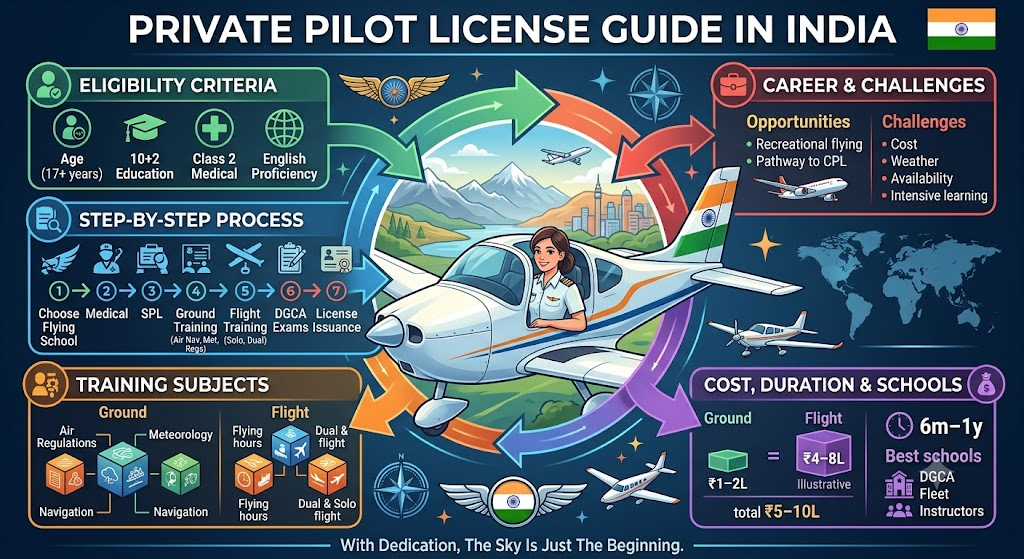
Eligibility Criteria for PPL in India
Before applying for a Private Pilot License, candidates must meet certain eligibility conditions:
Age Requirement
- Minimum age: 17 years
- No strict upper age limit, but medical fitness is mandatory
Educational Qualification
- Must have completed 10+2 (higher secondary education)
- Physics and Mathematics are preferred for future CPL progression
Medical Fitness
- Must obtain a DGCA Class 2 Medical Certificate
- Includes vision, hearing, and overall health assessment
Language Skills
- Basic English proficiency is required for aviation communication
Step-by-Step Process to Get a PPL in India
Becoming a private pilot involves structured training and certification.
Step 1: Choose a DGCA-Approved Flying School
Select a certified flying school approved by DGCA with good training standards, aircraft availability, and experienced instructors.
Step 2: Medical Examination
Complete the Class 2 medical test to ensure you are fit for aviation training.
Step 3: Obtain Student Pilot License (SPL)
The SPL allows you to begin basic flight training and ground learning.
Step 4: Ground Training
Study aviation subjects such as:
- Air navigation
- Meteorology
- Air regulations
- Aircraft technical knowledge
Step 5: Flight Training
Complete practical flying experience including:
- Dual flying with instructor
- Solo flying practice
- Navigation exercises
- Minimum required flying hours (as per DGCA norms and school standards)
Step 6: DGCA Examinations
Pass the required theoretical exams conducted by DGCA.
Step 7: License Issuance
After completing training hours and exams, you receive the Private Pilot License.
Cost of Private Pilot License in India
The cost varies depending on flying school, aircraft type, and location.
Estimated Cost Breakdown:
- Ground training: ₹1–2 lakh
- Flight training: ₹4–8 lakh
- Medical and exams: ₹20,000–50,000
- Additional expenses: ₹50,000+
Total Estimated Cost:
Approximately ₹5 lakh to ₹10 lakh
Duration of PPL Training
Average Time:
- 6 months to 1 year
Factors Affecting Duration:
- Weather conditions
- Aircraft availability
- Student performance
- Training schedule consistency
Best Flying Schools in India
Choosing the right flying school is crucial for quality training and safety.
Key Factors to Evaluate:
- DGCA approval status
- Aircraft fleet condition
- Instructor experience
- Training environment
- Practical flying opportunities
A good flying school ensures smooth progression toward licensing.
Career Opportunities After PPL
A Private Pilot License opens multiple pathways in aviation:
1. Recreational Flying
Fly aircraft for personal enjoyment and travel.
2. Pathway to CPL
PPL acts as a foundation for Commercial Pilot License training.
3. Aviation Knowledge Development
Gain hands-on experience and aviation understanding before advanced training.
Challenges in Getting a PPL in India
1. High Training Cost
Aviation training requires significant financial investment.
2. Weather Dependency
Flying schedules can be delayed due to weather conditions.
3. Limited Aircraft Availability
Training delays may occur due to aircraft scheduling.
4. Intensive Learning Process
Requires discipline, focus, and continuous practice.
Tips for Aspiring Pilots
- Build strong fundamentals in science and mathematics
- Stay consistent with training schedules
- Maintain physical fitness for medical requirements
- Choose a reputed DGCA-approved flying school
- Stay patient and disciplined throughout training
Frequently Asked Questions (FAQs)
1. What is a Private Pilot License in India?
A PPL is a license that allows individuals to fly aircraft for personal use, not for commercial purposes, under DGCA regulations.
2. What is the minimum age to apply for PPL?
The minimum age requirement is 17 years in India.
3. Is physics and math compulsory for PPL?
It is not mandatory for PPL, but recommended for those planning to pursue CPL in the future.
4. How long does it take to complete a PPL?
It usually takes between 6 months and 1 year depending on training progress and conditions.
5. What is the total cost of PPL in India?
The total cost ranges from approximately ₹5 lakh to ₹10 lakh.
6. Can I become a commercial pilot after PPL?
Yes, PPL is often the first step toward obtaining a Commercial Pilot License.
7. Is DGCA medical required for PPL?
Yes, a Class 2 DGCA medical certificate is mandatory.
8. Can I fly internationally with a PPL?
PPL allows private flying within rules, but international flying depends on regulations and approvals.
9. Are there exams in PPL training?
Yes, DGCA conducts theoretical examinations that must be cleared.
10. What are the job opportunities after PPL?
PPL does not provide direct jobs but supports recreational flying and progression to CPL.
Conclusion
A Private Pilot License in India is the starting point for anyone who dreams of becoming a pilot. It provides essential flying skills, theoretical aviation knowledge, and real cockpit experience that builds the foundation for advanced training.
Although the journey requires time, effort, and financial commitment, it is highly rewarding for those passionate about aviation. With proper guidance, dedication, and consistent training, students can successfully complete their PPL and move toward a professional flying career.
For aspiring pilots, the key is to start early, choose the right flying school, and stay focused on long-term goals. The sky is not the limit—it is just the beginning.

