
Introduction
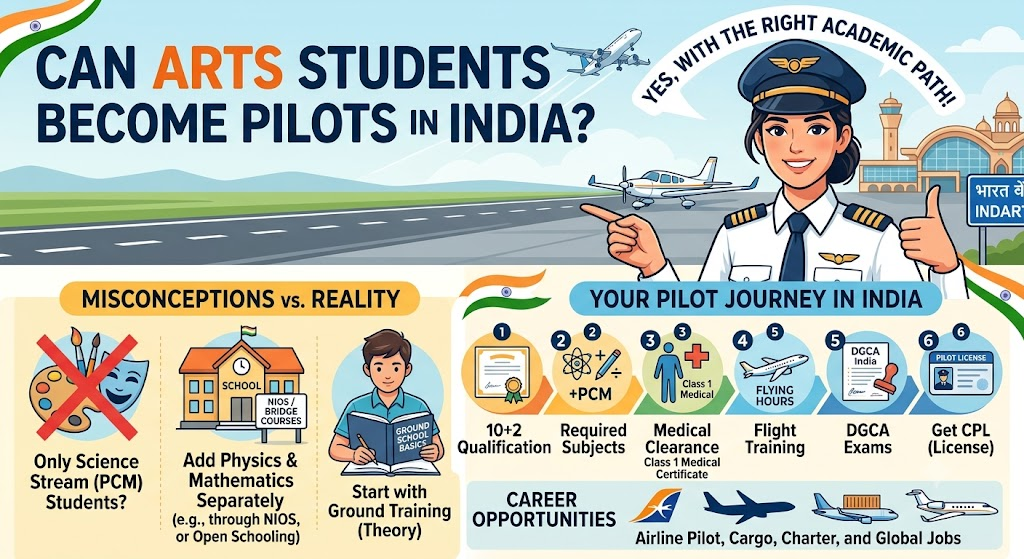
Becoming a pilot is one of the most exciting career dreams for many students in India. However, there is a common belief that only science students can become pilots, while Arts students are not eligible. This misconception often discourages many talented students from exploring aviation as a career.
The truth is more flexible than most people think. With the right academic pathway and preparation, Arts students can also become commercial pilots in India.
This blog explains everything in a simple and practical way, including eligibility rules, required subjects, step-by-step pathways, and how Arts students can still achieve their dream of flying.
Introduction: The Myth About Arts Students and Aviation
Many students assume that pilot training is only for those who studied Physics and Mathematics in 10+2. While it is true that science subjects make the path easier, it is not the only route.
Aviation careers are skill-based and training-focused. What matters most is:
- Meeting basic educational eligibility
- Completing required aviation training
- Clearing medical fitness standards
- Passing licensing exams conducted by aviation authorities
The aviation regulatory body in India, the Directorate General of Civil Aviation, sets clear rules for becoming a pilot—but it also allows flexibility for students from different academic backgrounds.
Can Arts Students Become Pilots in India?
✔️ The Direct Answer: YES
Arts students can become pilots in India, but they may need to complete additional academic requirements before starting formal flight training.
The main requirement is not the stream itself, but subjects like:
- Physics
- Mathematics
- English proficiency
If Arts students fulfill these subject requirements through alternative routes, they are fully eligible for pilot training.
Eligibility Requirements for Becoming a Pilot in India
To become a commercial pilot, students must meet the basic eligibility criteria defined by DGCA India.
1. Educational Qualification
- 10+2 or equivalent education is required
- Physics and Mathematics are mandatory subjects for CPL eligibility
- Arts students must complete these subjects through alternative methods if not studied earlier
2. Age Requirement
- Minimum age: 17 years to begin training
- Minimum age for Commercial Pilot License: 18+ years
3. Medical Fitness
- Class 1 medical certificate is mandatory
- Must meet vision, hearing, and overall health standards
4. Language Requirement
- Good command of English is essential
- Aviation communication is entirely in English globally
How Arts Students Can Become Pilots in India
Arts students who did not study Physics and Mathematics in school still have multiple pathways to qualify.
1. Complete Physics & Mathematics Later
Students can complete these subjects through:
- Open schooling systems (NIOS)
- Distance learning boards
- Bridge courses offered by education institutions
Once completed, they become eligible for DGCA-approved pilot training.
2. Join Ground School First
Arts students can start with aviation ground training:
- Aviation theory basics
- Navigation and meteorology
- Air regulations and safety principles
This helps build a strong foundation before flying.
3. Enroll in a Flying School
After meeting eligibility requirements:
- Join a DGCA-approved flight training academy
- Begin practical flight training
- Accumulate required flying hours
4. Complete DGCA Exams
Students must pass exams conducted by DGCA India:
- Air Navigation
- Aviation Meteorology
- Air Regulations
- Technical General Subjects
These exams are essential for licensing.
Step-by-Step Journey to Become a Pilot
Here is a simplified roadmap:
Step 1: Complete 10+2 or Equivalent
Ensure basic educational qualification is met.
Step 2: Add Physics and Mathematics (if needed)
Arts students can complete these subjects separately.
Step 3: Clear Medical Examination
Obtain Class 1 medical certification.
Step 4: Join Flight Training School
Enroll in a certified aviation institute.
Step 5: Complete Flying Hours
Accumulate required flight experience (typically 200 hours for CPL).
Step 6: Clear DGCA Exams
Pass all required theoretical exams.
Step 7: Obtain Commercial Pilot License (CPL)
This allows you to apply for airline jobs.
Challenges Arts Students May Face
While it is possible, Arts students may face some additional challenges:
1. Additional Academic Preparation
Physics and Mathematics need to be completed separately.
2. Competitive Exams
DGCA exams require strong understanding of technical subjects.
3. Financial Investment
Pilot training is expensive and requires careful planning.
4. Learning Curve
Students without science background may need extra time for technical concepts.
However, with consistent effort, these challenges can be overcome.
Career Opportunities After Becoming a Pilot
Once licensed, students can explore various aviation careers:
✈️ Airline Pilot
Work with domestic and international airlines.
📦 Cargo Pilot
Operate freight and logistics aircraft.
🛩️ Charter Pilot
Fly private jets and business aircraft.
🌍 International Aviation Jobs
Work with global aviation companies.
Pilot careers offer strong growth, high salary potential, and global opportunities.
Tips for Arts Students Aspiring to Become Pilots
Here are some practical tips to succeed:
- Start learning Physics and Mathematics early
- Improve English communication skills
- Stay physically fit for medical clearance
- Choose a DGCA-approved flying school
- Practice aptitude and reasoning skills
- Research financial options like loans or scholarships
Strong preparation makes the transition much smoother.
FAQs
1. Can Arts students become pilots in India?
Yes, Arts students can become pilots in India if they complete required Physics and Mathematics subjects through alternative education pathways.
2. Is Physics compulsory for becoming a pilot?
Yes, Physics is required for DGCA licensing, but Arts students can complete it later through open schooling or equivalent programs.
3. What is the minimum qualification for pilot training?
A 10+2 or equivalent qualification with Physics and Mathematics is required for commercial pilot training eligibility.
4. Can I become a pilot without Maths?
No, Mathematics is required, but it can be completed separately if not studied in school.
5. How long does pilot training take?
Pilot training typically takes 18–24 months depending on performance and flying conditions.
6. Is pilot training expensive in India?
Yes, it is expensive, but students can apply for loans or scholarships to manage costs.
7. What medical tests are required?
A Class 1 medical certificate is required, including vision, hearing, and overall fitness tests.
8. Are Arts students at a disadvantage?
Not necessarily. With proper preparation in Physics and Mathematics, Arts students can perform equally well in aviation training.
Conclusion
Arts students in India are absolutely capable of becoming commercial pilots. The key requirement is not the academic stream, but meeting the necessary subject qualifications and completing DGCA-approved training.
With determination, proper planning, and additional preparation in Physics and Mathematics, Arts students can successfully enter the aviation industry and build rewarding careers.
The sky is not limited by your stream—it is limited only by your preparation and commitment.

