
Introduction
Aviation is one of the most exciting and respected career paths in India today. With the rapid expansion of airlines, airports, and global connectivity, the demand for trained pilots is steadily increasing. Many students who complete their 10+2 often dream of flying aircraft and building a career in aviation.
One of the most frequently asked questions is: Can science students become pilots in India? The clear answer is yes. In fact, students from a science background, especially those who have studied Physics and Mathematics, are the most suitable candidates for pilot training.
This blog explains everything you need to know about becoming a pilot after 12th science, including eligibility, training steps, career scope, and common doubts.
Can Science Students Become Pilots in India?
Yes, science students can absolutely become pilots in India.
Students who have completed 10+2 with Physics and Mathematics are directly eligible for pilot training programs. These subjects are essential because aviation involves technical knowledge such as aerodynamics, navigation, weather systems, and flight calculations.
Even if a student is from a science background without prior aviation knowledge, they can still enter this field through proper training and certification.
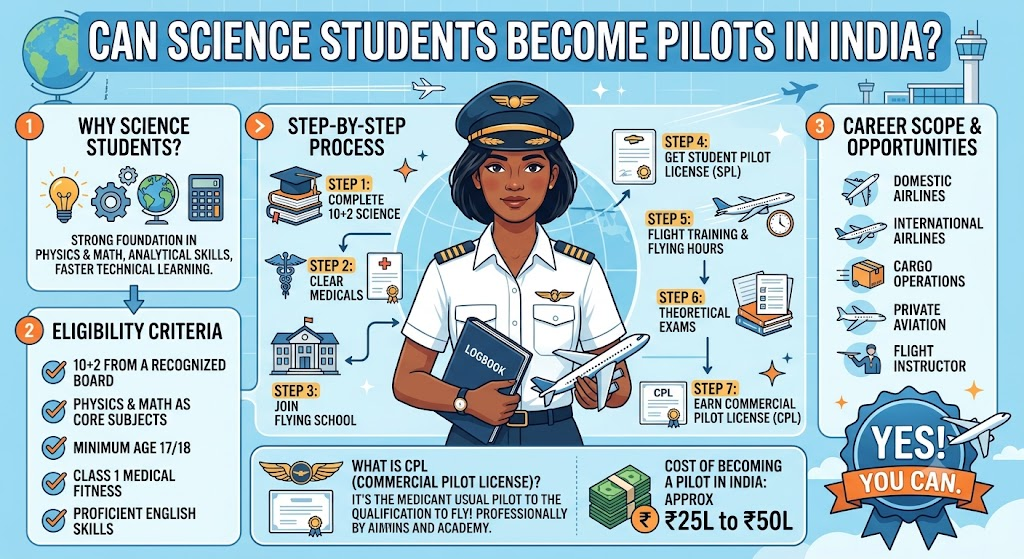
Eligibility Criteria to Become a Pilot in India
To pursue a pilot career in India, candidates must meet certain basic requirements:
Educational Qualification
- Completion of 10+2 from a recognized board
- Physics and Mathematics as compulsory subjects (preferred/required)
Age Criteria
- Minimum age: 17 years to begin training
- Minimum 18 years for Commercial Pilot License (CPL)
Medical Fitness
- Class 1 Medical Certificate is mandatory
- Good physical and mental health
- Vision standards must meet aviation guidelines (with or without correction)
Language Skills
- Basic proficiency in English is required
- English is the official language of aviation communication
Why Science Students Are Preferred for Pilot Training
Science students have a strong advantage in aviation because:
- Physics helps understand flight mechanics and aerodynamics
- Mathematics supports navigation, fuel planning, and distance calculations
- Analytical thinking improves decision-making during flights
- Technical understanding is easier for science learners
This makes the science stream the most suitable academic path for aspiring pilots.
Step-by-Step Process to Become a Pilot in India
Here is the complete journey to becoming a pilot:
Step 1: Complete 10+2 with Science
Focus on Physics and Mathematics as core subjects.
Step 2: Clear Medical Examination
Get a Class 1 medical certificate from authorized aviation medical examiners.
Step 3: Join a Flying School
Enroll in a DGCA-approved flight training academy.
Step 4: Obtain Student Pilot License (SPL)
This is the entry-level certification for training.
Step 5: Flight Training and Flying Hours
Complete approximately 200–250 hours of flying experience.
Step 6: Clear Theoretical Exams
Subjects include:
- Air Navigation
- Aviation Meteorology
- Air Regulations
- Technical General
Step 7: Earn Commercial Pilot License (CPL)
After completing training and exams, you receive your CPL, allowing you to work professionally as a pilot.
What is a Commercial Pilot License (CPL)?
A Commercial Pilot License (CPL) is the official certification that allows you to fly aircraft professionally and earn a salary as a pilot.
With a CPL, you can work in:
- Domestic airlines
- International airlines
- Cargo operations
- Charter and private aviation
It is the most important qualification for starting a professional aviation career.
Cost of Becoming a Pilot in India
Pilot training is a major investment.
- Approximate cost: ₹25 lakhs to ₹50 lakhs
This includes:
- Flying training hours
- Ground school training
- Simulator sessions
- Examination and licensing fees
Many students use education loans or airline cadet programs to manage the cost.
Challenges in Becoming a Pilot
Becoming a pilot is rewarding but comes with challenges:
- High training costs
- Strict medical requirements
- Competitive job market
- Continuous skill upgrades and certifications
Despite these challenges, dedication and proper training can lead to a successful aviation career.
Career Opportunities After Becoming a Pilot
After earning your CPL, multiple career options are available:
Airline Pilot
Fly commercial aircraft for domestic or international airlines.
Cargo Pilot
Operate cargo aircraft for logistics and freight companies.
Charter Pilot
Fly private jets for business or VIP clients.
Flight Instructor
Train new student pilots in aviation schools.
Government Aviation Roles
Work in defense or special aviation services (with additional qualifications).
FAQs
1. Can science students without Mathematics become pilots in India?
Mathematics is generally required. Without it, students may need to complete additional qualification requirements before applying for CPL training.
2. Is Physics compulsory for becoming a pilot?
Yes, Physics is essential because it helps understand aerodynamics, flight principles, and aviation systems.
3. What is the minimum qualification for pilot training in India?
10+2 with Physics and Mathematics from a recognized board is the standard requirement.
4. How long does it take to become a pilot?
It usually takes 18 months to 3 years depending on training pace and flying hours completion.
5. Is pilot training very difficult?
It requires discipline, focus, and strong technical understanding, but it is achievable with proper training.
6. Can girls become pilots in India?
Yes, aviation is open to all genders with equal opportunity.
7. What is the average cost of CPL training?
It typically ranges between ₹25 lakhs to ₹50 lakhs depending on the institute.
8. What is the salary of a pilot in India?
Salary varies widely based on experience, airline, and aircraft type. It increases significantly with experience.
9. Can arts or commerce students become pilots?
Yes, but they must complete Physics and Mathematics through additional education.
10. Is being a pilot a good career option?
Yes, it is one of the most prestigious and high-growth careers in the aviation industry.
Conclusion
Becoming a pilot in India is a realistic and highly rewarding career option for science students. With Physics and Mathematics in 10+2, students already have a strong foundation for aviation training. Although the journey requires dedication, financial planning, and rigorous training, the results are highly rewarding.
A career as a pilot offers global opportunities, high earning potential, and the unique experience of flying aircraft. If you are passionate about aviation, this path can turn your dream into reality with the right guidance and commitment.

