
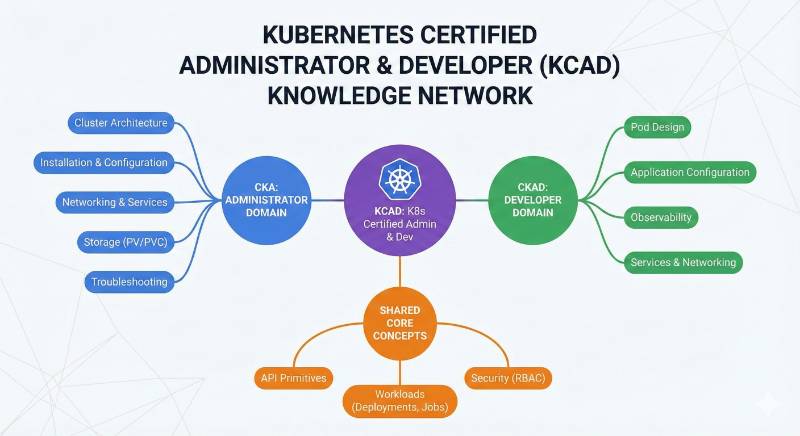
The way we build and ship software has shifted. If you are a software engineer or a manager today, you have likely seen how containers have taken over. At the center of this shift is Kubernetes. It is the engine that keeps modern apps running, scaling, and staying healthy.
For professionals in India and across the globe, mastering this tool is a major career milestone. The Kubernetes Certified Administrator & Developer (KCAD) program is a unique path that proves you can both manage the system and build the apps that run on it. This guide will help you understand why this program matters and how to conquer it.
The Big Picture: Certification Comparison
Before diving into the specifics, let’s look at how the different paths in the engineering world connect.
| Track | Level | Who it’s for | Prerequisites | Skills Covered | Recommended Order |
| Kubernetes (KCAD) | Foundation & Growth | Engineers & Leads | Linux/Docker basics | Cluster Admin, App Logic, Networking | 1st |
| DevOps | Intermediate | Aspiring DevOps Pros | Basic IT | Automation, CI/CD, Git | 2nd |
| SRE | Expert | Reliability Engineers | K8s Fundamentals | Uptime, SLIs, Monitoring | 3rd |
| DevSecOps | Expert | Security Professionals | DevOps Basics | Security as Code, Scanning | 3rd |
| MLOps | Specialized | Data Engineers/Scientists | Python, Kubernetes | Model serving, Data flows | 4th |
| FinOps | Strategic | Finance & Tech Leads | Cloud experience | Cost management, Savings | 4th |
Deep Dive: Understanding the KCAD
What it is
The KCAD is a dual-purpose certification. It teaches you how to set up and maintain a Kubernetes cluster while also showing you how to package, deploy, and scale applications correctly within that cluster. It is entirely practical and hands-on.
Who should take it
This program is perfect for Software Engineers, Platform Engineers, and Technical Managers. If you are responsible for the code or the machines it runs on, you need this knowledge to ensure your systems stay stable under pressure.
Skills you’ll gain
- Infrastructure Setup: Learning how to build a cluster from the ground up.
- Workload Management: Deploying apps that can automatically restart if they fail.
- Network Design: Controlling how different parts of your app talk to each other.
- Storage Solutions: Making sure your data stays safe even when containers are deleted.
- Live Debugging: Finding and fixing errors in a production-like environment.
Real-world projects you should be able to do after it
- Seamless Upgrades: Update your application to a new version without users noticing any downtime.
- Auto-Scaling Systems: Set up rules so your app adds more power when many people are using it and shrinks when they aren’t.
- Secure Configs: Keep passwords and API keys safe using Secrets and ConfigMaps.
- Health Monitoring: Create “liveness” checks so Kubernetes knows exactly when to restart a frozen app.
Preparation Plan
The 7–14 Day Sprint
- This is for those already using Kubernetes.
- Focus: Spend your time on the terminal. Stop using the UI.
- Action: Practice “imperative” commands to create resources in seconds.
- Goal: Efficiency. You need to solve problems fast to finish the exam.
The 30-Day Professional Path
- Days 1–10: Core concepts. Master Pods, Deployments, and Namespaces.
- Days 11–20: Networking and Storage. Understand how data and traffic move.
- Days 21–30: Troubleshooting and Mock Exams. Break things and fix them.
The 60-Day Foundation Path
- Month 1: Focus on the basics. Learn Linux commands and how to build Docker images.
- Month 2: Follow the 30-day plan. Move slowly through each concept until you can do it without looking at a guide.
Common Mistakes
- Typing out YAML: Don’t do it! Use
kubectl create --dry-run=client -o yamlto generate files. - Getting stuck: If a question is too hard, move to the next one immediately. Every minute counts.
- Not checking the Namespace: Many people fail because they create the right resource in the wrong place.
- Ignoring the Docs: You can use the official documentation during the exam. Practice searching it quickly.
Best next certification after this
- Cloud Architect Certification
- Certified Kubernetes Security Specialist
- Advanced DevOps Engineering Certification
Choose Your Path: 6 Career Tracks
Kubernetes is the starting point. Here is where you can go next:
- DevOps:
Focus on the “pipeline.” Use Kubernetes to make software delivery faster and more reliable through automation. - DevSecOps:
Focus on protection. Learn how to bake security into every layer of your Kubernetes cluster. - SRE:
Focus on the “promise.” Learn to keep systems running at 99.9% uptime by mastering observability and incident response. - AIOps/MLOps:
Focus on intelligence. Orchestrate complex machine learning models that require massive amounts of compute power. - DataOps:
Focus on the “flow.” Manage large-scale data systems and databases inside containers without losing performance. - FinOps:
Focus on the “bill.” Learn to scale your technical infrastructure without breaking the company’s budget.
Role → Recommended Certifications Mapping
| If your role is… | You should take these… |
| DevOps Engineer | KCAD + Certified DevOps Professional |
| SRE | KCAD + Site Reliability Engineering Cert |
| Platform Engineer | KCAD + Master in DevOps Engineering |
| Cloud Engineer | KCAD + AWS/Azure Specialist Certs |
| Security Engineer | KCAD + DevSecOps Certified Professional |
| Data Engineer | KCAD + DataOps Certified Professional |
| FinOps Practitioner | KCAD + FinOps Certified Engineer |
| Engineering Manager | KCAD + Certified DevOps Manager |
Top Institutions for KCAD Training & Certification
To pass a hands-on exam, you need guidance from people who do this work every day. Here are the best institutions to help you get certified:
- DevOpsSchool:
This is a top-tier choice for those who want deep, practical knowledge. They provide extensive labs and real-world scenarios that prepare you for the terminal-based exam. Their mentors help you understand the “why” behind every command. - Cotocus:
They specialize in making complex technology simple. Their training is very career-focused, helping engineers not just pass the exam but also handle the challenges they will face in high-stakes job roles. - Scmgalaxy:
A great place for those who love community and high-quality resources. They offer a massive library of tutorials and guides that break down Kubernetes into small, digestible pieces for easier learning. - BestDevOps:
They keep their curriculum very fresh. If there is a new tool or a change in the Kubernetes version, they are usually the first to update their training to ensure you are learning the latest standards. - devsecopsschool.com:
This institution is the leader for those who want to focus on security. They show you how to build clusters that are hardened against attacks from day one. - sreschool.com:
They focus purely on reliability. If you want to learn how to keep a massive system running even when things go wrong, their Kubernetes-heavy curriculum is for you. - aiopsschool.com:
Perfect for data scientists and engineers. They bridge the gap between AI models and the infrastructure needed to run them at a global scale. - dataopsschool.com:
They focus on stateful applications. They teach you how to manage big data and databases in containers, which is one of the hardest parts of Kubernetes. - finopsschool.com:
This is the place for technical leads who need to manage cloud costs. They teach you how to use Kubernetes to be efficient with both performance and money.
What’s Next? (Growth Options)
After you have your KCAD, you should consider these three directions for continued growth:
- Option 1: The Expert Path (Same Track)Master in DevOps Engineering (MDE): This is for people who want to be absolute experts. It covers everything from infrastructure code to advanced orchestration across different clouds.
- Option 2: The Security Path (Cross-Track)DevSecOps Certified Professional (DSOCP): Security is the most in-demand skill right now. Combining Kubernetes knowledge with security expertise makes you highly valuable to any company.
- Option 3: The Leadership Path (Management)Certified DevOps Manager (CDM): If you want to move away from the keyboard and start leading teams, this certification focuses on the strategy and culture of modern engineering.
Frequently Asked Questions (General)
1. Is the KCAD exam hard for beginners?
It can be challenging because there are no multiple-choice questions. You have to type the commands. But with 4–6 weeks of practice, it is very achievable.
2. How much time do I need to prepare?
If you are working full-time, expect to spend about 1-2 hours a day for a month.
3. Do I need to be a developer to take KCAD?
Not necessarily. While it says “Developer,” it is mostly about how to run and configure applications, not how to write the code itself.
4. How much does a KCAD certification help my salary?
In many regions, including India, Kubernetes experts can see a 25% to 40% increase in their pay because the skill is in such high demand.
5. How long is the certification valid?
It usually lasts for 2 to 3 years. After that, you can take a recertification exam to stay current.
6. Can I take the exam online?
Yes, it is a proctored online exam. You take it from your home or office with a webcam.
7. Is it better to do KCAD or CKA first?
KCAD is often seen as a slightly more approachable entry point for people who are used to building and deploying apps.
8. Can I use the internet during the exam?
You can only use one tab for the official Kubernetes documentation. You cannot use Google, Stack Overflow, or AI tools.
9. What if I fail?
Most vouchers include one free retake. Use the first attempt to learn the “feel” of the exam.
10. Is Linux knowledge required?
Yes, you should be comfortable with basic Linux commands like ls, cd, grep, and using a text editor like vim or nano.
11. Why do companies want KCAD-certified people?
It proves that you can actually do the work. Since it’s a lab-based exam, it shows you won’t break things when you get into a real production environment.
12. Does it matter where I live?
No. Kubernetes is a global standard. The skills you learn in India will be exactly the same as those needed in Silicon Valley or London.
Specific FAQs: Kubernetes Certified Administrator & Developer (KCAD)
1. What is the main goal of the KCAD certification?
It is to prove you can design, build, configure, and expose cloud-native applications on a Kubernetes cluster.
2. Where can I register for the program?
You can find all the registration and training details at DevOpsSchool.
3. What is the format of the exam?
It consists of several tasks (problems) that you must solve in a command-line interface within 2 hours.
4. Do I need to know how to install Kubernetes?
While KCAD focuses more on using the cluster, having a basic idea of how to set one up will help you troubleshoot better.
5. What is the passing score?
You generally need a 66% to pass the certification.
6. What is the provider for this certification?
You can find the training and support through DevOpsSchool.
7. Is there a lot of YAML involved?
Yes, Kubernetes uses YAML for configuration. You don’t need to be a YAML expert, but you must understand how to read and edit it.
8. Can I use a notepad during the exam?
The exam interface usually has a built-in notepad where you can copy and paste bits of code or keep notes.
Conclusion
The tech world moves fast, but some skills are worth the effort because they form the foundation of everything else. The Kubernetes Certified Administrator & Developer (KCAD) is one of those skills. It moves you from being someone who just writes code to someone who understands the entire lifecycle of an application in the cloud.
Whether you are an engineer looking to land a better role or a manager looking to help your team succeed, this certification is a proven way to level up. It takes time and practice, but the rewards—in terms of knowledge, confidence, and career growth—are well worth it.

