
Introduction
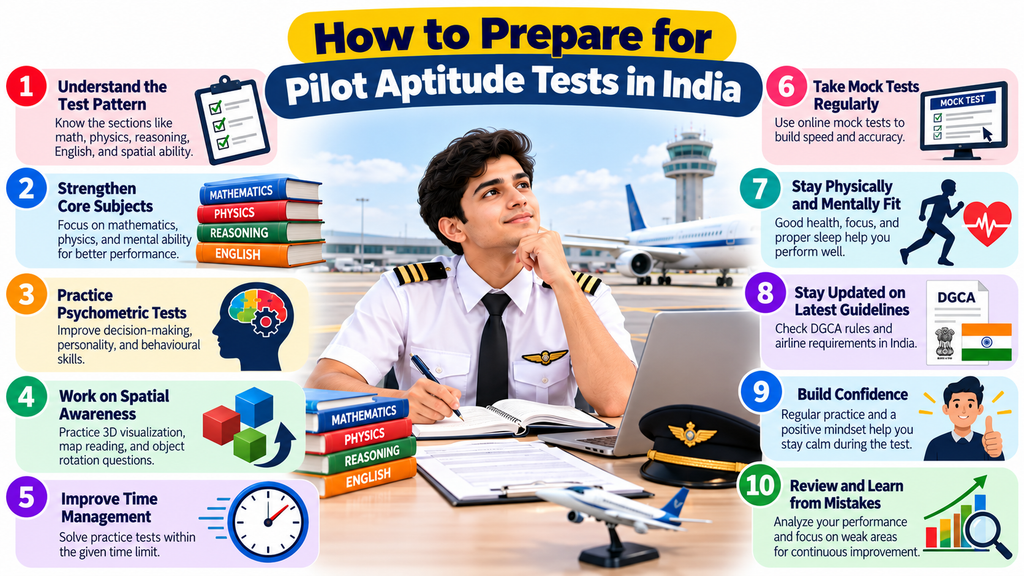
Becoming a pilot requires more than good marks and a passion for flying. Aspiring pilots also need skills such as logical thinking, quick decisions, and strong attention. Pilot aptitude tests help assess some of these abilities during selection. With regular practice and the right plan, candidates can prepare with greater confidence.
What Are Pilot Aptitude Tests?
Pilot aptitude tests are assessments used to measure skills that can help a person learn and perform flying tasks. They may check how well candidates understand information, recognize patterns, remember details, and respond under time pressure.
Some tests use computers to present questions, simulations, or timed exercises. Others may include written tasks, practical activities, or psychometric assessments. The exact format depends on the organization and the programme.
For example, a candidate may need to solve a number problem quickly, remember a series of symbols, or identify the direction of a moving object. These tasks can help assess different abilities needed during pilot training.
In India, candidates may face aptitude assessments during admission to a flying academy, a cadet pilot programme, or another aviation selection process. The requirements are not the same everywhere.
Therefore, the first step is to identify the exact test you need to take. This helps you focus on relevant skills instead of practising every possible question.
Why Aptitude Tests Matter in Pilot Selection
Pilots work in environments where attention, clear thinking, and sound decisions matter. They must understand information, follow procedures, and respond appropriately when conditions change.
Aptitude assessments can help selectors understand how candidates handle certain mental and practical tasks. They may also help identify areas that need further development.
For example, a candidate may understand mathematics well but struggle with tasks that require quick visual decisions. Another candidate may have strong spatial awareness but need more practice with numerical reasoning.
These differences show why preparation should cover several skills. Studying only one subject may leave important gaps.
However, an aptitude test is not a complete measure of someone’s future ability as a pilot. Selection may also involve academic examinations, interviews, medical assessments, and other requirements.
The best approach is to treat aptitude preparation as one part of your wider pilot career plan.
Common Skills Assessed in Pilot Aptitude Tests
The skills assessed vary by test provider. The following areas are useful to understand before you begin practising.
1. Numerical Reasoning
Numerical reasoning involves understanding numbers and solving problems accurately. Questions may involve percentages, ratios, averages, simple calculations, or numerical patterns.
For example, you may need to calculate a speed, compare values, or identify the next number in a sequence. Basic mathematics can help you solve these questions more efficiently.
Start by reviewing arithmetic, fractions, decimals, percentages, and ratios. Once you become accurate, practise solving questions within a time limit.
2. Logical Reasoning and Pattern Recognition
Logical reasoning tests how you identify relationships and draw conclusions. You may need to find missing shapes, complete number sequences, or choose an answer that follows a set of rules.
For example, a sequence may increase by three each time. Your task is to recognize the pattern and select the next number.
Practise different types of reasoning questions rather than memorizing answers. Focus on understanding why a pattern works.
3. Verbal Reasoning and English Comprehension
Pilots need to understand instructions and communicate clearly. Some selection assessments may therefore include English comprehension, vocabulary, or verbal reasoning.
You might read a short passage and answer questions about its meaning. You may also need to identify a conclusion supported by the information provided.
Read short English passages daily. Summarize their main points and practise following written instructions carefully.
4. Spatial Awareness
Spatial awareness involves understanding the position, direction, and movement of objects. It can help people interpret visual information and understand how objects relate to one another.
A test may ask you to rotate a shape mentally, identify a changed viewpoint, or determine the direction of an object.
Practise mental rotation puzzles, map directions, and simple three-dimensional shape exercises. Start slowly and focus on accuracy before increasing speed.
5. Memory and Attention
Memory tasks measure how well you retain and recall information. Attention tasks may assess whether you can identify important details without overlooking small changes.
For example, you might briefly view a group of symbols and then identify which symbols appeared earlier.
Begin with short exercises involving numbers, letters, symbols, or visual patterns. Gradually increase the amount of information you must remember.
You can also practise spotting differences between similar images. These exercises help you train your attention, although they cannot guarantee a particular test result.
6. Hand-Eye Coordination and Psychomotor Skills
Some pilot selection assessments measure how well you coordinate visual information with physical responses. Computer-based tasks may require you to move a control while watching objects on a screen.
These tasks can assess coordination, response accuracy, and the ability to manage more than one input.
Practise activities that require controlled movements and visual attention. If your target programme provides an approved practice resource, use it to understand the general task format.
Do not assume that ordinary computer games will fully reproduce a professional pilot aptitude assessment.
7. Multitasking and Information Processing
Pilots often need to monitor several pieces of information while following procedures. Some aptitude tests assess how well candidates manage competing tasks.
For example, a task might require you to track a moving object while responding to simple signals.
Begin with one task and learn to perform it accurately. Then introduce a second task gradually. If accuracy drops sharply, reduce the difficulty and build up again.
The goal is controlled performance, not simply doing several things at once.
8. Situational Judgment and Decision-Making
Some selection processes assess how candidates respond to practical situations. Questions may ask you to choose an appropriate response to a problem involving communication, safety, or teamwork.
Read each situation carefully. Identify the main concern, consider the available information, and select a response that follows the stated rules.
In aviation-related situations, safety, clear communication, and established procedures are important principles. However, follow the specific instructions provided by the assessment rather than assuming every test uses the same scoring method.
Types of Pilot Aptitude Assessments in India
Pilot aptitude assessments are not limited to one national test. Different aviation pathways use different selection methods.
Airline Cadet Pilot Programmes
Cadet pilot programmes may include aptitude assessments as part of a wider selection process. Depending on the programme, candidates may be assessed on numerical reasoning, spatial awareness, motor skills, critical thinking, and performance under pressure.
Air India’s published cadet programme information, for example, describes a technical evaluation that includes critical thinking, numerical reasoning, motor skills, and spatial awareness. The current requirements should always be checked before applying.
pilotcareers.airindia.com
Flying Academy Admission
Some flying academies conduct entrance examinations, pilot aptitude tests, interviews, or a combination of these stages.
Indira Gandhi Rashtriya Uran Akademi (IGRUA), for example, describes a selection process that includes a written examination, a pilot aptitude test, and an interview. Its published entrance information should be checked for the applicable admission cycle.
Indira Gandhi Rashtriya Uran Akademi
+1
Airline Pilot Recruitment
Airline recruitment assessments for already qualified pilots may differ from assessments designed for beginners. Requirements can depend on the airline, role, aircraft, and experience level.
Candidates should read the relevant recruitment notice carefully. A test designed for a cadet programme may not be suitable preparation for a qualified pilot’s recruitment assessment.
Indian Air Force Flying Selection
Candidates pursuing military flying careers follow a separate selection process. The Indian Air Force describes stages that can include screening, psychological tests, group tasks, interviews, and the Computerised Pilot Selection System for eligible flying-branch candidates.
Indian Air Force
These military selection procedures should not be confused with civilian airline or flying academy aptitude tests.
DGCA Licensing Examinations
DGCA flight crew licensing examinations assess the knowledge required for the relevant licensing pathway. They are different from aptitude assessments used by an airline or flying academy.
The DGCA’s official examination portal provides information about flight crew examinations, registration, and related requirements. Candidates should use the applicable official instructions when planning their licensing examinations.
Pariksha DGCA
+1
Understanding these differences helps you choose the right preparation materials and avoid studying for the wrong assessment.
How to Prepare for Pilot Aptitude Tests Step by Step
A clear preparation plan can help you improve your skills without feeling overwhelmed. Follow these steps and adjust them to match your test date and assessment format.
Step 1: Understand Your Test Format
Start by identifying the organization conducting your assessment. Read its latest selection notice and candidate instructions.
Check which skills are assessed, whether the test is computer-based, and whether practice materials are available. Also, confirm the test date, identification requirements, and any technical instructions.
Do not rely only on old sample papers or advice from other candidates. Selection procedures can change between admission cycles.
Step 2: Assess Your Current Skills
Before starting intensive practice, attempt a few sample questions from different areas. Include numerical reasoning, logic, spatial awareness, memory, and English comprehension.
Record your accuracy and the time taken for each exercise. Note which questions feel easy and which ones cause difficulty.
This initial assessment gives you a starting point. It also helps you decide where to spend more practice time.
Step 3: Build a Strong Foundation
Revise basic mathematics, common reasoning patterns, and English comprehension. Practise mental calculations and learn to recognize familiar question structures.
For spatial awareness, use shape rotation and direction exercises. For memory, begin with short sequences of letters, numbers, or symbols.
Avoid rushing through difficult questions. Understanding the method is more useful than memorizing an answer without knowing why it works.
Step 4: Practise With Time Limits
Once you can solve questions accurately, introduce time limits. Start with short sessions and gradually work toward longer practice sets.
Use a timer to track your performance. If your accuracy falls sharply, slow down and identify the reason.
Some errors happen because of weak knowledge. Others occur because of rushed reading or poor time management. Understanding the cause helps you correct the problem.
Step 5: Review Every Mistake
After each practice session, review the questions you answered incorrectly. Write down the reason for each mistake.
For example, you may have missed a pattern, misread an instruction, or spent too much time on one question.
Try similar questions again after reviewing the solution. This approach helps you develop a repeatable method rather than depending on guesswork.
Step 6: Take Full Practice Sessions
When you understand the main question types, combine them into mixed practice sessions. Include different skills so that you become comfortable changing between tasks.
Follow the time limits and instructions of your chosen practice resource. Keep distractions away and use a quiet study space.
After each session, review your results. Focus on steady improvement rather than expecting every practice score to increase.
Daily Practice Routine for Aspiring Pilots
A regular routine can help you practise without disrupting school, college, or other responsibilities. The following is an example of a 60-minute session.
Numerical and logical reasoning15 minutes
Solve basic calculations, number sequences, and reasoning questions.
Spatial awareness and memory15 minutes
Practise shape rotation, visual patterns, and short memory exercises.
English and comprehension10 minutes
Read a short passage and answer questions about its meaning.
Timed mixed practice10 minutes
Attempt questions from different areas without unnecessary breaks.
Review and correction10 minutes
Check errors, revise difficult concepts, and record your progress.
This schedule is a starting point, not a fixed rule. Spend more time on your weaker areas when needed. You can also use longer sessions for full-length practice tests.
Try to practise consistently throughout the week. Include rest and maintain a healthy sleep routine, especially before your assessment.
Practice Exercises and Examples
The following original questions are designed to help beginners practise basic aptitude skills. They are illustrative exercises, not official examination questions.
Example 1: Numerical Reasoning
An aircraft covers 180 kilometres in 30 minutes at a constant speed. What is its speed in kilometres per hour?
- A. 180 km/h
- B. 240 km/h
- C. 360 km/h
- D. 540 km/h
Answer: C. 360 km/h
Thirty minutes is half an hour. Therefore, the aircraft covers 180 kilometres in half an hour. Multiplying 180 by two gives 360 kilometres per hour.
Example 2: Logical Reasoning
Find the next number in this sequence:
3, 6, 12, 24, ?
- A. 30
- B. 36
- C. 48
- D. 54
Answer: C. 48
Each number is multiplied by two to produce the next number. Therefore, 24 multiplied by two equals 48.
Example 3: Attention and Memory
Study this sequence for a few seconds:
7 – 2 – 9 – 4 – 1
Now look away and try to recall the sequence in the correct order.
Answer: 7 – 2 – 9 – 4 – 1
To practise further, increase the sequence length gradually. Try recalling the numbers after a short pause rather than looking at them repeatedly.
Example 4: Direction and Spatial Reasoning
A person faces north. The person turns right, then turns right again. Which direction is the person facing?
- A. North
- B. South
- C. East
- D. West
Answer: B. South
The first right turn changes the direction from north to east. The second right turn changes it from east to south.
These examples cover only a few basic skills. Your actual assessment may use different questions, more complex tasks, or computer-based exercises.
Common Mistakes Candidates Should Avoid
Even motivated candidates can make preparation harder by using the wrong approach. Avoid these common mistakes.
– Practising without checking the test format: You may spend time on irrelevant question types. Read the official selection instructions before planning your preparation.
– Focusing only on mathematics: Aptitude assessments may cover several skills. Include logic, memory, spatial awareness, and other relevant areas.
– Choosing speed over accuracy: Rushing can lead to careless errors. Build accuracy first, then increase your speed gradually.
– Ignoring incorrect answers: Repeating practice without reviewing mistakes limits improvement. Understand why each error occurred before attempting similar questions.
– Depending on unverified sample papers: Online questions may not reflect the actual assessment. Use trustworthy resources and treat unofficial samples as general practice.
– Practising only familiar questions: Repeating easy exercises can create a false sense of readiness. Include new question types that match the skills listed by your test provider.
– Ignoring instructions: Small details can change what a question requires. Read the full instruction before selecting an answer or starting a task.
– Sacrificing sleep before the test: Tiredness can affect attention and concentration. Maintain a sensible routine instead of relying on last-minute study.
– Assuming one score guarantees selection: Aptitude tests may be only one part of the process. Prepare for interviews, eligibility checks, and other required stages as well.
Important Considerations Before Taking an Aptitude Test
Preparation is important, but candidates must also understand the wider requirements for becoming a pilot in India.
First, check your academic eligibility. The subjects, marks, age limits, and other conditions can vary by programme. Do not assume that meeting one academy’s criteria makes you eligible for every cadet programme.
Second, understand the difference between selection and licensing. A candidate may need to clear a selection assessment before beginning training. Separate academic, medical, and DGCA licensing requirements may also apply.
Third, review the latest instructions from your chosen airline or flying academy. Confirm the test format, required documents, reporting time, and permitted equipment before the assessment.
Fourth, use practice materials responsibly. Avoid claims of guaranteed selection or access to confidential examination questions. Focus on building the skills the assessment is designed to measure.
Finally, maintain a balanced preparation plan. Good aptitude scores alone do not replace the required education, medical fitness, flight training, examinations, or licensing conditions.
A careful approach can help you prepare with realistic expectations and make better decisions about your aviation career.
Frequently Asked Questions
1. What is a pilot aptitude test?
A pilot aptitude test assesses abilities that may help candidates learn and perform flying tasks. Depending on the programme, it may measure reasoning, memory, spatial awareness, coordination, attention, or decision-making.
2. Is a pilot aptitude test compulsory in India?
Not every aspiring pilot takes the same aptitude test. Requirements depend on the airline, cadet pilot programme, flying academy, or other selection pathway. Check the current instructions for your chosen programme.
3. Which skills are tested in pilot aptitude assessments?
Common areas may include numerical reasoning, logical thinking, spatial awareness, memory, attention, and hand-eye coordination. Some assessments also include verbal reasoning, multitasking, or situational judgment.
4. How can beginners prepare for pilot aptitude tests?
Begin by identifying the test format and assessing your current skills. Practise relevant questions daily, review mistakes, and gradually introduce timed exercises. Use resources that match your specific assessment.
5. Is mathematics important for pilot aptitude tests?
Mathematics can be important, especially when a test includes numerical reasoning. Review basic arithmetic, ratios, percentages, and number patterns. However, do not neglect other skills that your assessment may cover.
6. How can I improve spatial awareness and memory?
Practise mental rotation, direction questions, visual patterns, and short memory exercises. Start with simple tasks and increase the difficulty gradually. Track your accuracy to identify areas that need more work.
7. Are airline cadet pilot aptitude tests the same as DGCA examinations?
No. Airline cadet assessments generally support candidate selection, while DGCA flight crew examinations assess knowledge for the relevant licensing pathway. The exact requirements depend on the programme and applicable licensing rules.
8. How much time should I spend preparing?
There is no single preparation period that suits everyone. Your starting skills, test format, and available time all matter. Begin early enough to practise regularly, review mistakes, and become familiar with the required tasks.
9. Can I prepare for pilot aptitude tests without coaching?
Yes, many basic skills can be practised independently using suitable study materials and timed exercises. However, some computer-based assessments may require specific practice tools or guidance. Check whether your programme provides recommended resources.
10. Where can I check the current test requirements?
Check the official website and selection notice of the airline, flying academy, or programme you plan to join. For flight crew licensing examinations, consult the official DGCA examination portal and applicable licensing instructions.
Conclusion
Preparing for pilot aptitude tests in India begins with understanding the assessment you need to take. From there, build your numerical reasoning, logical thinking, spatial awareness, memory, and attention through regular practice.
Use timed exercises when you are comfortable with the basics. Review mistakes carefully and focus on steady improvement instead of memorizing answers. Most importantly, remember that aptitude assessments are only one part of the pilot selection and training journey.
With a clear plan, consistent effort, and accurate information, you can approach your assessment with better preparation and confidence.

